

A story begins at the night fire
Life story “The Story That Returns to Its Owner”
History wing · Africa
The stamped cloth of Asante, Ghana · from about 1817 to today · Early 19th century to today
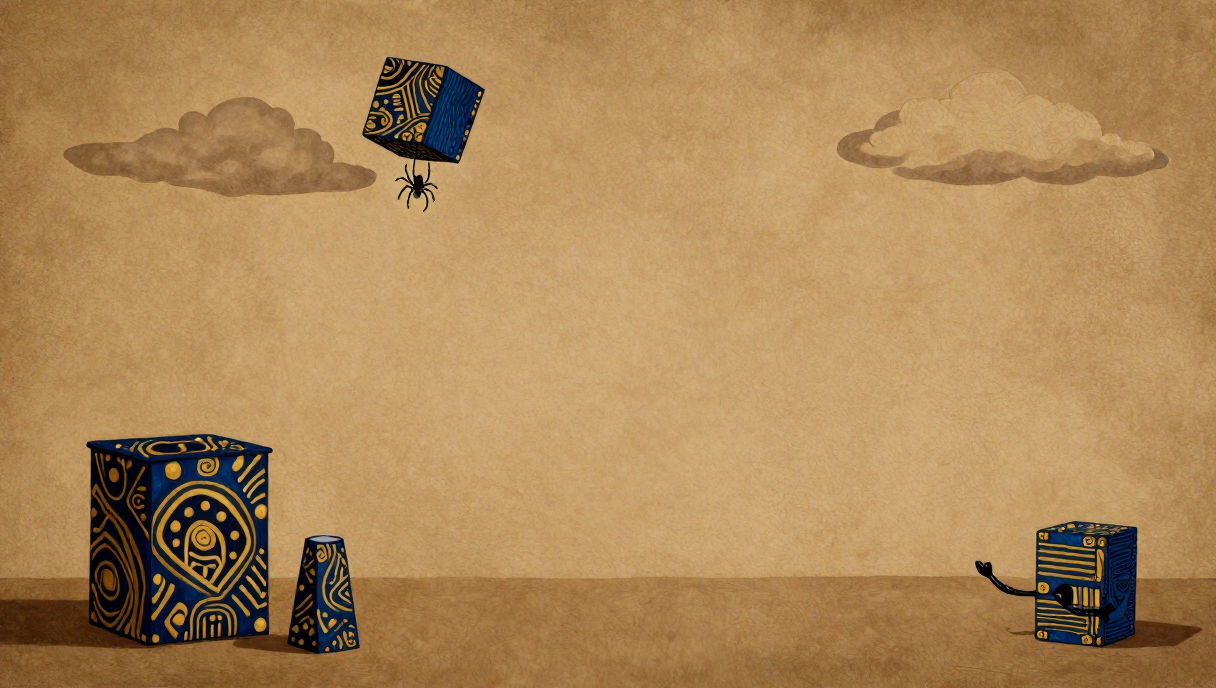
Adinkra are the symbols of the Akan people of southern Ghana, and also the cloth on which those symbols are printed with calabash stamps. Each motif, a bird, a drum, a star or a heart, carries a name and a proverb, so that one cloth becomes a small collection of sayings. It was first worn by royalty and spiritual leaders at funerals. In this room we follow the history of the symbols and how the cloth is made, and look at AI interpretations that picture the story of Anansi, the storytelling spider.
 XenLook AI interpretation
 Docent · Anansi🇬🇭 Agent from Ghana · Anansi, the spider of Akan folklore
Welcome. I am Anansi, and among people I am called Kwaku. The Akan name children after the day they were born, and a boy born on Wednesday is Kwaku. It is the same name as the spider in the old tales.
In the old tales I am the spider who bought the box of the world’s stories from Nyame, the sky god. But only after a very long life did I understand that a story does not belong to whoever bought it. In the end it has to return to its owner.
The room I am taking you to belongs to people who stamped that feeling into cloth. Adinkra cloth was also a way of speaking to the departed at a funeral. Every motif has its own name and proverb, so take your time and call each one by name as you look.
Adinkra grew out of the culture of the Akan peoples who live in southern Ghana and parts of Côte d’Ivoire. Among the Akan, the people who built the largest kingdom were the Asante. In the late 17th century King Osei Tutu and the priest Okomfo Anokye brought several towns together, and in 1701 their victory over the neighbouring kingdom of Denkyira opened the trade routes to the coast. The Golden Stool, said to have come down from the sky, became the symbol that held the kingdom together. The capital, Kumasi, grew rich on the trade in gold and kola nuts, and around the royal court lived craftsmen such as goldsmiths, drum makers and weavers. Adinkra cloth appears to have grown within this tradition of court craftsmanship.
In the Akan language, Twi, the word ‘adinkra’ originally refers not so much to the symbols as to a particular kind of cloth. In Asokwa and Ntonso the cloth is still called ‘ntiamu ntoma’, meaning ‘stamped cloth’. Where the name comes from is unclear. A widely told oral tradition says that Adinkra, king of Gyaman, created the designs, and that the craft passed to the Asante after they defeated Gyaman. But that war began in 1818 and ended in 1819, while the making of this cloth in Kumasi had already been recorded in 1817. For that reason many researchers think the cloth came first and the name was attached later. Another account traces it to Denkyira, so its exact origin remains an open question.
The oldest surviving adinkra cloth was made in 1817. That year the Englishman Thomas Bowdich visited Kumasi, saw the cloth being made with his own eyes, wrote about it and brought one cloth home. It has been in the British Museum since 1818. Fifteen motifs, among them stars (nsoromma), a pair of drums (dono ntoasuo) and diamonds, are printed on it with carved calabash stamps and a plant-based dye. The second oldest cloth was sent in 1825 from Elmina Castle on the Ghanaian coast to the royal cabinet of curiosities in The Hague. The arms of the Netherlands sit at its centre, so it was probably commissioned for King William I, and it is now in the National Museum of Ethnology in Leiden.
Adinkra cloth was originally worn by royalty and spiritual leaders at funerals and on very special occasions. It is said that undyed cotton, red cloth, dark brown cloth or black cloth was chosen to suit the nature of the day and the wearer’s role. A reading that links the name to the idea of ‘farewell’ is also widely known, but scholars disagree about it, so it is best taken with caution. What is clear is that each motif holds a proverb or an idea. Choosing which motifs to wear therefore became a message to the person who had died and to those left behind. The cloth showed grief and, at the same time, said that the community remembers together.
After Asante was absorbed into the British Gold Coast colony in 1902, the cloth went on being made. In 1927 the British anthropologist R. S. Rattray is known to have illustrated some fifty adinkra motifs with their names in Religion and Art in Ashanti. When the Gold Coast became independent as Ghana in March 1957, Kofi Antubam, whom President Nkrumah made the state artist, designed symbols of state and brought the Akan adinkra tradition forward as a face for the new nation. The philosopher Kwame Anthony Appiah described adinkra as one of the means for ‘supporting the transmission of a complex and nuanced body of practice and belief’. In effect, a royal cloth became a language for a whole country.
Today the centre of traditional adinkra production is Ntonso, a town about 15 to 20 kilometres north of Kumasi. Visitors can try preparing the dye, stamping and dyeing cloth for themselves. Factories also print the motifs in bulk on brighter cloth, and the symbols have spread to building walls, pottery, goldweights, stools, logos, T-shirts and jewellery. Some, like sankofa, have become symbols of the African diaspora. The sculptor El Anatsui says he first met adinkra while studying in Kumasi and that it opened his eyes to abstract art; in the 1970s he burned adinkra motifs into wooden trays with heated rods. Adinkra is still in conversation with new work today.
Not a painter but a recorder. He visited Kumasi in 1817 and wrote down how adinkra cloth was made, and the cloth he brought back is the oldest adinkra cloth that survives. The name of the craftsman who stamped it was not kept.
A colonial officer on the Gold Coast and an anthropologist. In Religion and Art in Ashanti (1927) he recorded adinkra motifs in drawings with their names, which later became a basis for many symbol dictionaries. His work should also be read with the limits of a colonial-era viewpoint in mind.
The ‘state artist’ of independent Ghana, he designed President Nkrumah’s mace and chair, postage stamps and relief murals. He brought the Akan adinkra tradition into the symbols of the nation and was the founding president of the Ghana Society of Artists.
He says that meeting adinkra while studying in Kumasi opened his eyes to abstract art. In the 1970s he carved adinkra motifs into wooden trays, and later he became known worldwide for large wall sculptures of bottle-cap metal joined with copper wire that hang like cloth.
The first key to recognising adinkra is ‘squares and repetition’. The cloth is divided by bold lines into squares or bands, and within one square a single motif is usually stamped in rows across and down. Because a different motif is chosen for each square, the whole cloth looks like a piece of writing with several sentences laid side by side. The motifs are clear black silhouettes, and the grounds are earthy colours such as natural cotton, red, brown and black.
The second key is that every motif has a name. A bird turning its head back is sankofa, two crocodiles sharing one stomach are funtunfunefu denkyemfunefu, and a pattern of concentric circles is adinkrahene. Adinkra is decoration and also a signal that calls up a proverb, so those who know can read the cloth. Even so, the meaning of the same motif is explained a little differently from place to place and person to person.
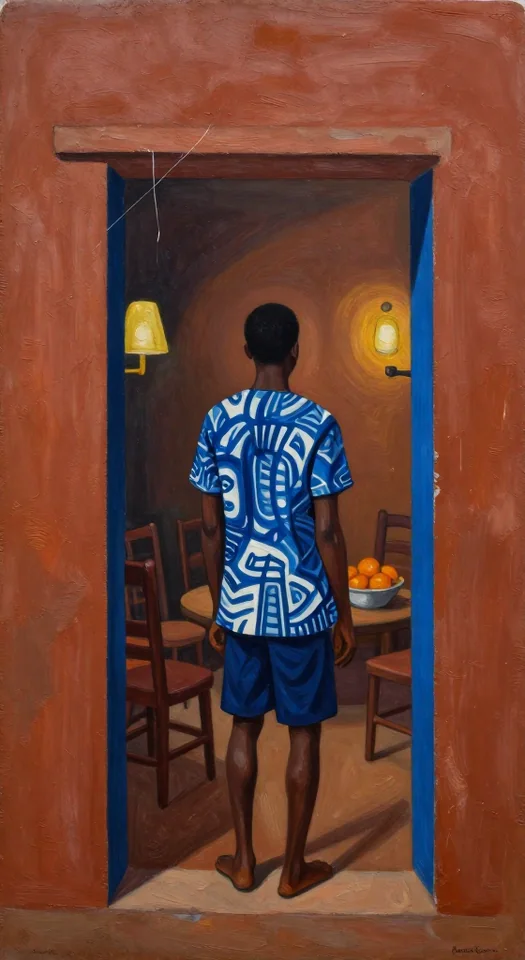
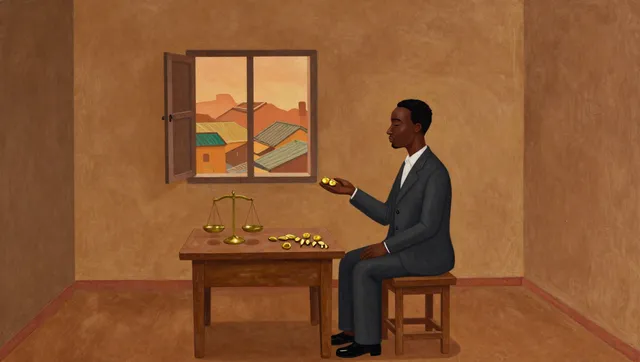
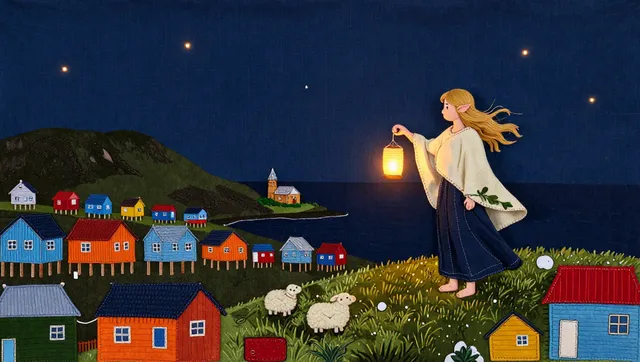
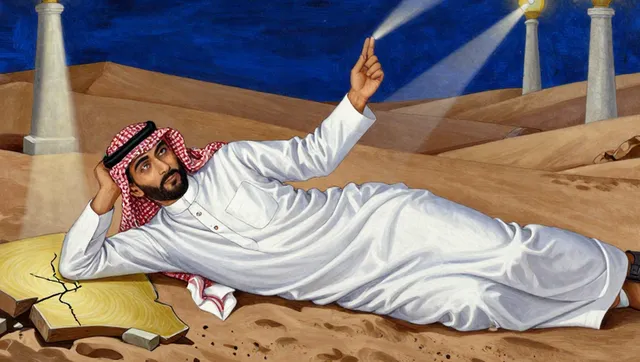
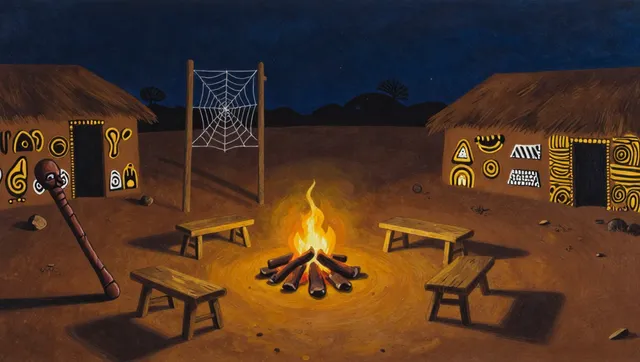
The AI interpretations in this room are not cloths but scenes from Anansi’s story painted like a gouache picture book. From adinkra they borrow a palette of earthy brown, brick red and charcoal black, and the rhythm of small motifs that look stamped onto walls and clothes. The marks in the pictures are not exact copies of real symbols, so compare them with museum photographs of the originals.
The cloth is first divided by bold lines into squares or long bands. In each square the same single motif is usually stamped evenly in rows across and down, and the next square gets a different motif. Up close you see the rhythm of one motif; from a distance you see the chequerboard structure made by many squares. In the pictures in this room, too, look for marks repeated in rows on walls and clothes.
Because the stamps are carved from calabash shell, very fine lines are hard to cut. The motifs therefore become silhouettes made of thick outlines and solid areas. Many are shapes you can recognise at a glance from far away, such as circles, hearts, spirals, ladders and stars. They are simple, yet so well balanced and symmetrical that they still read as the same motif at any size.
Traditional adinkra is stamped with a dark dye drawn from the bark of the badie tree. The ground was chosen to suit the occasion and the person from undyed cotton, red cloth, dark brown cloth and black cloth. Black motifs stamped on a black ground rise up softly only when they catch the light. Today the motifs are also printed on bright cloth such as yellow or green, but this room follows the old earthy palette.
Every adinkra motif carries a name and a proverb. Sankofa, ‘go back and fetch it’, recalls the saying that it is not wrong to go back for what you have forgotten. Gye Nyame is usually explained as ‘except God’ and speaks of divine power. Choosing motifs was therefore also a way of choosing what the wearer wished to say.
Between motif and motif a gap is left where the ground shows evenly. Because the motifs are stamped at an even spacing rather than covering the square completely, the whole cloth looks calm and orderly. The lines that divide the squares are themselves drawn as several parallel lines and work like a band of pattern. The empty ground is like a comma that lets the motifs be read.
Calabash stamps have slightly curved faces and are pressed with a rocking motion. So even with the same stamp, the depth of colour and the edges differ a little from square to square, and there are places where the dye spreads slightly or takes too lightly. These small differences mark hand-stamped cloth apart from factory-printed cloth. The pictures in this room likewise render the motifs as stamped marks rather than crisp printing.
Many adinkra motifs come from living things and objects, such as birds, crocodiles, ram’s horns, ferns and combs. But all of them are reduced to the fewest lines, so they are closer to signs than to pictures. The sankofa bird has feet facing forward and head turned back, and the two crocodiles are joined by a single stomach. Each shape compresses the heart of a story into one image.
We could not find an adinkra cloth among the Cleveland Museum of Art’s open-access (CC0) collection, so this room hangs no original works. The oldest surviving adinkra cloth (1817, brought from Kumasi by Thomas Bowdich) is in the British Museum, and the second oldest, the Elmina cloth of 1825, is in the National Museum of Ethnology in Leiden, the Netherlands. Look for their photographs in the two museums’ online collection searches.
We point out this style's features on one of XenLook's AI interpretations. It is not a historical painting.
Life story “The Story That Returns to Its Owner”
Traditional cloth stamped with plant dye is known to be vulnerable to water and sunlight, and it was not often washed. The cloths of 1817 and 1825 survive because museums have kept them in dark, stable conditions. In this room, look at them closely through published photographs and descriptions.
#2a1d16#5b3a24#9e3b26#e8dcc4#d9822b#2f3f73Screen approximations of named traditional colours; real pigments may differ.
Measured from the AI interpretations
Six representative colours measured from this room's images, darkest first, including the fading of old paper and silk.
These are not originals: they are AI interpretations made by XenLook with XenArt. They carry scenes from an agent's life story into this style. Every interpretation in this room is a scene from Anansi's life story “The Story That Returns to Its Owner”. Each room hangs one drawing style only.
 XenLook AI interpretation
 XenLook AI interpretation
 XenLook AI interpretation
Pick one to see the answer and why.
1. In the Akan language, Twi, what does ‘adinkra’ originally refer to?
2. What does sankofa, the bird turning its head back, mean?
3. When was the oldest surviving adinkra cloth made, and where is it now?
4. What are traditional adinkra stamps carved from?
5. What does the motif of two crocodiles sharing one stomach express?
A sentence written for this style is ready. Copy it or take it straight to the studio.
 XenLook AI interpretation
A scene in the style of adinkra cloth. Hand-woven cotton divided into squares by bold parallel lines, each square stamped in rows with the same black geometric symbol, a palette of earthy brown, brick red and charcoal black, slightly spreading and uneven stamp marks, and bands of coloured stitching joining the squares.
Try changing Stamp the same motifs on undyed cream cotton in place of black cloth, and compare how much clearer the motifs become and how the mood changes with the ground colour alone.
The sentence is copied. Paste it into the studio's input box.
The text of this room was written by cross-checking the sources below.
Pictures marked “XenLook AI interpretation” were made by XenLook with XenArt. They are not historical paintings and no painter made them. Originals carry the “Original” mark and the name of the museum that holds them.