In the early twentieth century, many Black families left the American South for cities of the North and Midwest. This is called the Great Migration. Harlem in New York was the final destination of the largest number of these migrants. As jobs, neighbours, newspapers, theatres and churches gathered in one district, poets, musicians and painters began to recognise one another. This surge of the 1920s is called the Harlem Renaissance, or the New Negro Movement. It is not the name of one painting style but of a period when literature, music and art rose together.
In 1925 appeared The New Negro, an anthology edited by Alain Locke, a philosopher who taught at Howard University and is called the ‘dean’ of the movement. The painter who illustrated it was Aaron Douglas. He came to Harlem in 1925, studied under the painter Winold Reiss, and also drew for the magazines The Crisis and Opportunity. Douglas simplified people into faceless dark silhouettes and overlaid rings of light around them, weaving African art, Cubism and Art Deco into one picture.
Artists needed patronage to live. The Harmon Foundation, established in 1921 by William E. Harmon, gave awards to Black artists and toured their exhibitions. Thanks to it, many painters met a large public for the first time. Yet the practice of showing Black artists only, with juries that were mostly white, drew criticism, and Romare Bearden later condemned it. Patronage was an opportunity, but it also left a question: who chooses and shows the story? That is why this room keeps asking about the one who chooses.
After the stock market collapsed in 1929 and the Depression came, patronage and jobs shrank, which is counted among the reasons the Renaissance faded. Government work programmes then supported artists. The Federal Art Project ran from 29 August 1935 to 30 June 1943 under the director Holger Cahill. It opened more than a hundred community art centres and sustained about ten thousand artists, who were paid 23.60 dollars a week. Harlem had a centre too, where young painters gained materials, studio space and teachers.
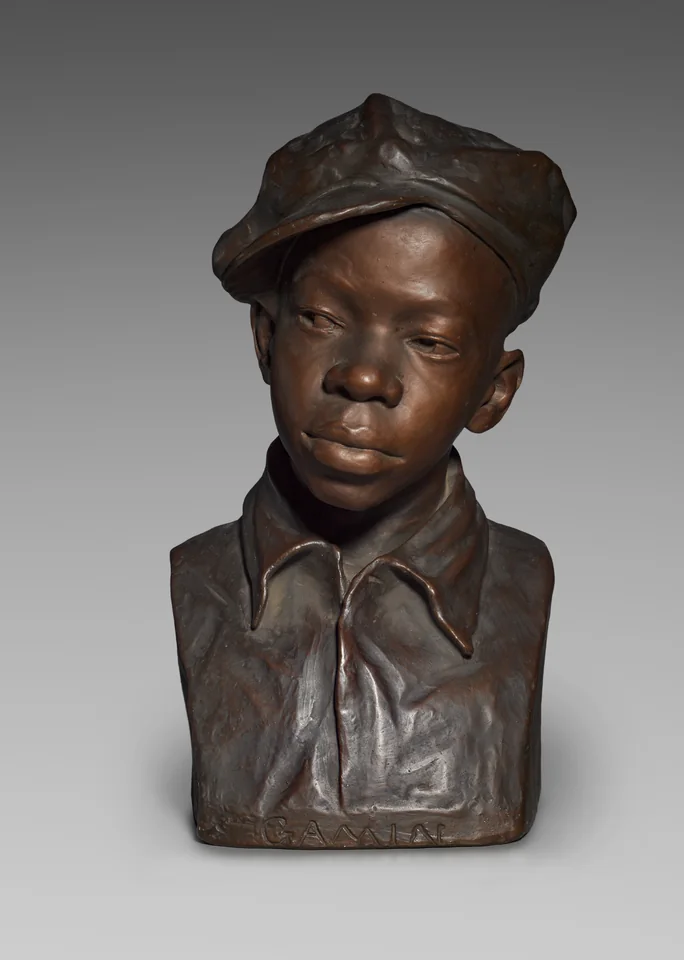
The sculptor Augusta Savage (1892–1962) was born in Florida and came to New York in 1921. In 1923 she was chosen for a summer art school at Fontainebleau in France, but the committee withdrew the offer when it learned she was Black. Savage protested publicly. In 1929 she went to Paris on a Rosenwald grant, and in 1932 she opened the Savage Studio of Arts and Crafts in Harlem. In 1937 she became director of the Harlem Community Art Center. Among her students were Jacob Lawrence and Norman Lewis.
Jacob Lawrence (1917–2000) came to Harlem at thirteen and studied in Charles Alston’s workshop. Savage helped him obtain a scholarship and a federal job. His Migration Series of 1940–41 tells the Great Migration in sixty panels. Horace Pippin (1888–1946) took another road. He injured his right arm in the First World War in 1918, began by burning designs into wood with a hot poker, and took up oil painting in 1930. His subjects were memories of war, historical figures such as John Brown, and the everyday life of his neighbours.
Romare Bearden (1911–1988) was born in Charlotte, and his family moved north in the tide of the Great Migration. On 5 July 1963 he began the group Spiral with Norman Lewis, Hale Woodruff and Charles Alston, and in 1964 he showed collages of enlarged photographic copies cut and pasted together at the Cordier and Ekstrom gallery. This room states one thing plainly: most key works of the movement are still in copyright, so little CC0 material exists. That is why it presents Savage’s Gamin and works by the earlier generation, Tanner and Duncanson, as the real originals.