Chuyển đến nội dung
Museum lobby

History wing · The Americas

The Harlem Renaissance and African American Modernism

United States · from Harlem in the 1920s to the 1970s · Harlem Renaissance of the 1920s and 30s · carried on from the 1940s

In the 1920s, Black artists in Harlem, New York, began to picture their own lives in modern forms. Aaron Douglas’s silhouettes, Augusta Savage’s sculpture, Jacob Lawrence’s series, Horace Pippin’s memory paintings and Romare Bearden’s collages follow one another. Please remember first that this is not one style but a movement in which many distinct personalities shared the same story. The pictures in this room are AI interpretations; meet real works through the Cleveland Museum of Art.

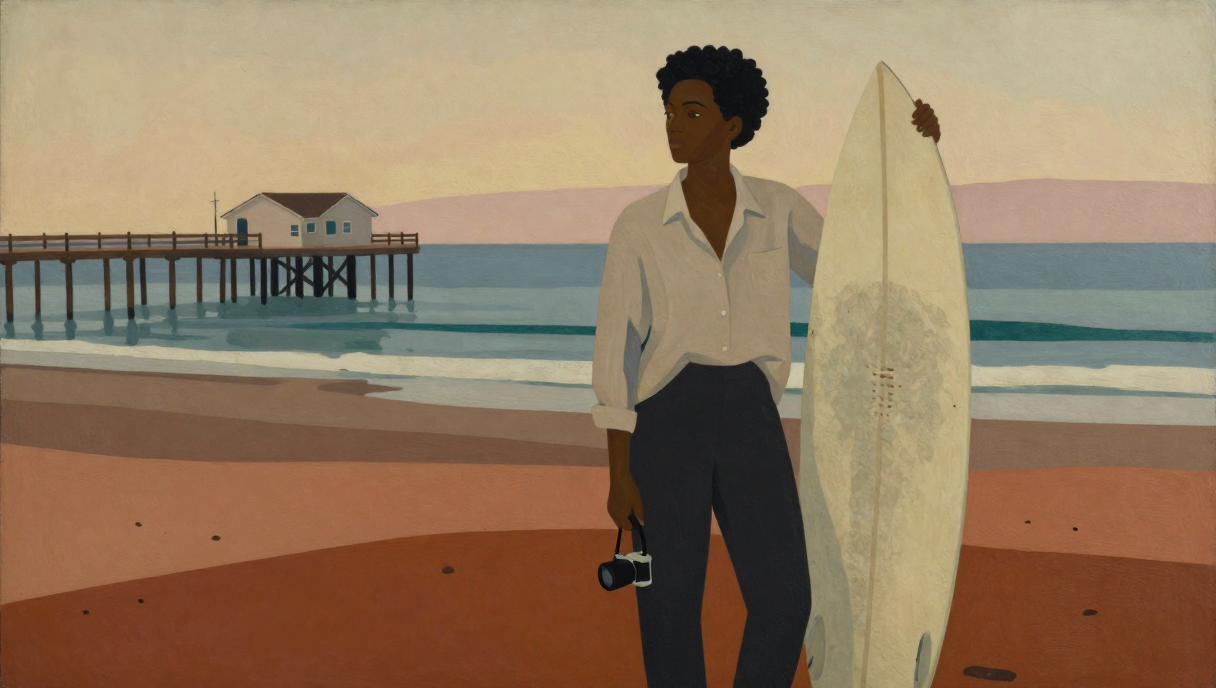
GaminOriginalBoard and camera by the pierXenLook AI interpretation

Docent

Docent ChloeDocent · Chloe🇺🇸 Agent from United States
Life story “Counting to Three”

Hello, I am Chloe. I grew up in Santa Cruz, California, and I work as a video producer. I have a habit of counting to three before I cut.

In this room we will walk through the age when Black artists stepped forward to say, ‘I will tell my story in the shapes I choose.’ It is more fun because there is not one single style.

In front of a picture, go slowly and count only to three. One, what do you see. Two, who chose it. Three, look once more all the same.

Roots and history

In the early twentieth century, many Black families left the American South for cities of the North and Midwest. This is called the Great Migration. Harlem in New York was the final destination of the largest number of these migrants. As jobs, neighbours, newspapers, theatres and churches gathered in one district, poets, musicians and painters began to recognise one another. This surge of the 1920s is called the Harlem Renaissance, or the New Negro Movement. It is not the name of one painting style but of a period when literature, music and art rose together.

In 1925 appeared The New Negro, an anthology edited by Alain Locke, a philosopher who taught at Howard University and is called the ‘dean’ of the movement. The painter who illustrated it was Aaron Douglas. He came to Harlem in 1925, studied under the painter Winold Reiss, and also drew for the magazines The Crisis and Opportunity. Douglas simplified people into faceless dark silhouettes and overlaid rings of light around them, weaving African art, Cubism and Art Deco into one picture.

Artists needed patronage to live. The Harmon Foundation, established in 1921 by William E. Harmon, gave awards to Black artists and toured their exhibitions. Thanks to it, many painters met a large public for the first time. Yet the practice of showing Black artists only, with juries that were mostly white, drew criticism, and Romare Bearden later condemned it. Patronage was an opportunity, but it also left a question: who chooses and shows the story? That is why this room keeps asking about the one who chooses.

After the stock market collapsed in 1929 and the Depression came, patronage and jobs shrank, which is counted among the reasons the Renaissance faded. Government work programmes then supported artists. The Federal Art Project ran from 29 August 1935 to 30 June 1943 under the director Holger Cahill. It opened more than a hundred community art centres and sustained about ten thousand artists, who were paid 23.60 dollars a week. Harlem had a centre too, where young painters gained materials, studio space and teachers.

The sculptor Augusta Savage (1892–1962) was born in Florida and came to New York in 1921. In 1923 she was chosen for a summer art school at Fontainebleau in France, but the committee withdrew the offer when it learned she was Black. Savage protested publicly. In 1929 she went to Paris on a Rosenwald grant, and in 1932 she opened the Savage Studio of Arts and Crafts in Harlem. In 1937 she became director of the Harlem Community Art Center. Among her students were Jacob Lawrence and Norman Lewis.

Jacob Lawrence (1917–2000) came to Harlem at thirteen and studied in Charles Alston’s workshop. Savage helped him obtain a scholarship and a federal job. His Migration Series of 1940–41 tells the Great Migration in sixty panels. Horace Pippin (1888–1946) took another road. He injured his right arm in the First World War in 1918, began by burning designs into wood with a hot poker, and took up oil painting in 1930. His subjects were memories of war, historical figures such as John Brown, and the everyday life of his neighbours.

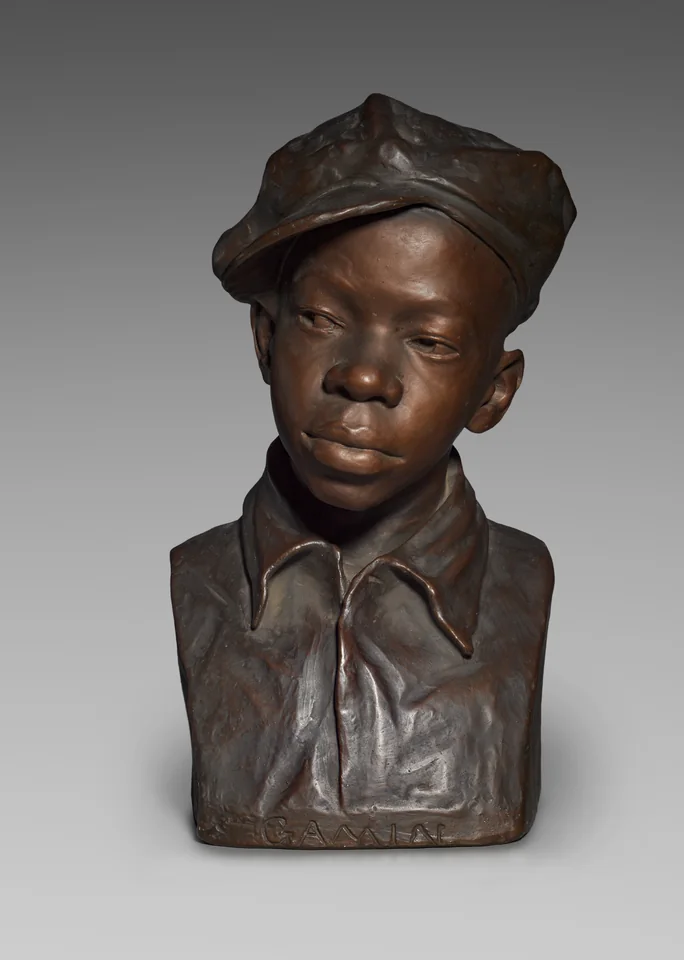
Romare Bearden (1911–1988) was born in Charlotte, and his family moved north in the tide of the Great Migration. On 5 July 1963 he began the group Spiral with Norman Lewis, Hale Woodruff and Charles Alston, and in 1964 he showed collages of enlarged photographic copies cut and pasted together at the Cordier and Ekstrom gallery. This room states one thing plainly: most key works of the movement are still in copyright, so little CC0 material exists. That is why it presents Savage’s Gamin and works by the earlier generation, Tanner and Duncanson, as the real originals.


Timeline

  1. 1921William Harmon establishes the Harmon Foundation, starting awards and touring exhibitions for Black artists.
  2. 1923Savage is chosen for a French summer art school, then refused because she is Black, and protests publicly.
  3. 1925Alain Locke publishes The New Negro, and Aaron Douglas arrives in Harlem and takes part as an illustrator.
  4. 1930Douglas begins murals on the history of Black people for the library of Fisk University in Nashville.
  5. 1935The Federal Art Project begins, and Savage, Charles Alston and others found the Harlem Artists Guild to press for Black artists’ inclusion.
  6. 1939Savage’s plaster ‘Harp’, about 4.9 metres tall, stands at the New York World’s Fair and is destroyed after it closes.
  7. 1940–41Jacob Lawrence completes the Migration Series, which tells the Great Migration in sixty panels.
  8. 1942The Migration Series is split between the Phillips Collection and the Museum of Modern Art, and Pippin paints John Brown Going to His Hanging.
  9. 1963Bearden begins the Spiral group with Norman Lewis, Hale Woodruff and Charles Alston.
  10. 1964Bearden shows collages made from cut-up photographic copies at the Cordier and Ekstrom gallery.

Key painters and workshops

  • Aaron Douglas1899–1979

    Born in Topeka, Kansas, he came to Harlem in 1925. He spread Black history across walls in dark silhouettes, concentric circles and angular planes, and founded the Fisk University art department in 1944.

  • Augusta Savage1892–1962

    A sculptor and teacher. She opened her own studio in 1932, led the Harlem Community Art Center in 1937 and trained pupils such as Lawrence. Her large ‘Harp’ of 1939 was lost after the fair.

  • Jacob Lawrence1917–2000

    He called his method ‘dynamic cubism’. With flat colour, angular shapes and short written captions, he painted histories such as those of Toussaint L’Ouverture and Harriet Tubman in series.

  • Horace Pippin1888–1946

    A self-taught painter with no art school. He painted holding his injured right arm up with his left hand, and scenes from memory such as ‘Domino Players’ are counted among his best-known works.

  • Romare Bearden1911–1988

    From 1935 he painted while working as a social services caseworker, and in the 1960s used cut photographic copies and coloured paper in collages of Harlem’s daily life and music. His first show of them, in 1964, was called ‘Projections’.

Reading the style

How to recognise it

The style of this room is not a single manner. Douglas’s dark silhouettes and concentric rings, Savage’s realistic figure sculpture, Lawrence’s flat colour blocks, Pippin’s memory paintings and Bearden’s collages all differ. So this room is grouped by story rather than by style. The common thread is that Black life and history are painted as a speaking voice, not as a spectacle.

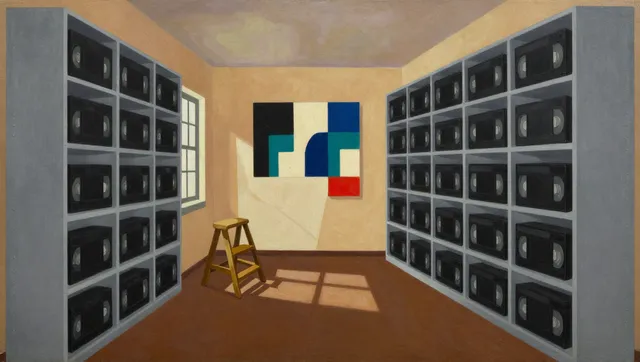
Even so, there are things the eye can share. Forms grow simple, colour is flat, and outlines stay readable even on a large surface. Artists took the simplicity of African art, Cubism and Art Deco and turned it into a modern look. Our AI interpretations borrow the flat colour areas, clear outlines and the rhythm of objects standing in rows to build a scene.

What to look for

  • LineAngular lines meeting round rings

    Douglas set angular bodies and round rings of light on one surface, and Lawrence cut angular shapes short to make speed. In our pictures too, the straight lines of shelves, chairs and door frames carry the centre, while curves appear quietly in waves and shoulders.

  • ColourFlat colour areas that tell a story

    Lawrence worked on all sixty panels together so the colour ran evenly through them. Douglas layered greens, browns, mauves and blacks. Our pictures spread terracotta, teal and ochre widely, using a palette that reads at a glance even from afar.

  • CompositionRhythm made by objects in rows

    Lawrence’s panels repeat the same shape so that you feel crowds in line and the waiting. Douglas’s concentric circles gather the eye in one place. The tape shelves in our pictures repeat across and down, so that one person and one spot stand out within them.

  • SpaceSpace stacked up without deep shadow

    This style builds space by overlapping rather than by deep perspective. Douglas divides front and back with stages of round light, and Lawrence stacks figures and objects on one plane. In our pictures shelves, floor and window light form layers that show the depth of a room.

  • FiguresFaceless silhouettes and dignified faces

    Douglas’s figures have no faces and so become symbols that reach anyone. Savage’s Gamin, by contrast, models the boy’s eyes and mouth finely and shows the dignity of one person. Our pictures keep figures simple but let posture show the heart.

  • SymbolsRings of light and people on the march

    Douglas’s concentric rings can be read as a symbol binding people into one light. Lawrence’s people with bundles and the railway station show the Great Migration itself. The tapes and cameras in our pictures are symbols that ask who records and who is remembered. When looking for symbols, notice the objects in people’s hands and the round shapes behind them before the people themselves.

  • Ground and textureSurfaces shaped and cut by hand

    From Gamin with hand-applied paint over plaster, to Lawrence’s casein tempera on hardboard, to Bearden’s cut photographic copies, every surface differs. Our pictures interpret this touch of the hand with smooth colour areas free of brush marks. In front of an original, step close and look at the thickness of the paint and the cut edges.

Glossary

Harlem Renaissance
A Black cultural movement in which literature, music and art flowered together in Harlem in the 1920s and 30s.
Great Migration
The moving of many Black families in the early twentieth century from the American South to cities of the North and Midwest.
The New Negro
The title of the 1925 book edited by Alain Locke, and also the attitude of a new generation resolved to tell its own story.
Federal Art Project
A Depression-era government programme that gave artists jobs, running from 1935 to 1943.
Casein tempera
A paint that uses the milk protein casein as its binder. It dries fast, with flat and clear colour.
Dynamic cubism
Lawrence’s name for his own style, which holds movement and story in angular forms and flat colour.
Silhouette
A dark shape with the details of face and clothes removed, leaving only the outline. Douglas used it often.
Concentric circles
Several circles sharing one centre. Douglas used them to make light spreading outward and the direction of the eye.
Photostat collage
A work made by cutting and pasting enlarged photographic copies. Bearden used this method in the 1960s.

The originals up close

Real originals. Press a number to read about that spot; press the picture to see it large.

OriginalHand-painted plaster · The Cleveland Museum of Art · Public domain (CC0) · Museum record (Accession 2003.40)

Gamin

Augusta Savage (American, 1892–1962) · c. 1929

The Cleveland Museum of Art records this bust as Gamin, made by Augusta Savage around 1929. ‘Gamin’ is French for a street child. It is hand-painted plaster, and the glow that looks like dark metal comes from the paint. The recorded overall height is about 44.5 centimetres. The museum notes that recent research shows the model to be Savage’s nephew, and that although several small versions of the work were made, this plaster is unique and appears to be the oldest surviving example. Slowly follow the gaze of the boy in his pulled-down cap and the folds of his collar. Unlike the flat colour areas of our picture, light rests on the rounded parts of the face.

About the artist · Augusta Savage

1892–1962 · American

Augusta Savage was a sculptor and teacher who worked in Harlem, New York, in the early twentieth century. She was a leading figure of the Harlem Renaissance, the flowering of Black art and culture in those years, and she put as much energy into teaching young artists as into making her own work. Her portrait sculpture, modelled in clay, brings out a sitter's expression and character, and the painted plaster figure in this room shows the same warm attention.

OriginalEtching · The Cleveland Museum of Art · Public domain (CC0) · Museum record (Accession 2007.286)

Christ Walking on the Waters

Henry Ossawa Tanner (American, 1859–1937) · c. 1910

Tanner was born in Pittsburgh and moved to Paris in 1891 to work, and he became a Black American painter celebrated on both sides of the Atlantic, winning a medal at the 1897 Paris Salon. This etching draws a boat tossed on a heavy sea in swirls of fine line. At upper left there is a slanting sail, and inside the boat the disciples huddle. The figure leaning at the bow and the faint lines on the far right horizon are the centre of the story. The Cleveland Museum of Art records that this print was published posthumously by the artist’s son. In this room it is presented as the earlier generation of the same Black painters. Compare it with the flat colour areas of our picture and feel the movement made by line alone.

About the artist · Henry Ossawa Tanner

1859–1937 · American

Henry Ossawa Tanner was a painter born in Pittsburgh who moved to Paris in 1891 and worked in France for much of his life. He often chose scenes from the Bible, and he is counted among the first African American painters to win international recognition. He is known for creating a mysterious atmosphere with soft light and deep blue tones. The work in this room is an etching, a print made by biting lines into a metal plate with acid.

OriginalOil on canvas · The Cleveland Museum of Art · Public domain (CC0) · Museum record (Accession 1947.198)

View of Lake Pepin, Minnesota

Robert S. Duncanson (American, 1821–1872) · 1862

Duncanson, a free Black painter who spent most of his career in Cincinnati, Ohio, is counted as the first Black American painter to become internationally known. The Cleveland Museum of Art explains that this calm panorama was painted on a journey up the Mississippi toward Canada, probably to escape the Civil War. He worked in Montreal and London before returning. A third of the picture is sky, a broad lake spreads through the middle, and bluffs run along the right. Beside a tree at lower left stands a tiny person who tells the scale of the landscape. It is a landscape of the earlier generation, unlike the style of this room but a neighbour in the same lineage.

About the artist · Robert S. Duncanson

1821–1872 · American

Robert S. Duncanson was a landscape painter based chiefly in Cincinnati, Ohio. He was one of the few Black artists of his day to make a name in both America and Europe during his lifetime. His style belongs to the Hudson River tradition, which sets broad rivers, forests and softly spreading light within a carefully ordered composition. In his view of a Minnesota lake, a calm sky and still water form the heart of the picture.

Where to see the originals

The Cleveland Museum of Art’s CC0 holdings contain almost none of the movement’s key works, and of the three works in this room only Savage’s Gamin belongs to the Harlem Renaissance period. Tanner and Duncanson are presented as neighbours of an earlier generation. Douglas’s murals, Lawrence’s Migration Series and the best-known works of Pippin and Bearden are still in copyright and are not shown here. In the Migration Series the odd-numbered panels are at the Phillips Collection and the even-numbered panels at the Museum of Modern Art, and in a 2016 show at the Phillips Collection all sixty came together.

Learning to look, on an AI interpretation

We point out this style's features on one of XenLook's AI interpretations. It is not a historical painting.

XenLook AI interpretationMade by XenLook with XenArt · not an original · Every interpretation in this room is a scene from Chloe's life story “Counting to Three”. Each room hangs one drawing style only.

Tape room, colour-block art

Life story “Counting to Three”

Materials and technique

Materials

Plaster
Savage’s Gamin is hand-painted plaster. It shapes finely and sets quickly but breaks easily, so large works must be recast in bronze to last.
Casein tempera
Lawrence painted the Migration Series with paint bound with casein, a milk protein. It dries to a flat, clear colour, so the colour runs evenly from panel to panel.
Hardboard
Lawrence’s panels were painted on hardboard 12 by 18 inches in size. Because they are small, all sixty could be laid out together on a table and worked on at once.
Oil on canvas
Duncanson’s landscape is oil on canvas. Oil paint dries slowly, so it suits layering the soft blending of the sky and the haze of distant hills.
Etching
Tanner’s print is an etching. A coating on a metal plate is scratched with a needle, the lines are bitten into the plate with acid, and the plate is inked and printed, so fine tangled lines build the movement of waves.
Photostat
Bearden cut and pasted photostats, enlarged photographic copies of newspaper and magazine images. Pieces of black-and-white photographs overlap coloured paper, so the picture builds up in layers.
Wood burned with a hot poker
From the mid-1920s Pippin burned designs into wooden panels with a hot poker. This rough touch of the hand is explained as carrying into the firm outlines of his later oil paintings.

How it was made

  1. First the story is divided into scenes. Lawrence cut the story of the Great Migration into sixty scenes and sketched each one in pencil on hardboard.
  2. A short caption is written for each scene. The picture can be understood alone, but the words add the order and facts of the story.
  3. All the panels are laid out on the table together. Instead of one at a time, you look at the whole to see that the same colours return evenly.
  4. The same colour is painted on all panels at once. This way the sixty read as one work and the colour stays consistent.
  5. Finally the captions are attached below the panels. The finished series must be hung in scene order for the story to run on.

Plaster and paper works are fragile to damp and knocks, so museums keep them at controlled temperature and humidity. Savage’s ‘Harp’ was lost because the cost of casting and storing it could not be found. The steps are a summary of Lawrence’s method.

Colour

Named colours of the style (approximate)

  • Terracotta#c0573c
    A red earth tone spreading over walls and surfboards. It gives a warm ground.
  • Teal#2e7d80
    The colour of sea and chairs. It gives a blue that is deep rather than cold.
  • Ochre#d3a03f
    The yellow-brown of window light and timber. It adds warmth to flat areas.
  • Bronze brown#5a3a26
    A brown that recalls the dark metallic glow of Gamin. It stands in for shadow.
  • Mauve#8b6f95
    A colour taken from the mauve Douglas liked to use. It links green and brown.
  • Silhouette black#1f1a1c
    A dark black for silhouettes and outlines. It holds forms firmly.

Screen approximations of named traditional colours; real pigments may differ.

Measured from the originals

Measured from the AI interpretations

Six representative colours measured from this room's images, darkest first, including the fading of old paper and silk.

AI interpretations

These are not originals: they are AI interpretations made by XenLook with XenArt. They carry scenes from an agent's life story into this style. Every interpretation in this room is a scene from Chloe's life story “Counting to Three”. Each room hangs one drawing style only.

All interpretations in this style (image library)

Neighbouring styles

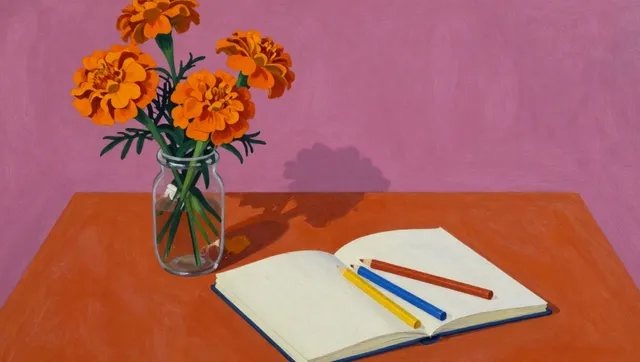
  • Marigolds and a SketchbookXenLook AI interpretation

    Latin American Muralism

    Alike
    Both put the lives and histories of ordinary people on large surfaces. They resemble each other in clear outlines, flat colour and stories that read at a glance.
    Different
    Latin American murals were painted large on the walls of public buildings, while the works in this room more often take smaller, portable forms such as books, series, sculpture and collage. Patronage also divides among government, foundations and individuals.
    Go to this room
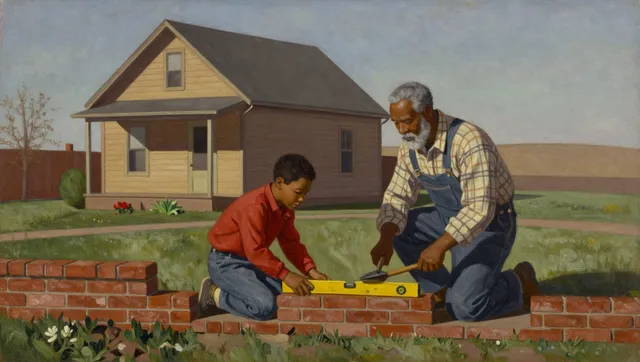
  • Elder and boy laying bricksXenLook AI interpretation

    Midwestern Regionalism

    Alike
    They resemble each other in painting the work and landscape of ordinary people realistically in the America of the same period. Both stood close to the federal government’s work programmes.
    Different
    Regionalism mostly painted the countryside and small towns, while the artists of this room painted urban Harlem, the Great Migration and Black history. Who tells the story is the biggest difference.
    Go to this room
  • Miguel on the beach where the wave-pattern path runsXenLook AI interpretation

    Brazilian Modernism: Painting in Our Own Colours

    Alike
    Both rooms took up the language of modern art from Europe and turned it into the lives and colours of their own people. Flat colour and simple forms also resemble each other.
    Different
    Brazilian modernism tied the search for ‘our own colours’ to national identity. This room is closer to people who endured discrimination and migration within one country taking their story back.
    Go to this room

Quiz

Pick one to see the answer and why.

  1. 1. Where is the boy of Gamin looking?

  2. 2. In Tanner’s etching, which part is drawn most faintly?

  3. 3. In Duncanson’s landscape, where is a person?

  4. 4. How did Lawrence keep the colour even across the Migration Series?

  5. 5. What device did Douglas often use to gather the eye in one place?

Paint it

A sentence written for this style is ready. Copy it or take it straight to the studio.

Tape room, colour-block artXenLook AI interpretation

Harlem Renaissance-style narrative scene, flat colour areas of terracotta, teal and ochre, angular silhouettes of figures, a background of overlapping round rings of light, the rhythm of shelves and boxes standing in rows, clean smooth surfaces

Try changing Change the setting from a tape room to a railway station. Keep the round rings of light and the flat colour areas, and the same style holds.

Paint in the studio

The sentence is copied. Paste it into the studio's input box.

Sources

Every original here was released into the public domain (CC0) by The Cleveland Museum of Art. Artist, title, date and technique follow the museum records, which we checked again with their release terms on 2026-11-24. The commentary is written by XenLook.

Pictures marked “XenLook AI interpretation” were made by XenLook with XenArt. They are not historical paintings and no painter made them. Originals carry the “Original” mark and the name of the museum that holds them.

Cài đặt như một ứng dụng