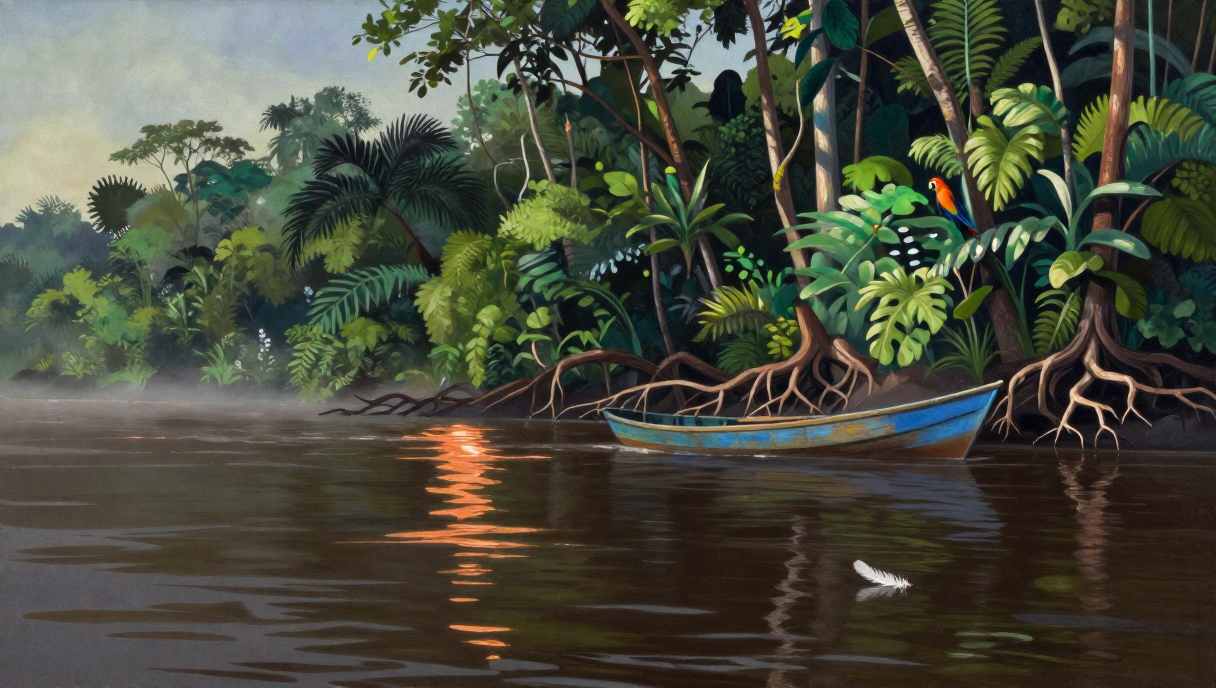
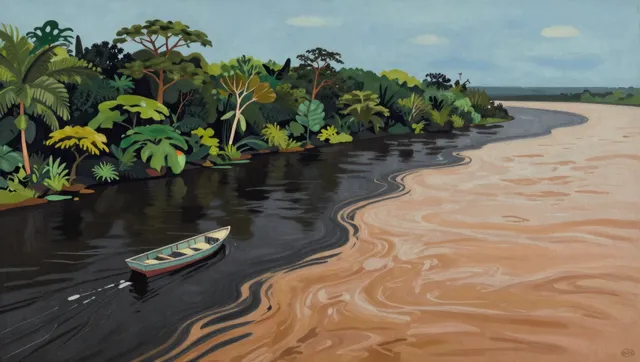
“Amazon River Painting” is not a school name found in art history books. It is the name of a modern genre that this museum uses to group one strand of pictures. The rules are simple. Water fills about the lower half of the picture, and that water is a black-brown like strong black tea. The forest and the sky are reflected upside down on it. The forest is not drawn leaf by leaf; masses are stacked in many layers to give depth. People appear small, or only as traces such as boats, houses and lamps. These rules have clear roots, and we will look at them one by one below.
The first root is the German naturalist Alexander von Humboldt. From 1799 to 1804 Humboldt travelled the Americas with the French botanist Aimé Bonpland. He went up the Orinoco River in Venezuela and confirmed the Casiquiare canal, which links the Orinoco with the Rio Negro of the Amazon basin. In his later book Kosmos, Humboldt included a chapter on landscape painting and gave the painter a major role in portraying the diverse nature of the New World. He even challenged artists to paint the “physiognomy” of the Andes. This advice drew the next generation of painters to South America.
The painter who took up that advice most fully was the American Frederic Edwin Church. Church began in the Hudson River School and owned a copy of Humboldt's Kosmos himself. He travelled to South America twice, in 1853 and 1857, staying mostly in Quito, Ecuador, and moving through Colombia and Ecuador. His great 1859 painting The Heart of the Andes was the fruit of those journeys. Church's Twilight in the Wilderness (1860), shown in this room, depicts a forest in Maine in the United States rather than the tropics, but the way the sky is mirrored in still water shows the core of this genre exactly.
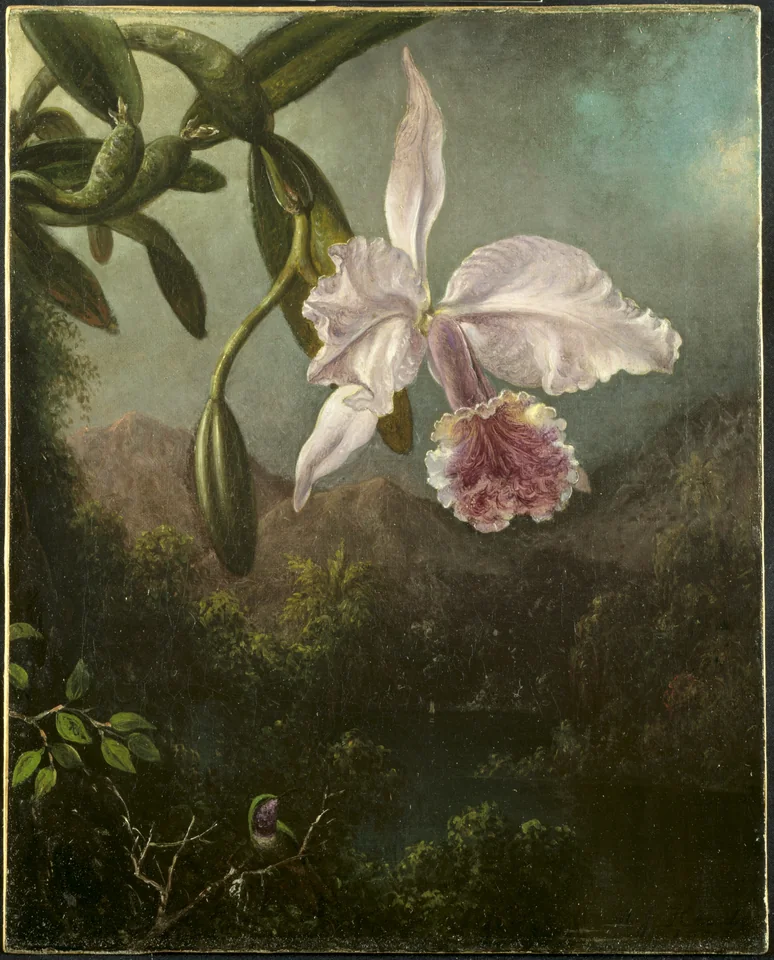
The second painter is Martin Johnson Heade, a close friend of Church. Heade became interested in the tropics after seeing The Heart of the Andes, and he stayed in Brazil from 1863 to 1864. There he painted more than forty small pictures of hummingbirds and planned a book called The Gems of Brazil. Because of money problems and his worries about the quality of reproduction, however, the book never appeared. Heade went back to the tropics twice more after that. He liked a composition that sets a nearby flower and bird large and a distant valley small in the haze.
A word that ties together how these painters handled light is “luminism”. This name, however, was not chosen by the painters themselves. The art historian John I. H. Baur recognised the style in the late 1940s and named it “luminism” in an article in 1954. Still water, a smooth surface on which brushstrokes are hardly visible, and calm light spreading wide are its marks. Heade is often counted among the luminists, while Church is generally not seen as a central luminist painter. This room borrows the method rather than the name.
The last root is the river itself. The Rio Negro, a great tributary of the Amazon, is a “blackwater river”. Because of plant matter dissolved out of the forest, its water is as dark as strong black tea. Near Manaus this black water meets the yellowish, silt-laden water of the Solimões, and the two do not mix at once but flow side by side for some kilometres. The palette of this genre, that is, the black-brown ground, the silty band and the copper reflections on top, all comes from the colours of this real river.
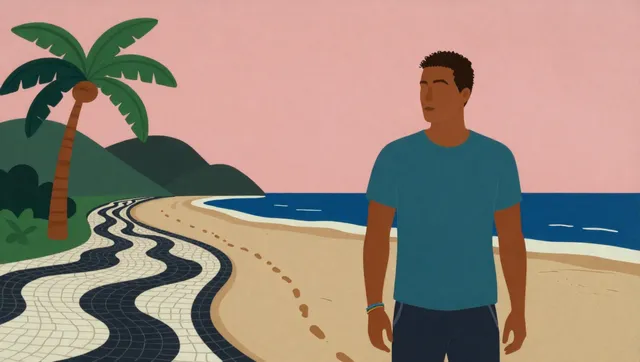
The AI interpretations in this room follow these rules to paint Kurupira's life story, “Footprints Turned Backwards”. Each scene belongs to a different time, like the lamp of 1931, the boat Esperança of 1974 and the riverside emergency room of 2021, but the black water and the layered forest are always the same. The Brazilian Modernism room next door treats the same Brazilian nature, yet paints pink, earth and cobalt in flat planes of colour. This room, by contrast, builds space with dark, deep layers and light reflected in water. Following the rule of one painting style per room, the two rooms look at Brazil with different eyes.