The roots of this room’s style lie in the newspaper offices of 1890s Philadelphia. Before the technology of printing photographs in newspapers replaced hand-drawn illustration, papers reported scenes of events and street life through pictures drawn by artists. Young illustrators such as John Sloan, William Glackens, George Luks and Everett Shinn came to know one another working in these offices and were later called the ‘Philadelphia Four’. Every day they trained at glancing at a scene, holding it in memory and turning it, before the deadline, into a picture anyone could recognise at a glance. That reporter’s eye, drawing what is seen accurately yet so that it reads quickly, became the ground of the oil paintings they later made.
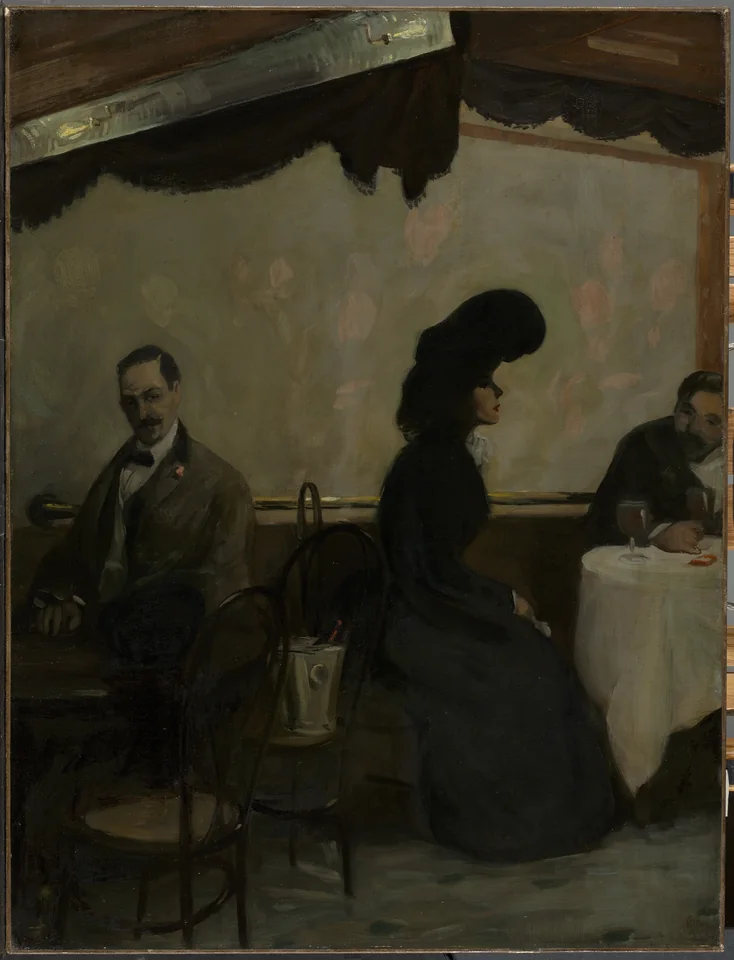
John Sloan (1871–1951) grew up in Philadelphia, worked from an early age to earn a living, and in 1892 became an illustrator for The Philadelphia Inquirer. That year he met the painter Robert Henri, back from Paris, and took him as a lifelong mentor, while studying in the evenings with the realist painter Thomas Anshutz at the Pennsylvania Academy of the Fine Arts. At the end of 1895 he moved to The Philadelphia Press, and even after moving to New York in 1904 he earned his living for some time by newspaper and magazine illustration. Sloan had a habit of watching his neighbours’ lives from his apartment window without being noticed, and he turned what he saw there, saloon customers, people on rooftops and a woman hanging laundry, into pictures. The two oil paintings hanging in this room were painted with exactly that eye.
Robert Henri (1865–1929), back from study in Paris, gathered newspaper illustrators in his Philadelphia studio to talk about art and life. Instead of the smooth, genteel pictures favoured by the conservative National Academy of Design, he taught them to paint the city life moving before their eyes. The art critic Robert Hughes remarked that Henri “wanted art to be akin to journalism.” The scenes that Henri, Sloan, Glackens, Luks and Shinn painted, street children, tenement rooms, saloons and laundry, were at first mocked as unrefined, and from that mockery the name ‘Ashcan School’, after the rubbish bin, took hold. A name meant to belittle them now names a chapter of American realism.
In 1908 an exhibition of eight painters opened at the Macbeth Galleries in New York, and the group was afterwards called ‘The Eight’. The show was a protest against the exclusive exhibition practices of the National Academy of Design, which chose its entries strictly. Yet the eight did not all paint alike. Only five of them, Henri, Sloan, Glackens, Luks and Shinn, were Ashcan painters, while Arthur B. Davies, Ernest Lawson and Maurice Prendergast painted in quite different styles. Even so, they proved that painters could show their work directly to the public without passing through a jury. But once the 1913 Armory Show in New York gave America its first large-scale introduction to European modernism, and more galleries began promoting Cubists and Fauves, the pictures of Henri and his circle began to look tame to a younger generation.
Among Henri’s students, the one who showed the most forceful brushwork was George Bellows (1882–1925). Born in Columbus, Ohio, he played baseball and basketball at Ohio State University, and in 1904, just before graduating, he left for New York to study painting with Henri. He made his name as a realist painter of bold scenes of New York city life, and above all his series of boxing matches at private clubs is counted as his greatest contribution. In Stag at Sharkey’s of 1909, hanging in this room, he blurred the two fighters’ bodies with quick strokes to create motion, and seated the viewer among the crowd with a low eye level. This way of making a body’s movement and weight felt through the brushwork itself carries on into the thick brushwork of this room’s AI interpretations.
Edward Hopper (1882–1967) was born in Nyack, New York, studied illustration at his parents’ urging and then studied with Henri at the New York School of Art. While working for nearly two decades from 1906 as an illustrator for an advertising agency and magazines, he made three trips to Paris by 1910, and in 1924 he married Josephine Nivison, a fellow painter. Like Sloan he favoured the frame of a window, but he did not count himself among the Ashcan painters, and his streets were said to have not a single ashcan in sight. Nighthawks of 1942 shows four people through the large glass window of a downtown diner late at night, the diner’s light falling on a dark, deserted street. His themes of solitude, light and shadow are not among the Cleveland Museum of Art’s CC0 holdings, so this room tells them in words only, but that light can be seen in his Lighthouse Village, which hangs in Amelia’s room.
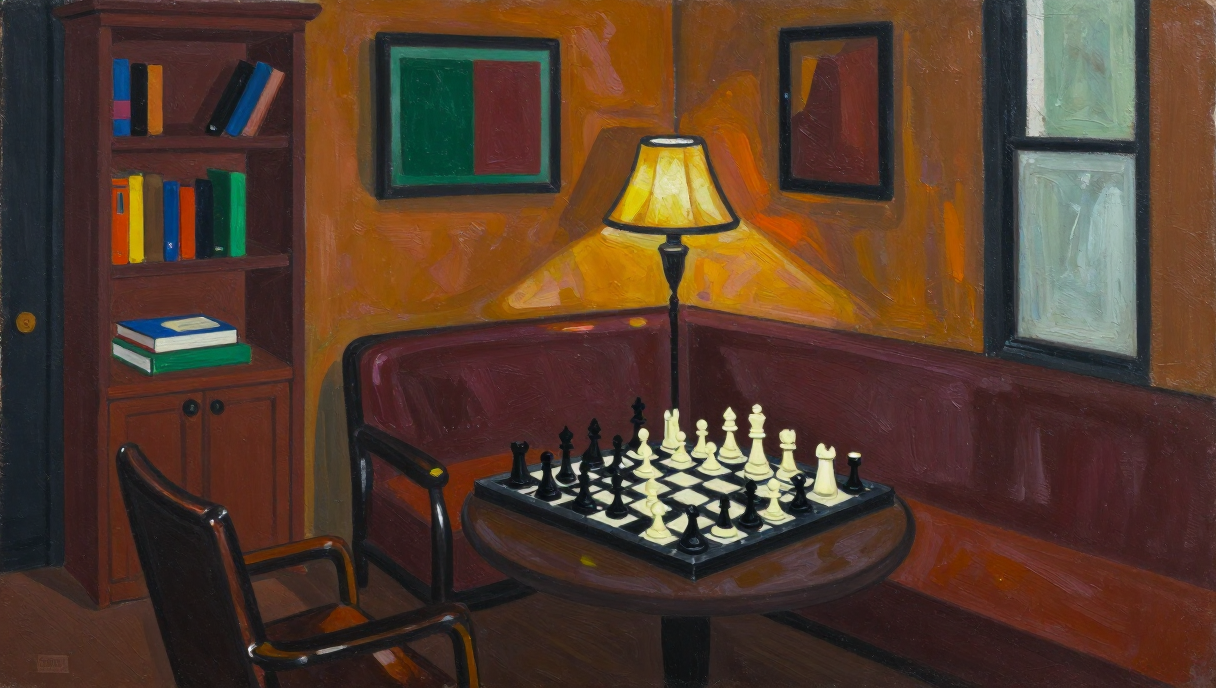
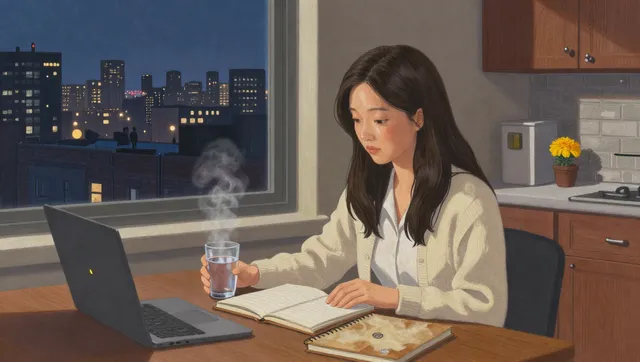
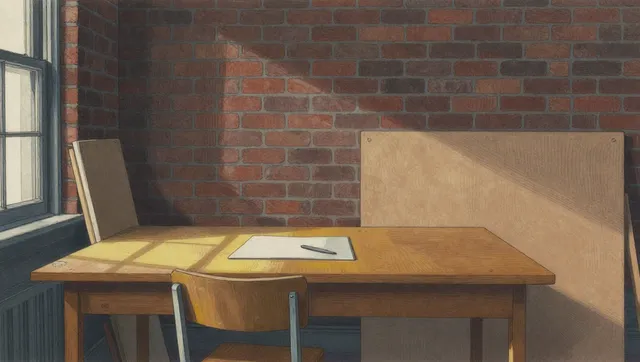
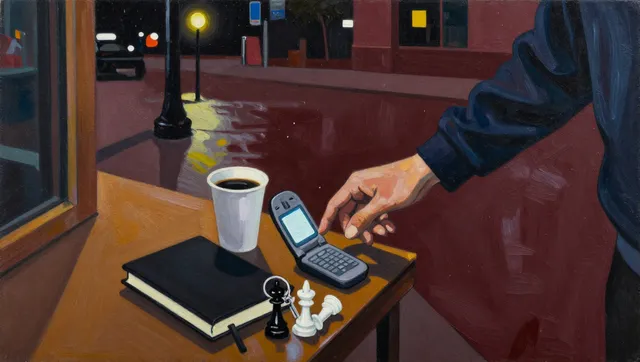
Today’s American narrative painting inherits all three strands together. What Sloan’s saloons and windows left behind is a reporter’s eye that quietly watches an ordinary person’s day; what Bellows’s boxing rings left is a hand that builds a body’s weight with bold strokes instead of outlines; and what Hopper’s empty rooms left is the still time of a person standing alone under artificial light. This room’s AI interpretations lay that legacy over the life of an international patent researcher. In an oxblood and bottle-green study, cool grey meeting rooms under fluorescent light and rain-wet Brooklyn streets at night, the man in the navy suit mostly stands with his back to us, and we look over his shoulder at what he is looking at.