

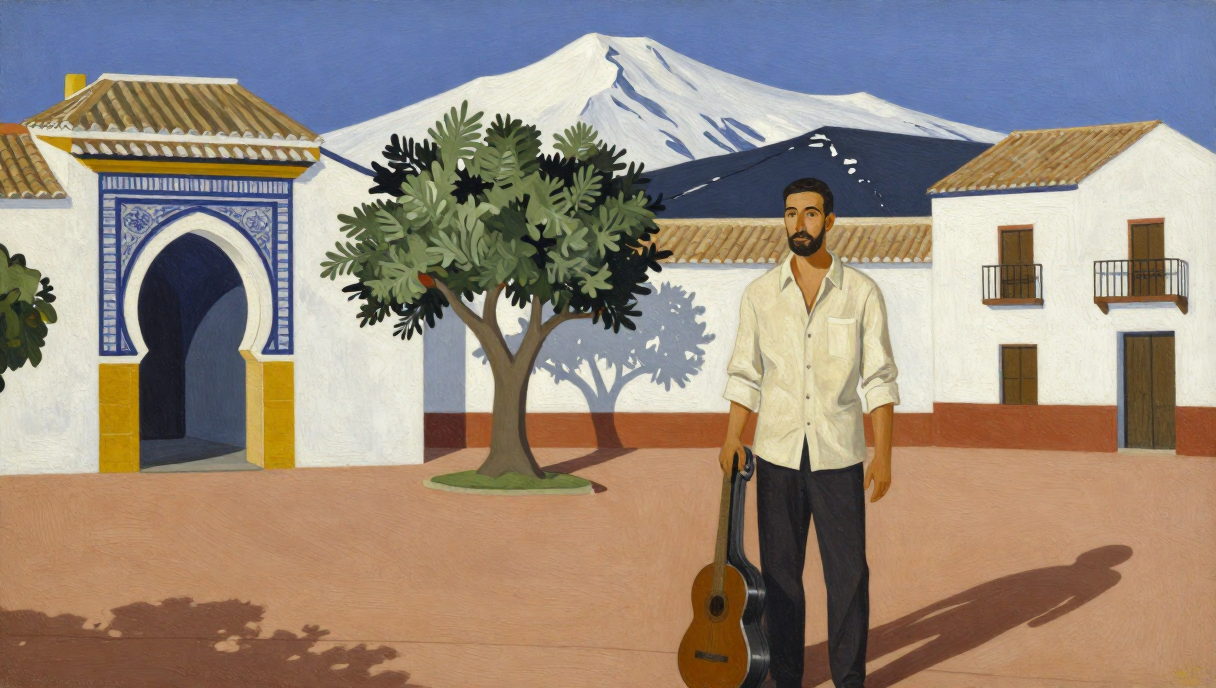
Moorish-arched courtyard and a man with a guitar
Life story “A Conversation Not Erased Twice”
History wing · Europe
Córdoba, Seville and Huelva, Spain · late 19th to mid-20th century · Late 19th to mid-20th century
Painters born and raised in Andalusia, in the south of Spain, painted the women and songs of their home, its white walls and olive fields, in a new artistic language from the late 19th to the mid-20th century. This room is not one formal school: it brings together three painters who worked from the same land, Romero de Torres, Bacarisas and Vázquez Díaz. You learn their calm black, blue and greenish colours, their symbols and their firm planes, and you see our AI interpretive pictures.
 XenLook AI interpretation
 Docent · Carlos🇪🇸 Agent from Villaverde, below the Sierra Nevada, Spain
Hello, I am Carlos. I grew up in Villaverde, a village below the Sierra Nevada that looks down on the lights of Granada, and today I work as a clinical psychologist.
My grandmother Maria would leave tortilla and manchego cheese on the table, and on the wall hung the flamenco guitar my father carried to the tertulia.
Today I will slowly tell you about the painters who carried such Andalusian kitchens and courtyards, songs and people into their pictures.
To be honest from the start, there is no formal school called ‘Andalusian modernism’. This room picks three painters who were born in Andalusia, in the south of Spain, or put down roots there, and who painted the people and landscapes of home in a new language from the late 19th to the mid-20th century. They are Julio Romero de Torres of Córdoba, Gustavo Bacarisas, born in Gibraltar and settled in Seville, and Daniel Vázquez Díaz from Nerva in the province of Huelva. Their pictures differ a great deal, yet they are worth seeing together because all three held on to a land of white walls and olives, songs and women.
Julio Romero de Torres was born in Córdoba on 9 November 1874. His father, Rafael Romero Barros, was a painter who directed the Córdoba fine arts museum, so he grew up inside a building hung with pictures. His first works are recorded as Head of an Arab and On Horseback of 1889. In 1895 he received an honourable mention at the national fine arts exhibition, and in 1899 a third-class medal. In 1903 he began to teach, and he travelled through Italy, France, England and the Low Countries, seeing new European currents for himself. These journeys turned him from a painter of his hometown into a Symbolist painter.
In 1906 his Nurseries of Love was rejected for exhibition, but in 1908 he won a first-class medal for Gypsy Muse and made his name. His painting is described as grounded in Symbolism and influenced by modernismo and the Generation of '98 in Spanish letters of the day. He balanced black, blue and greenish colours, and mixed popular culture, folklore and Andalusian art in one picture. After 1915 he settled in Madrid, and in 1916 he became a professor at the school of the Royal Academy of San Fernando. For his 1922 show at the Witcomb Gallery in Buenos Aires, the writer Valle-Inclán wrote the catalogue text.
Romero de Torres left more than five hundred portraits, and he also drew posters and labels for the anise liqueur ‘La Cordobesa’. His key works include Mystic Love and Profane Love of 1920, Oranges and Lemons of 1927 and La chiquita piconera of 1930, counted as his most famous painting. Many pictures take songs and his hometown as their titles, such as La saeta, Cante hondo and The Poem of Córdoba. He died in Córdoba on 10 May 1930, and his museum was founded on 23 November of the following year. In 1953 his La Fuensanta appeared on the 100-peseta banknote.
Gustavo Bacarisas was born in Gibraltar in the early 1870s; sources disagree between 1872 and 1873. He studied painting in Rome, Paris and elsewhere, worked in Buenos Aires around the 1910s, and settled in Seville in the 1910s. He painted the poster for the Seville spring festival of 1917, and in 1919 he was named an adopted son of Seville. He also made painted ceramic shop signs and pavilion decoration for the Ibero-American Exposition, and painted stage sets for Carmen in Stockholm and for the premiere of El amor brujo at the Teatro Español in Madrid. He died in Seville in January 1971.
Daniel Vázquez Díaz was born on 15 January 1882 in the village of Río Tinto in the province of Huelva, today Nerva. He is said to have seen pictures by Zurbarán and El Greco in Seville at about the age of ten. He then went to Paris and spent several years there, where he met Cubism; rather than breaking forms apart, he borrowed its outward shapes and structure and built his own language of sober greys and vigorous planes. This solemnity led some to call his work Zurbaranesque. In 1930 he painted fresco murals of Columbus and the people of Palos in the monastery of La Rábida, he taught mural painting in Madrid, and he died in Madrid on 17 March 1969.
A Symbolist painter of Córdoba. Balancing black, blue and greenish tones, he painted the women and songs of Andalusia; La chiquita piconera is his most famous work.
A painter born in Gibraltar who settled in Seville. He helped paint the face of the city, from festival posters and tile signs to exhibition decoration and stage sets.
From Nerva in the province of Huelva. Borrowing the forms of Cubism, he painted portraits and landscapes in greys and vigorous planes, and left the La Rábida monastery murals.
Father of Julio Romero de Torres and a painter who directed the Córdoba fine arts museum. He was the first teacher who let his son grow up among pictures.
The first impression these pictures give is that they are dark and quiet. Romero de Torres laid black, deep blue and greenish tones in the ground and set a woman with olive-toned skin facing us on top. The figures are usually silent, and only their gaze turns towards the viewer. Behind them sit streets or a river of Córdoba and small symbolic objects, so the picture reads less as a plain portrait and more like a line from a song or poem.
Vázquez Díaz painted the same land in an entirely different way. Borrowing the outward look of the Cubism he met in Paris, he divided people and buildings into large planes and built them up firmly in greys and earth tones. Bacarisas used brighter colour and ornament in posters, tiles and stage work. Their hands differ, yet they share the solemn eye with which they looked at white walls, songs and the people of home.
The centre of a Romero de Torres picture is almost always a woman. Her body may turn a little, but her eyes look straight at the viewer. Instead of a posed smile she wears a calm expression, so the viewer is the first to wonder about her story. Her hands rest quietly on her lap or chest and speak for her feelings.
His colour is described as balancing black, blue and greenish tones. Bright reds and yellows appear only sparingly. Because the ground is dark, olive-toned skin and white cloth rise up warmer and brighter, and the whole picture settles like the hour of dusk.
Picture titles come from songs and poems, as in La saeta, Cante hondo and The Poem of Córdoba. Everyday objects such as oranges and lemons, guitars and braziers are placed as symbols, so one person's portrait comes to hold the story and feeling of a whole land.
Light gathers quietly on faces and shoulders rather than pouring from a window. The background sinks deep, and brightness is kept only for foreheads, the backs of hands and white cloth. So the figure is as clear as if lit on a stage, yet never loud.
Behind the figure, streets, the river, a church or a small village of Córdoba sit in the distance. Rather than exact perspective, the layers overlap flatly like a dream, so the figure in front and the land behind read as one remembered scene. In this room's interpretive pictures, snowy peaks and white villages take that place.
Vázquez Díaz borrowed the outward look of Cubism to divide people and buildings into large planes. He painted each plane in a slightly different grey or earth tone and stacked up their weight, so the picture stands as heavy and solemn as a building of stone.
These painters' surfaces did not stop at canvas. Frescoes on monastery walls, festival posters, bottle labels, tiled shop signs and theatre stages all became pictures. So the people of Andalusia met these images every day in the streets as well as in museums.
The Cleveland Museum of Art's CC0 collection holds no works by the three painters of this room, so we show only our AI interpretive pictures instead of originals. You can see their real paintings at the Julio Romero de Torres Museum in the former Hospital de la Caridad on the Plaza del Potro in Córdoba, at the Daniel Vázquez Díaz art centre in Nerva, and at the Museo de Huelva. The Romero de Torres museum is reported to have closed temporarily after a false ceiling fell in one of its rooms at the end of August 2026, until the restoration is finished, so please check before you go.
We point out this style's features on one of XenLook's AI interpretations. It is not a historical painting.
Life story “A Conversation Not Erased Twice”
Our AI interpretive pictures were not made in oil or fresco; they imitate these painters' colours and planes on screen.
#1d1b20#2c3b5e#66764a#eee8db#c49c78#8a8174Screen approximations of named traditional colours; real pigments may differ.
Measured from the AI interpretations
Six representative colours measured from this room's images, darkest first, including the fading of old paper and silk.
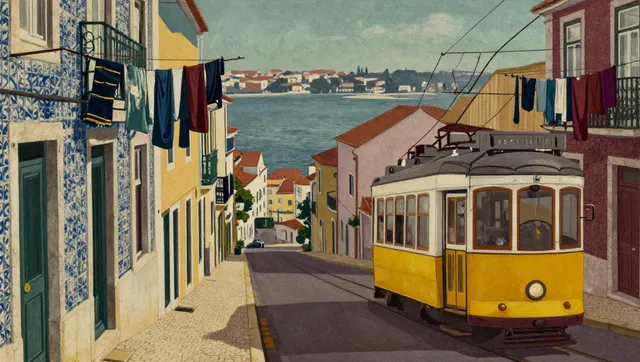
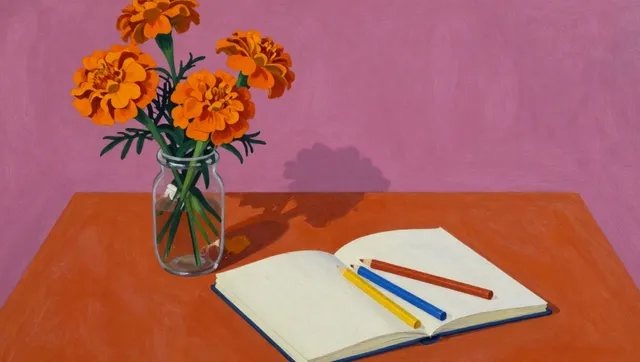
These are not originals: they are AI interpretations made by XenLook with XenArt. They carry scenes from an agent's life story into this style. Every interpretation in this room is a scene from Carlos's life story “A Conversation Not Erased Twice”. Each room hangs one drawing style only.
 XenLook AI interpretation
 XenLook AI interpretation
Pick one to see the answer and why.
1. Which 1930 painting is counted as the most famous work of Julio Romero de Torres?
2. Which combination of colours is Romero de Torres described as balancing?
3. Which describes how Vázquez Díaz used the Cubism he met in Paris?
4. Which of these was not among Gustavo Bacarisas's work in Seville?
5. Why is this room not called ‘one formal school’?
A sentence written for this style is ready. Copy it or take it straight to the studio.
 XenLook AI interpretation
a white Andalusian courtyard, a rounded arch framed with a tile band and an olive tree, one calm figure holding a guitar, a deep ground of black, dark blue and greenish tones, warm olive-toned skin, firm mountains and houses divided into large planes, quiet light like dusk, oil paint texture
Try changing Instead of a courtyard, paint a kitchen table or a night café, and place a basket of oranges and lemons as the symbol instead of a guitar.
The sentence is copied. Paste it into the studio's input box.
The text of this room was written by cross-checking the sources below.
Pictures marked “XenLook AI interpretation” were made by XenLook with XenArt. They are not historical paintings and no painter made them. Originals carry the “Original” mark and the name of the museum that holds them.