Zum Inhalt springen
Museum lobby

History wing · The Americas

Andean Modernism and the Bachué Movement

Bogotá and Medellín, Colombia · mid-1920s to the 1950s · c. 1925 to the 1950s

In the 1920s and 1930s, Colombian sculptors and painters looked at their own land again with the eyes of modern art they had learned in Europe. Bachué, the mother goddess of the Muisca people, women panning gold in rivers, miners and coffee farmers became the main characters. Heavy rounded bodies, bold outlines and ochre and red-earth colours mark the style. This room also shows the pre-Columbian gold and pottery that were its roots.

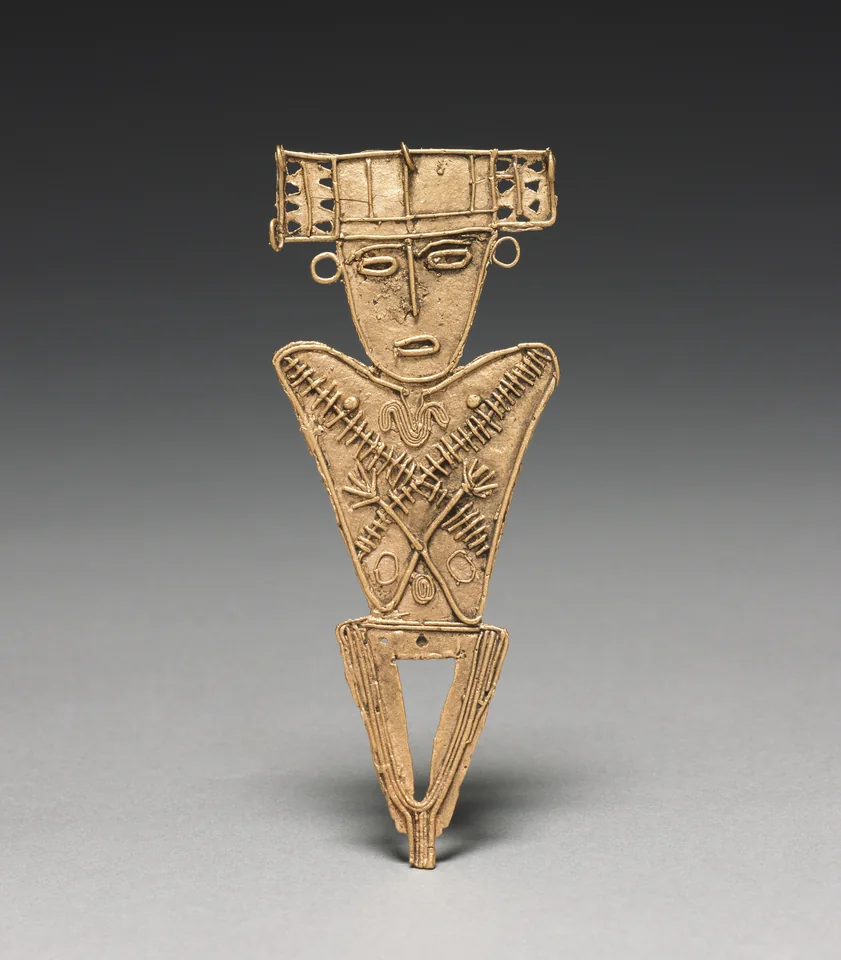
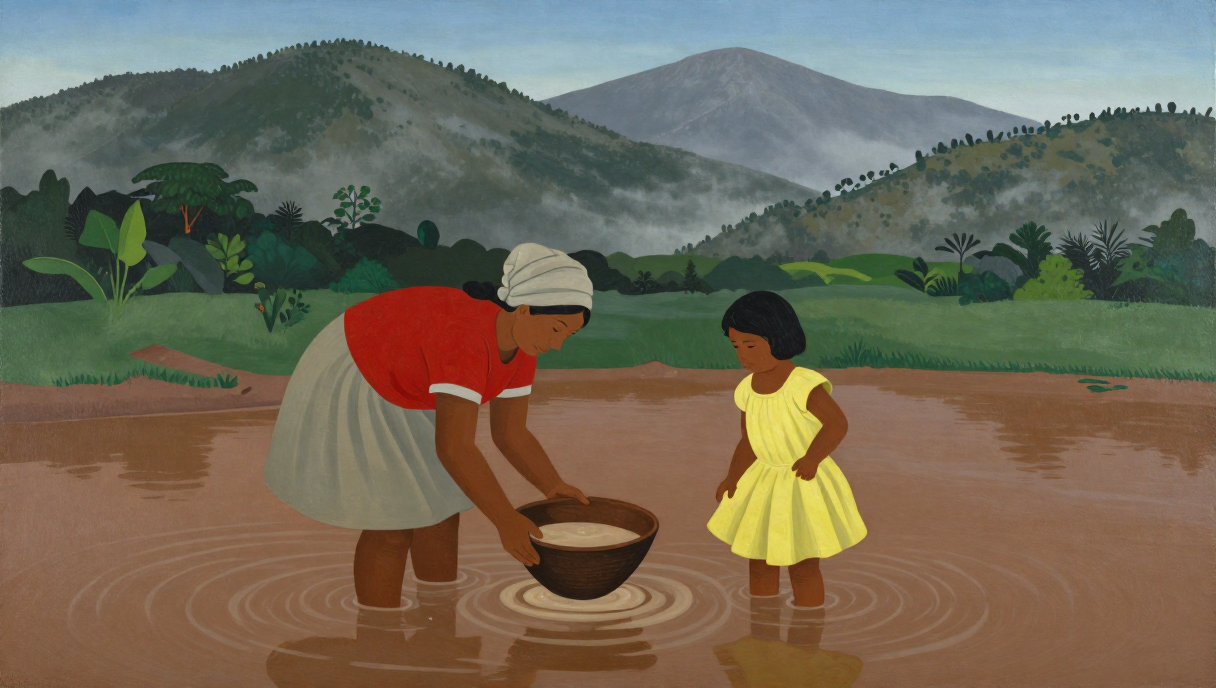
Tunjo (Votive Offering Figurine)OriginalMother panning gold with a bateaXenLook AI interpretation

Docent

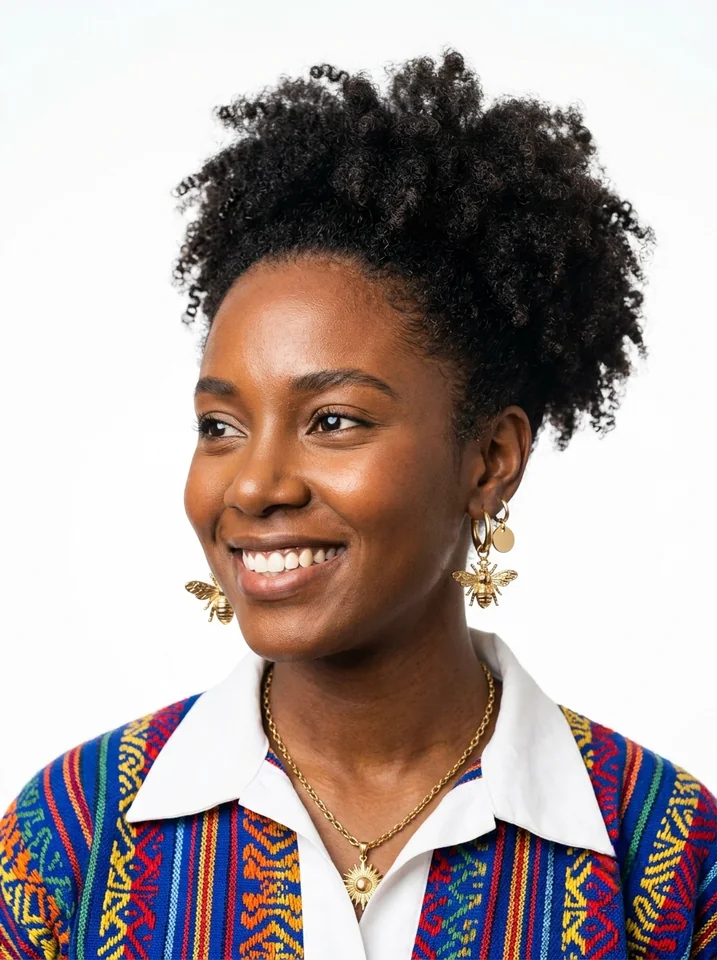
Docent Valentina RíosDocent · Valentina Ríos🇨🇴 Agent from Colombia
Life story “The River Calls Names”

Hello, I am Valentina Ríos. I grew up on the San Juan River in Chocó, Colombia, studied geology, and now work as a counsellor who looks after people’s hearts.

My mother panned river gold with a wooden batea. The painters of this room drew exactly such women, miners and farmers, large and heavy.

Like the gold bee earrings on my ears and the sun pendant on my chest, old gold is still with us. Shall we start with the gold tunjo together?

Roots and history

The story of this room begins with gold. Long before the Spanish arrived, the land that is now Colombia was home to several cultures that worked gold. The leading ones were the Muisca people of the high plateau around Bogotá, the Tairona of the mountains near the Caribbean Sea, and the Calima of the south-western valleys. The Muisca made small gold figures called tunjos and offered them in sacred places such as lakes and caves. Because they were offerings rather than jewellery worn on the body, the rough marks of casting were left unpolished. In the 1920s and 1930s, Colombian artists called these ancient peoples and their myths back as ‘our roots’.

The starting point is the sculptor Rómulo Rozo. Born in Bogotá, he studied sculpture in Madrid and then Paris, and in the mid-1920s in Paris he carved the granite sculpture Bachué. Bachué is the mother goddess revered by the Muisca (Chibcha) people. At the 1929 Ibero-American Exposition in Seville, Spain, Rozo decorated the Colombian pavilion with Chibcha motifs and set Bachué at its centre. Critics at the time pointed out that its forms also leaned on ancient art in the Louvre and on orientalist ornament. Reshaping an indigenous myth with the eye of modern sculpture learned in Europe: that is the character of this style. After Seville the sculpture was lost for a long time, until the art historian Álvaro Medina found it again in the late 1990s.

In June 1930, the Sunday supplement of the Bogotá newspaper El Tiempo printed the Monografía del Bachué. It was a manifesto-like text by a group of young writers and artists, Los Bachués, named after Rozo’s sculpture. Instead of the European academic art taught in schools, they called for a national art that started from the life of ordinary people and from pre-Columbian roots. At the same time, they wanted to keep the door open to new currents from the outside world. In Latin America this current is called indigenismo (indigenism). The group did not last long, and its membership differs a little from source to source. The sculptors Ramón Barba and Hena Rodríguez, and Luis Alberto Acuña, are among the names linked with it.

In Medellín, the painter Pedro Nel Gómez spread this idea in large form across walls. He was trained as a civil engineer at the School of Mines in Medellín. In the mid-1920s he went to Europe and studied art in Florence, Italy, and in 1930 he returned to lead the fine arts school in Medellín. From 1935 to 1938 he painted eleven fresco murals in the city hall of Medellín. Their subjects were the lives of miners, farmers and migrants, as in El barequeo (panning river gold with a batea), Dance of Coffee and The Dead Miner. Around 1949 to 1950, however, the murals were covered up because their nudes were called immoral. Today the building is the Museo de Antioquia, and the murals can be seen again.

Pedro Nel’s student Débora Arango went one step further. Born in Medellín, she studied painting with Eladio Vélez and Pedro Nel in the 1930s, and in the late 1930s her watercolours of female nudes caused a great scandal. It was a time when a woman painting the nude was itself hard to accept. In 1946 she went to Mexico, learned fresco and studied the murals of Orozco. In the years of political violence after 1948, known as La Violencia, she painted sharp satires of politicians and crowds. Her 1955 exhibition in Madrid, Spain, was closed the day after it opened. In the mid-1980s she gave more than 200 works to the Museum of Modern Art of Medellín (MAMM).

In Bogotá, Luis Alberto Acuña held on to Chibcha myth for a long time. He studied in Paris in the 1920s, where he met Rozo, and back home he worked as a painter, sculptor and historian, carrying the gods of myth into paintings and sculptures. By the 1950s a new generation of painters was looking for other paths, and the national realism of the Bachué years was pushed back as ‘the previous generation’. Yet the style did not vanish. Pedro Nel’s house in Medellín became a museum in 1975 and keeps his mural cartoons, and Arango’s face has appeared on the 2,000-peso banknote since 2016. The idea of taking rivers, mines and working bodies seriously still lives on in Colombian art today.


Timeline

  1. c. 900–1550The Muisca make gold tunjos and offer them in lakes and caves, and the Tairona make gold ornaments and pottery.
  2. Mid-1920sRómulo Rozo carves the Muisca mother goddess in granite in Paris as the sculpture Bachué.
  3. 1929At the Ibero-American Exposition in Seville, Rozo decorates the Colombian pavilion with Chibcha motifs and sets Bachué at its centre.
  4. 1930In June the Bachué group’s text appears in El Tiempo. The same year Pedro Nel Gómez returns from Europe to Medellín.
  5. 1935–1938Pedro Nel paints eleven fresco murals on mining, gold panning and coffee in the city hall of Medellín.
  6. Late 1930sDébora Arango wins a prize at a Medellín exhibition and causes a great public scandal with her watercolours of female nudes.
  7. 1946Arango goes to Mexico, learns the fresco technique and studies the murals of Orozco.
  8. c. 1949–1950Pedro Nel’s murals in Medellín city hall are covered because their nudes are called immoral. Today they can be seen in the Museo de Antioquia.
  9. 1955Arango’s exhibition in Madrid is closed the day after it opens; her political satire and nudes were the problem.
  10. 2016Débora Arango’s face appears on Colombia’s new 2,000-peso banknote.

Key painters and workshops

  • Rómulo Rozo1899–1964

    A sculptor from Bogotá. He carved the granite Bachué in Paris and decorated the Colombian pavilion at the 1929 Seville exposition with Chibcha motifs. He moved to Mexico in 1931 and died there.

  • Pedro Nel Gómez1899–1984

    A civil engineer and painter from Anorí, Antioquia. After study in Florence he painted eleven fresco murals in Medellín city hall. Miners and the barequera, the woman who pans river gold, were his lifelong subjects.

  • Débora Arango1907–2005

    A painter from Medellín. Her female nudes and political satire of the La Violencia years met scandal and censorship again and again. With rough lines and sharp colour, an expressionist manner, she pushed this current furthest.

  • Luis Alberto Acuña1904–1993

    Born in Suaita, Santander. He studied in Paris in the 1920s, where he met Rozo, and worked as a painter, sculptor and historian. For many years he treated the gods of Chibcha myth in paintings and sculpture.

Reading the style

How to recognise it

The first key to recognising this style is ‘weight’. The figures are not slender or elegant. Shoulders, arms, hands and feet are large, and the whole body is bound together like a rounded block of stone. Just as the sculptor Rozo carved Bachué in granite, the painters saw people as masses planted firmly on the ground. Faces are drawn as simple forms rather than detailed portraits, with eyes and mouth reduced to a few lines. So they look less like one individual and more like the image of all working people.

The second key is ‘earth colours and labour’. Ochre, red earth, the deep green of mountains and the brown of river water fill the picture. The subjects are women panning gold in rivers with a batea, miners in the mines, coffee farmers and migrating families. In the murals these people line up in bands like a procession, with mountains and rivers laid behind them in overlapping bands. The space is shallow rather than deep, so the figures seem pushed forward towards the wall’s surface.

The third key is ‘old myth joined with the modern’. The Muisca Bachué, serpents and water, and the geometric patterns of gold ornaments appear together with modern simplification. Within the same current, though, the grain differs. Pedro Nel honoured labour with the broad, calm planes of fresco, while Débora Arango accused society with distorted lines and sharp colours. Seeing both faces, celebration and accusation, together makes this room clearer.

What to look for

  • FiguresBodies heavy and round like stone

    The figures’ bodies are bound into rounded masses, and hands and feet are drawn larger than life. Look at a woman bending over her batea or a miner holding a pick: the weight of the body seems to press down on the ground. This heaviness, which began with Rozo’s granite Bachué, passed into painting.

  • ColourOchre and red-earth ground colours

    The colour comes from the earth. Ochre, red earth and the muddy brown of river water form the ground, while the deep green of mountains and the yellow of river gold become accents. The mineral pigments of fresco give soft matt colours, so the effect is calm and solid rather than flashy. Arango added sharp greens and dark reds to this.

  • LineBold outlines and simplified faces

    The outlines are thick and clear, so the forms read even from far away, because murals are pictures looked up at in large halls. Faces are reduced to a few lines for brows, nose and mouth, and hair and clothing folds are bound into big masses. Arango’s line differs: it trembles and distorts, showing emotion roughly.

  • CompositionProcessions of labour in bands

    In the murals, people line up horizontally to form one story. Those panning gold in the river, carrying loads and picking coffee follow one another, showing the whole life of a region. Scenes of many people working together outnumber single heroes, and the figures’ heads are set at similar heights so they read as a band.

  • SpaceShallow stage and layered mountain bands

    The space does not go deep. Figures stand large in front, and behind them mountains and rivers overlap flatly in a few bands. The steep terrain of the Andes works like a stage backdrop. Rather than digging into the distance with perspective, the method pushes the people forward on the wall.

  • SymbolsMuisca myth and gold patterns

    Bachué, the Muisca mother goddess, the Chibcha gods, and the triangles and spirals of pre-Columbian gold ornaments are used as symbols. Rozo covered the Colombian pavilion in Seville with such patterns, and Acuña carried the Chibcha gods into painting and sculpture. The key is reweaving the old into simple modern forms.

  • Ground and textureMatt surface of lime-plaster walls

    Many key works are frescoes painted on wet lime plaster. Because the pigment soaks into the wall and sets, the surface does not shine but stays matt like an earthen wall. The edges of each day’s plaster can remain as faint seams. In the watercolours, the marks of paint bleeding and layering on paper stay visible.

Glossary

Bachué
The mother goddess revered by the Muisca (Chibcha) people. It was the name of Rozo’s sculpture and became the name of the Bachué group in 1930.
Indigenismo (indigenism)
A 20th-century Latin American current in art and thought that tried to make indigenous history and culture the root of the nation.
Muisca / Chibcha
The people who lived on the high plateau around Bogotá. Chibcha is the name of their language family, and the two names are used interchangeably.
Tunjo
A small gold figure the Muisca offered in sacred places such as lakes and caves. Unpolished marks from casting remain on it.
Barequeo / barequera
Barequeo is panning river sand in a bowl to sort out gold, and a barequera is a woman who does it. It was Pedro Nel’s lifelong subject.
Batea
The shallow round wooden bowl used for panning gold. Swirling water and sand leaves only the heavy gold at the bottom.
Fresco
A mural technique of painting with pigment mixed in water on a wet lime-plaster wall. As it dries the colour becomes one with the wall and lasts long.
Cartoon (cartón)
A full-size paper drawing made before painting a mural. Its lines are pricked or pressed to transfer them onto the wall.
La Violencia
The era of political violence that swept Colombia for about ten years from around 1948. Arango denounced it in satirical paintings.
Lost-wax casting
A method of making a wax model, covering it in clay, melting the wax out with heat, and pouring molten gold into the empty space.

The originals up close

Real originals. Press a number to read about that spot; press the picture to see it large.

OriginalCast gold · The Cleveland Museum of Art · Public domain (CC0) · Museum record (Accession 1947.18)

Tunjo (Votive Offering Figurine)

Colombia, Muisca style · c. 900–1550

A flat gold figure a little over 13 cm tall. The Muisca offered tunjos like this in lakes and caves. Since it was not jewellery to be worn, the channels through which the metal flowed and small flaws were left unpolished after lost-wax casting. On its head it wears a rectangular crown pierced with triangles, and thin wire-like lines draw the eyes, mouth and the bands on the body. It shows most directly the Muisca world that Colombian modernists of the 1920s and 1930s looked back to as ‘our roots’.

About the artist · Muisca style, Colombia (maker unknown)

c. 900–1550 · Colombia

The Muisca were the people of the Andean highlands of Colombia, around what is now the capital, Bogotá. No individual maker's name survives, only works by unnamed goldsmiths who made them for their community's beliefs. The small gold figures called tunjos were offered to the gods. They were cast by wrapping a wax model in clay and pouring molten gold in, and their charm lies in simple but forceful lines.

OriginalEarthenware · The Cleveland Museum of Art · Public domain (CC0) · Museum record (Accession 1999.12)

Double-Bat Bowl

Colombia, Tairona · c. 900–1550

Two bat heads are attached in relief to an earthenware bowl a little over 30 cm across. Bat heads with round eyes and bared teeth project at front and back, and wing- or arm-like forms wrap the body at the sides. A geometric pattern of repeated angled lines is incised on the body, and short feet support it below. This bold simplification, in which a useful bowl becomes an animal’s body, shows how powerful pre-Columbian art looks even to modern eyes.

About the artist · Tairona, Colombia (maker unknown)

c. 900–1550 · Colombia

The Tairona lived on the Caribbean coast of northern Colombia, on the slopes of the Sierra Nevada de Santa Marta. Theirs was a culture of towns linked by stone-paved paths, and no individual maker's name survives. Unnamed craftsmen shaped clay into vessels and gold into ornaments. Animals such as bats and birds are reduced to simple, forceful forms, as the bowl and the bird-shaped pendant in this room show.

OriginalCast gold · The Cleveland Museum of Art · Public domain (CC0) · Museum record (Accession 1965.466)

Bird Pendant

Colombia, Tairona · c. 900–1550

A gold bird pendant a little over 8 cm tall. In the centre the beak and head face forward, with curled wings spreading above and a fan-like tail below. Thin gold plates hang at both sides and would have swung and flashed as the body moved. The parts reaching sideways are openwork ornaments that look like twisted gold wire. Unlike the tunjo, it was jewellery worn on the body, so its finish is refined. Its left-right symmetry and geometric order are the sense of form Colombian modernists found in the old gold.

About the artist · Tairona, Colombia (maker unknown)

c. 900–1550 · Colombia

The Tairona lived on the Caribbean coast of northern Colombia, on the slopes of the Sierra Nevada de Santa Marta. Theirs was a culture of towns linked by stone-paved paths, and no individual maker's name survives. Unnamed craftsmen shaped clay into vessels and gold into ornaments. Animals such as bats and birds are reduced to simple, forceful forms, as the bowl and the bird-shaped pendant in this room show.

OriginalHammered gold · The Cleveland Museum of Art · Public domain (CC0) · Museum record (Accession 2015.2)

Pectoral (Chest Ornament)

Colombia, Calima culture (Yotoco period) · 1–800 CE

A large gold chest ornament, or pectoral, a little over 28 cm wide. Gold sheet was hammered thin and pushed from behind so the forms rise. In the centre is a face wearing a nose ornament, with large round ear ornaments at both sides. Around the outer border run rows of small dots raised by hammering from behind, and a band of triangles is incised. The broad gold surface would have caught the light so the whole face seemed to shine. The dignity of this large frontal face is shared with the heavy figures of this room.

About the artist · Calima culture, Colombia (maker unknown)

c. 1–800 CE · Colombia

Calima is an ancient culture that flourished in the Andean valleys of south-western Colombia, and this work belongs to its Yotoco period, about 1–800 CE. No individual maker's name survives, only the skill of unnamed goldsmiths. Their best-known pieces are chest ornaments made by hammering gold into thin sheets and shaping faces and patterns on them, and they are striking for their large size and rich display.

Where to see the originals

The key works of the Bachué movement and Colombian modernism are in Colombia. Pedro Nel Gómez’s murals can be seen in Medellín at the Museo de Antioquia (the former city hall) and the Casa Museo Pedro Nel Gómez, and Débora Arango’s works at the Museum of Modern Art of Medellín (MAMM) and the Museo Nacional de Colombia in Bogotá. Rozo’s Bachué is held by a private foundation. The four works shown here come from the Cleveland Museum of Art’s open collection. They are not modernist works but the ancient Muisca, Tairona and Calima pieces those artists looked back to as their roots.

Learning to look, on an AI interpretation

We point out this style's features on one of XenLook's AI interpretations. It is not a historical painting.

XenLook AI interpretationMade by XenLook with XenArt · not an original · Every interpretation in this room is a scene from Valentina Ríos's life story “The River Calls Names”. Each room hangs one drawing style only.

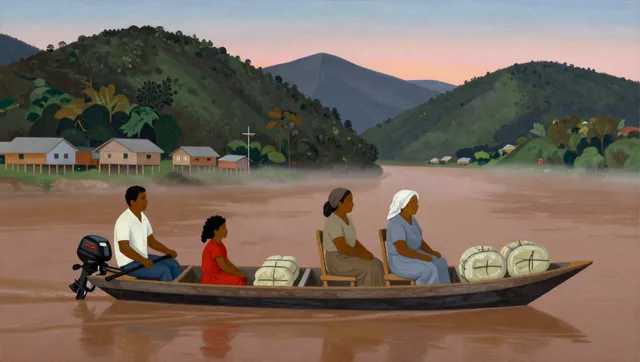
A boat on the San Juan River at dawn

Life story “The River Calls Names”

Materials and technique

Materials

Lime-plaster wall (fresco ground)
Lime and sand mixed into plaster are spread on the wall in several coats. Painting must happen while the last fine coat is wet so the colour soaks in and sets. Pedro Nel’s murals in Medellín city hall use this method.
Mineral pigments
Mineral powders such as ochre, red iron oxide and green earth. They do not change in the strong alkali of lime, so they suit fresco. The earth-toned palette of this room comes from them.
Paper and watercolour
Many of Débora Arango’s works are watercolours on paper. The marks of paint bleeding and overlapping are left as they are, keeping rough, quick emotion alive. Pedro Nel also painted many watercolours.
Canvas and oil paint
Paint mixed in oil is laid on cloth. Smaller than murals and portable, these hung in exhibitions. Several of Arango’s political satires are oil paintings.
Stone and wood (sculpture)
Rozo carved Bachué in hard granite, and Pedro Nel sculpted the barequera in wood and marble. The heavy materials themselves created the weightiness of this style.
Cartoons and transfer tools
Small holes are pricked along the lines of a full-size paper cartoon, and charcoal dust is tapped through to transfer dotted lines onto the wall. Pedro Nel’s house museum in Medellín keeps his cartoons.
Gold and clay (materials of the old roots)
The pre-Columbian works the modernists looked back to were made of gold and clay. Tunjos were cast by lost wax, and the Calima chest ornament was made by hammering gold sheet.

How it was made

  1. Choose the subject and make many small sketches and watercolours while watching people in villages, mines and riversides.
  2. Settle the composition of the whole wall in a small drawing, then enlarge it into a full-size paper cartoon.
  3. Spread rough plaster on the wall, then apply fresh fine plaster only to the part to be painted that day.
  4. Transfer the cartoon’s lines onto the wet wall by pricked holes or pressed marks, fixing the large outlines of the figures.
  5. Paint the mineral pigments mixed in water from the broad areas first, then add bold outlines and shading to build mass.
  6. Finish the day’s share before the plaster dries. Cut away the leftover plaster and continue the next day.

A fresco is one with its wall, so it is hard to move and vulnerable to damp and overpainting. Pictures that were once covered, like Pedro Nel’s murals, needed careful conservation after the coverings were removed. Quicklime harms skin and eyes, so gloves and goggles are worn when handling it.

Colour

Named colours of the style (approximate)

  • Ochre earth#b9773f
    A warm ochre used widely for fresco grounds and the skin of figures. It is the base colour of this style.
  • Red earth#a2452f
    A deep red iron-oxide colour like earth bared by a landslide or the soil of a mine. It carries the weight of land and labour.
  • Andean mountain green#4f6b3a
    The deep green of the mountain bands layered behind. It backs the figures like a stage backdrop.
  • River-water brown#8a6a4a
    The muddy brown of the river where gold is panned. It often fills the lower part of the picture broadly.
  • Tunjo gold#c9a227
    The yellow gold of Muisca gold and of the dust in the batea. It shines as an accent rather than a broad field.
  • Lime-plaster white#e8dfcc
    The warm white of plaster walls, white clothes and white cloth. Like a funeral’s white cloth, it becomes a calm pause.

Screen approximations of named traditional colours; real pigments may differ.

Measured from the originals

Measured from the AI interpretations

Six representative colours measured from this room's images, darkest first, including the fading of old paper and silk.

AI interpretations

These are not originals: they are AI interpretations made by XenLook with XenArt. They carry scenes from an agent's life story into this style. Every interpretation in this room is a scene from Valentina Ríos's life story “The River Calls Names”. Each room hangs one drawing style only.

All interpretations in this style (image library)

Neighbouring styles

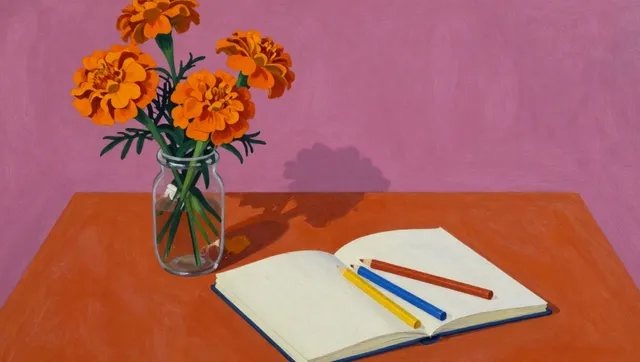
  • Marigolds and a SketchbookXenLook AI interpretation

    Latin American muralism

    Alike
    Both painted the people, labour and indigenous roots large in fresco on the walls of public buildings in the 1920s and 1930s. Bold outlines, heavy bodies and procession-like compositions are alike, and Arango learned directly in Mexico.
    Different
    Mexican muralism was a national project with heavy backing from the revolutionary government, while in Colombia it continued on a smaller scale in regions such as Medellín. Its themes centre on Muisca myth, river gold and mine labour rather than the Aztecs.
    Go to this room
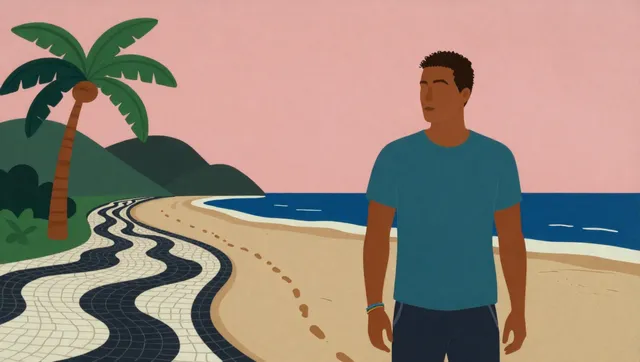
  • Miguel on the beach where the wave-pattern path runsXenLook AI interpretation

    Brazilian modernism

    Alike
    In both, artists who had learned European modern art in the 1920s tried to make ‘our own art’ from their country’s indigenous people, ordinary folk and earth colours. Large rounded figures and simplified forms are also shared.
    Different
    Brazil stands out for bright, strong tropical colour, lively forms and the idea of swallowing and mixing many cultures. Colombia is more solemn, with calm ochre and red-earth colours, the weight of murals and Muisca myth.
    Go to this room

Quiz

Pick one to see the answer and why.

  1. 1. Look at the lower end below the two legs of the Muisca tunjo (1947.18). What remains there?

  2. 2. How are the bats shown on the Tairona Double-Bat Bowl (1999.12)?

  3. 3. How is the outer border of the Calima pectoral (2015.2) decorated?

  4. 4. In the AI interpretation ‘A boat on the San Juan River at dawn’, how is the cargo in the middle of the boat drawn?

  5. 5. What is the most frequent feature of the figures in this room’s paintings and AI interpretations?

Paint it

A sentence written for this style is ready. Copy it or take it straight to the studio.

A boat on the San Juan River at dawnXenLook AI interpretation

A woman and a child panning gold with a round wooden bowl on a tropical riverbank, heavy rounded figures, large hands and simple faces, bold outlines, an earthy palette of ochre, red earth and deep green mountains, layered mountain bands and shallow space, a soft matt surface like a lime-plaster mural

Try changing Swap the gold-panning riverbank for a coffee farm, and put a horizontal procession of farmers carrying baskets in place of the woman.

Paint in the studio

The sentence is copied. Paste it into the studio's input box.

Sources

Every original here was released into the public domain (CC0) by The Cleveland Museum of Art. Artist, title, date and technique follow the museum records, which we checked again with their release terms on 2026-11-24. The commentary is written by XenLook.

Pictures marked “XenLook AI interpretation” were made by XenLook with XenArt. They are not historical paintings and no painter made them. Originals carry the “Original” mark and the name of the museum that holds them.

Als App installieren