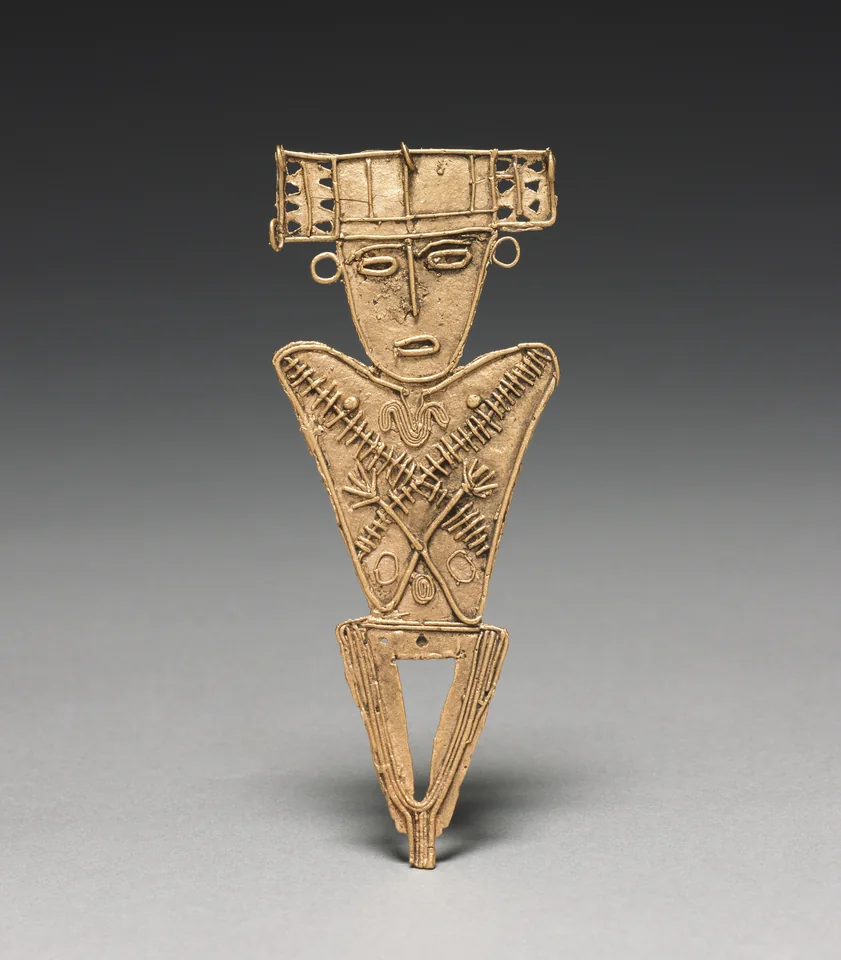
The story of this room begins with gold. Long before the Spanish arrived, the land that is now Colombia was home to several cultures that worked gold. The leading ones were the Muisca people of the high plateau around Bogotá, the Tairona of the mountains near the Caribbean Sea, and the Calima of the south-western valleys. The Muisca made small gold figures called tunjos and offered them in sacred places such as lakes and caves. Because they were offerings rather than jewellery worn on the body, the rough marks of casting were left unpolished. In the 1920s and 1930s, Colombian artists called these ancient peoples and their myths back as ‘our roots’.
The starting point is the sculptor Rómulo Rozo. Born in Bogotá, he studied sculpture in Madrid and then Paris, and in the mid-1920s in Paris he carved the granite sculpture Bachué. Bachué is the mother goddess revered by the Muisca (Chibcha) people. At the 1929 Ibero-American Exposition in Seville, Spain, Rozo decorated the Colombian pavilion with Chibcha motifs and set Bachué at its centre. Critics at the time pointed out that its forms also leaned on ancient art in the Louvre and on orientalist ornament. Reshaping an indigenous myth with the eye of modern sculpture learned in Europe: that is the character of this style. After Seville the sculpture was lost for a long time, until the art historian Álvaro Medina found it again in the late 1990s.
In June 1930, the Sunday supplement of the Bogotá newspaper El Tiempo printed the Monografía del Bachué. It was a manifesto-like text by a group of young writers and artists, Los Bachués, named after Rozo’s sculpture. Instead of the European academic art taught in schools, they called for a national art that started from the life of ordinary people and from pre-Columbian roots. At the same time, they wanted to keep the door open to new currents from the outside world. In Latin America this current is called indigenismo (indigenism). The group did not last long, and its membership differs a little from source to source. The sculptors Ramón Barba and Hena Rodríguez, and Luis Alberto Acuña, are among the names linked with it.
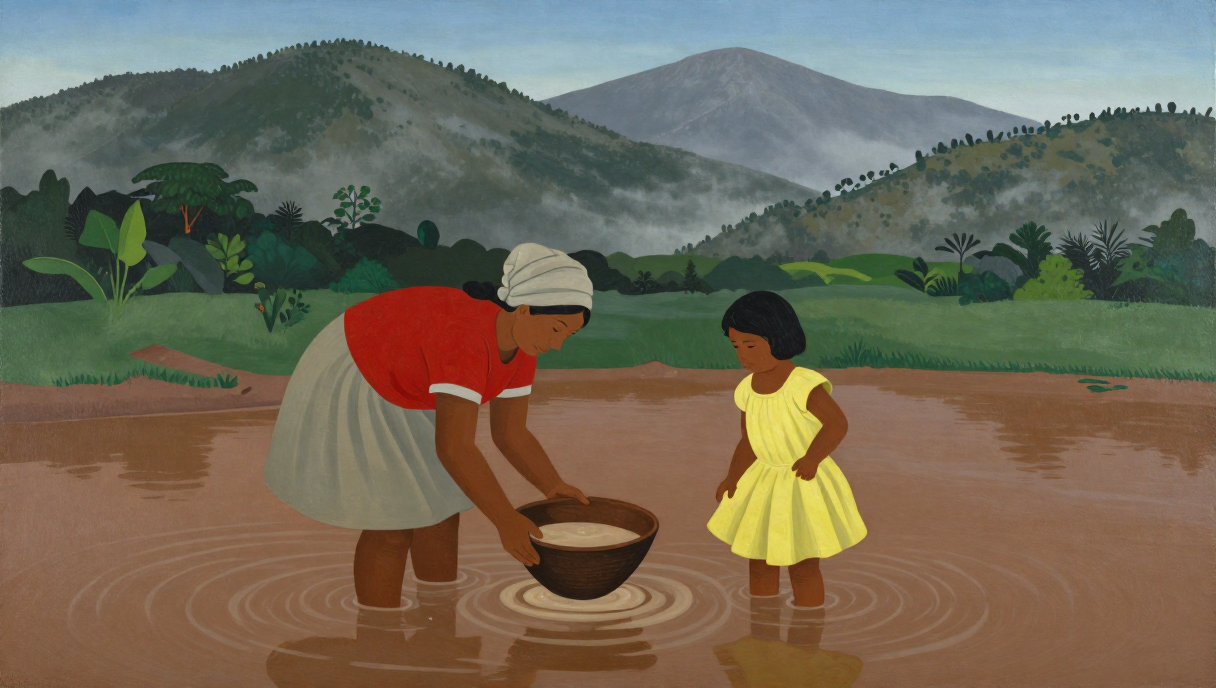
In Medellín, the painter Pedro Nel Gómez spread this idea in large form across walls. He was trained as a civil engineer at the School of Mines in Medellín. In the mid-1920s he went to Europe and studied art in Florence, Italy, and in 1930 he returned to lead the fine arts school in Medellín. From 1935 to 1938 he painted eleven fresco murals in the city hall of Medellín. Their subjects were the lives of miners, farmers and migrants, as in El barequeo (panning river gold with a batea), Dance of Coffee and The Dead Miner. Around 1949 to 1950, however, the murals were covered up because their nudes were called immoral. Today the building is the Museo de Antioquia, and the murals can be seen again.
Pedro Nel’s student Débora Arango went one step further. Born in Medellín, she studied painting with Eladio Vélez and Pedro Nel in the 1930s, and in the late 1930s her watercolours of female nudes caused a great scandal. It was a time when a woman painting the nude was itself hard to accept. In 1946 she went to Mexico, learned fresco and studied the murals of Orozco. In the years of political violence after 1948, known as La Violencia, she painted sharp satires of politicians and crowds. Her 1955 exhibition in Madrid, Spain, was closed the day after it opened. In the mid-1980s she gave more than 200 works to the Museum of Modern Art of Medellín (MAMM).
In Bogotá, Luis Alberto Acuña held on to Chibcha myth for a long time. He studied in Paris in the 1920s, where he met Rozo, and back home he worked as a painter, sculptor and historian, carrying the gods of myth into paintings and sculptures. By the 1950s a new generation of painters was looking for other paths, and the national realism of the Bachué years was pushed back as ‘the previous generation’. Yet the style did not vanish. Pedro Nel’s house in Medellín became a museum in 1975 and keeps his mural cartoons, and Arango’s face has appeared on the 2,000-peso banknote since 2016. The idea of taking rivers, mines and working bodies seriously still lives on in Colombian art today.