Ir para o conteúdo
Museum lobby

History wing · Africa

Asante Narrative Art

Ashanti Region, Ghana · c. 15th to 19th century, and a reading for today · c. 15th to 19th century

The name “Asante Narrative Art” is a label of our own library, and no historical school was ever called by it. What this room studies is the long Asante tradition of putting stories into objects: gold weights that turn proverbs into a pinch of brass, kente cloth whose stripes carry names, and adinkra symbols printed with a stamp. Four real works from the Cleveland Museum of Art stand beside our AI interpretive pictures, so you can learn how a story is carried.

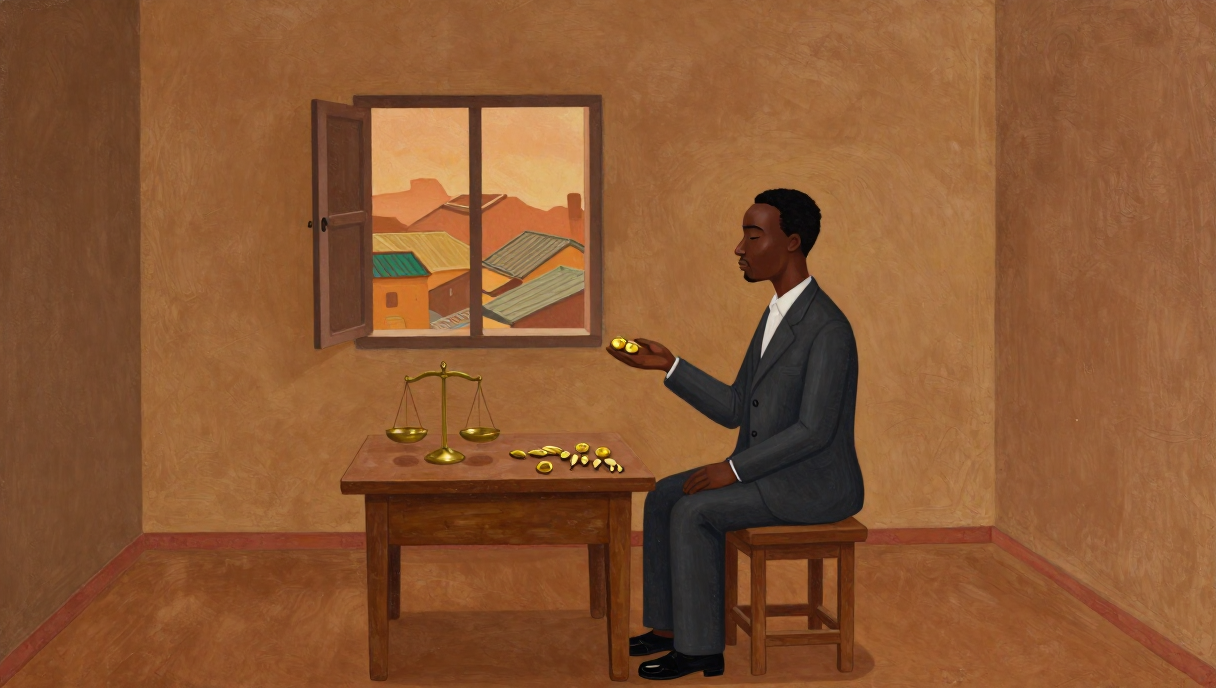
Gold Weight (abrammuo): FishOriginalA man weighing gold by the windowXenLook AI interpretation

Docent

Docent Kofi MensahDocent · Kofi Mensah🇬🇭 Agent from Kumasi, Ghana
Life story “Gold Weight”

I am Kofi Mensah. I was born and raised in Kumasi, and in the army I served as a major who made plans.

As a boy I sat beside my grandfather with a brass scale and small weights, and learned to measure where to stop before anything else.

In this room, let us look slowly together at how a pinch of brass becomes a single line of a proverb.

Roots and history

Let me begin by being honest about the name. “Asante Narrative Art” is a label of this museum's library. Art history has not set out any school that one would call an “Asante narrative school.” Instead, the Asante put their stories into objects rather than onto painting panels: the weights that measure gold, the cloth worn on the body, the stools and ornaments of kings. This room takes that tradition of visual storytelling as its root, and says openly that the scenes we drew are AI interpretive works reading its spirit.

The Asante are an Akan-speaking people who live today around the Ashanti Region of central and southern Ghana, with Kumasi as the central city. The Cleveland Museum of Art explains that the wealth and power of the Asante kingdom came mainly from its abundant gold. Where gold passes from hand to hand like money, weighing exactly is the same thing as credit. To understand why weights, gold ornaments and court textiles were made with such care in this society, one first has to know this bond between gold and trust.

A gold weight is called an abrammuo. A model is made in beeswax and wrapped in clay; when it is fired the wax runs out, and molten brass is poured into the empty space. After cooling, the weight is filed to bring it to the right mass. Wikipedia summarises that these weights were made from about 1400 to about 1900, that early ones were often geometric, and that forms imitating people, animals and buildings appear from about 1600. How many were made is only an estimate, but it is said to run into the millions.

The shape becomes a story because the form of a weight points to an Akan proverb. The Cleveland Museum of Art explains that representational shapes often refer to proverbs, and that using proverbs fittingly marked a wise person. On the scale a weight goes on one side, and gold dust, scooped with a brass spoon, goes on the other. The smallest scales shook in a breeze and were called wind scales, and JSTOR Daily reports that gold falling to the ground went to the state. An object in the palm carried a proverb and a rule together.

Kente is cloth made of narrow strips woven by hand and sewn together. The strips that come off the loom are said to be about four inches (around ten centimetres) wide. Asante oral tradition says kente began in the town of Bonwire, but the accounts differ in who and when, so it cannot be fixed. Wikipedia summarises that in the 18th century, imported silk cloth was unravelled and rewoven, and colourful kente developed. Patterns have names, and the cloth called adweneasa, “my skill is exhausted,” is the most lavish kente, with patterns filling every block that can be filled.

Adinkra are patterns printed on cloth with stamps carved from calabash, dipped in a dark dye made from tree bark. The oldest adinkra cloth to survive was made in 1817 and carries 15 stamped symbols; Thomas Bowdich took it away and it has been in the British Museum since 1818. The oral tradition that the name comes from King Adinkra of Gyaman is widely told, but the war with Gyaman was in 1818–19, so the cloth predates it and doubt remains. That each symbol links to a proverb is the same as with the weights.

At the top of this tradition stands the Golden Stool (sika dwa). According to legend, Okomfo Anokye called it down from the sky before Osei Tutu, and since the stool is the soul of the nation it must never touch the ground. In 1900 the British governor Hodgson demanded to sit on it, which led to the War of the Golden Stool, and in 1921 road workers are said to have stumbled on the hidden stool by chance. Manhyia Palace in Kumasi was built in 1925 by the British after they pulled down the Aban Palace, and the older palace became a museum. Where these objects are now is also part of the story, as when the V&A bought 13 court items after British forces plundered Kumasi in 1874.


Timeline

  1. c. 1400Geometric gold weights begin to be made, according to Wikipedia's summary.
  2. c. 1600Weights in the form of people, animals and buildings appear. The Cleveland Museum of Art says weights were in use since at least 1600.
  3. 17th century (oral tradition)The period in which Asante oral tradition places the start of kente weaving at Bonwire. The oral accounts differ in persons and dates.
  4. 18th centuryImported silk cloth is unravelled and rewoven, and richly coloured kente develops. A record also says a weaving workshop was set up under Opoku Ware I.
  5. 1817Thomas Bowdich visits Kumasi, sees adinkra cloth being made, and takes one cloth away. It is the oldest surviving adinkra cloth.
  6. 4 February 1874British forces plunder Kumasi. The V&A later buys some of the court objects taken then.
  7. 1896–1900Prempeh I is deported in 1896, and in 1900 the British governor demands to sit on the Golden Stool, bringing on the War of the Golden Stool.
  8. 1921Road workers discover the hidden Golden Stool. It regains its place in 1935 when Prempeh II takes the throne.
  9. 1925The British pull down the Aban Palace and build Manhyia Palace. The older palace is now a museum.

Key painters and workshops

  • The goldweight casters15th–19th century

    Almost no names of these craftsmen survive. People who shaped wax models, poured brass and filed the weights to the right mass made millions of weights. Each differs in shape and proverb, and together they can be seen as the largest collection of stories made by unnamed craftsmen.

  • The Kumasi goldsmiths' guild19th century

    The Cleveland Museum of Art's record for the gold disc pendant names its maker as “a member of the goldsmiths' guild.” No personal name is given, but it shows a body of craftsmen who cast or flattened gold for court ornaments.

  • The weavers of BonwireOral tradition of the 17th century to today

    Asante oral tradition says kente began in this town. The accounts differ in persons and dates, so we do not state it as established history, but weavers still make kente in the town today.

  • The adinkra stampers of Ntonso and AsokwaBefore 1817 to today

    Wikipedia reports that in these two areas adinkra cloth is still called ntiamu ntoma, “stamped cloth.” The oldest cloth already existed in 1817, so the stamping culture is older still.

  • Okomfo Anokye (a figure of legend)Legendary, placed in the 17th century

    In oral tradition he is the priest who called the Golden Stool down from the sky. We could not independently verify him as a figure of the written record, so this room introduces him only as a name from legend.

Reading the style

How to recognise it

In this tradition a story lives not in one large picture but in small objects with a use. A gold weight is a tool for weighing and also a proverb; kente is a cloth to wear and also a sentence whose patterns have names; adinkra is a printed cloth and also a code that carries words. So when you look with this room's eyes, ask what is being said before asking whether it is well drawn.

The shapes are simple and the size is small. A gold weight is about as big as one can pinch between thumb and forefinger; Wikipedia likens it to a piece from the board game Monopoly. Into that small size go fish, drums, buildings, and each is a key to a proverb. Kente works the other way round: narrow strips are joined into a large cloth, and the stripes and the repetition of blocks are its rhythm.

Our AI interpretive pictures do not imitate old works. Instead they place the objects that once carried stories, such as scales, brass vessels, kente patterns and gold, into scenes of today, and let those objects lead the meaning of the scene. Please read the pictures in this room with the label “interpretive work,” not “original.”

What to look for

  • FiguresAnimals and people in a palm-sized body

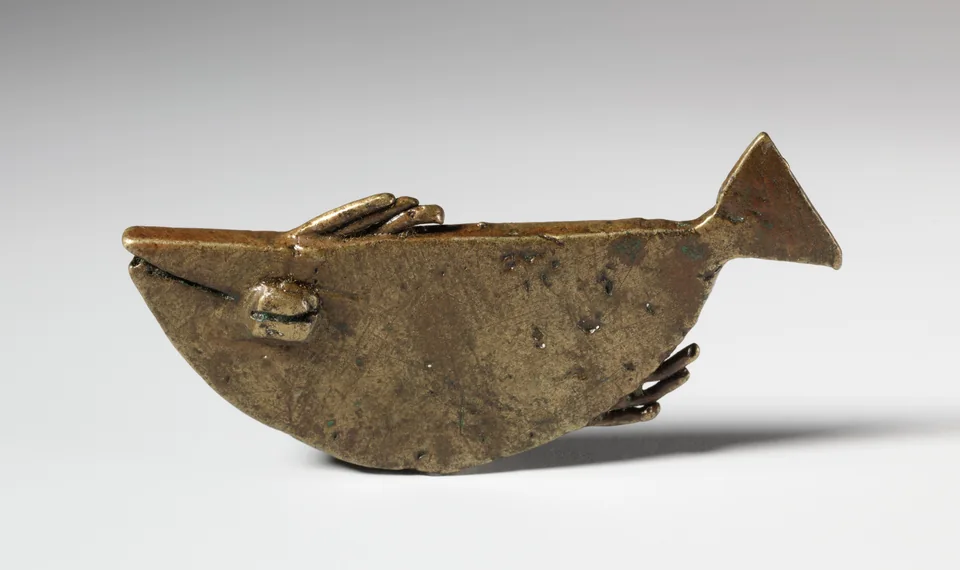
    A weight's figure is too small to draw in all its detail. A fish, for instance, is cut down to a flat body and a fin or two, kept only as much as is needed to recognise it. This reduction makes the shape readable at once and leaves the viewer room to recall the proverb.

  • SymbolsSymbols that use a proverb as a key

    One shape points to one line of a proverb, and only someone who knows the proverb reads its meaning fully. The Cleveland Museum of Art explains that such symbols often refer to proverbs. So even the same fish says different things depending on the agreement between maker and reader.

  • LineSentences made by stripes and stamped lines

    In kente the warp stripes and the weft-patterned blocks, in adinkra the thick stamped lines, work as sentences. The lines carry the small wobble of the hand rather than ruler-straight exactness, and become a trace that lets you feel who made them. The engraved grain of the gold disc pendant is the same kind of hand-made line.

  • ColourGold and the strong colours of woven cloth

    Kente sets red, green, blue, black and gold side by side in strong colour. A reading in which each colour has a meaning is widespread, but the readings are said to differ by weaver and region, so this room does not give a single right answer. The warm light of brass and gold supports these colours.

  • CompositionA modular composition built from joined strips

    Kente is not made as one piece but as narrow strips woven separately and sewn together. The whole cloth is therefore a composition of vertical strips of equal width, and it reads as one even when each strip's pattern differs. In a picture this repetition and variation becomes the weave of the frame.

  • Ground and textureThe surface of cast brass and woven cloth

    A cast weight keeps file marks, the grain of the wax model and small bubble holes on its surface. Kente has the grain of crossing threads. Both surfaces show the order in which they were made, so a picture too is best with a surface in which the maker's hand stays alive.

  • SpaceA space where use comes before perspective

    The objects of this tradition do not hold scenes drawn in perspective. Instead the things linked by use, such as a scale and weights, a spoon and gold dust, are set together in one place and make the space. In a picture, the scale and tools gathered on a table become the meaning of the scene, and the background steps back to support their use.

Glossary

abrammuo
The Akan word for a gold weight. It is cast in brass or bronze and is geometric or modelled on things.
lost-wax casting
A method in which a wax model is wrapped in clay and fired so the wax runs out, and molten metal poured into the empty space gives the shape.
kente
A Ghanaian textile of narrow hand-woven strips sewn together. It uses silk and cotton thread, and strips with different patterns read as one cloth once sewn together.
adweneasa
A kente pattern name meaning “my skill is exhausted.” It is the most lavish type, with weft patterns in every block that can take one.
adinkra
Akan symbols printed with calabash stamps. Each links to a proverb or a value, and they are used on cloth, pottery and stools.
Golden Stool (sika dwa)
The stool held to be the soul of the Asante nation. It must not touch the ground and, on solemn occasions, is set on its own seat at the king's left.
Asantehene
The title of the Asante king. Kofi Karikari, who fled Kumasi in 1874, was an Asantehene.
akrafokɔnmu
A gold disc ornament hung on the chest of high Akan officials. It marks a rank linked to the officials who “wash” the king's soul.

The originals up close

Real originals. Press a number to read about that spot; press the picture to see it large.

OriginalCopper alloy · The Cleveland Museum of Art · Public domain (CC0) · Museum record (Accession 1961.399)

Gold Weight (abrammuo): Fish

Unknown artist · 1800s

A flat fish-shaped weight about 6.6 centimetres long. The Cleveland Museum of Art explains that weights like this had been used since at least 1600 to weigh gold dust and nuggets, that the royal court held the most elaborate store of them, and that commoners often had about a dozen. Which proverb the fish points to is not stated in that record, so we do not claim one here either. What to notice is the skill of reducing the form to a few large masses. The fins and tail are simple triangles, yet it reads at once as a fish.

OriginalBrass · The Cleveland Museum of Art · Public domain (CC0) · Museum record (Accession 1969.266)

Gold Weight (abrammuo): Drum with Jaws of Defeated Enemies

Unknown artist · 1800s

A brass weight 3.6 centimetres high and 5.3 centimetres wide, titled “Drum with Jaws of Defeated Enemies.” A small drum with a handle has a twisted-rope rim around its body, and jaw-like projections stand out at the edges. The Cleveland Museum of Art explains that the forms of such weights often refer to proverbs, but the record does not say which proverb this drum is tied to. What impresses is that the drum's body, rope, holes and projections are all contained in so small an object.

OriginalCopper alloy · The Cleveland Museum of Art · Public domain (CC0) · Museum record (Accession 1969.265)

Gold Weight (abrammuo): Geometric

Unknown artist · 1800s

A geometric weight made only of lines and grooves, without imitating any object. The Cleveland Museum of Art explains that the imagery of the weights falls into two broad kinds, geometric and representational, and Wikipedia summarises that geometric forms are the older. Still, this weight was made in the 1800s, so one should not read it as meaning geometric shapes occurred only long ago. The cross-shaped grooves, the round rim and the slots at the edge speak of shape in a different way from the fish or the drum.

OriginalGold · The Cleveland Museum of Art · Public domain (CC0) · Museum record (Accession 1944.290)

Disk Pendant (akrafokɔnmu)

Unknown artist · 1800s, before 1871 (pin added later)

A gold disc about 7.6 centimetres across. The Cleveland Museum of Art explains that such discs hung on the chests of Akan state officials and elites and showed their rank and duties. The wearers are akrafo, “soul people,” linked to kradware, officials who represent and purify, or “wash,” the king's soul. A member of the goldsmiths' guild cast or flattened it, and it likely drew its form from North African gold coins and its composition from concentric water rings. If a gold weight speaks a proverb, this disc speaks one's duty from the chest.

Learning to look, on an AI interpretation

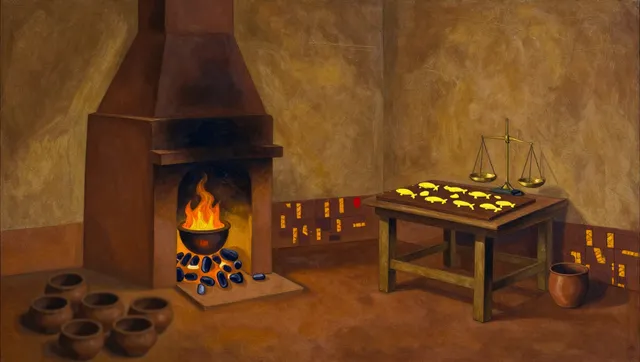
We point out this style's features on one of XenLook's AI interpretations. It is not a historical painting.

XenLook AI interpretationMade by XenLook with XenArt · not an original · Every interpretation in this room is a scene from Kofi Mensah's life story “Gold Weight”. Each room hangs one drawing style only.

A table of gold fish forms by a hearth and clay pots

Life story “Gold Weight”

Materials and technique

Materials

Brass and copper alloy
The main material of a weight. The Cleveland Museum of Art says brass and bronze were used to weigh gold dust and nuggets. Once melted it flows well and fills even the fine parts of a small shape.
Beeswax and clay
The model is shaped in beeswax and wrapped in clay. A hole is left in the clay so the wax can run out when it is fired. The clay mould must be broken after one use, so even the same shape is made one at a time.
Gold dust and the brass spoon
Gold was traded as dust. A weight was put on one side of the scale and gold dust was scooped with a brass spoon onto the other. The smallest scales shook even in the wind and were called wind scales.
Silk and cotton thread
Kente is woven of silk and cotton. In the 18th century imported silk cloth is known to have been unravelled and rewoven. It is a cloth whose thread colour is the pattern colour.
Calabash stamps and bark dye
Adinkra are printed with stamps carved from calabash, dipped in a vegetable-based dark dye. The dye is said to come from tree bark. The 1817 cloth carries 15 symbols printed with such stamps.
Gold
Court ornaments were made by casting gold or by flattening it. The Cleveland Museum of Art explains that its disc pendant likely drew its form from North African gold coins and its composition from concentric water rings.

How it was made

  1. A small model is shaped from beeswax, and a recognisable form such as a fish or a drum is carved into it.
  2. The model is wrapped in clay, and one hole is left at the top for the wax to run out.
  3. When the clay is fired the wax melts and runs out, leaving an empty space of the same shape as the model.
  4. Molten brass or bronze is poured slowly through the hole until it fills every part of the space the wax left.
  5. Once it cools the clay is broken away and the metal weight is taken out. A mould used once cannot be used again.
  6. It is filed to bring it to the set mass. However fine the shape, a weight that is off cannot be used.
  7. The weight goes on one side of the scale, and gold dust is added to the other until the two balance.

Kente and adinkra each have their own order of hand work. Kente strips are woven then sewn together; adinkra is stamped onto cloth and then dried.

Colour

Named colours of the style (approximate)

  • Gold#c8a136
    The warm gold of ornaments and weights. It recalls that the wealth of the Asante kingdom came from gold.
  • Brass#a9772c
    The brass of weights and spoons. It is darker than gold, with a brownish warmth.
  • Kente red#9e2a1f
    A deep red often used in kente. Readings of what each colour means differ by weaver and region.
  • Kente green#2e6b3c
    A deep green that rests the eye between red and gold. It is often read as the colour of plants and growth.
  • Kente blue#2d4f8e
    A blue that gives calm depth. In kente stripes it supports the warm colours.
  • Kente black#1d1a18
    A deep black that firmly sets the edges of patterns. A colour similar to the black dye of adinkra.

Screen approximations of named traditional colours; real pigments may differ.

Measured from the originals

Measured from the AI interpretations

Six representative colours measured from this room's images, darkest first, including the fading of old paper and silk.

AI interpretations

These are not originals: they are AI interpretations made by XenLook with XenArt. They carry scenes from an agent's life story into this style. Every interpretation in this room is a scene from Kofi Mensah's life story “Gold Weight”. Each room hangs one drawing style only.

All interpretations in this style (image library)

Neighbouring styles

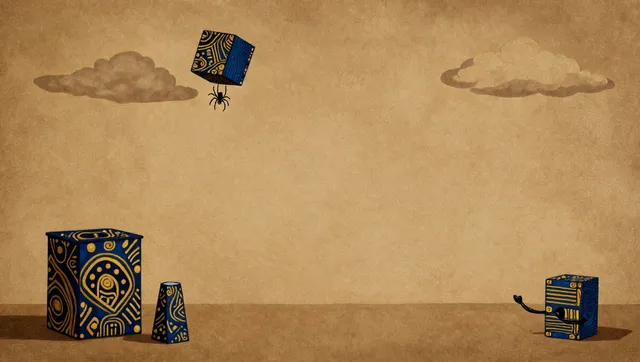
  • The small spider climbs to Nyame’s boxXenLook AI interpretation

    Adinkra

    Alike
    Both come from the symbolic culture of the same Akan people, and one shape points to one proverb or value. They are alike in speaking through signs on small objects and cloth.
    Different
    The Adinkra room puts each stamped symbol at its centre; this room looks at how whole objects with a use, such as weights and kente, carry the story.
    Go to this room
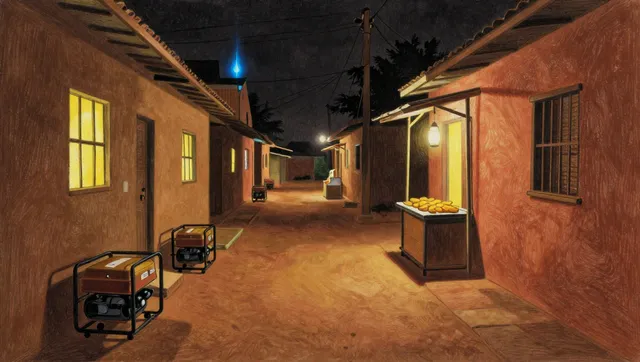
  • Generators and a yellow window in an alley during a power cutXenLook AI interpretation

    Lagos Gouache

    Alike
    Both deal with stories of West Africa's Gulf of Guinea coast, and a place where people work, such as a market or workshop, is at the centre of the scene. Hands handling things lead the story.
    Different
    Lagos Gouache is a lane that paints today's city in opaque watercolour. This room takes as its root the way stories were held in old objects.
    Go to this room

Quiz

Pick one to see the answer and why.

  1. 1. By what method were Asante gold weights made?

  2. 2. According to the Cleveland Museum of Art, what do the shapes of representational weights often refer to?

  3. 3. How is kente cloth made?

  4. 4. When was the oldest surviving adinkra cloth made?

  5. 5. In the legend, which rule holds for the Golden Stool (sika dwa)?

Paint it

A sentence written for this style is ready. Copy it or take it straight to the studio.

A table of gold fish forms by a hearth and clay potsXenLook AI interpretation

A wooden table with a brass scale and small fish-shaped weights, a floor laid with striped kente cloth, warm afternoon light from a window, a deep earthen wall, colours of gold, red and green together, a still life composed at the scale of a palm

Try changing Put a drum- or palm-nut-shaped weight in place of the fish, and change the cloth stripes to ones centred on blue.

Paint in the studio

The sentence is copied. Paste it into the studio's input box.

Sources

Every original here was released into the public domain (CC0) by The Cleveland Museum of Art. Artist, title, date and technique follow the museum records, which we checked again with their release terms on 2026-11-24. The commentary is written by XenLook.

Pictures marked “XenLook AI interpretation” were made by XenLook with XenArt. They are not historical paintings and no painter made them. Originals carry the “Original” mark and the name of the museum that holds them.

Instalar como app