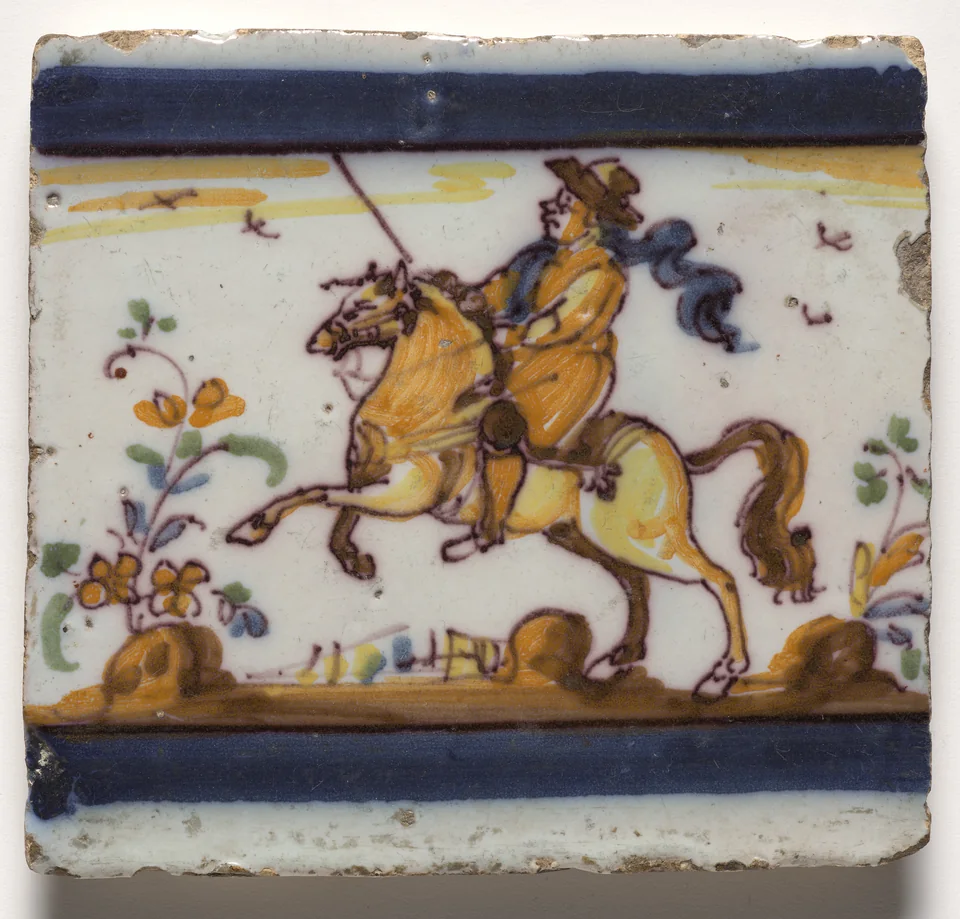
Azulejo is the Iberian art of painting tin-glazed ceramic tiles and covering walls and floors with them. The name comes from the Arabic al-zillīj and is explained as meaning “polished stone”, because the first idea was to imitate Byzantine and Roman mosaics. In Portuguese and Spanish today, azulejo is also the everyday word for any tile. It was ornament with a use as well: tiled walls helped to soften the heat inside a house. This room follows the branch that flowered in Portugal, where tile pictures fill a whole wall with one scene of a story.
From the 13th to the 15th century the centre of such tiles was Seville in Spain. In 1498 the Italian potter Francisco Niculoso settled in Seville, and in the early 16th century Italian potters opened workshops there and brought maiolica, the technique of painting with a brush on a white ground. With it, far more figures and stories could be painted on tiles. King Manuel I of Portugal brought the technique home after a visit to Seville in 1503, and tiles of that time remain in the Arab Room of the Sintra National Palace.
The Portuguese took up the Moorish horror vacui, the fear of empty space, and covered entire walls with tiles. Until the mid-16th century they imported tiles mostly from Spain and, on a smaller scale, from Antwerp in Flanders. Marçal de Matos is counted among the early Portuguese masters, and Susanna and the Elders of 1565 is attributed to him. The Miracle of St Roque (1584) in the Church of São Roque in Lisbon is the first dated Portuguese tile composition, made by Francisco de Matos, probably his nephew and pupil. Both borrowed their designs from Italian and Flemish paintings and prints.
In the 17th century the carpet composition, azulejo de tapete, became hugely popular: one patterned tile repeated until the wall was covered like a rug. It was framed with borders and friezes, sometimes with a scene of Christ or a saint set in the middle, and the Igreja do Salvador in Évora is named among the best examples. Between about 1650 and 1680 the birds-and-branches pattern, aves e ramagens, came into vogue, echoing the flowers and birds of printed textiles imported from India. In the second half of the century the Spanish painter Gabriel del Barco introduced Delft blue-and-white tiles to Portugal, and Amsterdam workshops sent history panels to places such as the Fronteira Palace in Lisbon.
When King Pedro II stopped all tile imports between 1687 and 1698, del Barco's workshop took over production, and the last major delivery from Holland came in 1715. After that, large blue-and-white figurative tiles made in Portugal became the fashion. This period, around the reign of King João V (1706–1750), is called the Cycle of the Masters (Ciclo dos Mestres), and large orders from the colony of Brazil also drove production. The workshop of António de Oliveira Bernardes and his son Policarpo is a leading example, and churches, monasteries and palaces were covered inside and out with Baroque tiles.
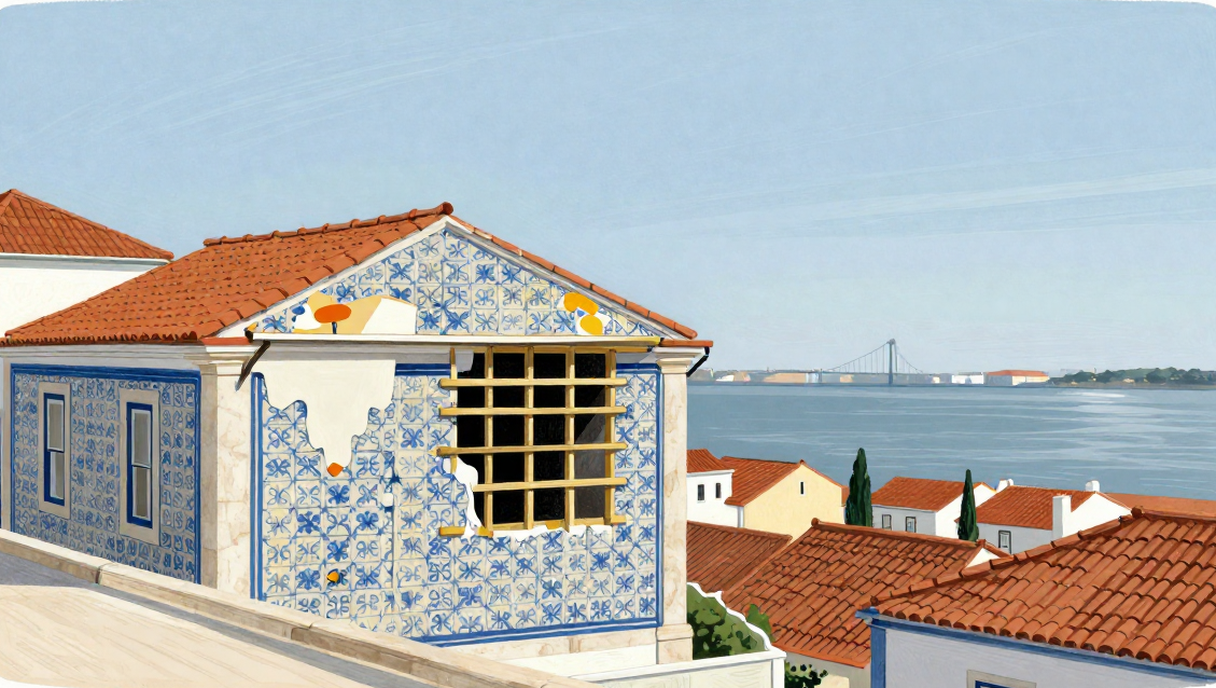
After the great earthquake of 1755, tiles took on a more practical role in rebuilding Lisbon. In this plain Pombaline style, named after the Marquis of Pombal who led the reconstruction, small devotional panels began to appear on buildings as protection against future disasters. Around 1840 immigrant Brazilians started industrial tile production in Porto, and the Brazilian fashion of covering house façades with tiles spread through Portugal. In the 20th century Jorge Colaço filled the vestibule of São Bento station in Porto with about 20,000 tiles, and Maria Keil renewed the art with abstract panels in Lisbon metro stations.