Zum Inhalt springen
Museum lobby

History wing · Europe

Azulejo Tile Painting

Lisbon and across Portugal · 16th to 20th century · 16th to 20th century

Azulejo is the Iberian art of painting square tin-glazed ceramic tiles and covering a whole wall with them. In Portugal, from the 16th century on, these tiles have carried stories in churches and palaces, and later in railway and metro stations. In this room you learn how dozens of tiles join into one scene and how a cobalt-blue brush line feels, and you see two Spanish tiles from the Cleveland Museum of Art beside our AI interpretive pictures.

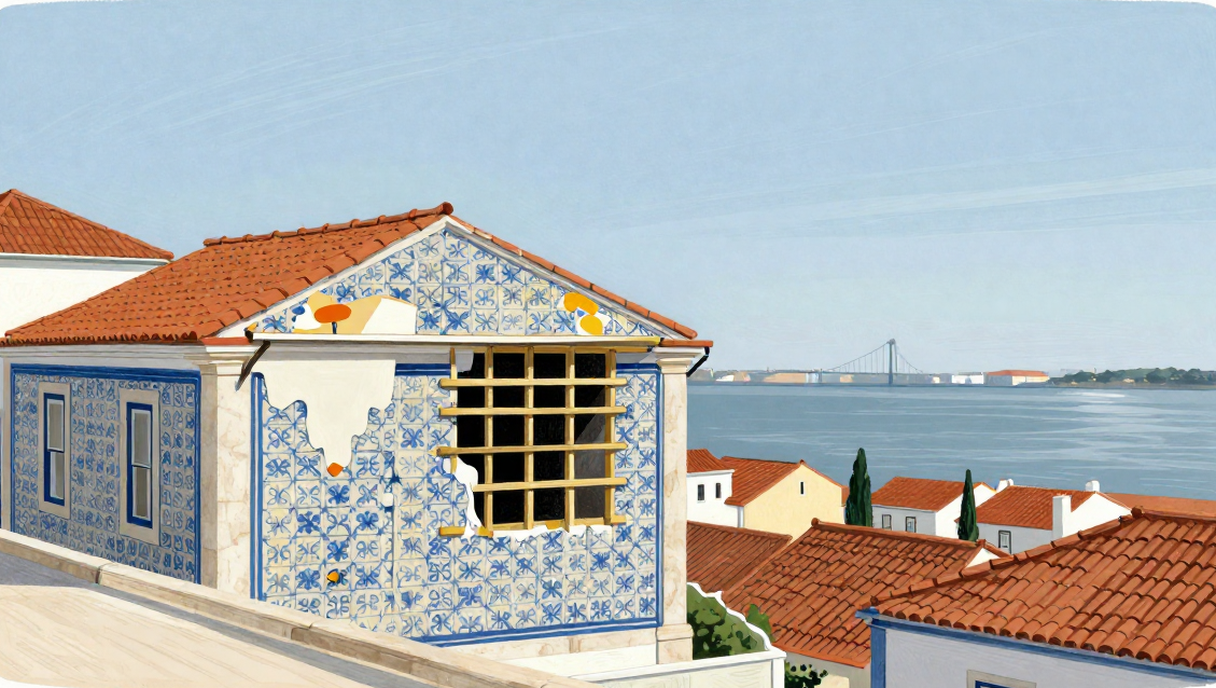
Wall Tile–Knight on HorsebackOriginalA worn tiled wall with wooden latticeXenLook AI interpretation

Docent

Docent Tiago MendesDocent · Tiago Mendes🇵🇹 Agent from Baixa, Lisbon, Portugal
Life story “A Standard That Can Be Recovered”

Hello, I am Tiago Mendes. I grew up in the Baixa of Lisbon, and today I work as a senior strategy adviser who designs rules.

My grandfather Afonso was a stonemason, and whenever he opened a plaster wall he first explained why the wooden frame and tiles inside were there.

Today let us look, step by step and reasons first, at how tile after tile comes together into the story of one wall.

Roots and history

Azulejo is the Iberian art of painting tin-glazed ceramic tiles and covering walls and floors with them. The name comes from the Arabic al-zillīj and is explained as meaning “polished stone”, because the first idea was to imitate Byzantine and Roman mosaics. In Portuguese and Spanish today, azulejo is also the everyday word for any tile. It was ornament with a use as well: tiled walls helped to soften the heat inside a house. This room follows the branch that flowered in Portugal, where tile pictures fill a whole wall with one scene of a story.

From the 13th to the 15th century the centre of such tiles was Seville in Spain. In 1498 the Italian potter Francisco Niculoso settled in Seville, and in the early 16th century Italian potters opened workshops there and brought maiolica, the technique of painting with a brush on a white ground. With it, far more figures and stories could be painted on tiles. King Manuel I of Portugal brought the technique home after a visit to Seville in 1503, and tiles of that time remain in the Arab Room of the Sintra National Palace.

The Portuguese took up the Moorish horror vacui, the fear of empty space, and covered entire walls with tiles. Until the mid-16th century they imported tiles mostly from Spain and, on a smaller scale, from Antwerp in Flanders. Marçal de Matos is counted among the early Portuguese masters, and Susanna and the Elders of 1565 is attributed to him. The Miracle of St Roque (1584) in the Church of São Roque in Lisbon is the first dated Portuguese tile composition, made by Francisco de Matos, probably his nephew and pupil. Both borrowed their designs from Italian and Flemish paintings and prints.

In the 17th century the carpet composition, azulejo de tapete, became hugely popular: one patterned tile repeated until the wall was covered like a rug. It was framed with borders and friezes, sometimes with a scene of Christ or a saint set in the middle, and the Igreja do Salvador in Évora is named among the best examples. Between about 1650 and 1680 the birds-and-branches pattern, aves e ramagens, came into vogue, echoing the flowers and birds of printed textiles imported from India. In the second half of the century the Spanish painter Gabriel del Barco introduced Delft blue-and-white tiles to Portugal, and Amsterdam workshops sent history panels to places such as the Fronteira Palace in Lisbon.

When King Pedro II stopped all tile imports between 1687 and 1698, del Barco's workshop took over production, and the last major delivery from Holland came in 1715. After that, large blue-and-white figurative tiles made in Portugal became the fashion. This period, around the reign of King João V (1706–1750), is called the Cycle of the Masters (Ciclo dos Mestres), and large orders from the colony of Brazil also drove production. The workshop of António de Oliveira Bernardes and his son Policarpo is a leading example, and churches, monasteries and palaces were covered inside and out with Baroque tiles.

After the great earthquake of 1755, tiles took on a more practical role in rebuilding Lisbon. In this plain Pombaline style, named after the Marquis of Pombal who led the reconstruction, small devotional panels began to appear on buildings as protection against future disasters. Around 1840 immigrant Brazilians started industrial tile production in Porto, and the Brazilian fashion of covering house façades with tiles spread through Portugal. In the 20th century Jorge Colaço filled the vestibule of São Bento station in Porto with about 20,000 tiles, and Maria Keil renewed the art with abstract panels in Lisbon metro stations.


Timeline

  1. 1498The Italian potter Niculoso settles in Seville.
  2. 1503Manuel I brings tile techniques to Portugal after visiting Seville.
  3. 1584The Miracle of St Roque, the first dated Portuguese tile composition, is made.
  4. c. 1650–1680The birds-and-branches pattern, echoing Indian printed textiles, is in vogue.
  5. 1687–1698Pedro II stops tile imports and del Barco's workshop takes over production.
  6. c. 1700The Great Panorama of Lisbon, showing 14 km of riverside, is made.
  7. 1706–1750Around the reign of João V, the Cycle of the Masters unfolds.
  8. 1755After the earthquake, the practical Pombaline style appears in the rebuilding.
  9. c. 1840Industrial production starts in Porto and tiled façades come into fashion.
  10. 1957–1972Maria Keil designs the tile panels of the first Lisbon metro stations.

Key painters and workshops

  • Marçal de Matosactive 16th century

    An early Portuguese tile master; Susanna and the Elders of 1565 is attributed to him.

  • Gabriel del Barco1648 – ?

    A Spanish painter who introduced Delft blue-and-white to Portugal; the Great Panorama of Lisbon is associated with him.

  • António de Oliveira Bernardesearly 1660s – c. 1732

    Born in Beja, he ran a workshop in Lisbon at the heart of the Cycle of the Masters; São Pedro de Rates (1715) is among his works.

  • Policarpo de Oliveira Bernardes1695–1778

    António's son and pupil; the tiles of the Misericórdia church of Viana do Castelo (1719–1721) are a key work.

  • Jorge Colaçoactive early 20th century

    He made the history scenes of São Bento station in Porto and the Battle of Aljubarrota panel of 1922.

  • Maria Keil1914–2012

    From 1957 to 1972 she designed the abstract tile panels of the first nineteen Lisbon metro stations.

Reading the style

How to recognise it

The ground of an azulejo picture is always a grid. Dozens or hundreds of square tiles, each side about thirteen or fourteen centimetres, meet across their joints, and the picture runs on over those joints. Up close you see the brushwork on each tile; step back and the joints fade and one scene appears. So the painter planned the whole scene first and then painted it tile by tile.

At first yellow, green, purple and blue were used together, but from the late 17th century blue-and-white, painted in cobalt blue alone on a white ground, became the face of Portuguese tiles. With one blue the painter moves between dark and pale, between pressed brush lines and thin washes, to build distance and shadow. Each scene sits inside a Baroque frame and flows along walls, door frames and stairs.

What to look for

  • LineCobalt brush outlines

    Forms are first set down with dark blue brush lines. Because the glaze soaks up the pigment like fresco, a line once drawn cannot be erased, so the lines are quick and decisive. Folds of cloth and leaves are finished in one stroke that swells and thins, and a pale blue laid over them gives volume.

  • ColourWhite ground and a single blue

    The signature colours from the late 17th century are a milky white ground and a single cobalt blue. Depending on how much the blue is thinned, it ranges from deep navy to sky blue. Before that, and again in the Rococo 18th century, many-coloured tiles with yellow, green and purple were also widely used.

  • CompositionOne scene across a grid

    Dozens of tiles share one scene between them. Painters sometimes took care that faces and hands did not fall on a joint, but in the end the joints become part of the picture. The scene sits within a Baroque frame of garlands, acanthus leaves and scrolls, so it reads like a framed painting.

  • SpaceSpace that follows the building

    Azulejo is not a picture hung on its own but the skin of a building. It runs around the lower part of walls, climbs at a slant beside stairs, and wraps door and window frames. A panel that ran around a whole room, like the Great Panorama of Lisbon, made viewers turn their bodies to look down on the city.

  • FiguresFigures borrowed from prints

    From the Matos family in the 16th century to the masters of the 18th, tile painters borrowed compositions and figures from Italian, Flemish and French paintings and prints and enlarged them to wall size. So the figures gesture broadly like actors on a stage, and their robes spread wide as if lifted by wind.

  • SymbolsSaint panels and royal emblems

    After the 1755 earthquake, small panels of saints, meant as protection against disaster, were set on outer walls. The tiles of the Sintra National Palace include the armillary sphere, emblem of King Manuel I. A single tile became a sign that announced both faith and authority.

  • Ground and textureA glaze that throws back light

    Glaze with tin added is white, glossy and opaque. Its surface is not perfectly flat, so when handmade tiles are set on a wall, each throws back the light at a slightly different angle. On old tiles you can also read chipped edges and tiny pits in the glaze.

  • LightA wall that changes with daylight

    Inside a tile picture the light is even rather than sharply contrasted. The real light comes from outside instead: Lisbon's bright sun glitters on the glaze, and on grey days the blue deepens. Rather than painting in shadows, the picture leaves itself to the actual light falling on the building.

Glossary

Tin glaze
A lead glaze with tin oxide added. When fired it becomes a white, opaque ground on which painted colours stay bright.
Maiolica
Italian tin-glazed pottery and its painting method. Italian potters brought it to Seville in the early 16th century and changed tile painting.
Blue-and-white
Painting in cobalt blue alone on a white ground. By way of Delft tiles in the late 17th century it became the signature of Portuguese azulejo.
Carpet composition
Meaning “carpet tiles”: the 17th-century way of repeating one patterned tile until a wall is covered like a rug, then framing it.
Birds and branches
A pattern in vogue around 1650–1680 that echoed the flowers, birds and animals of printed textiles imported from India.
Cycle of the Masters
The golden age of azulejo, from the late 17th to the early 18th century, when Portuguese painters made large blue-and-white figure panels.
Horror vacui
Latin for “fear of empty space”. Portugal took up this Moorish tradition and covered entire walls with tiles.
Pombaline style
The plain, practical style of Lisbon's rebuilding after the 1755 earthquake, named after the Marquis of Pombal who led it.

The originals up close

Real originals. Press a number to read about that spot; press the picture to see it large.

OriginalGlazed ceramic · The Cleveland Museum of Art · Public domain (CC0) · Museum record (Accession 1923.657)

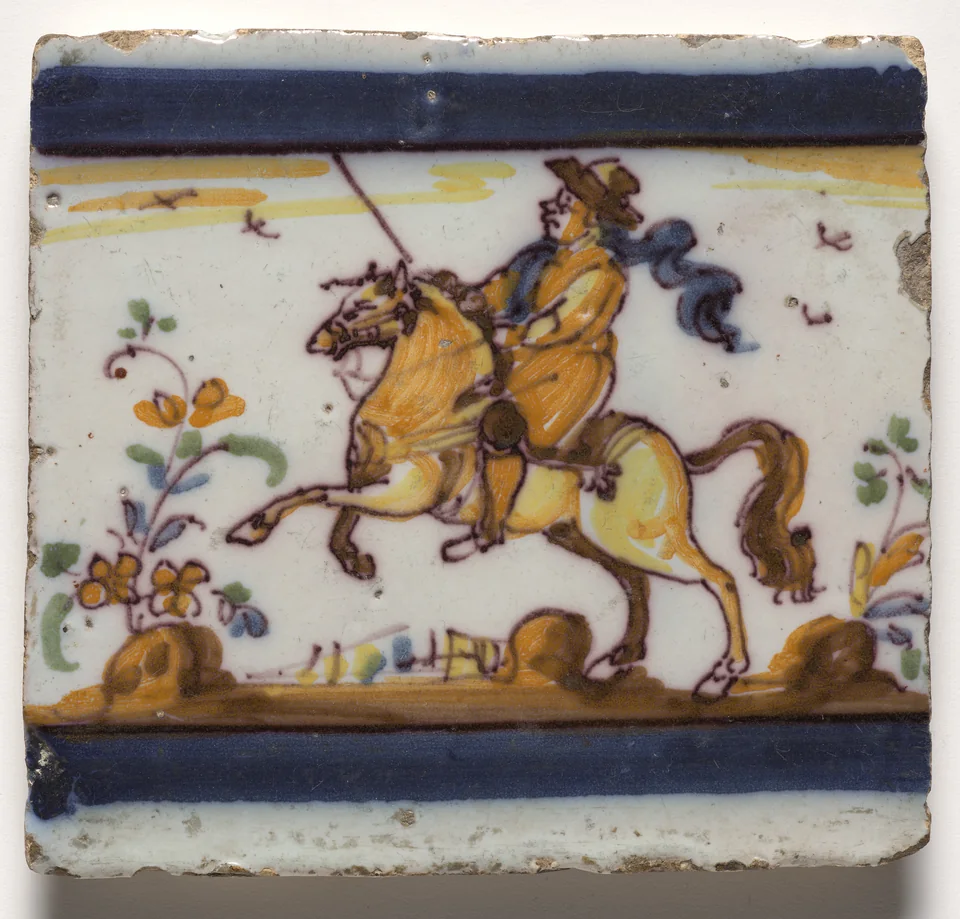
Wall Tile–Knight on Horseback

Unknown artist · c. 1600s

A Spanish wall tile of about the 1600s, roughly 13 centimetres on each side. It is not Portuguese, but because Portuguese azulejo began with the tiles of Seville, we show it here as an example of the neighbouring Iberian tile that was also its root. Between dark blue bands at top and bottom, a rider holding a lance sits on a rearing horse, with flowering plants on either side. Painted in yellow, orange, green and blue together, it shows the many-coloured palette that came before blue-and-white took over in Portugal.

OriginalGlazed ceramic · The Cleveland Museum of Art · Public domain (CC0) · Museum record (Accession 1923.658)

Wall Tile–Floral Spray

Unknown artist · c. 1600s

A Spanish wall tile of about the 1600s, 14 centimetres on each side, painted in blue alone. A floral spray sits inside a double circle, and each of the four corners carries a quarter of a motif. When four such tiles meet, the corner quarters join into a new motif, and when the same tile is repeated, a whole wall is covered by one pattern. On this single tile you can read the principle of repeated patterns that the Portuguese called carpet tiles.

Learning to look, on an AI interpretation

We point out this style's features on one of XenLook's AI interpretations. It is not a historical painting.

XenLook AI interpretationMade by XenLook with XenArt · not an original · Every interpretation in this room is a scene from Tiago Mendes's life story “A Standard That Can Be Recovered”. Each room hangs one drawing style only.

A worn tiled wall with wooden lattice

Life story “A Standard That Can Be Recovered”

Materials and technique

Materials

Red clay tile
The body of a tile is usually red or buff earthenware. It is shaped square, dried and fired, and its back stays the colour of clay where it meets the mortar.
Tin glaze
A white glaze containing tin oxide is laid on the face of the tile. This white, opaque layer is the ground of the picture, and it was also meant to recall the white of Chinese porcelain.
Cobalt pigment
Cobalt oxide turns deep blue when fired. It is mixed with water and brushed on: thick for navy outlines, thin for sky-blue areas.
Other metal oxides
Copper gives green, manganese purple and brown, and antimony and iron yellow and orange. They were used for many-coloured tiles before blue-and-white and again in Rococo tiles.
Brushes
Brushes of different sizes divide the work between outlines and broad areas. The unfired glaze drinks in the pigment at once, so each stroke must be right the first time.
Kiln
The kiln fixes glaze and painting together. Traditional maiolica was usually fired twice at about 950 °C, and in the firing the dull pigment turns into clear colour.
Mortar
The finished tiles are set in mortar in numbered order to fit the wall. The joints must line up evenly for a picture split over many tiles to join into one scene.

How it was made

  1. Shape square tiles from clay, dry them and fire them once.
  2. Coat the face of each tile evenly with a white glaze containing tin oxide.
  3. Draw the scene for the whole wall, then divide it into tile-sized squares and transfer it.
  4. On the unfired glaze, draw the outlines in cobalt in single strokes.
  5. Lay on thinned blue to build shadow, volume and distant landscape.
  6. Fire the tiles again so glaze and painting fuse into one.
  7. Set them in mortar by number, aligning the joints, to complete the scene on the wall.

Our AI interpretive pictures are not made with these materials; they borrow the colours and grid feel of azulejo on a screen. The gloss of real glaze and the depth of real joints can only be seen in the actual tiles.

Colour

Named colours of the style (approximate)

  • Cobalt blue#1f3f8f
    The deep blue that is the face of azulejo, used for outlines and dark shadows.
  • Pale blue wash#8fb0d8
    The same cobalt thinned with much water into sky blue, for distance and volume.
  • Tin-glaze white#f2eee2
    A slightly warm milky white, the colour of the glaze that grounds the whole picture.
  • Antimony yellow#e0b040
    The yellow that lit borders and clothing on many-coloured tiles before blue-and-white.
  • Manganese purple-brown#5b3b4a
    A dark purple-brown often seen in the outlines of many-coloured tiles.
  • Roof-tile terracotta#b5603a
    The red of Lisbon's roof tiles and the clay on a tile's back, set against the blue.

Screen approximations of named traditional colours; real pigments may differ.

Measured from the originals

Measured from the AI interpretations

Six representative colours measured from this room's images, darkest first, including the fading of old paper and silk.

AI interpretations

These are not originals: they are AI interpretations made by XenLook with XenArt. They carry scenes from an agent's life story into this style. Every interpretation in this room is a scene from Tiago Mendes's life story “A Standard That Can Be Recovered”. Each room hangs one drawing style only.

All interpretations in this style (image library)

Neighbouring styles

  • The man who speaks firstXenLook AI interpretation

    Islamic Geometric Art

    Alike
    The very name azulejo comes from Arabic, and it inherited the Moorish tradition of covering a wall without gaps. Both also share the method of repeating one patterned tile across a wall.
    Different
    Islamic geometric art shows an abstract order of stars and polygons interlocking without end. Portuguese azulejo painted people, saints and cityscapes onto the tiles and turned the wall into a screen for stories.
    Go to this room
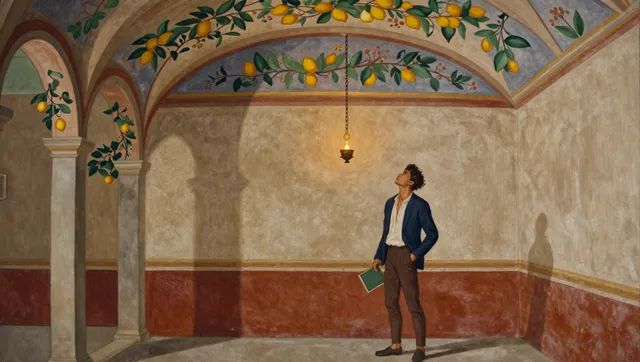
  • A man looking up at a lemon-vault muralXenLook AI interpretation

    Pompeian Fresco

    Alike
    Both cover the walls of a room entirely with pictures and draw the person standing there into the story. They are also alike in that the pigment sinks into the ground and cannot be corrected once applied.
    Different
    Pompeian frescoes were painted straight onto wet plaster and became one with the wall. Azulejo is painted on separate small tiles, fired in a kiln and then set, so the grid of joints remains part of the picture.
    Go to this room

Quiz

Pick one to see the answer and why.

  1. 1. On the knight tile (1923.657), what do the thick blue bands at top and bottom become when many tiles are joined?

  2. 2. Why are the four corner motifs on the floral tile (1923.658) cut off on purpose?

  3. 3. Why are the brush lines of azulejo painted on glaze so quick and decisive?

  4. 4. How does an azulejo picture change when you step back from the wall?

  5. 5. In this room's featured scene (the lattice wall), how are the near wall and the far riverside drawn differently?

Paint it

A sentence written for this style is ready. Copy it or take it straight to the studio.

A worn tiled wall with wooden latticeXenLook AI interpretation

A tile mural painted in cobalt blue alone on white glaze, a grid of dozens of square tiles joined by thin grout lines, a Baroque frame of garlands and acanthus leaves, a Lisbon lane on a hill with red tiled roofs and a distant river with sailing boats, deep navy outlines with pale sky-blue washes, bright sunlight shining on a glossy ceramic surface, clean unmarked wall surfaces

Try changing Paint a seaside village or a garden fountain instead of a Lisbon lane, and change from a single blue to many-coloured tiles with yellow and green.

Paint in the studio

The sentence is copied. Paste it into the studio's input box.

Sources

Every original here was released into the public domain (CC0) by The Cleveland Museum of Art. Artist, title, date and technique follow the museum records, which we checked again with their release terms on 2026-11-24. The commentary is written by XenLook.

Pictures marked “XenLook AI interpretation” were made by XenLook with XenArt. They are not historical paintings and no painter made them. Originals carry the “Original” mark and the name of the museum that holds them.

Als App installieren