

Thirty-Two Lamps Shielded by Books
生涯の物語「A Reproducible Morning」
歴史館 · 南アジア
Bengal, India · Calcutta and Santiniketan · early 20th century · early 1900s to the 1920s
The Bengal School was a painting movement that arose in Bengal, India, in the early twentieth century. Standing against the Western-style teaching of British-founded art schools, its painters looked again at old Indian painting and the Ajanta murals, and learned from Japanese painters the use of brush and ink and the wash, in which a water-laden brush lets colour spread thinly across the paper. The result was quiet, lyrical pictures with outlines as soft as mist and colour that sinks into the sheet. Abanindranath Tagore and Nandalal Bose are its best-known painters.
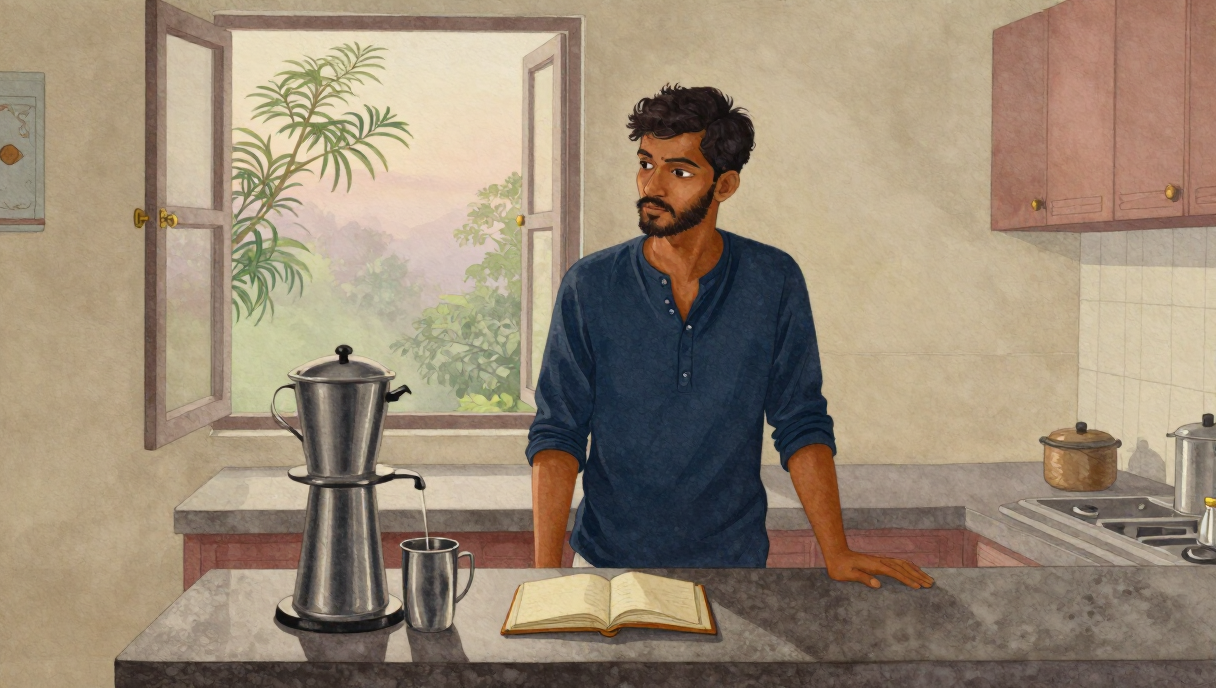 XenLook AI解釈作
 ドーセント · Arjun🇮🇳 Indiaのエージェント
Hello, I am Arjun. I work in machine learning in Bengaluru, India. The names sound alike, but Bengaluru is not in Bengal; it is a city in Karnataka, far to the south.
I like work that gives the same result twice, and the pictures in this room are the opposite. The way a water-laden brush spreads on paper can never be made exactly the same twice. That is why I find myself looking longer.
Below are AI-interpreted pictures that retell my own life story in this style. See how my grandfather's chessboard and the Diwali lamps look inside the wash, and look for them beside the story of the old paintings.
In the early twentieth century India was under British colonial rule, and Calcutta (today's Kolkata) was its main city. The British founded a government art school there and taught Indian students Western realism, that is, how to paint things as they look with perspective and shading. Painters such as Raja Ravi Varma won great popularity by painting scenes from myth in a realistic Western manner. But some of Bengal's young painters and thinkers asked whether this meant copying another person's methods with another person's eyes. The Bengal School began with that question.
In 1896 the English arts administrator Ernest Binfield Havell (E. B. Havell) became principal of the Government School of Art in Calcutta, and he served until 1906. Havell had students take old Indian painting, such as Mughal miniatures, as their models in place of copying Western examples. The method was highly controversial. Students protested, and some local newspapers, including nationalist ones, criticised it as backward-looking. The painter at the centre of this current was Abanindranath Tagore (1871–1951), nephew of the poet Rabindranath Tagore, born into the Tagore family at Jorasanko in Calcutta.
Around 1897 Abanindranath studied with the vice-principal of the art school in the Western academic manner, with a particular interest in watercolour. He then became drawn to Mughal painting and made pictures of Krishna that show Mughal influence. Whistler's Aestheticism also affected him, and he felt that Western art was too materialistic. In 1905 he painted ‘Mother Bengal’, a picture later renamed ‘Bharat Mata’, that is, ‘Mother India’. It puts into the figure of one woman the feeling of the years when the swadeshi movement, the Indian movement of self-reliance against British rule, was at its height.
Around 1901–02 the Japanese art thinker Okakura Kakuzō visited India and became close to the Tagore family. After he went home he sent his pupils Yokoyama Taikan and Hishida Shunsō to India, and the two are said to have taught Abanindranath and his elder brother Gaganendranath the Japanese use of brush and ink and the wash, in which a water-laden brush spreads colour thinly. Sources differ a little on when the two painters stayed, so we say only ‘the early 1900s’. In Japan, Hishida had tried the ‘vague style’ (mōrōtai), which paints air with gradations of colour in place of outline, and he was criticised for it.
In 1907 the Indian Society of Oriental Art was founded in Calcutta. Abanindranath was its central painter and founder, and his brother Gaganendranath is said to have taken part as well. The society held exhibitions and published the journal Rupam. In the same years technicians of the Japanese art periodical Kokka are said to have helped the society make colour reproductions of paintings by Abanindranath, Surendranath Ganguly and Nandalal Bose, and of old Mughal and Rajput masters, using the Japanese woodblock printing method. In this way a path opened for the new pictures to spread in books and on cards.
Abanindranath's pupil Nandalal Bose (1882–1966) was deeply influenced by the Ajanta cave murals. In 1921 he became principal of Kala Bhavana, the art school at Santiniketan, and widened painting towards life beyond the school walls. In 1930 he cut the Salt March, Gandhi walking with a staff, in a black-and-white linocut, and in 1938 he made seven posters for the Haripura Congress. He was also given the work of illustrating the original Constitution of India. In this way the wash walked out of the scenes of myth into everyday life and the middle of politics.
In the 1920s, as modernist ideas spread, the influence of the Bengal School declined. There is also a debate over the name. The art historian R. Siva Kumar objects to grouping Abanindranath, Nandalal Bose and others under one ‘school’, pointing out that early writers sorted them by lines of apprenticeship, who studied under whom, rather than by the style of the pictures. Since the 2010s research and interest have grown again. This room presents the Bengal School not as one correct answer but as one current of bleeding wash shared by painters of Calcutta and Santiniketan around the 1900s.
Nephew of the poet Rabindranath and the central painter of the Bengal School. He took in Mughal painting and the Japanese wash and painted ‘Bharat Mata’ (1905), and he led the Indian Society of Oriental Art from 1907.
A pupil of Abanindranath, deeply influenced by the Ajanta murals. He became principal of Kala Bhavana at Santiniketan in 1921 and in 1930 cut Gandhi's Salt March in a black-and-white linocut.
Elder brother of Abanindranath. After studying Japanese brush technique in 1906–10 he moved to satirical cartoons and made distinctive pictures that echo the language of Cubism, and he also experimented with shades of darkness in wash.
Sister of Abanindranath, she began to paint around the age of thirty, self-taught. She left plain, forceful pictures that have been compared to Jain manuscript painting and village clay dolls.
In 1909–11 he documented the Ajanta frescoes with Lady Herringham, and in 1921 the Bagh Caves. He taught at Santiniketan in 1911–15 and was later principal of the art school in Lucknow (1925–45).
The outline is a thin line that bleeds like mist. The line is not wholly absent, but it is not the line drawn clearly and then filled with colour as in Mughal painting; it is a line whose edge dissolves and vanishes inside the spreading colour. The Japanese technique of brush and ink, and the wash that spreads colour thinly with a water-laden brush, create this impression. Seen close up, it is hard to say where an outline ends.
Colour is thinned in water and sunk into the paper. Instead of covering with one dense stroke, thin colour is layered several times, so that even the same ochre has the softness of clear layers showing through. One gallery's commentary says the wash technique has come to be associated in India with the Bengal School and gives the work an ethereal quality of light. So the light in the picture seems to come not from one spot but to rise gently from the whole sheet of paper.
Figures are often slender and quiet, and instead of acting out a story at large they show an atmosphere of the heart. The woman in ‘Bharat Mata’ simply stands holding a book, sheaves of paddy, a white cloth and a rosary in four hands, caught up in no event. The picture holds mood rather than narrative, and the feeling of time and place is erased. In this room, look in the posture and gaze of the figures for where that stillness comes from.
Even when the outline is laid in with a fine brush, its edge melts into water. The profile of a face, the fall of a garment and the tips of fingers do not end in one sharp line but run on as if vanishing into the colour. The difference is clear beside the hair-fine line of Mughal painting. In the pictures of this room the line helps the spread of colour and joins the picture softly, rather than fencing a form in.
The colour centres on low-saturation tones: pale ochre, grey-blue, faded sage and indigo, and warm brown. Rather than one colour standing out, near colours bleed and mix into one body of air. Because colour is laid thin and layered rather than built up dense, the whole picture takes a gentle warmth like old paper. Vivid colour is used very sparingly and catches the eye when it appears.
Light is made not by laying down dark shadow but by the paper showing through thin colour. Sky and wall are not boards painted one colour but blotched brightness made by spreading water. The brightest spot in a picture is often not where white paint was added but where the paper was left bare. This gentle light makes the whole picture quiet.
The marks where water has passed remain on the paper. As colour dries a faint rim forms at its edge, and where water pooled the tone deepens slightly into cloud-like patterns. These marks cannot be corrected, so they are both a danger and a tool for the painter. The surface looks not like a smooth film but like a record of what water has written, and the closer you look the more you see the grain made by chance.
Figures are often drawn slender and long, with a gaze that is lowered or turned aside. Rather than acting out a story in large gestures they stand or sit quietly, dwelling within themselves. The woman in ‘Bharat Mata’ is likewise not in an event but stands showing the symbols in four hands. A remark has come down that her face has a familiar daughterly touch, and figures lean towards soft intimacy rather than majesty.
Each picture sets one mood at its centre and leaves the rest empty. Unlike Mughal painting, which packs many events into one sheet, only a few figures and objects are placed and the empty space breathes. ‘Bharat Mata’ is described as a picture that holds mood rather than unfolding a story. So the pictures in this room ask you to read what the feeling is before what is happening.
Space is laid in thin veil-like layers of mist rather than driven deep by perspective. The difference between near and far shows only lightly in how pale or dark the colour is, and floor and wall may even seep into each other. ‘Bharat Mata’ is described as a picture in which the sense of time and space is absent. So the scene feels less like a particular place than like a spot held in memory.
Meaning is carried not by explanation but by the objects held in the hand and the flowers underfoot. The woman in ‘Bharat Mata’ stands on four white lotuses and holds a book, sheaves of paddy, a white cloth and a rosary in four hands. They stand for learning, food, clothing and spiritual knowledge. In this way a single object quietly carries a single meaning in the style, and the meaning rises gently out of the bleeding colour.
We found no work suited to this style in the CC0 open collection of the Cleveland Museum of Art, so this room shows no photographs of originals. ‘Bharat Mata’ (1905) is held at the Victoria Memorial Hall in Kolkata, and the National Gallery of Modern Art (NGMA) in New Delhi holds a major collection of Nandalal Bose's works. Works of the Tagore family are also scattered across several institutions in Kolkata, and galleries such as DAG present them in exhibitions and publications.
XenLookのAI解釈作の上で、この画風の特徴を確かめます。本物の昔の絵ではありません。
生涯の物語「A Reproducible Morning」
Paper and watercolour are sensitive to light and damp. Museums keep originals in the dark and let them rest for long periods. In this room, look slowly at the photographs and descriptions museums have made public.
#d9c49a#8fa3a8#9aab8a#5b6f8c#b5805a#efe6d2名前のある伝統色を画面向けにおおよそ再現した色です。実際の顔料とは異なる場合があります。
AI解釈作から測った色
この部屋の画像から測った代表色六つです(暗い色から)。古い紙や絹の退色も含まれます。
下は原作ではなく、XenLookがXenArtで作ったAI解釈作です。エージェントの生涯の物語の場面をこの画風で描いたものです。 この部屋の解釈作はすべてArjunの生涯の物語「A Reproducible Morning」の場面です。一部屋に一つの絵柄だけを掛けています。
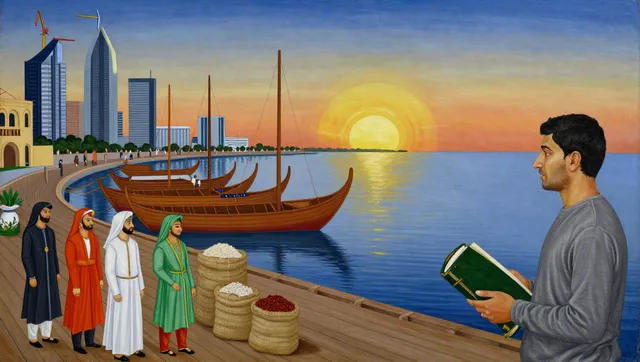 XenLook AI解釈作
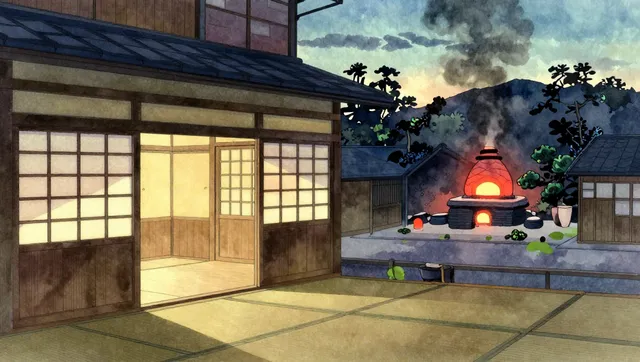 XenLook AI解釈作
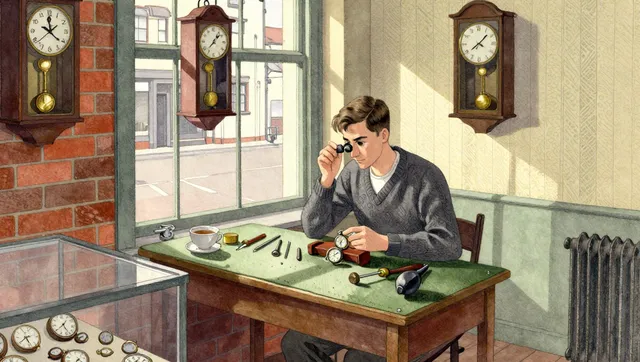 XenLook AI解釈作
一つ選ぶと、すぐに答えと説明が出ます。
1. What is the main reason the colour in this room's pictures looks softly bled like mist?
2. Which of these is NOT held in the four hands of the woman in ‘Bharat Mata’?
3. What did the painters of Bengal take from Japanese painters?
4. How does the sky often look in this room's pictures?
5. Compared with Mughal miniatures, what is the most striking difference of the Bengal School?
この画風に合わせた文が用意されています。コピーするか、そのままスタジオへ。
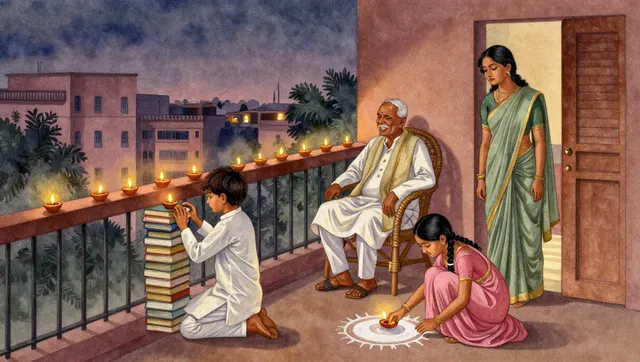 XenLook AI解釈作
A quiet scene in the style of the Indian Bengal School. Pale wash spread to bleed with a water-laden brush on handmade paper, a low-saturation palette of pale ochre, grey-blue and faded sage, soft outlines laid in with a fine brush that melt at the edges, slender figures with heads slightly bowed, a bright sky left empty like mist.
変えてみる Change the ground colour from pale ochre to grey-blue and compare whether the same scene becomes calm like dawn.
文をコピーしました。スタジオの入力欄に貼り付けてください。
この部屋の文は下の資料を照らし合わせて書きました。
「XenLook AI解釈作」の印がある絵はXenLookがXenArtで作った絵です。本物の昔の絵ではなく、画家が描いたものでもありません。原作は「原作」の印と所蔵館で区別します。