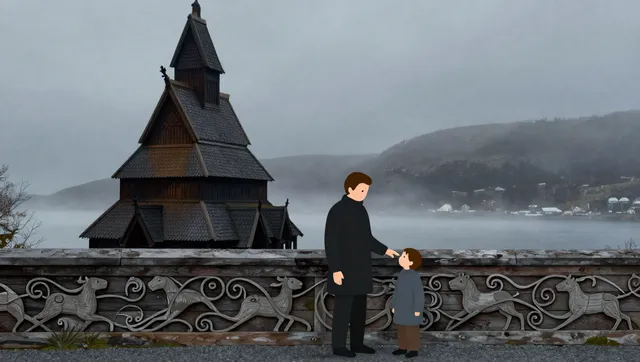
Gouache is a water-based paint made opaque by mixing pigment with water and gum arabic or dextrin, sometimes adding a white powder such as chalk as 'body'. It dries into a matte surface that does not reflect light, and light colours darken a little as they dry while dark colours lighten a little. Paints of this kind have been used for at least 1,200 years, and after the metal paint tube was invented in 1841 they became easy to carry and spread widely into posters, illustration and picture books. Its strong covering power makes it good for spreading low-saturation colours such as grey and blue-grey evenly over broad areas, which is why it suits a city of frequent fog and rain.
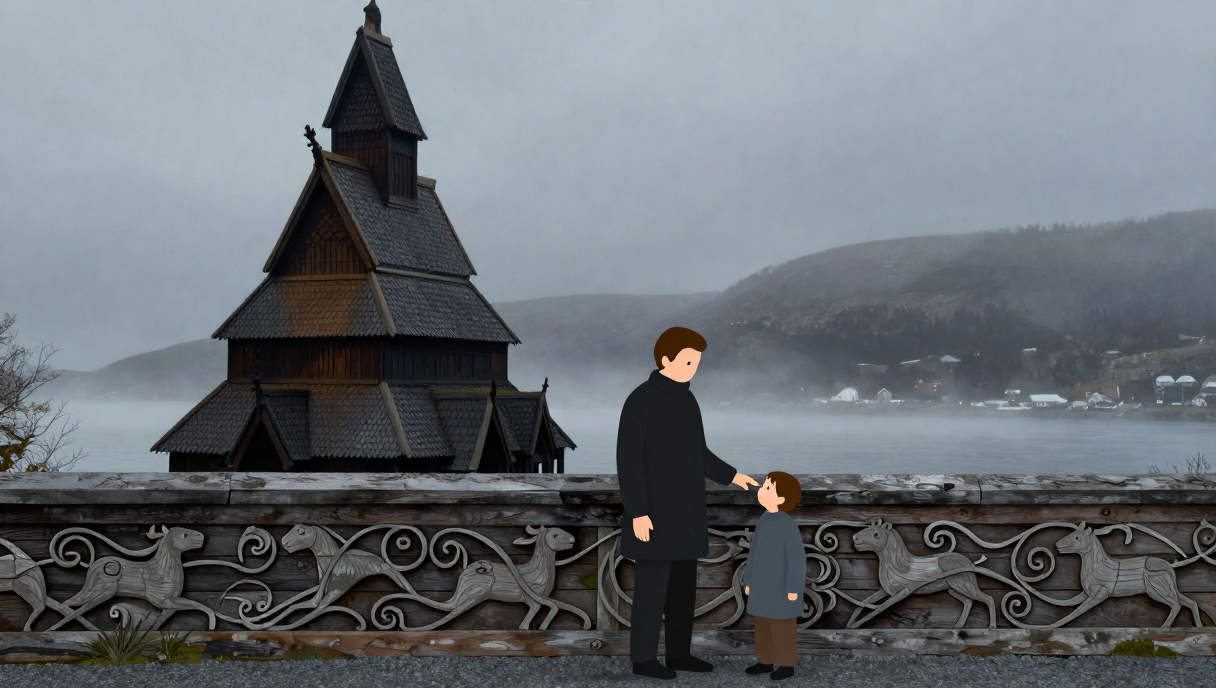
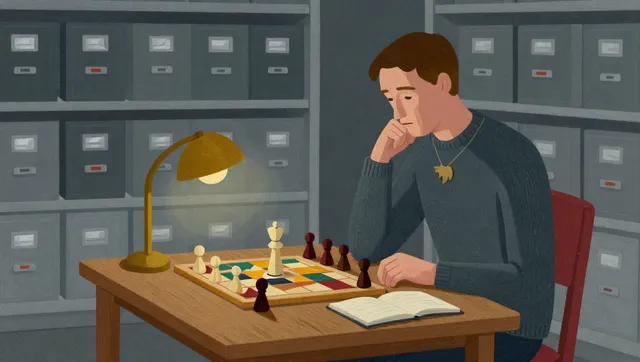
Bergen Gouache is not an official school of art history. It is the name this room gives, as one genre, to the approach that today's illustrators and on-the-spot sketchers share when they paint this city. There are four rules. First, the sky, walls and water are painted broadly as flat planes of fog grey, blue-grey and grey-green. Second, the table edge or the horizon sits low in the picture and the space above it is left wide and empty. Third, tar black and warehouse red are used sparingly, only in small areas. Fourth, the story is handed to a single object such as a key, a notebook or a chessboard, or to one small figure. The AI interpretations in this room apply these four rules to scenes from Rune's chronicle.
Bergen is a harbour city on Norway's west coast, said by tradition to have been founded in 1070 by King Olav Kyrre; in the 13th century it was Norway's capital, and until the 1830s it was the largest city in Norway. Around 1350 the Hanseatic League, an association of North German merchants, set up a trading office, a Kontor, on the wharf, and that old wharf, where dried cod from the north was stored, is Bryggen. Bryggen burned many times, the last fire coming in 1955, but after every fire it was rebuilt following the earlier plot layout and building methods, and some 62 timber buildings still stand today. The rows of gabled roofs and board walls of these wooden houses, inscribed as a UNESCO World Heritage Site in 1979, are widely painted as the emblematic view of Bergen.
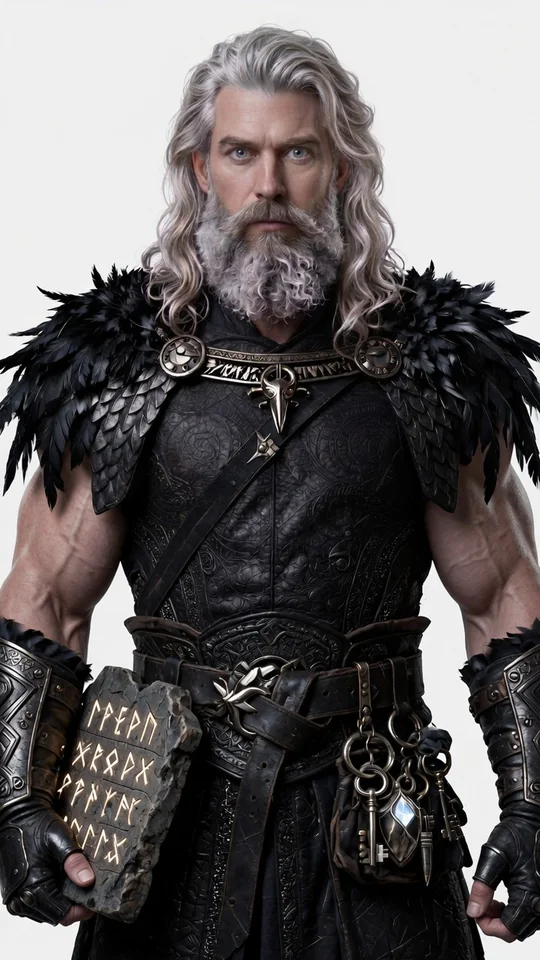
In the excavation that ran for thirteen years after the 1955 fire, some 670 runic inscriptions carved on wood and bone came to light. Mixed with everyday notes such as 'My love, kiss me', these Bryggen inscriptions are counted as the most important runic find of the 20th century. On the shore of the Lustrafjord in western Norway stands Urnes Stave Church, built around 1130. Its north wall and portal carry carvings of slender, stretched animals biting and coiling around one another, which is why the last phase of Scandinavian animal art, running from the second half of the 11th century into the early 12th, came to be called the 'Urnes style'. The eighteen runes on the Urnes post in Rune's chronicle are part of the story, but the church and its carvings really survive.
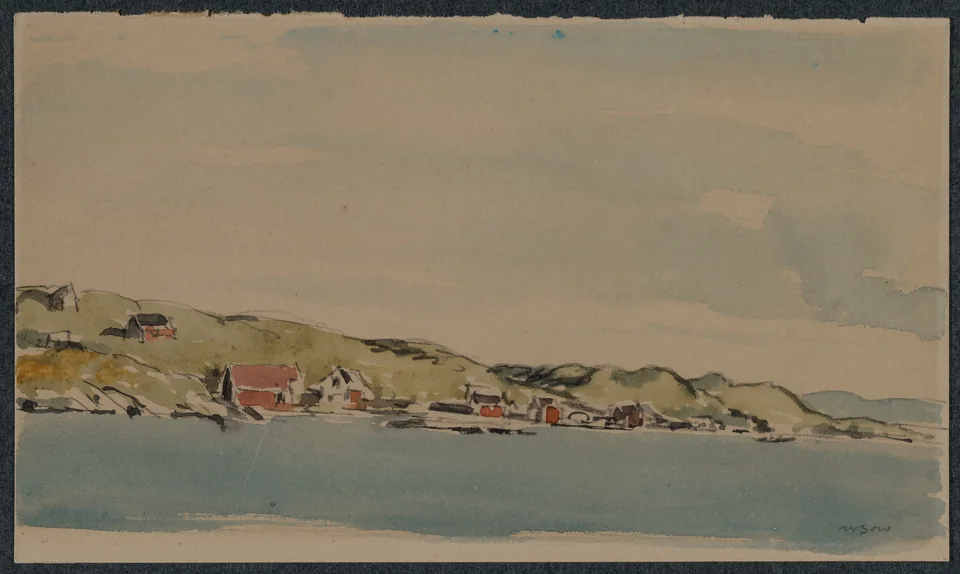
Johan Christian Dahl, born in Bergen in 1788, is called 'the father of Norwegian landscape painting'. He moved to Dresden in Germany in 1818 and became a friend of Caspar David Friedrich, and from 1826 he returned to Norway several times to paint its mountains and sea. The 1819 etching hung in this room tells of the day after a storm on the sea off Bergen, where he grew up, through a small man sitting on a rock and a damaged ship far away. Between the late 19th century and the first half of the 20th, the Scottish printmaker Muirhead Bone quickly set down the view of entering Bergen in pencil and thin watercolour. Telling a story through traces and small figures rather than painting the event itself, and catching a city on the spot with a few lines and colours: these are the two branches of this genre's lineage.
The lineage of Norwegian illustration also connects with the story pictures in this room. In 1841 Asbjørnsen and Moe published the first volume of Norwegian Folktales, and in 1879 the first fully illustrated edition appeared, with pictures by several artists. In later editions Erik Werenskiold, and Theodor Kittelsen, who joined on Werenskiold's recommendation, became the main illustrators, and Kittelsen made his name above all with his pictures of trolls. Meanwhile Urban Sketchers, which began in 2007 on the photo-sharing site Flickr, spread around the world under a manifesto that says 'we draw on location, indoors or out, capturing what we see from direct observation'. Today's Bergen Gouache stands where these two currents, story-telling illustration and on-the-spot city drawing, meet in a foggy harbour.