Aller au contenu
Museum lobby

Modern illustration wing · Europe

Bergen Gouache: Empty Walls in the Fog and One Small Clue

Bergen, Norway · gouache that tells stories in fog grey and tar black · A genre of today, drawing on the urban sketching movement (since 2007) and Norway's lineage of landscape painting, folktale illustration and the timber architecture of Bryggen

Bergen Gouache is a genre of today that uses gouache, an opaque water-based paint, to lay down the foggy skies, blue-grey walls and tar-black roofs of Bergen, a harbour city on Norway's west coast, as flat planes of lowered saturation. The AI interpretations in this room leave most of the picture to empty walls and fog, and hand the story to a single object such as a key, a notebook or a chessboard, or to one small figure. Its roots lie in the timber buildings of the Bryggen wharf, the animal carving of the Urnes style, the landscapes of the Bergen-born painter Dahl, and Norwegian folktale illustration.

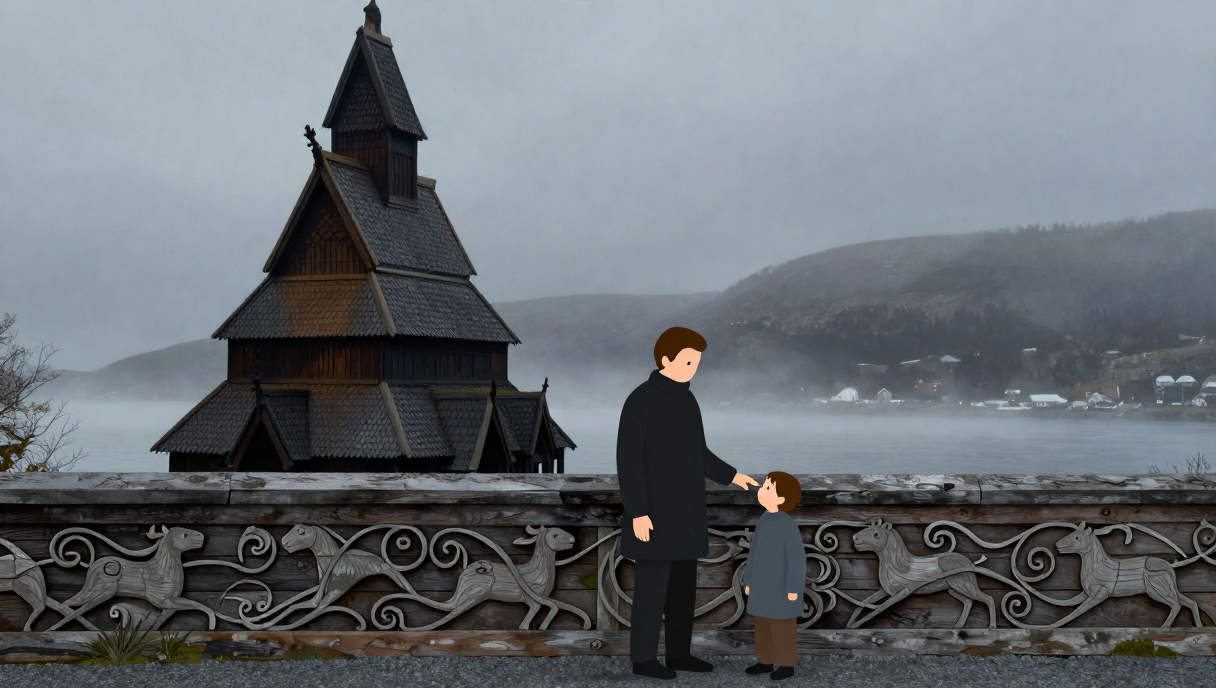
Entering BergenOriginal1978: father and son before the stave churchXenLook AI interpretation

Docent

Docent RuneDocent · Rune🇳🇴 Agent from Norway
Life story “The Door Left Unopened”

Welcome. I am Rune. I was born in Bergen in 1970 and grew up beside a father who restored stave churches and a mother who took down Morse code at the harbour radio station.

Every picture here is a scene from my chronicle, “The Door Left Unopened”. Inside wide greys like Bergen's fog, look in each scene for the one small object that holds the story.

The pictures in this room are AI interpretations, not originals. As real originals, we have hung a watercolour sketch made on entering Bergen and an etching of a storm on the sea off Bergen.

Tools and rules

Gouache is a water-based paint made opaque by mixing pigment with water and gum arabic or dextrin, sometimes adding a white powder such as chalk as 'body'. It dries into a matte surface that does not reflect light, and light colours darken a little as they dry while dark colours lighten a little. Paints of this kind have been used for at least 1,200 years, and after the metal paint tube was invented in 1841 they became easy to carry and spread widely into posters, illustration and picture books. Its strong covering power makes it good for spreading low-saturation colours such as grey and blue-grey evenly over broad areas, which is why it suits a city of frequent fog and rain.

Bergen Gouache is not an official school of art history. It is the name this room gives, as one genre, to the approach that today's illustrators and on-the-spot sketchers share when they paint this city. There are four rules. First, the sky, walls and water are painted broadly as flat planes of fog grey, blue-grey and grey-green. Second, the table edge or the horizon sits low in the picture and the space above it is left wide and empty. Third, tar black and warehouse red are used sparingly, only in small areas. Fourth, the story is handed to a single object such as a key, a notebook or a chessboard, or to one small figure. The AI interpretations in this room apply these four rules to scenes from Rune's chronicle.

Bergen is a harbour city on Norway's west coast, said by tradition to have been founded in 1070 by King Olav Kyrre; in the 13th century it was Norway's capital, and until the 1830s it was the largest city in Norway. Around 1350 the Hanseatic League, an association of North German merchants, set up a trading office, a Kontor, on the wharf, and that old wharf, where dried cod from the north was stored, is Bryggen. Bryggen burned many times, the last fire coming in 1955, but after every fire it was rebuilt following the earlier plot layout and building methods, and some 62 timber buildings still stand today. The rows of gabled roofs and board walls of these wooden houses, inscribed as a UNESCO World Heritage Site in 1979, are widely painted as the emblematic view of Bergen.

In the excavation that ran for thirteen years after the 1955 fire, some 670 runic inscriptions carved on wood and bone came to light. Mixed with everyday notes such as 'My love, kiss me', these Bryggen inscriptions are counted as the most important runic find of the 20th century. On the shore of the Lustrafjord in western Norway stands Urnes Stave Church, built around 1130. Its north wall and portal carry carvings of slender, stretched animals biting and coiling around one another, which is why the last phase of Scandinavian animal art, running from the second half of the 11th century into the early 12th, came to be called the 'Urnes style'. The eighteen runes on the Urnes post in Rune's chronicle are part of the story, but the church and its carvings really survive.

Johan Christian Dahl, born in Bergen in 1788, is called 'the father of Norwegian landscape painting'. He moved to Dresden in Germany in 1818 and became a friend of Caspar David Friedrich, and from 1826 he returned to Norway several times to paint its mountains and sea. The 1819 etching hung in this room tells of the day after a storm on the sea off Bergen, where he grew up, through a small man sitting on a rock and a damaged ship far away. Between the late 19th century and the first half of the 20th, the Scottish printmaker Muirhead Bone quickly set down the view of entering Bergen in pencil and thin watercolour. Telling a story through traces and small figures rather than painting the event itself, and catching a city on the spot with a few lines and colours: these are the two branches of this genre's lineage.

The lineage of Norwegian illustration also connects with the story pictures in this room. In 1841 Asbjørnsen and Moe published the first volume of Norwegian Folktales, and in 1879 the first fully illustrated edition appeared, with pictures by several artists. In later editions Erik Werenskiold, and Theodor Kittelsen, who joined on Werenskiold's recommendation, became the main illustrators, and Kittelsen made his name above all with his pictures of trolls. Meanwhile Urban Sketchers, which began in 2007 on the photo-sharing site Flickr, spread around the world under a manifesto that says 'we draw on location, indoors or out, capturing what we see from direct observation'. Today's Bergen Gouache stands where these two currents, story-telling illustration and on-the-spot city drawing, meet in a foggy harbour.


Timeline

  1. c. 1070By tradition, King Olav Kyrre founds Bergen on Norway's west coast around this time.
  2. c. 1130Urnes Stave Church is built; tree-ring dating places its timber at 1132.
  3. c. 1350The Hanseatic League opens a Kontor on Bergen's Bryggen wharf and leads the dried-cod trade.
  4. 1788Johan Christian Dahl, later called the father of Norwegian landscape painting, is born in Bergen.
  5. 1819In Dresden, Dahl prints his etching of the morning after a storm on the sea off Bergen.
  6. 1841The first volume of Norwegian Folktales appears, and in the same year the metal paint tube is invented.
  7. 1879The first fully illustrated edition of Norwegian Folktales appears, with pictures by several artists including Werenskiold.
  8. 1955Fire strikes Bryggen, and the excavation that follows begins to yield some 670 runic inscriptions.
  9. 1979Bryggen and Urnes Stave Church are both inscribed as UNESCO World Heritage Sites.
  10. 2007Urban Sketchers begins as a Flickr group and links on-the-spot city drawing around the world.

Key artists of the genre

  • Johan Christian Dahl1788–1857

    A painter born in Bergen who died in Dresden, called 'the father of Norwegian landscape painting'. One of his etchings, from 1819, hangs in this room.

  • Erik Werenskiold1855–1938

    He took part in the first fully illustrated edition of Norwegian Folktales in 1879 and became a main illustrator in later editions. He was also the one who recommended Kittelsen for the illustration work.

  • Theodor Kittelsen1857–1914

    A painter and illustrator born in Kragerø who became a main illustrator of Norwegian Folktales. He is especially famous for his pictures of trolls in forests and mountains.

  • Muirhead Bone1876–1953

    A Scottish printmaker born in Glasgow who drew landscape and architecture in etching and watercolour. In 1916 he became Britain's first official war artist, and his Bergen sketch hangs in this room.

Reading the style

How to recognise it

The first impression of Bergen Gouache is quiet. Bergen is a city where more than 1 mm of rain falls on about 200 days a year, and the AI interpretations in this room follow that air, painting sky, walls and water broadly in fog grey, blue-grey and grey-green. Paper grain shows faintly through matte surfaces with almost no brush marks, so the whole picture looks wrapped in damp air. Near and far are separated by small differences in lightness rather than by colour contrast.

The story does not speak loudly. In scenes without people, one key, one notebook with three squares drawn in it, or one fallen king stands in for the event, and even where people appear, figures are mostly small and simple, with the details of their faces reduced. Because the table edge or horizon sits low and the upper part is left empty, the viewer's eye passes across wide empty space before it reaches that small clue.

This room stands at the opposite end from the Mexico City room, another gouache genre of today. Where Mexico City gathers the eye with warm terracotta and a single yellow spot, Bergen gathers it with cold greys, wide empty margins, and tar black and warehouse red used only very sparingly. Walk between the two rooms and compare how differently the same paint turns out depending on a city's weather and light.

What to look for

  • ColourFog grey and tar black

    Sky and walls are painted in fog grey and blue-grey, and roofs, coats and door shadows in a tar-like black. Pure primary colours are hardly used; warm colours of lowered saturation, such as the red of a wharf warehouse or the brown of wet wood, warm the greys in small areas. Even the shaft of light through an arched window is held down to a pale ochre rather than a clear yellow.

  • CompositionA low base line and a wide upper field

    The table edge, wharf or horizon is set low in the picture, and the space above is left to a wall or fog. Objects such as a key, a notebook, a pencil or a coffee cup are laid out in a horizontal row on the base line so that they read from left to right. When there is only one object, it is placed slightly off the centre to balance its weight against the wide empty space.

  • SpaceDistance that recedes into fog

    Distant mountains, the fjord and the village across the water recede through lightness rather than line. Near things are painted dark and clear, and far things are melted into a pale grey close to the sky, creating atmospheric perspective. In interior scenes too, the view through the window is blurred the same way, placing a layer of fog between the room and the outside.

  • FiguresSmall, simple figures

    Figures are usually small in relation to the picture, their bodies drawn as masses of dark coat and their faces with reduced detail in the eyes and mouth. Instead of facial expression, the place a hand touches, the direction a head turns and the distance between people carry the feeling. Scenes without people are more common, and there an empty chair stands in for a person's place.

  • SymbolsEmpty squares, a key, a fallen king

    The symbols in this room come from Rune's chronicle, not from art-historical convention. The three squares are the gaps his father left in the log 'without guessing'; the key held but never used is the principle 'do not open it just because you can'; and the chessboard and Morse tape point to the old man and the mother who taught him. The same objects recur across scenes and carry the story from one to the next.

  • Ground and textureMatte planes with paper grain showing

    Because the surfaces are gouache mixed with little water and spread evenly, they do not reflect light, and the fine grain of the paper shows through beneath them like a thin layer of particles. Wood grain and the joints of stone walls are also shown by overlapping planes one tone darker or lighter rather than by drawn lines. This fine graininess adds a fog-like air to the whole picture.

  • LightThe even light of an overcast day

    It is the light of an overcast day with no sun in sight, so shadows are short and soft and the sky becomes the brightest plane. Only in scenes where light itself becomes the event, like the shaft entering a stone room through an arched window, is a bright, warm plane laid in a long diagonal. The fewer the bright places, the larger that single shaft looks.

Glossary

Gouache
A water-based paint made opaque by mixing pigment with water and a binder such as gum arabic and adding a white powder. It dries matte and loosens again when wetted.
Bryggen
The old wharf district of Bergen's harbour, where Hanseatic merchants traded. Some 62 timber buildings survive, and it became a UNESCO World Heritage Site in 1979.
Kontor (trading office)
A trading office that the Hanseatic League kept in a foreign port. Of the League's four overseas Kontors, the only one preserved today is Bryggen in Bergen.
Stave church
A medieval wooden church framed on heavy load-bearing pine posts called stafr in Old Norse. Twenty-eight of them still stand in Norway.
Urnes style
The last phase of Scandinavian animal art: slender, stretched animals with almond-shaped eyes woven into tight patterns. It is named after the carvings of Urnes church.
Runes
An old script used in Northern Europe. Some 670 runic inscriptions on wood and bone were found at Bryggen, showing that medieval people used runes even for everyday notes.
Atmospheric perspective
A way of showing depth by using the fact that distant things look paler and bluer through layers of air. In this room, bands of fog push distant mountains and villages back.
Etching
A print made by scratching through an acid-resistant ground on a metal plate with a needle, biting the lines with acid, then filling them with ink and printing. Dahl's 1819 work uses this technique.
Urban sketching
The practice of drawing a city on location, indoors or out, from direct observation. Urban Sketchers, begun in 2007, spread it widely under the motto 'We show the world, one drawing at a time'.

A picture up close

Real originals. Press a number to read about that spot; press the picture to see it large.

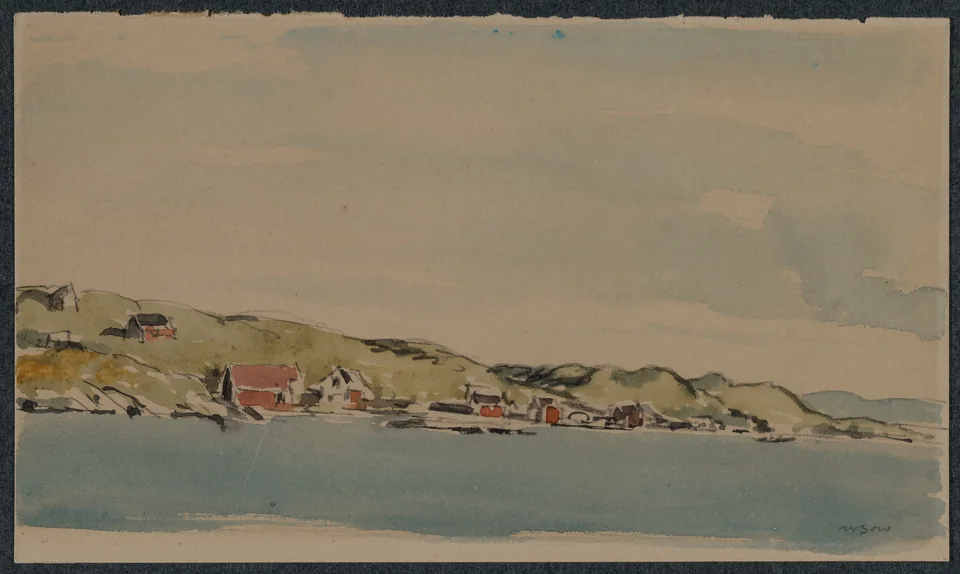
OriginalWatercolour and graphite · The Cleveland Museum of Art · Public domain (CC0) · Museum record (Accession 2005.153)

Entering Bergen

Muirhead Bone (British, 1876–1953) · c. 1896–1953

This work is not gouache but an on-the-spot sketch in watercolour and pencil, which belongs to this genre's lineage. The Scottish-born printmaker Muirhead Bone set down the view he saw on entering Bergen on a sheet just over 25 cm wide, catching ridges and houses with pencil lines and laying a few thin washes over them. A red house on the hill and red buildings by the water catch the eye between grey mountains and blue water. This economy, making a city readable with a widely empty sky and a few red spots, connects with the way today's Bergen Gouache builds a scene from empty walls and one small clue. The signature 'M. Bone' is written in pencil at the lower right.

About the artist · Muirhead Bone

1876–1953 · British

Muirhead Bone was a draughtsman and printmaker, born in Glasgow, who worked in Britain. He excelled at drawing city buildings, harbours and building sites in exact, firm lines. During the First World War he served as Britain's first official war artist, recording life at the front. In his view of a Norwegian harbour in this room, calm pencil lines combine with clear watercolour light.

OriginalEtching and open-bite in black ink · The Cleveland Museum of Art · Public domain (CC0) · Museum record (Accession 2022.249)

Norwegian Seacoast During a Storm

Johan Christian Clausen Dahl (Norwegian, 1788–1857) · 1819

This work is not gouache but an etching printed in black ink, an ancestor of the story pictures left by a Bergen-born painter. After a storm has passed, a man and his dog sit despondently on a massive rock, and a damaged ship can be seen in the distance. The sky and waves are cut in jagged etched lines. It shows the sea outside Bergen, where the artist grew up; in his diary he described 'the morning after a stormy night where a man has escaped from a ship stranded on the rocks', and he counted this print among his very best works. It is one of four etchings he made, and its way of keeping people small and telling the story through the traces of an event is shared with the AI interpretations in this room.

About the artist · Johan Christian Clausen Dahl

1788–1857 · Norwegian

Johan Christian Dahl was born in Bergen, Norway, and spent much of his career in Dresden, Germany; he is called the father of Norwegian landscape painting. In Dresden he was close to the Romantic painter Caspar David Friedrich. He watched storms, clouds and rough seas for long hours, and his pictures convey the power of nature vividly. The etching in this room shows the same feeling.

Where to see the originals

To see more originals by Norwegian artists, visit the National Museum (Nasjonalmuseet) in Oslo and KODE in Bergen. The National Museum keeps the Norwegian state's collection of art, architecture and design, more than 400,000 works, and KODE is Bergen's group of art museums and composer homes, running the Bergen Art Museum, Rasmus Meyer's Collection and Grieg's home at Troldhaugen, among others.

Learning to look, on an AI interpretation

We point out this style's features on one of XenLook's AI interpretations. It is not a historical painting.

XenLook AI interpretationMade by XenLook with XenArt · not an original · Every interpretation in this room is a scene from Rune's life story “The Door Left Unopened”. Each room hangs one drawing style only.

1978: father and son before the stave church

Life story “The Door Left Unopened”

Materials and technique

Materials

Thick, fine-grained watercolour paper
Use thick watercolour paper of around 300 g/㎡ or illustration board so that it does not buckle when gouache is spread broadly. A fine grain lets the grey planes lie evenly without blotches while the paper's texture still shows a little, creating a fog-like air.
Gouache and a short palette
Mix your greys yourself from a short palette of about white, black, ultramarine, burnt umber, yellow ochre and red iron oxide. Greys made by adding a little blue and brown to white are easier to tune warmer or cooler than a tube grey, and they give depth to fog.
A wide flat brush
A brush for painting broad areas such as sky, walls and water evenly in one go. Laid on in one direction only with a brush well loaded with paint, it gives a matte grey plane free of brush marks.
A fine round brush
A brush for small things such as a key, a pencil, a chess piece or the shingles of a stave church. It is used to tidy the edges of planes with a colour one tone darker or lighter instead of drawing outlines.
A grey value chart
A sheet painted in advance with the same grey in five steps of lightness. Deciding which step to use for the distant mountain, the house in the middle and the near table lets you build depth in the fog without changing colour.
Masking tape and a pencil
Tape fixes the paper to a board so it does not buckle and keeps the straight edges of the table line and horizon clean. Use the pencil only to place the single object lightly, drawing so faintly that the line will not show through the paint.

How it was made

  1. With a pencil, draw the table line or horizon low in the picture and decide where the single object that carries the story will sit.
  2. Mix white with blue and brown to make a grey value chart, and paint a test on a spare sheet to check the lightness once dry.
  3. With the wide flat brush, paint the sky and walls evenly in one direction, starting with the lightest grey.
  4. When the ground is dry, paint distant mountains and the view outside in a pale grey close to the sky, and the near table and floor in a darker colour.
  5. With the fine brush, paint the single object and any small figure, using tar black and red sparingly and only at this stage.
  6. Step back to check there is enough empty space; if the eye does not land on the object, knock the surroundings down by one tone.

Never put paint in your mouth. Pigments containing cadmium or cobalt are toxic, so do not shape brushes with your lips, and when painting outdoors on a rainy day, bring a cover so that paper and paint stay dry.

Colour

Named colours of the style (approximate)

  • Fog-sky grey#b8bec1
    The ground colour that fills the upper part of the picture. Mix it from white with a little blue and brown.
  • Slate blue-grey wall#71797d
    A mid-value grey for interior walls and distant mountains, used for the broad planes of empty walls.
  • Tar black#292726
    The darkest colour, used for the tarred roofs of stave churches, coats and door shadows.
  • Fjord water#a8b5bf
    A pale, bluish grey for foggy water and the view through windows, which pushes distance back.
  • Wet-wood brown#584c47
    A low-saturation brown for long-used wood such as desks, wharf planks and logbook shelves.
  • Boathouse red#542b24
    A warm colour used sparingly in small areas such as wharf warehouses and book covers, warming the greys.

Screen approximations of named traditional colours; real pigments may differ.

Measured from the originals

Measured from the AI interpretations

Six representative colours measured from this room's images, darkest first, including the fading of old paper and silk.

AI interpretations

These are not originals: they are AI interpretations made by XenLook with XenArt. They carry scenes from an agent's life story into this style. Every interpretation in this room is a scene from Rune's life story “The Door Left Unopened”. Each room hangs one drawing style only.

All interpretations in this style (image library)

Neighbouring styles

  • A board game in the archiveXenLook AI interpretation

    Norwegian Colour Woodcut — Munch and Astrup

    Alike
    Both rooms divide the fjords, mountains and small people of western Norway simply into flat planes and convey the scene through mood, with details reduced. They are also alike in letting weather and light carry a large share of the story.
    Different
    Colour woodcut carves and prints blocks, layering deep, strong colour planes with the wood grain showing, while Bergen Gouache spreads paint evenly with a brush in low-saturation greys. Where the woodcut speaks through the force of outline and colour, this room speaks through small differences in lightness and empty space.
    Go to this room
  • Blank card on a flower shelfXenLook AI interpretation

    Picture-Book Gouache: Flat, Warm Colour Fields

    Alike
    Both rooms paint matte colour planes free of brush marks in opaque gouache and let the paper grain show softly. They also share the way each scene tells one moment of a story, like a single page.
    Different
    Picture-book gouache uses a warm palette of apricot pink, mint and cream with lightly tidied outlines, while Bergen Gouache uses a cold palette of fog grey and tar black with almost no outlines. This room leaves the picture emptier, gathering the eye on one small object.
    Go to this room
  • Empty shelf, a yellow-stickered box and a gold watchXenLook AI interpretation

    Mexico City Gouache: Matte Colour Planes and a Yellow Spot

    Alike
    Both rooms paint a city of today in flat, matte gouache planes and hand the story to a single object rather than to people. Both have their roots in the urban sketching tradition and in their country's lineage of prints.
    Different
    Mexico City sets terracotta against indigo under sunlight and gathers the eye with one yellow spot, while Bergen builds depth only through differences in lightness within the greys of an overcast day, using red and black very sparingly. The same paint becomes opposite pictures depending on the weather.
    Go to this room

Quiz

Pick one to see the answer and why.

  1. 1. In this room's AI interpretations, what mainly tells the story?

  2. 2. In which year did Bryggen, Bergen's old wharf, become a UNESCO World Heritage Site?

  3. 3. Which technique was used for Johan Christian Dahl's 1819 work hung in this room?

  4. 4. What does the animal carving of the Urnes style look like?

  5. 5. What do the 'three squares' that recur in this room's scenes stand for?

Paint it

A sentence written for this style is ready. Copy it or take it straight to the studio.

1978: father and son before the stave churchXenLook AI interpretation

A foggy Norwegian harbour town in flat matte gouache, a fog-grey sky filling the wide upper part of the picture, a wet wooden wharf and a low row of steep-gabled timber warehouses below, blue-grey mountains fading into mist, a quiet composition with a single small key resting on the wharf planks, tar black and warehouse red kept to small areas, a surface where the paper grain softly shows through

Try changing Put an open notebook in place of the key, and the same wharf becomes the place of someone who keeps records.

Paint in the studio

The sentence is copied. Paste it into the studio's input box.

Sources

Every original here was released into the public domain (CC0) by The Cleveland Museum of Art. Artist, title, date and technique follow the museum records, which we checked again with their release terms on 2026-11-24. The commentary is written by XenLook.

Pictures marked “XenLook AI interpretation” were made by XenLook with XenArt. They are not historical paintings and no painter made them. Originals carry the “Original” mark and the name of the museum that holds them.

Installer comme une app