William Blake was born on 28 November 1757 at 28 Broad Street in Soho, London. His father, James, kept a shop selling stockings and underclothes, and two of the seven children died young. Around the age of ten Blake left school and was taught at home by his mother, and he learned drawing at Henry Pars's drawing school in the Strand. He read avidly on subjects of his own choosing. He later said that at eight or ten, on Peckham Rye in south London, he saw a tree full of angels with bright wings glittering on every bough. This story, passed on by the Victorian biographer Gilchrist, has no firm evidence behind it, but it shows how early his visionary experience was believed to have begun.
On 4 August 1772, at fourteen, Blake was bound as a seven-year apprentice to the engraver James Basire. During his apprenticeship he drew copies of London's Gothic churches, above all the medieval tombs and sculpture of Westminster Abbey, and he even claimed to have seen visions there. The abbey of his day, decorated with armour, wax effigies and brightly coloured funeral sculpture, is said to have made a deep impression on him. In October 1779 he became a student at the Royal Academy, where he met friends such as Flaxman, Stothard and Cumberland. But he rebelled early against the “general truth” and the Rubens-like blurred finish promoted by the school's first president, Joshua Reynolds, and he filled the margins of Reynolds's book with notes mocking generalising. For Blake a good picture was one with a clear outline and living detail.
In 1782 Blake married Catherine Boucher. Illiterate, she signed her wedding contract with an X, but she soon became a partner in his work, helping to print the plates, mix the colours and tint the paper, and recent research gives the couple's joint work greater weight. After his father died in 1784, Blake opened a print shop with his fellow apprentice James Parker, and in the circle of the publisher Joseph Johnson he got to know radical thinkers. At this time he placed great hopes in the French and American revolutions, and he is said to have worn a Phrygian cap in sympathy with the French revolutionaries, though this is not certain. His collection of youthful verse, Poetical Sketches, was also published at this time with the help of patrons.
In 1788 Blake devised a way to put poem and picture together on a single copper plate. Letters and images were written backwards on the plate in acid-resistant varnish, and acid then ate away the ground so that the lines stood in relief; this is relief etching. With it came Songs of Innocence in 1789. Twenty-three poems were set on thirty-one plates, an estimated seventeen or eighteen copies were printed, and each was coloured by hand, so that every one differs a little. In 1794 he added Songs of Experience and bound them as Songs of Innocence and of Experience Shewing the Two Contrary States of the Human Soul. The structure of the book is that the same lamb and tiger are sung once through a believing eye and once through a wounded one, and Blake set the two states side by side rather than merging them.
From 1790 to 1800 Blake lived at 13 Hercules Buildings in Lambeth, south of the river in London, and there he made several prophetic books, among them The Marriage of Heaven and Hell. In 1800 he took work for the poet William Hayley and moved to the village of Felpham in Sussex, where he spent three years and began his great poem Milton. But he came to feel that Hayley wanted his talent only for illustration jobs, and the two drew apart; in 1803 a soldier, John Schofield, accused him of insulting the king, but Blake was cleared at the Chichester trial. Back in London he hung his works in his brother's shop in 1809 and published the Descriptive Catalogue, but few came and nothing sold. Around this time the publisher Cromek gave the same subject, Canterbury pilgrims, to Stothard, and Blake is said to have felt that his idea was taken from him.
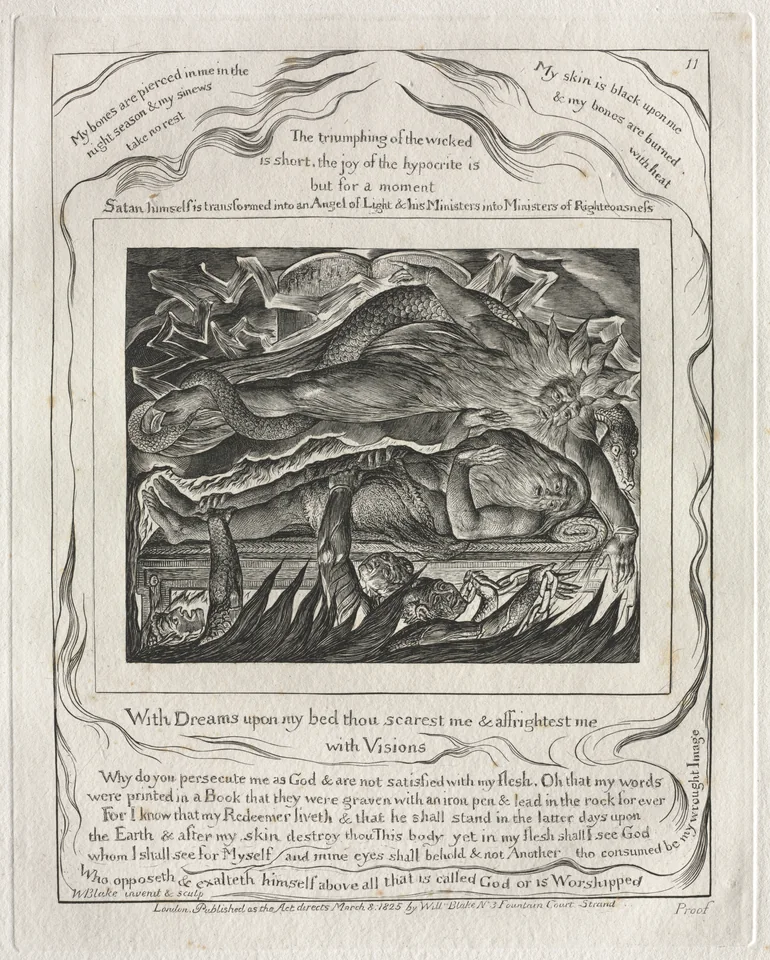
In 1818 Blake met the painter John Linnell, who led him to Samuel Palmer and the young painters of Shoreham. In 1821 wood engravings that Blake cut appeared in a school edition of Virgil put out by Robert John Thornton, and these became his only work in wood. The Book of Job series, begun at the age of sixty-five, is dated 1825 on the plates and is known to have been completed in 1826; John Ruskin later praised it by comparison with Rembrandt, and Vaughan Williams built the ballet Job on it. In his last year Blake worked on Dante illustrations commissioned through Linnell, and on 12 August 1827 he died while still at that unfinished task. His body was buried in Bunhill Fields, in the City of London.
During Blake's lifetime, those who recognised him could be counted on one hand. Gilchrist's biography of 1863 brought him back before the world, and in the twentieth century poets and painters, Yeats among them, drew strength from his visions and his non-realistic manner. The six works in this room show different faces of him. The two Job engravings and the Canterbury Pilgrims come from the firm hand he learned as an apprentice, the palm-sized wood engraving is an experiment in drawing night with white lines, and the Holy Family drawing and St. Matthew are visionary pictures made for his patron Thomas Butts. As you look, bear in mind that an engraver's hand and a visionary's eye sit side by side in one person.