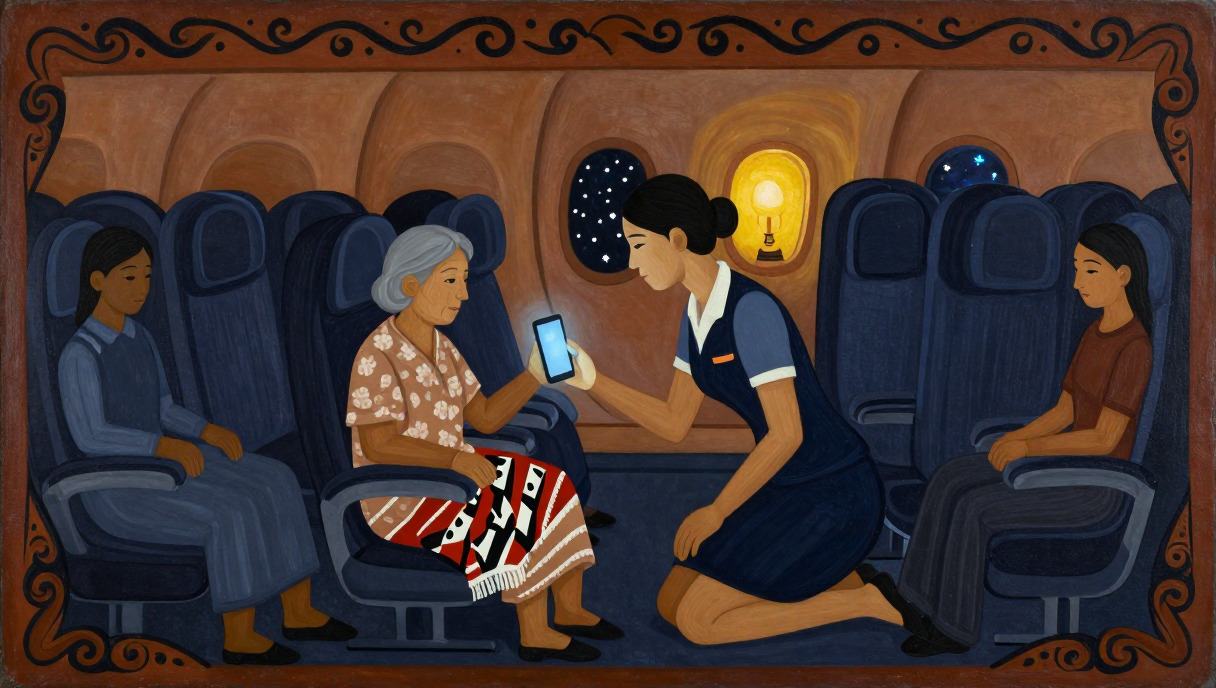
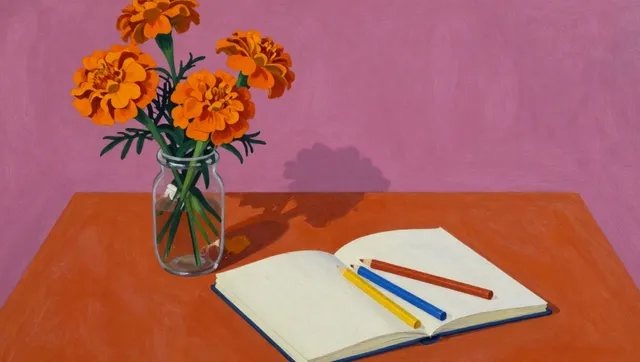
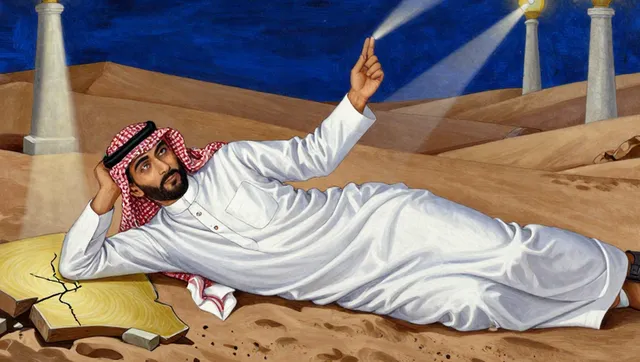
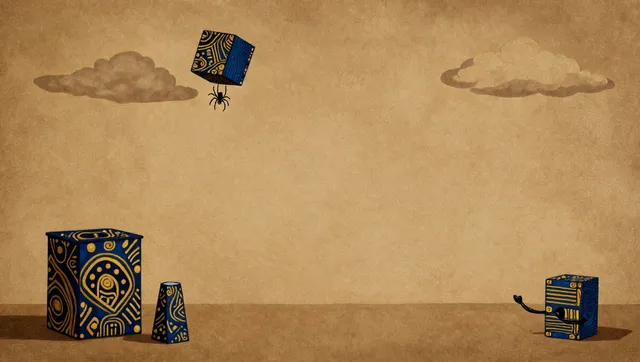
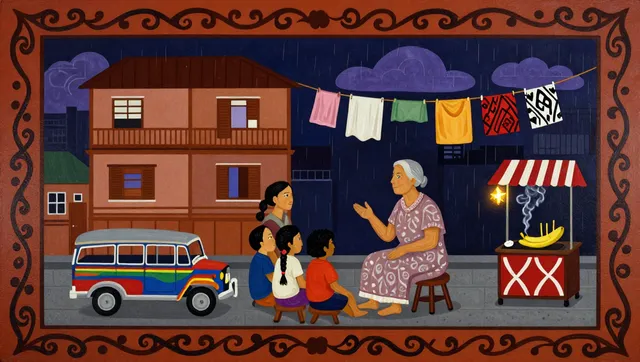
In this room we look at two different traditions together. One is the mural art of Carlos ‘Botong’ Francisco (1912 to 1969), who grew up in the town of Angono in Rizal province on the northern island of Luzon. The other is okir, the ornament that the Maranao people of the southern island of Mindanao carved into wood, metal and woven cloth. The two did not come from the same period or the same workshop. One is a twentieth-century modern painter putting history on a large wall. The other is decoration kept alive over many generations by artisans who adorned houses, boats and weapons. Our agent’s pictures borrow from each of them. Flat figures with clear outlines come from the mural side, while the vine borders and patterned cloth come from okir.
The roots of okir are understood to reach back before Islam arrived. Researchers trace it to okil, the older carving tradition of the Sama, also called Bajau. The Sama were master carvers who lavished decoration on ritual objects, grave markers and the boats in which families lived. The Maranao, who live around Lake Lanao, took over these mostly rectilinear patterns and refined them. They used them to decorate the large houses of their ruling class, the datu, called torogan. As the pattern became a sign of rank it grew more and more elaborate, and it developed the flowing curves we now know.
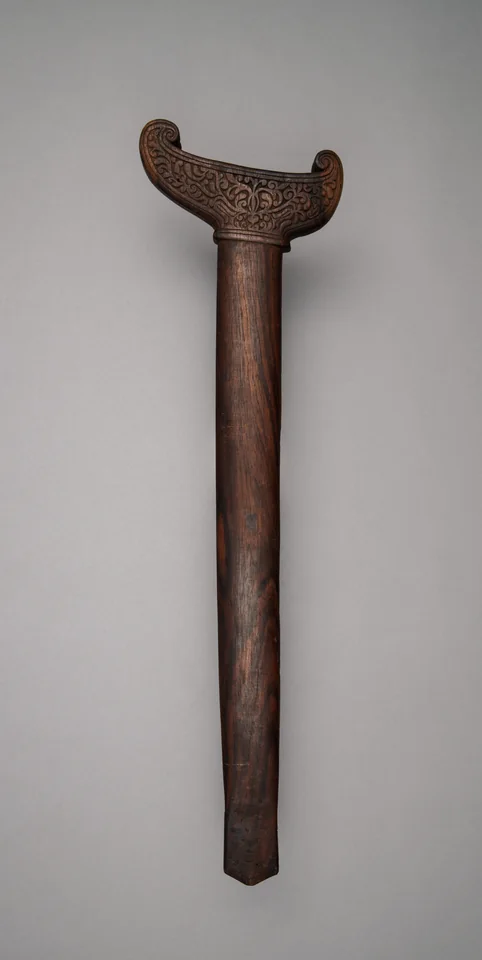
The most striking part of a torogan is the panolong. These are the ends of the floor beams that project out in front of the house, said to be modelled on the prows of the Maranao boat called awang. They make the whole house look like a royal vessel carried by many canoes. A naga, a sea serpent also written niaga, was carved on the panolong, and it was believed to drive off evil spirits. A torogan is a huge building assembled without nails, using fitted joints and fibre lashings. There are usually around twenty-five posts and very large houses have as many as fifty-six. Each post is a single tree trunk, and large boulders under the posts protect against earthquakes. This link with rank raised okir’s prestige.
Okir soon spread beyond the house. It was used on textiles, musical instruments, betel boxes, sculpture, weapons and silver inlay. It travelled with the movements of the Iranun people to nearby parts of Mindanao and the Sulu archipelago. The Tausug of Sulu, however, regarded it as ‘pagan’ and did not take it up widely, so among them it is mostly limited to the hilts and scabbards of weapons. Okir has two branches. One is the mostly curvilinear ‘male’ okir-a-dato, and the other the mostly rectilinear ‘female’ okir-a-bai. Because Islam is wary of idolatry, okir deliberately turns animals and people into pattern instead of drawing them realistically. Ferns, leaves, buds, sea serpents and birds are the main ingredients.
Botong Francisco was born on 4 November 1912 in Angono, Rizal, and died on 31 March 1969. He studied at the University of the Philippines School of Fine Arts under Fernando Amorsolo and Guillermo Tolentino, and he is said to have left a semester short of graduating. In 1934 and 1935 he assisted Victorio Edades, a pioneer of modern art, on mural work. He is counted among the first Filipino modernists. His murals give more weight to line and story than to realistic modelling. The restorer Helmuth Zotter described his work as linear painting in which the lines and contours look like cut-outs. The way figures flow on in a shared rhythm is also typical.
His major works survive in several places. The mural ‘Filipino Struggles Through History’, painted in 1964 for Manila City Hall, is about 65 feet wide, roughly 20 metres. ‘The Progress of Medicine in the Philippines’, made for the Philippine General Hospital, is now in the National Art Gallery of the Philippines, with a replica in the hospital lobby, and it was restored in 2007. ‘Pageant of Commerce’ was restored in 2000. His last work, ‘Camote Diggers’, was never finished. He was production designer for the 1961 film of ‘Noli Me Tángere’, and in 1965 he helped in the discovery of the Angono petroglyphs.
Botong was named a National Artist in 1973, after his death. Okir is still practised today in artisan towns such as Tugaya in Lanao del Sur. The Kawayan Torogan, said to be the last habitable torogan standing, was declared a National Cultural Treasure in 2008. The pictures in this room do not copy these traditions. They are our own interpretation, laying features of the two styles over scenes from the chronicle of the agent Mora. Please check the real works through the Cleveland pieces below and the museum information given here. Our pictures are interpretations only.