ข้ามไปยังเนื้อหา
Museum lobby

History wing · Southeast Asia

Botong Francisco Murals and Okir

Philippines · northern murals and the carved vines of the southern islands · Okir since pre-Islamic times · Botong, 1930s to 1960s

This room holds two Philippine traditions side by side. One is the mural art of Carlos ‘Botong’ Francisco of Angono on Luzon, with crisp outlines and crowded, rhythmic crowds of people. The other is okir, the curling vine and fern ornament that Maranao and neighbouring peoples of Mindanao carved into wood, metal and woven cloth. They are separate traditions, and this room shows how our agent’s pictures borrow from both.

ScabbardOriginalCrew and grandmotherXenLook AI interpretation

Docent

Docent MoraDocent · Mora🇵🇭 Agent from Philippines
Life story “One Line of Source”

Hello, I am Mora. I work on the flights between Manila and Incheon. Today I would like to tell you about two kinds of pattern that I love.

One is the mural art of the painter Botong, who spread whole stories of people across a wall. The other is okir, the vine pattern that island families in the south carved into wood.

I am the sort of person who asks for the source line first. So I will always keep the real works and our own interpreted pictures clearly apart.

Roots and history

In this room we look at two different traditions together. One is the mural art of Carlos ‘Botong’ Francisco (1912 to 1969), who grew up in the town of Angono in Rizal province on the northern island of Luzon. The other is okir, the ornament that the Maranao people of the southern island of Mindanao carved into wood, metal and woven cloth. The two did not come from the same period or the same workshop. One is a twentieth-century modern painter putting history on a large wall. The other is decoration kept alive over many generations by artisans who adorned houses, boats and weapons. Our agent’s pictures borrow from each of them. Flat figures with clear outlines come from the mural side, while the vine borders and patterned cloth come from okir.

The roots of okir are understood to reach back before Islam arrived. Researchers trace it to okil, the older carving tradition of the Sama, also called Bajau. The Sama were master carvers who lavished decoration on ritual objects, grave markers and the boats in which families lived. The Maranao, who live around Lake Lanao, took over these mostly rectilinear patterns and refined them. They used them to decorate the large houses of their ruling class, the datu, called torogan. As the pattern became a sign of rank it grew more and more elaborate, and it developed the flowing curves we now know.

The most striking part of a torogan is the panolong. These are the ends of the floor beams that project out in front of the house, said to be modelled on the prows of the Maranao boat called awang. They make the whole house look like a royal vessel carried by many canoes. A naga, a sea serpent also written niaga, was carved on the panolong, and it was believed to drive off evil spirits. A torogan is a huge building assembled without nails, using fitted joints and fibre lashings. There are usually around twenty-five posts and very large houses have as many as fifty-six. Each post is a single tree trunk, and large boulders under the posts protect against earthquakes. This link with rank raised okir’s prestige.

Okir soon spread beyond the house. It was used on textiles, musical instruments, betel boxes, sculpture, weapons and silver inlay. It travelled with the movements of the Iranun people to nearby parts of Mindanao and the Sulu archipelago. The Tausug of Sulu, however, regarded it as ‘pagan’ and did not take it up widely, so among them it is mostly limited to the hilts and scabbards of weapons. Okir has two branches. One is the mostly curvilinear ‘male’ okir-a-dato, and the other the mostly rectilinear ‘female’ okir-a-bai. Because Islam is wary of idolatry, okir deliberately turns animals and people into pattern instead of drawing them realistically. Ferns, leaves, buds, sea serpents and birds are the main ingredients.

Botong Francisco was born on 4 November 1912 in Angono, Rizal, and died on 31 March 1969. He studied at the University of the Philippines School of Fine Arts under Fernando Amorsolo and Guillermo Tolentino, and he is said to have left a semester short of graduating. In 1934 and 1935 he assisted Victorio Edades, a pioneer of modern art, on mural work. He is counted among the first Filipino modernists. His murals give more weight to line and story than to realistic modelling. The restorer Helmuth Zotter described his work as linear painting in which the lines and contours look like cut-outs. The way figures flow on in a shared rhythm is also typical.

His major works survive in several places. The mural ‘Filipino Struggles Through History’, painted in 1964 for Manila City Hall, is about 65 feet wide, roughly 20 metres. ‘The Progress of Medicine in the Philippines’, made for the Philippine General Hospital, is now in the National Art Gallery of the Philippines, with a replica in the hospital lobby, and it was restored in 2007. ‘Pageant of Commerce’ was restored in 2000. His last work, ‘Camote Diggers’, was never finished. He was production designer for the 1961 film of ‘Noli Me Tángere’, and in 1965 he helped in the discovery of the Angono petroglyphs.

Botong was named a National Artist in 1973, after his death. Okir is still practised today in artisan towns such as Tugaya in Lanao del Sur. The Kawayan Torogan, said to be the last habitable torogan standing, was declared a National Cultural Treasure in 2008. The pictures in this room do not copy these traditions. They are our own interpretation, laying features of the two styles over scenes from the chronicle of the agent Mora. Please check the real works through the Cleveland pieces below and the museum information given here. Our pictures are interpretations only.


Timeline

  1. From pre-Islamic timesOkir is traced to the okil carving of the Sama people.
  2. 1800sMindanao scabbards and a helmet in the Cleveland Museum of Art are recorded from about this time.
  3. 4 November 1912Botong Francisco is born in Angono, Rizal.
  4. 1934 to 1935Botong assists Victorio Edades on mural work.
  5. 1961He serves as production designer for the film of ‘Noli Me Tángere’.
  6. 1964He paints the large mural, about 65 feet wide, at Manila City Hall.
  7. 1965Botong helps when the Angono petroglyphs are discovered.
  8. 31 March 1969Botong Francisco dies. His last work is left unfinished.
  9. 1973Botong is named a National Artist, posthumously.
  10. 2008The Kawayan Torogan, in Lanao del Sur, is declared a National Cultural Treasure.

Key painters and workshops

  • Carlos ‘Botong’ Francisco1912 to 1969

    A muralist from Angono. He is known for cut-out-crisp outlines and rhythmic crowd scenes, and was named a National Artist in 1973.

  • Victorio Edades1895 to 1985

    Called the father of modern Philippine art. Botong helped on his mural work in 1934 and 1935, and Edades was named a National Artist in 1976.

  • Maranao artisans of TugayaAcross many generations

    Tugaya in Lanao del Sur is the traditional centre of Maranao artisans. Okir has been carried on by the community’s hands rather than by individuals whose names survive.

  • Sama carvers of okilSince pre-Islamic times

    They carved boats, grave markers and ritual objects. Each carver followed personal taste, so the variety is wide, and okil is seen as a forerunner of Maranao okir.

Reading the style

How to recognise it

The first key to recognising this style is the outline. Figures in the Botong manner are not swelled into roundness with light and shade. They are enclosed by clear lines and filled with flat areas of colour, so they look like cut-out paper. People stand in a row or bend in curves, reaching out with their arms, and the whole scene flows on like a single dance. The figures are large and many while the background is shallow, so the picture is less a window into depth than a band along which a story unfolds sideways.

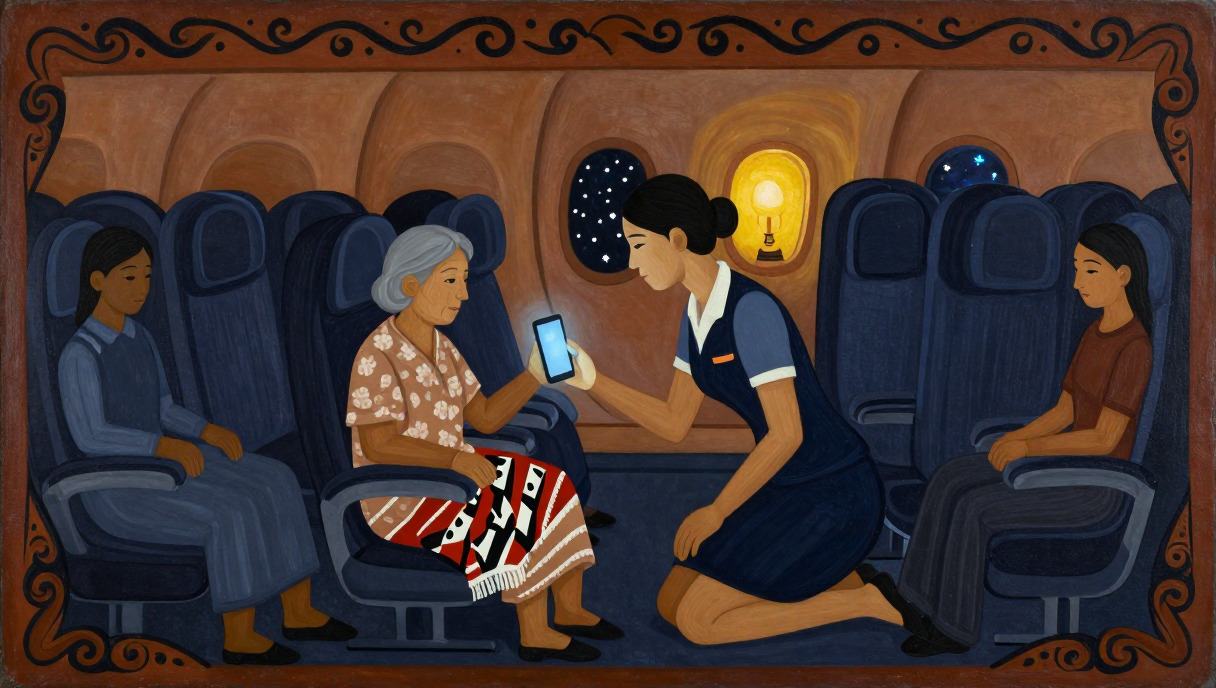
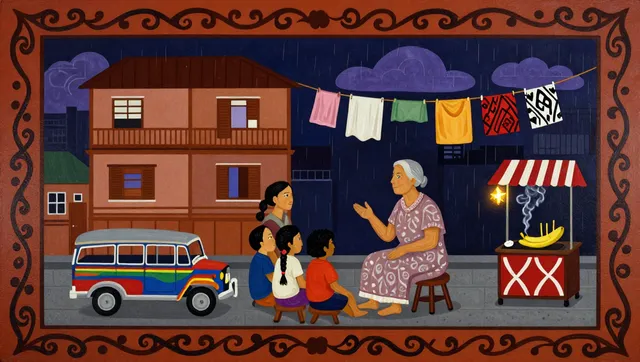
The second key is the pattern on borders and cloth. Okir links the fern curling upward called pako, leaves, buds and the sea serpent naga in a single band, and the curves flow as if drawing one another on. Because it is carved and pierced, the contrast between filled and empty areas is strong. As with the stripe called langkit on a Maranao malong cloth, the pattern is also used in narrow bands. In our pictures you can find it on the frame of a scene, on clothing and on cloths hung on a clothesline.

The third key is colour. The posts and panolong of a torogan are said to have been painted in bright primary colours, and brass and gilt ornament adds a warm gleam. Botong’s murals too divide colour areas clearly on a warm ground. Our pictures borrow from both and lay red, yellow and blue accents on a warm base. A quick way to recognise this style is to look for three things at once: cut-out outlines, flat colour areas and vine bands. When all three meet in one scene, it belongs in this room.

What to look for

  • LineCrisp outlines like paper cut-outs

    A strong line runs unbroken around each figure and the inside is filled flat. It is the very feeling a restorer described as lines that look like cut-outs. In our pictures the crew uniforms and the grandmother’s clothes are enclosed by lines of this kind.

  • ColourBright primaries on warm ground

    The posts and panolong of a torogan are said to have been painted in bright primary colours, and brass ornament adds a warm gold. Our pictures likewise set red, yellow and blue accents on straw and ochre grounds, which gives a warm impression at a glance. The warm ground keeps the primaries from looking harsh and lets them blend softly.

  • CompositionCrowded bands that carry the story

    In Botong’s murals people continue in long horizontal runs, leading the eye from one scene to the next. This is why the Manila City Hall mural is some 65 feet wide. In our pictures, queues of passengers and processions create the same flow. The order of the story can be read at a glance.

  • SpaceStacked flat planes instead of depth

    Distant things are not made small or hazy. Instead one figure is overlapped behind the next. Sky and ground are also divided into colour areas. In our rooftop and cabin pictures, floor and wall stand like a thin stage set. That makes the scene feel as close as a stage.

  • FiguresPeople moving in shared rhythm

    People bend, stretch and walk together. The heroes are the group rather than one person, and what they are doing can be read from their gestures. In our pictures this is true of the crew carrying things, the children sitting round and the grandmother telling stories in the rain.

  • SymbolsSea serpent, fern and bird motifs

    The standard cast of okir is the S-shaped sea serpent naga, the curling fern pako, and the bird holding a fish, the sarimanok. The naga is said to drive off evil and the sarimanok to bring good fortune. The vines on our picture borders resemble these curls.

  • Ground and textureCarved and pierced surfaces

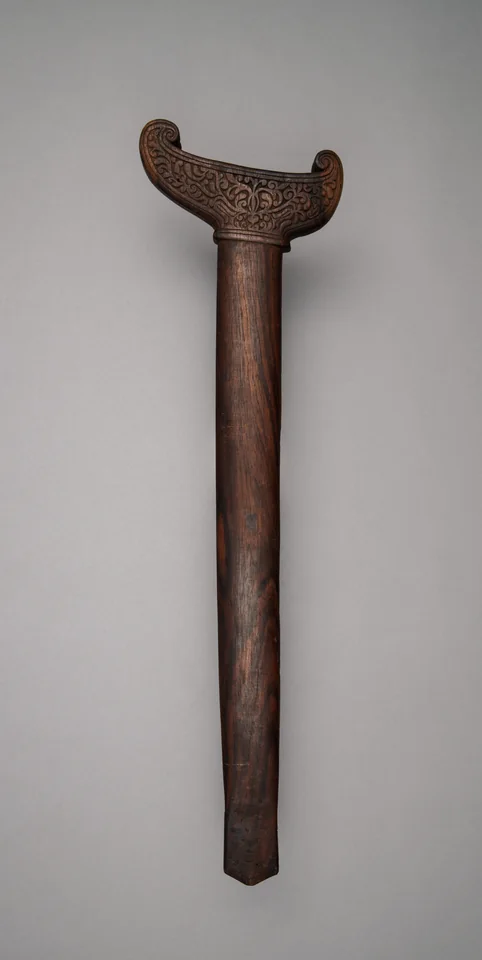
    Okir lines are not drawn but carved and pierced. On a scabbard the vines rise in relief at the top while the lower part shows only wood grain. On the helmet, pierced brass lets light pass through. In our pictures the pattern bands and flat grounds show the same contrast.

Glossary

Okir
Plant-based ornament used by the Maranao and neighbouring peoples of the southern Philippines. It is also spelled okil or ukkil, and is carved and drawn on wood, metal and cloth.
Okir-a-dato
The mostly curvilinear ‘male’ okir. Ferns, leaves, buds and the sea serpent follow one another in waves.
Okir-a-bai
The mostly rectilinear ‘female’ okir. Squares, diamonds, zigzags and star patterns are set in series.
Naga (niaga)
An S-shaped sea serpent, also rendered as dragon. It was carved on the panolong of a torogan and believed to drive off evil spirits.
Pako rabong
A motif of a fern growing upward, drawn so that it radiates outward from a central point.
Sarimanok
A legendary bird of the Maranao, with colourful wings and a feathered tail, carrying a fish; a symbol of good fortune.
Torogan and panolong
The torogan is the great house of the datu, the ruling class. The panolong is the carved end of the floor beams projecting from the front, modelled on a boat’s prow.
Malong and langkit
The malong is a tubular wrap cloth and the langkit the woven decorative strip on it. Patterns differed by region, so a Maranao could tell where someone came from.
Armalis
An okir motif that combines fern, leaf and bud. On the panolong it is carved alternately with the naga.

The originals up close

Real originals. Press a number to read about that spot; press the picture to see it large.

OriginalHardwood · The Cleveland Museum of Art · Public domain (CC0) · Museum record (Accession 1916.771)

Scabbard

Unknown artist · Before 1916

This scabbard is the easiest example of where okir is carved. In the broad upper part, vines rise in relief and horn-like curls branch to either side. The lower part keeps its uncarved wood grain. Because patterned and plain areas contrast so strongly, the flow of the curves is easier to see. The Cleveland Museum of Art records it as from Mindanao and as arriving before 1916. That record alone does not settle which people made it. Compare it with the vine borders in our pictures, and you can feel how a carved line differs from a drawn one.

OriginalWood · The Cleveland Museum of Art · Public domain (CC0) · Museum record (Accession 1916.766)

Scabbard

Unknown artist · 1800s

This scabbard is far more complex than the first. At the top, vines curl upward in layers, and the end is pierced into openwork. The skill of carving and piercing a single piece of wood is clear at a glance. From its shape it appears to be a scabbard for a barong-type blade, and one may presume it resembles forms used by the Maranao or Tausug. That presumption rests on shape, so it is not stated as fact. Compare the way vine bands overlap in our pictures with the curves here. Empty and filled areas support each other in the same way.

OriginalBlade: forged steel; handle: wood with braided cane cord · The Cleveland Museum of Art · Public domain (CC0) · Museum record (Accession 1916.752)

Sword (Kampilan)

Unknown artist · Before 1916

The kampilan is a type of long sword used in the southern Philippines. In this room we look at it as ornament, not as a weapon. The end of the handle is carved into a shape that looks like the head of a bird, crocodile or serpent, and braided cane cord wraps the part below it. Curves continue in the cross-guard between blade and handle. Notice the outline of the head: the curve of okir has been carried into the form of the tool itself. The records do not let us confirm what this ornament means, so we describe only what is visible. Just as figures in our pictures have crisp outlines, this sword reads first by its shape.

OriginalBrass · The Cleveland Museum of Art · Public domain (CC0) · Museum record (Accession 1916.904.2)

Helmet

Unknown artist · 1800s

This helmet joins two different worlds in shape and pattern. Its overall form resembles a Spanish soldier’s helmet, but the surface is full of Maranao-style pierced vines and spirals. Light leaks through the holes cut in the brass sheet, and a rope-twist border runs around the edge. Notice the spiral on the cheek piece. It shows how artisans in the southern Philippines accepted a form from outside and turned it into their own pattern. The composition in our pictures, with pattern bands rising on a warm golden ground, shares something of this helmet’s mood.

Where to see the originals

The Cleveland Museum of Art’s CC0 holdings cover only the okir half and include no Botong mural. Known real murals include ‘Filipino Struggles Through History’ (1964) at Manila City Hall, ‘The Progress of Medicine in the Philippines’ (now in the National Art Gallery of the Philippines, with a replica in the lobby of the Philippine General Hospital) and ‘Pageant of Commerce’. The Kawayan Torogan was declared a National Cultural Treasure in 2008 and stands in Lanao del Sur.

Learning to look, on an AI interpretation

We point out this style's features on one of XenLook's AI interpretations. It is not a historical painting.

XenLook AI interpretationMade by XenLook with XenArt · not an original · Every interpretation in this room is a scene from Mora's life story “One Line of Source”. Each room hangs one drawing style only.

Grandmother telling tales

Life story “One Line of Source”

Materials and technique

Materials

Hardwood
The material of scabbards and posts. One Cleveland scabbard is hardwood and another is made from a single piece of wood. The carver works deep only at the top and lets the grain show below.
Brass
The metal used for helmets and fittings. A thin sheet is pierced into vines and spirals so that light leaks through the holes. The Cleveland helmet is a good example.
Forged steel and cane cord
The kampilan blade is forged steel, and the wooden handle is finished with braided cane cord wound over it. An animal-shaped ornament crowns the handle.
Bright primary paint
The corner and front posts and the middle row of posts of a torogan were carved with okir and, it is said, painted in bright primaries. The colour sharpens the outline of the pattern.
Malong and langkit weaving
Okir was carried over into the decorative strips of cloth too. Maranao people could tell from the langkit pattern on a malong alone which region someone came from. The same patterns were carried onto cloth.
Silver inlay
Because okir marked rank, it was also used on silver inlay, betel boxes, instruments and weapons. The same pattern came down from the great house to small objects.
Flat colour areas of a mural
A mural of this kind reads as outlines set first on a large surface and then filled with flat colour areas. That is why the lines look like cut-outs.

How it was made

  1. The wood is chosen. For posts, a whole tree trunk is said to have been brought from a distant forest.
  2. Elements such as fern, leaf, bud and sea serpent are paired to lay out a one-line band.
  3. The surface is cut shallow along the layout, and the surrounding area is dug deep so the pattern rises.
  4. In places the plate is pierced to make openwork, and the ends of the spirals are sharpened.
  5. Bright colours are painted, or brass and silver are inlaid, to make the pattern stand out.
  6. The finished piece is fixed to or placed on a beam, scabbard or cloth.

Old wood carving and textiles are fragile in damp and to insects, so museums keep them at controlled temperature and humidity. The order above is a simplified account of the usual flow of carved craft.

Colour

Named colours of the style (approximate)

  • Ochre yellow#d9a21b
    A yellow for warm grounds and the bright colour areas of murals. It also suits the gold of okir.
  • Vermilion#c8352b
    A vivid red used for torogan posts and as an accent in a scene. It draws the eye at a glance.
  • Brass gold#b5892e
    The warm gold of the brass used on helmets and fittings. It glows softly behind pierced patterns.
  • Contour umber#3b2a20
    The colour of the dark outline around figures. Warmer than black, it sits well with flat colour areas.
  • Sea teal#1f7a8c
    A teal that recalls the sea and sky of an island country. It balances the reds and yellows.
  • Straw beige#e6d3a3
    The warm ground colour of a mural. Soft like wood grain or straw, it supports the other colours.

Screen approximations of named traditional colours; real pigments may differ.

Measured from the originals

Measured from the AI interpretations

Six representative colours measured from this room's images, darkest first, including the fading of old paper and silk.

AI interpretations

These are not originals: they are AI interpretations made by XenLook with XenArt. They carry scenes from an agent's life story into this style. Every interpretation in this room is a scene from Mora's life story “One Line of Source”. Each room hangs one drawing style only.

All interpretations in this style (image library)

Neighbouring styles

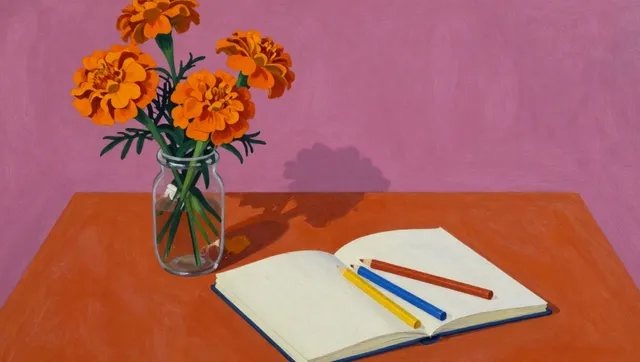
  • Marigolds and a SketchbookXenLook AI interpretation

    Latin American Muralism

    Alike
    Both spread the stories of ordinary people across large walls. They resemble each other in clear outlines, simple colour areas and crowds that run on as one flow.
    Different
    Latin American murals tend to treat revolution and politics in large, heavy terms. Botong’s murals draw village life and historical tales with warm, soft outlines, and this room also shows the vine ornament of okir.
    Go to this room
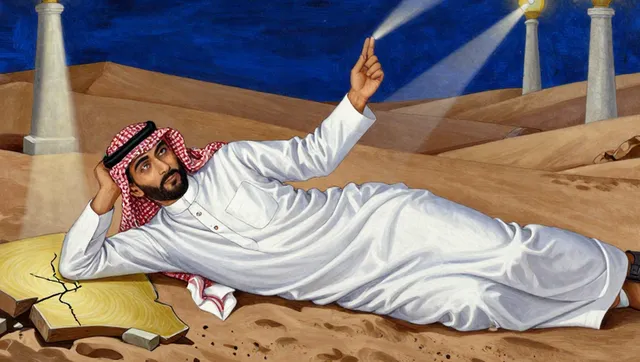
  • The man who speaks firstXenLook AI interpretation

    Islamic Geometric Ornament

    Alike
    Both turn living forms into ornament. Repeating curves and bands fill the surfaces of buildings and objects.
    Different
    Islamic geometric ornament centres on stars and polygons built with compass and ruler. Okir centres on hand-carved curls of fern, sea serpent and bird, and the background of this room is that the same Maranao society held both traditions.
    Go to this room
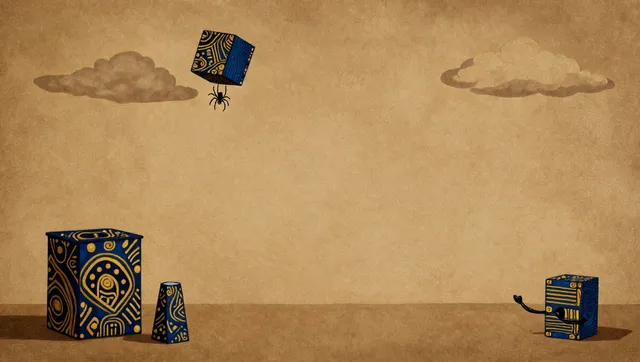
  • The small spider climbs to Nyame’s boxXenLook AI interpretation

    Adinkra Symbols

    Alike
    In both, each pattern carries a meaning, and is placed on cloth or objects to convey the community’s values. The meanings of the sea serpent and the bird are likewise passed down as named patterns.
    Different
    Adinkra are signs stamped repeatedly on cloth, while okir is vine ornament carved and pierced in wood and brass. Adinkra are close to words, while okir is ornament that shows rank and household.
    Go to this room

Quiz

Pick one to see the answer and why.

  1. 1. Which okir type is the mostly curvilinear ‘male’ pattern?

  2. 2. On the first scabbard, where are the carved vines gathered?

  3. 3. What is the strongest clue to a figure in the Botong manner?

  4. 4. What is the panolong of a torogan modelled on?

  5. 5. In the rainy-grandmother picture, where is the okir-like element?

Paint it

A sentence written for this style is ready. Copy it or take it straight to the studio.

Grandmother telling talesXenLook AI interpretation

Philippine mural-style narrative scene, flat figures outlined in dark brown contour, warm ochre ground, scrolling fern-and-vine okir border, patterned woven cloth, bright primary accents of red, yellow and teal, crowded rhythmic composition

Try changing Change the setting from a plane cabin to a market alley. Keep the vine border and figure outlines, and the same style holds.

Paint in the studio

The sentence is copied. Paste it into the studio's input box.

Sources

Every original here was released into the public domain (CC0) by The Cleveland Museum of Art. Artist, title, date and technique follow the museum records, which we checked again with their release terms on 2026-11-24. The commentary is written by XenLook.

Pictures marked “XenLook AI interpretation” were made by XenLook with XenArt. They are not historical paintings and no painter made them. Originals carry the “Original” mark and the name of the museum that holds them.

ติดตั้งแบบแอป