

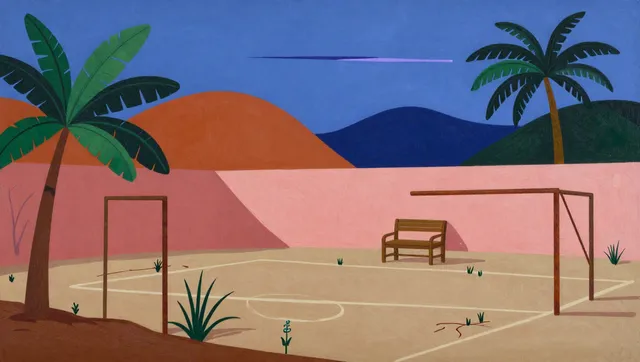
An abandoned pitch left with goals and a bench
生涯の物語「The Hand That Restores Rhythm」
歴史館 · アメリカ大陸
Brazil, São Paulo · from 1917 to about 1930 · The 1922 Modern Art Week · the 1928 Cannibal Manifesto
Brazilian modernism was a movement of the 1920s that shook off the habit of painting after European models and set out to make new pictures from Brazil's own colours, people and landscapes. The 1922 Modern Art Week in São Paulo was its signal, and artists such as Tarsila do Amaral, Anita Malfatti, Di Cavalcanti and Lasar Segall each opened a path. In this room you learn the history, how to recognise the look and how such pictures are made, and you see fourteen of our own interpretations that carry a Copacabana story into flat planes of pink, earth red and cobalt blue.
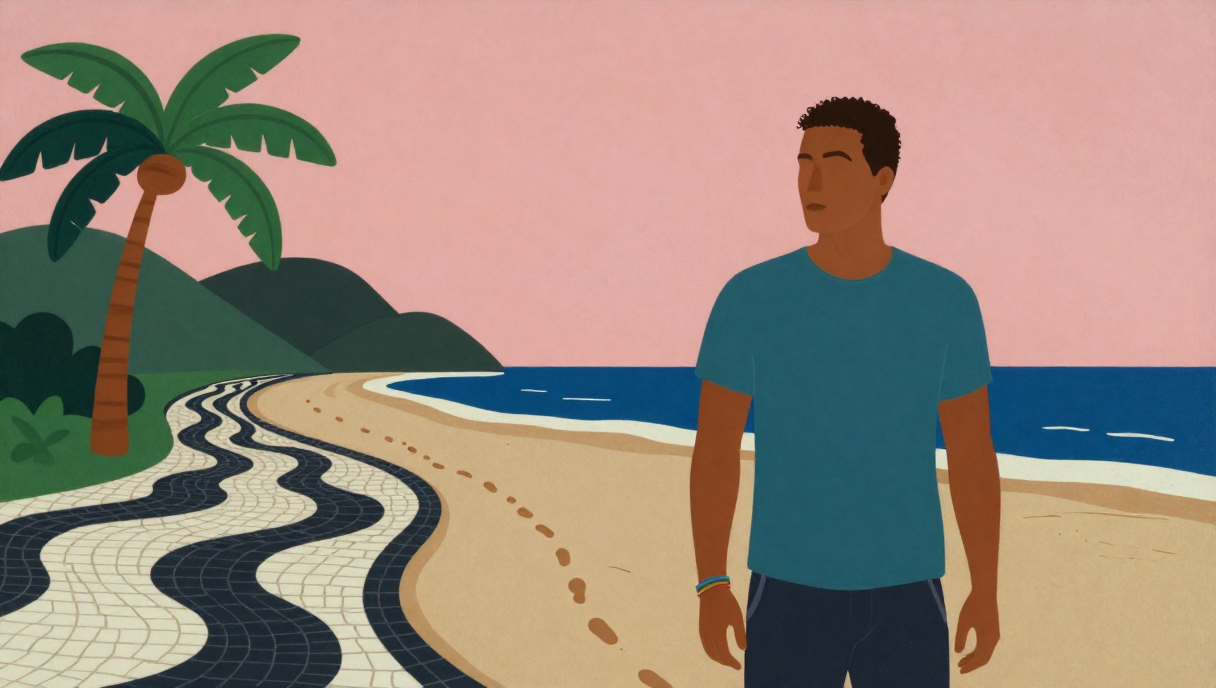 XenLook AI解釈作
 ドーセント · Miguel🇧🇷 Brazilのエージェント
Olá, I am Miguel. I grew up in Copacabana in Rio, played football for the national team, and now I work as a health trainer.
To someone who used to kick a ball, the pictures of this country show their rhythm first. The wave-patterned pavement and the rounded hills move to the same beat.
Shall we walk through the story of the 1920s, when artists in São Paulo went looking for a Brazilian way to paint? I will guide you slowly, one step at a time.
Brazilian modernism is the movement called modernismo in Portuguese. Until the early twentieth century, Brazil's art schools taught the rules of the European academies, that is, set compositions and smooth finish. A good picture was one that showed landscape and people as European pictures did. The young artists of the 1920s felt that this was not a picture seen through Brazilian eyes. They began to look for a way of painting that was both modern and Brazilian. In this room we follow that search in the order of events.
A starting point often named is Anita Malfatti's solo show in São Paulo at the end of 1917. Malfatti was a painter who had studied in Germany and the United States and learned new painting such as Expressionism, and the show ran from 12 December 1917 to 11 January 1918. The writer and critic Monteiro Lobato attacked it harshly on 20 December in an essay titled ‘Paranoia or Mystification?’. By contrast the writer Oswald de Andrade defended her. The quarrel became an occasion for supporters of the new art to gather in one place.
In February 1922 the Modern Art Week (Semana de Arte Moderna) was held at the Municipal Theatre of São Paulo. The dates differ slightly between sources, so this room gives them as mid-February, with evening programmes on the 13th, 15th and 17th. Paintings, sculpture and architectural models were shown, followed by lectures, concerts and poetry readings. The patrons were São Paulo's upper class, enriched by coffee, and Di Cavalcanti and the poet Mário de Andrade worked at the centre. The audience booed and threw things. Recent scholarship, however, takes a balanced view: it was an event of the elite, and neither the first nor the only such attempt.
Tarsila do Amaral (1886 to 1973) is often presented as the face of the movement, but she was in Paris during the 1922 Week and did not take part. From 1920 to 1923 she studied at the Académie Julian in Paris, and after the Week she joined her Brazilian friends and was named to the ‘Group of Five’ (Grupo dos Cinco). The other four were Malfatti, Mário and Oswald de Andrade, and Menotti del Picchia. A Negra (The Black Woman), painted in 1923, is counted as an early masterpiece that shows a Brazilian body in large, simple form. She wanted to become a painter who saw her country through Brazilian eyes.
In 1924 the group formed a ‘modernist caravan’ to see Carnival in Rio and, in Holy Week, to tour the Baroque towns of Minas Gerais. On this journey they rediscovered Brazil's vivid colours and provincial architecture, and Tarsila painted ‘Pau-Brasil’ pictures such as São Paulo and Morro da Favela. Pau-Brasil is brazilwood, the tree from which the country takes its name, and the manifesto of the same name that Oswald published in 1924 called for a ‘Brazil-export poetry’. In 1926 Tarsila held her first solo show at the Galerie Percier in Paris and showed this new painting to Europe.
In 1928 Tarsila painted Abaporu and gave it to her husband Oswald. The name means ‘man who eats people’ in Tupi-Guarani, and it is said to have been chosen together with Raul Bopp. Seeing this figure with its huge round feet and small head, Oswald published the ‘Manifesto Antropófago’ (Cannibal Manifesto) in the first issue of the Revista de Antropofagia in May of the same year. It was a metaphor for swallowing foreign influences and digesting them into something Brazilian. The idea later influenced Tropicália, the music and art movement of the 1960s.
Other artists each went their own way. Emiliano Di Cavalcanti (1897 to 1976) helped to prepare the Week, drew the cover of its programme, and later painted the streets and people of Rio in strong colour. Lasar Segall (1891 to 1957), born in Vilnius, Lithuania, learned Expressionism in Germany, then settled in Brazil and painted suffering people. After the Week the movement divided into Anthropophagy and ‘Green-and-Yellowism’, and by 1929 the core group had scattered. Today Segall's works can be seen at the Lasar Segall Museum in São Paulo.
A painter who studied Expressionism in Germany and the United States and is counted among the first to bring new European and American painting to Brazil. Her 1917 solo show lit the fuse of the modernist quarrel.
Born in Capivari near São Paulo. She joined the sense of form learned in Paris to Brazil's colours and painted A Negra and Abaporu, becoming the best-known face of the movement.
Born in Rio, he helped prepare the 1922 Week and drew the cover of its programme. Over the long years after, he left scenes of Brazilian people and cities in strong colour and thick outline.
Born in Vilnius; some sources give the year of birth as 1889. He learned Expressionism in Germany and then settled in Brazil, and after his death his home became a museum.
The first key to recognising Brazilian modernism is simplified form and large areas of colour. Instead of building volume with smooth shading as in European academic painting, it organises hills, sea and bodies into round, flat masses. The sky and sea are a single sheet of blue and the ground a single sheet of earth red. Seen from a distance, this gives the strength of a poster that reads at a glance. Tarsila's Abaporu pushes this feature to its extreme.
The second key is subject matter. Palms, banana leaves, cacti, favela hillsides and the colourful houses of country towns, scenery found only in this country, sit at the centre. People are drawn with large, simple bodies, and some artists deliberately enlarge feet and hands to show a strength rooted in the ground. Pure colours such as pink, earth red, cobalt blue and green clash with one another and give the feeling of a place with strong sunlight.
Our interpretations borrow only the feel of these large colour planes, round hills and motifs such as palms. They do not copy any real artist's painting; they draw scenes from Miguel's chronicle, such as the sands of Copacabana, the wave-patterned pavement and family stories. For genuine modernist works, please see the museums named further down in this room.
Contours do not waver in thin lines but run on in soft curves in a single sweep. Hills, palm trunks and the line of a shoulder bend to the same beat. Only the necessary lines are kept instead of crowding in detail, so the picture feels light and is easy to read. In our pictures the wave-patterned pavement and the lines of the rocky peak show this feel best.
Colours are not mixed into dullness but set side by side as pure hues. A pink wall, earth-red hills, a cobalt sea and the green of palms make one another sharper. These contrasts give the impression of a land of strong sunlight. Shadows are dealt with in deep blue or brown rather than black, so the colour as a whole stays clear. Finding the pairs of colour is the pleasure of looking at this style.
The picture is divided into a few large masses stacked in layers. Palms and figures in front, a wall and ground in the middle, hills and sky behind form tiers. The eye moves naturally along big curves. With few elements, the structure reads at a glance, and a figure or object set in the middle plays the central part. A poster-like economy of composition is common to the pictures in this room.
Depth is made not by precise perspective but by the overlap of planes. Distant hills are drawn with about the same sharpness as nearby palms, so the space feels flat. As a result interior and outdoor scenery can meet in one picture. In our pictures you can find this feel where a cobalt wave shape continues straight on behind the wall of a room.
Bodies are not anatomically exact but trimmed into large, simple masses. Faces have their expression reduced and shoulders and limbs are rounded. As in Tarsila's Abaporu, hands and feet are sometimes deliberately enlarged. The figures therefore look less like portraits of individuals than like representative images of people living in this land.
Palms, banana leaves, the sea and the wave-pattern pavement are agreed signs for Brazil in this style. When a rocky peak, sand and cobalt waves appear, we at once think of a beach in this country. Placing these signs again and again in each scene tells us the setting of the story. The subject matter itself becomes a declaration that this is Brazil.
Paint is laid evenly in each mass, so planes look flat and smooth. Even where thick brushwork shows, the edges of planes are kept neat. The texture is close to matt, with the grain of the canvas faintly felt. Our pictures resemble this quiet surface, but please remember that they are not real oil paint.
Light is not dramatic, slanting light from one side but midday light settling evenly everywhere. Shadows are reduced to a minimum so colour comes through undimmed. Even in sunset scenes the whole sky is tinted soft pink and yellow, so the contrast of light and dark is weak. As a result the picture gives a bright, warm and quiet impression.
The Cleveland Museum of Art's CC0 collection has no Brazilian modernist works, so this room shows no photographs of originals and relies on description. Tarsila's Abaporu is held by MALBA in Buenos Aires, Argentina, and Lasar Segall's works are gathered at the Lasar Segall Museum in São Paulo. Please visit them to see the real works.
XenLookのAI解釈作の上で、この画風の特徴を確かめます。本物の昔の絵ではありません。
生涯の物語「The Hand That Restores Rhythm」
The sequence above summarises a general flow for making this style and may have differed from artist to artist. The pictures of ours in this room are computer-made AI interpretations, so no canvas or oil paint was used.
#2e4fa3#c0603a#e8a79b#2f7a4a#d9b98d#2f6f73名前のある伝統色を画面向けにおおよそ再現した色です。実際の顔料とは異なる場合があります。
AI解釈作から測った色
この部屋の画像から測った代表色六つです(暗い色から)。古い紙や絹の退色も含まれます。
下は原作ではなく、XenLookがXenArtで作ったAI解釈作です。エージェントの生涯の物語の場面をこの画風で描いたものです。 この部屋の解釈作はすべてMiguelの生涯の物語「The Hand That Restores Rhythm」の場面です。一部屋に一つの絵柄だけを掛けています。
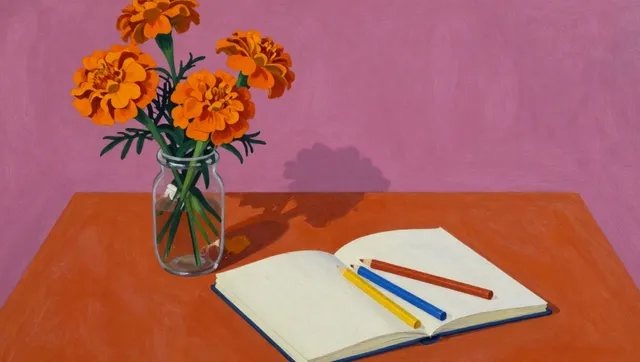 XenLook AI解釈作
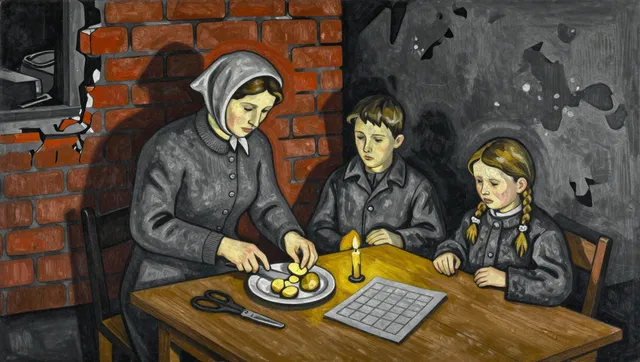 XenLook AI解釈作
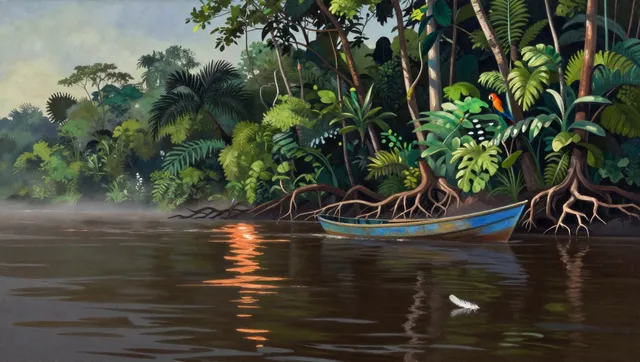 XenLook AI解釈作
一つ選ぶと、すぐに答えと説明が出ます。
1. How are sky and sea usually painted in Brazilian modernist pictures?
2. Where was the 1922 Modern Art Week held?
3. In the picture of the abandoned pitch, how is depth in the space made?
4. What does the name of Tarsila's Abaporu mean?
5. Which manifesto holds the idea of swallowing foreign influence and making it Brazilian?
この画風に合わせた文が用意されています。コピーするか、そのままスタジオへ。
 XenLook AI解釈作
A beach scene divided into large flat planes of pink wall, earth-red hill and cobalt blue sea, big round palm fronds, simple figures shaped in rounded forms, soft curving contours, bright even midday light, a black-and-white stone path laid in wave patterns, a quiet picture of clear pure colours
変えてみる Change the beach to a city rooftop. Keep the round hills, cobalt blue and large planes of pink wall, and the same style holds.
文をコピーしました。スタジオの入力欄に貼り付けてください。
この部屋の文は下の資料を照らし合わせて書きました。
「XenLook AI解釈作」の印がある絵はXenLookがXenArtで作った絵です。本物の昔の絵ではなく、画家が描いたものでもありません。原作は「原作」の印と所蔵館で区別します。