In the 1890s London was a city of print. New magazines piled up at every railway bookstall and bookshop, and thanks to photographic blockmaking (製版), which photographed a pen drawing and transferred it to a metal plate, an artist's line could be printed exactly and cheaply. The older generation, William Morris and Walter Crane, believed that beautiful books and ornament could change daily life, and that idea spread as the Arts and Crafts movement. On top of this current, young artists tried out bolder lines. At about the same time colour posters from Paris and Japanese woodblock prints were shown in London, and flat areas and daring empty space were welcomed as a new kind of beauty.
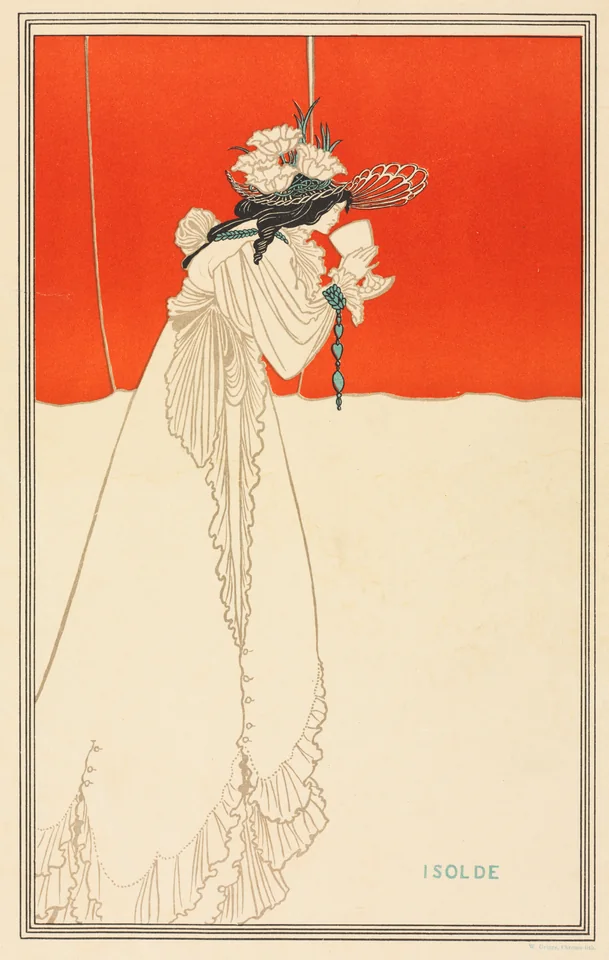
The name that stands for this age is Aubrey Beardsley. Born in Brighton in 1872, he chose the path of art in 1891 on the advice of the painters Burne-Jones and Puvis de Chavannes. The next year he went to Paris and saw the posters of Toulouse-Lautrec and Japanese prints, and in 1893 he received his first large commission from the publisher J. M. Dent: the illustrations for Le Morte d'Arthur. Then his black-and-white drawings for Oscar Wilde's play Salome made his name almost overnight. Pictures that showed desire and unease with nothing but masses of black ink and hair-fine lines drew praise and attack in equal measure.
In 1894 the London publisher The Bodley Head (Elkin Mathews and John Lane) launched the quarterly The Yellow Book. Beardsley started the magazine with the writer Henry Harland and was its art editor for the first four issues, drawing covers and illustrations. With black pictures set on a yellow cover, it ran until 1897 and became a symbol of fin-de-siècle London. Beardsley later helped to found the magazine The Savoy, and he also published drawings in The Studio, the art magazine founded by Charles Holme in 1893. He died of tuberculosis in Menton, France, in 1898, at the age of twenty-five, yet his work of a little over seven years gave a strong spark to artists across Europe.
In street posters the Beggarstaffs opened a new road. They are often called the 'Beggarstaff Brothers', but they were not brothers: it was the name shared from 1894 to 1899 by William Nicholson and his brother-in-law James Pryde. In the summer of 1894, making a poster for the actor Gordon Craig's Hamlet, the two cut and pasted black paper and stencilled the design onto brown wrapping paper. Shown that November at a poster exhibition at the Royal Aquarium in London, their works showed a way of building form from large areas of colour with no outline at all. This simplicity, readable at a glance from far away, later became a model for many poster designers.
In Glasgow, to the north, another voice was heard. Charles Rennie Mackintosh, Herbert MacNair and the sisters Margaret and Frances Macdonald, who met around 1892 at the Glasgow School of Art, came to be called 'The Four'. Mixing the ornament of the Celtic Revival, the Arts and Crafts movement and a feeling for Japanese art, they made tall stretched figures, lines that rise straight up and rose motifs curled into rounds. At first a mocking nickname, the 'Spook School', was attached to them. In 1896 Margaret and Frances opened a studio on Hope Street, and in 1900 Margaret and Mackintosh took part in the Vienna Secession exhibition and are judged to have influenced artists on the Continent.
As the century turned, the line went back into books. In 1905 Arthur Rackham filled Rip Van Winkle, published by Heinemann, with fifty-one colour plates made by colour-separated printing, and the next year he drew Peter Pan in Kensington Gardens. His pictures, with pale colour laid over fine pen lines, led the golden age of British illustration along a road different from Beardsley's black and white. The habits of this room, the contrast of black and white, the empty space left alone and the simple silhouette readable from afar, still live on in book covers and posters today. Their trace may be hiding even in a poster you pass in the street.