Today’s colour picture book blossomed from English woodblock printing in the late nineteenth century. The London printer Edmund Evans made children’s books by cutting a separate wooden block for each colour and printing them one over another. In 1877 he asked the illustrator Randolph Caldecott for two Christmas books, and in 1878 The House that Jack Built and The Diverting History of John Gilpin appeared. Caldecott’s pen drawings, made of thin lines and wide white spaces, suited wood-engraved printing especially well. Rather than simply illustrating a story, he interpreted it in pictures, opening the way for picture books in which words and images answer each other.
In 1879 Evans also printed Kate Greenaway’s Under the Window, which became an instant best-seller. Born into a working-class family in Hoxton, London, and starting out designing greeting cards, Greenaway created the ‘Greenaway style’ by drawing children dressed in her own versions of late eighteenth- and early nineteenth-century clothes. Within a few years her pictures were widely imitated in England, Germany and the United States, used on calendars, plates and textiles, and even influenced real children’s fashion. Mother and Child, which hangs in this room, is an ancestor work that shows that tender world.
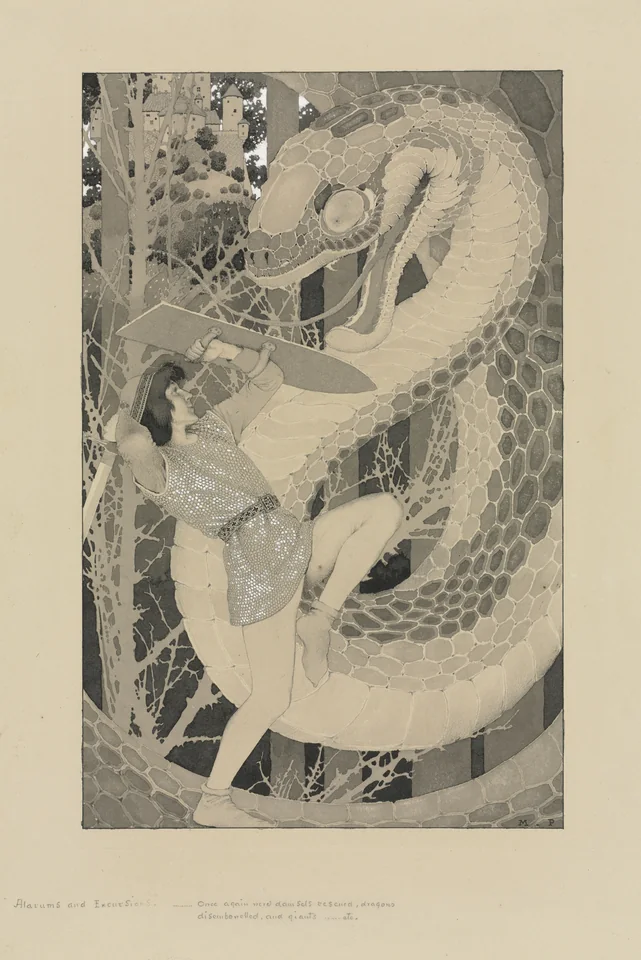
At the same time, the ‘Golden Age’ of illustration unfolded in America. Howard Pyle published pictures and writing in magazines such as the children’s monthly St. Nicholas and taught young illustrators at the Drexel Institute in Philadelphia. One of his students, Maxfield Parrish (1870–1966), worked for more than half a century and left close to 900 works, from calendars and greeting cards to magazine covers. In 1899 he drew nineteen illustrations for Kenneth Grahame’s children’s book The Golden Age, mostly in black and white as was typical of his early work. This room’s Alarums and Excursions is one of them, showing the picture-book habit of taking a child’s imagination seriously.
In 1937 the publisher Frederic G. Melcher proposed an award for American picture-book artists, named after the English Caldecott. The sculptor René Paul Chambellan designed the medal that year, and the scene on its front comes from Caldecott’s cover illustration for The Diverting History of John Gilpin. Every year the Association for Library Service to Children, a division of the American Library Association, gives the medal to the artist of the ‘most distinguished American picture book for children’. The first went in 1938 to Animals of the Bible, illustrated by Dorothy P. Lathrop with text selected from the Bible by Helen Dean Fish. English woodblock picture books had grown into an award of American libraries.
Brooklyn is where two masters of the American picture book were born. Ezra Jack Keats (1916–1983) was born Jacob Ezra Katz to a poor family of Polish-Jewish immigrants in East New York, Brooklyn, and from childhood he made pictures from whatever scraps of wood, cloth and paper he could collect. The Snowy Day, published in 1962, follows Peter, an African American child exploring his neighbourhood after the first snowfall, and won the 1963 Caldecott Medal for its collage of cut paper and patterned cloth. It became the first picture book with an African American protagonist to win a major children’s award. This room introduces the book in words only and does not hang it.
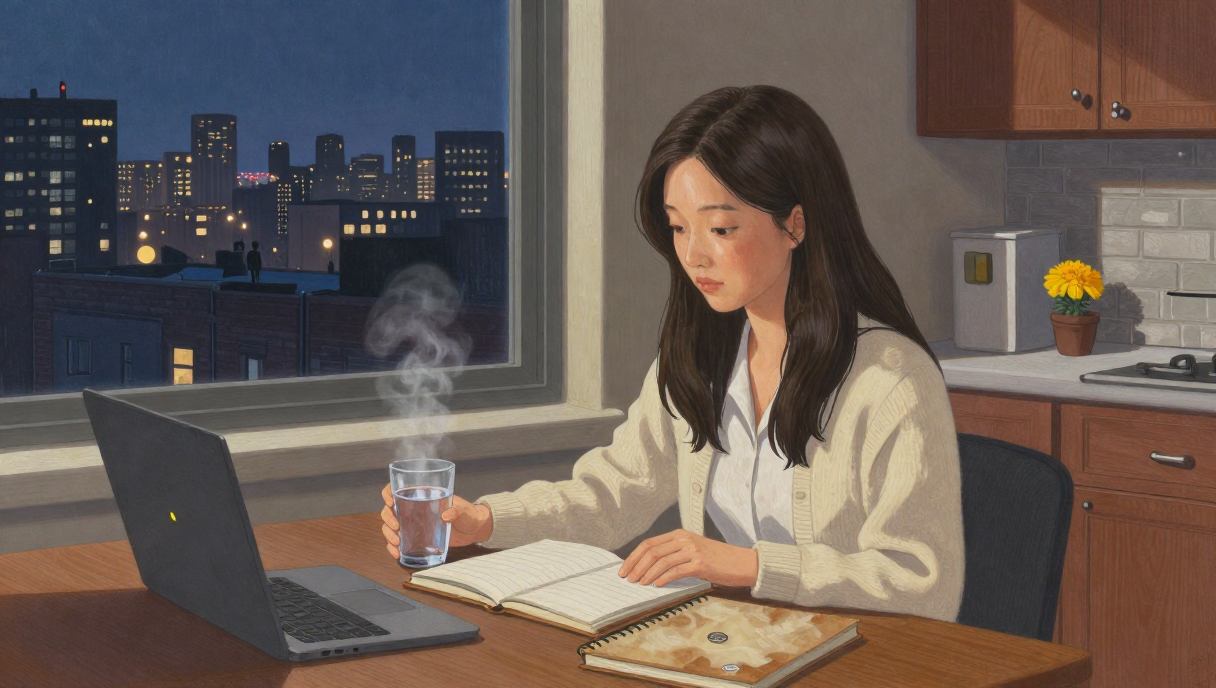
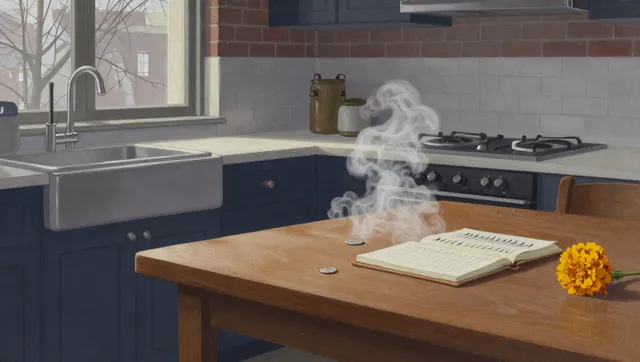
Maurice Sendak (1928–2012) was also born in Brooklyn, the child of Polish-Jewish immigrants. Where the Wild Things Are, published by Harper & Row in 1963, tells of Max, a boy in a wolf suit who makes mischief, is sent to his room, and sails across an imagined sea to an island of monsters; it won the 1964 Caldecott Medal. Sendak followed it with In the Night Kitchen (1970) and Outside Over There (1981) to form a trilogy. A child’s night, imagination and the kitchen as a stage share a feeling with the night kitchens of this room’s AI interpretations. These books, too, are told in words only and not hung.