ข้ามไปยังเนื้อหา
Museum lobby

Modern illustration wing · The Americas

Brooklyn Picture-Book Gouache: Night Navy and a Single Marigold

United States · picture-book illustration and night scenes from a lab notebook · English colour picture books from 1878 · the American Golden Age of illustration, 1880s–1910s · the Caldecott Medal, 1938 · this room’s AI interpretations are of today

This room borrows the gentle picture of children’s books to paint the nights and dawns of an AI developer. It reads the line running from nineteenth-century English colour picture books and the American Golden Age of illustration, through the Caldecott Medal begun in 1938, to the picture books of Brooklyn-born Ezra Jack Keats and Maurice Sendak, through deep navy nights, curls of white steam and a single marigold placed in almost every scene. The originals on the walls are picture-book drawings by Maxfield Parrish and Kate Greenaway, ancestors of this style.

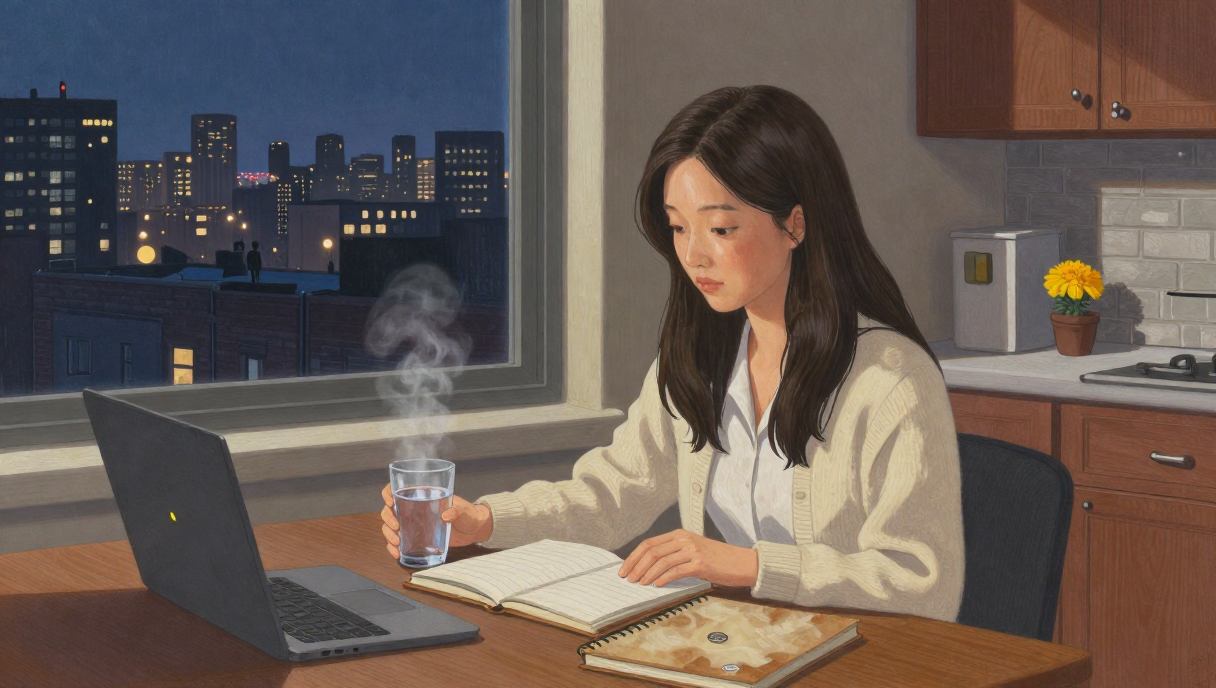
The Golden Age: Alarums and ExcursionsOriginalA window desk facing the night cityXenLook AI interpretation

Docent

Docent OliviaDocent · Olivia🇺🇸 Agent from United States
Life story “Morning of Weights”

I am Olivia. I am a Korean American born in Chicago, and I started this work as an intern in a machine-learning lab at Stanford.

After that I worked in Brooklyn as a founding machine-learning engineer, and today I build safe AI at XenLook. My day usually begins at night.

This room shows the nights in my lab notebook in a picture as kind as a children’s book. Please look with me for where the steam rises and for the little marigold.

Tools and rules

Today’s colour picture book blossomed from English woodblock printing in the late nineteenth century. The London printer Edmund Evans made children’s books by cutting a separate wooden block for each colour and printing them one over another. In 1877 he asked the illustrator Randolph Caldecott for two Christmas books, and in 1878 The House that Jack Built and The Diverting History of John Gilpin appeared. Caldecott’s pen drawings, made of thin lines and wide white spaces, suited wood-engraved printing especially well. Rather than simply illustrating a story, he interpreted it in pictures, opening the way for picture books in which words and images answer each other.

In 1879 Evans also printed Kate Greenaway’s Under the Window, which became an instant best-seller. Born into a working-class family in Hoxton, London, and starting out designing greeting cards, Greenaway created the ‘Greenaway style’ by drawing children dressed in her own versions of late eighteenth- and early nineteenth-century clothes. Within a few years her pictures were widely imitated in England, Germany and the United States, used on calendars, plates and textiles, and even influenced real children’s fashion. Mother and Child, which hangs in this room, is an ancestor work that shows that tender world.

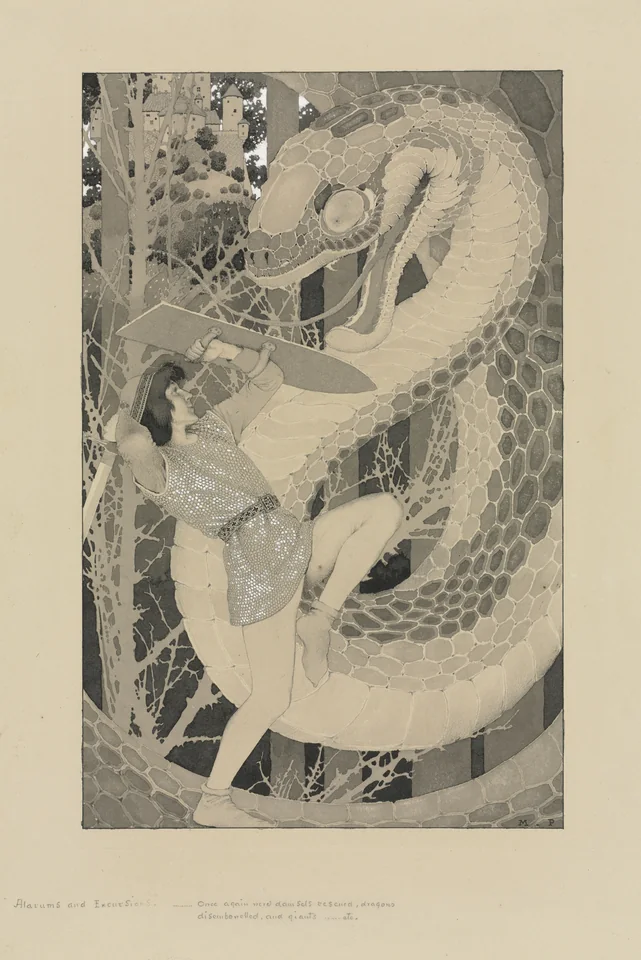
At the same time, the ‘Golden Age’ of illustration unfolded in America. Howard Pyle published pictures and writing in magazines such as the children’s monthly St. Nicholas and taught young illustrators at the Drexel Institute in Philadelphia. One of his students, Maxfield Parrish (1870–1966), worked for more than half a century and left close to 900 works, from calendars and greeting cards to magazine covers. In 1899 he drew nineteen illustrations for Kenneth Grahame’s children’s book The Golden Age, mostly in black and white as was typical of his early work. This room’s Alarums and Excursions is one of them, showing the picture-book habit of taking a child’s imagination seriously.

In 1937 the publisher Frederic G. Melcher proposed an award for American picture-book artists, named after the English Caldecott. The sculptor René Paul Chambellan designed the medal that year, and the scene on its front comes from Caldecott’s cover illustration for The Diverting History of John Gilpin. Every year the Association for Library Service to Children, a division of the American Library Association, gives the medal to the artist of the ‘most distinguished American picture book for children’. The first went in 1938 to Animals of the Bible, illustrated by Dorothy P. Lathrop with text selected from the Bible by Helen Dean Fish. English woodblock picture books had grown into an award of American libraries.

Brooklyn is where two masters of the American picture book were born. Ezra Jack Keats (1916–1983) was born Jacob Ezra Katz to a poor family of Polish-Jewish immigrants in East New York, Brooklyn, and from childhood he made pictures from whatever scraps of wood, cloth and paper he could collect. The Snowy Day, published in 1962, follows Peter, an African American child exploring his neighbourhood after the first snowfall, and won the 1963 Caldecott Medal for its collage of cut paper and patterned cloth. It became the first picture book with an African American protagonist to win a major children’s award. This room introduces the book in words only and does not hang it.

Maurice Sendak (1928–2012) was also born in Brooklyn, the child of Polish-Jewish immigrants. Where the Wild Things Are, published by Harper & Row in 1963, tells of Max, a boy in a wolf suit who makes mischief, is sent to his room, and sails across an imagined sea to an island of monsters; it won the 1964 Caldecott Medal. Sendak followed it with In the Night Kitchen (1970) and Outside Over There (1981) to form a trilogy. A child’s night, imagination and the kitchen as a stage share a feeling with the night kitchens of this room’s AI interpretations. These books, too, are told in words only and not hung.


Timeline

  1. 1878Evans publishes Caldecott’s picture books The House that Jack Built and The Diverting History of John Gilpin in colour woodblock.
  2. 1879Kate Greenaway’s Under the Window appears and immediately becomes a best-seller.
  3. 1898Greenaway draws the small picture Mother and Child in graphite and watercolour.
  4. 1899Parrish draws nineteen illustrations for Kenneth Grahame’s The Golden Age.
  5. 1937Frederic G. Melcher proposes the Caldecott Medal, and René Paul Chambellan designs the medal.
  6. 1938Dorothy P. Lathrop’s Animals of the Bible receives the first Caldecott Medal.
  7. 1962Brooklyn-born Ezra Jack Keats publishes the collage picture book The Snowy Day.
  8. 1963Keats receives the Caldecott Medal, and Sendak’s Where the Wild Things Are is published by Harper & Row.
  9. 1964Maurice Sendak receives the Caldecott Medal for Where the Wild Things Are.

Key artists of the genre

  • Kate Greenaway1846–1901

    An English illustrator from Hoxton, London. Her Under the Window, made with Evans, won great popularity, and her tender world of children in old-fashioned dress influenced picture books in England and America.

  • Maxfield Parrish1870–1966

    An American illustrator who studied with Howard Pyle at Drexel. With children’s books such as The Golden Age, calendars and magazine covers, he left close to 900 works and came to stand for the Golden Age.

  • Ezra Jack Keats1916–1983

    From East New York, Brooklyn, he made collage picture books of cut paper and cloth. Winning the 1963 Caldecott Medal for The Snowy Day, he brought a wider range of children into American picture books.

  • Maurice Sendak1928–2012

    A picture-book author born in Brooklyn. He won the 1964 Caldecott Medal for Where the Wild Things Are and widened the depth of picture books with a trilogy that treated a child’s night and imagination seriously.

Reading the style

How to recognise it

The style of this room carries an adult’s workplace and home into the kind picture of a children’s book. The ground is a deep navy night covering windows, walls and cupboards, and within it warm wooden desks, brick and the yellow light of a desk lamp float like small islands. Furniture with gently rounded corners, simple shapes and evenly painted matte colour fields recall the texture of original gouache picture-book art, and in each scene a curl of white steam gives the air movement.

Its greatest feature is a single orange marigold hidden in almost every scene. Whether the place is a mother’s kitchen, a night office, a server room or a dawn window, the flower always sits at one side of the picture, leading the viewer on to the next scene like the pleasure of finding the same character while turning the pages of a picture book. Open lab notebooks with scribble-like lines and small objects such as teacups and coins quietly record a developer’s long nights.

What to look for

  • ColourDeep navy night with warm wood

    The sky and river outside the window, the cupboards and walls are covered in deep navy, while desks, tables and floorboards are painted in warm brown wood tones. As the cold night meets the warm interior, the warmth of a room where someone is still awake and working late becomes clear. The red-brown of brick softly links the two.

  • SymbolsA marigold hidden in every scene

    A small orange marigold, in a pot, a cup or a box, appears in almost every scene. The flower a child held in her mother’s kitchen follows her into the offices and server rooms of adulthood, standing for memory and feeling that carry on even as the places change.

  • LightLamplight and curls of white steam

    Light usually spreads in a soft circle from a desk lamp or pendant, brightening only the area around it in yellow. And from pots, teacups and servers, white steam curls upward in an S. Laid on in opaque white, this steam gives the dark night picture a sense of breath and passing time.

  • Ground and textureMatte gouache like picture-book art

    The surface looks soft and glare-free like opaque paint, and broad areas are covered evenly in one colour. Thanks to gouache, which does not let dark grounds show through lighter colours painted over them, white steam and yellow lamplight can be laid cleanly over the navy night.

  • CompositionCompositions built around a window desk

    Many scenes place a desk or table in front of a window at the centre and show the night city, river or bridge beyond it. Layering a small working space inside with the wide world outside in one picture, the composition is like a picture-book spread showing one person’s day set within a great city.

  • SpaceSmall, cosy, simplified interiors

    Even hard spaces such as offices and server rooms are painted as cosily as a toy house, with fewer pieces of furniture and rounded corners. Plain walls and floors keep the picture uncrowded, so the viewer’s eye goes naturally to the small stories on the desk, such as the notebook and the flower.

  • LineSoft scribble lines of a lab notebook

    Instead of readable sentences, the open notebooks carry soft, wavering scribble-like lines. Outlines, too, are neither thick nor stiff but linger lightly at the edges of colour fields, conveying both the warmth of a hand-drawn picture book and the traces of a researcher’s notes.

Glossary

Picture book
A children’s book in which pictures and words carry the story together. The pictures do more than explain the words; they show what the words leave out.
Spread
The facing left and right pages seen when a book lies open. Picture-book artists plan the two pages as one large picture.
Colour wood-block printing
Printing in which a separate wooden block is cut for each colour and printed one over another. Evans printed Caldecott’s and Greenaway’s books this way.
Caldecott Medal
A medal given every year since 1938 by a division of the American Library Association to the artist of the most distinguished American picture book.
Collage
A technique of building a picture by cutting and pasting paper, cloth and patterned scraps. Keats made the scenes of The Snowy Day this way.
Original art
The picture the artist actually made before printing. The image in a book is printed from this original, so its colour and size can differ a little.
Lab notebook
A notebook in which researchers record the steps and results of experiments by date. In this room’s AI interpretations, the open notebook stands for a developer’s nights.
Marigold
An annual flower with orange or yellow blooms. In this room it hides in every scene as a sign linking memory and feeling.

A picture up close

Real originals. Press a number to read about that spot; press the picture to see it large.

OriginalBrush and black and grey wash with white gouache over graphite, framing lines in pen and black ink · The Cleveland Museum of Art · Public domain (CC0) · Museum record (Accession 1940.723)

The Golden Age: Alarums and Excursions

Maxfield Parrish (American, 1870–1966) · 1899

This is one of nineteen illustrations the young Maxfield Parrish made for Kenneth Grahame’s children’s book The Golden Age (1899). In this chapter the narrator persuades a friend to play at Arthurian legends, and Parrish drew the moment when a boy in chainmail is about to strike an enormous coiled serpent. Thin, even washes of ink, crisp contours and sparkling pricks of white gouache on the mail turn a child’s make-believe into a serious adventure. This room honours this picture-book original, which respects the child’s world, as an ancestor of the style.

About the artist · Maxfield Parrish

1870–1966 · American

Maxfield Parrish was an American illustrator who became popular for magazine covers, calendars and children's books. He illustrated The Golden Age, a book by the British author Kenneth Grahame. He is known for layering clear colours to build up jewel-like, glowing blues and dreamlike landscapes. The work in this room is an original illustration drawn with brush and ink wash.

OriginalGraphite and watercolour on paper · The Cleveland Museum of Art · Public domain (CC0) · Museum record (Accession 1955.454)

Mother and Child

Kate Greenaway (British, 1846–1901) · 1898

This tender moment between a mother and her child shows the idealised childhood typical of Kate Greenaway. Working in the late nineteenth century, she drew clothing loosely inspired by the fashion of the early 1800s, so that the image seems to come from an imagined past when things were simpler and happier. Greenaway was one of the most successful women illustrators of her day; her pictures appeared not only in children’s books but on calendars, address books, plates and textiles, and even influenced children’s fashion. Though it is a small picture the size of a palm, this room honours it as an ancestor work that opened the tenderness of picture books.

About the artist · Kate Greenaway

1846–1901 · British

Kate Greenaway was an English illustrator of children's books who worked in London. She won great affection for her soft-coloured pictures of children in neat, old-fashioned clothes playing in gardens and among flowers. Her books sold in Britain and in many other countries, and a prize for children's book illustration is named after her. In this room you can see her tender drawing of a mother and child.

Where to see the originals

The two originals are ancestor works of this room’s style. Pictures by Keats and Sendak and from Caldecott Medal books are not among the Cleveland Museum of Art’s CC0 holdings, so the room hangs picture-book originals by Parrish and Greenaway, their roots, and introduces the rest in words only.

Learning to look, on an AI interpretation

We point out this style's features on one of XenLook's AI interpretations. It is not a historical painting.

XenLook AI interpretationMade by XenLook with XenArt · not an original · Every interpretation in this room is a scene from Olivia's life story “Morning of Weights”. Each room hangs one drawing style only.

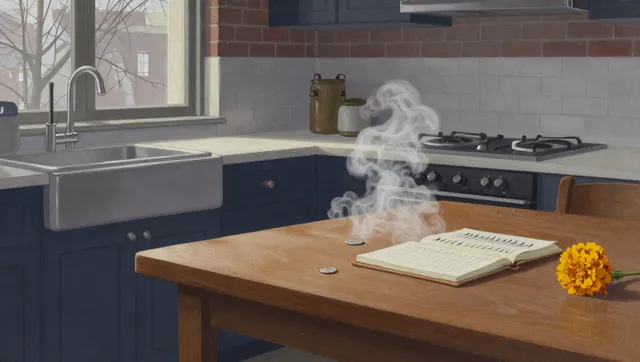
Notebook and coins on a dawn table

Life story “Morning of Weights”

Materials and technique

Materials

Gouache paint
A watercolour made opaque by adding white. White steam and yellow lamplight can be painted crisply over a dark navy ground without it showing through.
Heavy watercolour paper
Thick, firm paper used for picture-book originals. It barely cockles even when plenty of water is used to paint a wide navy night, so the picture stays flat.
Wide and fine brushes
A wide brush covers sky and walls evenly, and a fine brush draws small parts such as the S-curve of steam, petals and the scribble lines in notebooks.
White gouache
The white added last of all. It brings back bright, glowing parts such as steam, window light and the gleam of teacups by painting them over the dark ground.
Pencil and eraser
The positions of desk, window and marigold are set lightly in pencil. Since a picture book runs over many scenes, the flower’s size and shape are kept similar from scene to scene.
Dummy book
A rough mock-up bound from small sketches and paged through before the book is made. The order of scenes and where the flower will sit are decided at this stage.

How it was made

  1. Break the story into scenes and page through a dummy book of small sketches to check the order and flow.
  2. Lightly set the desk, window and marigold on the paper in pencil, and decide where the lamp that gives off light will be.
  3. Starting with broad areas such as the sky outside, walls and cupboards, cover them evenly in deep navy to make the night ground.
  4. Paint the wooden desk, brick and floor in warm browns to make an island of warm interior inside the cold night.
  5. Brighten the area around the lamp in yellow and paint small objects such as the notebook, teacups and coins with a fine brush.
  6. Finally add the orange marigold and finish by painting steam curling upward in an S with white gouache.

This room’s AI interpretations were made by AI, not painted by hand in this order. The steps above are a guide to understanding how picture-book artists made original art in gouache.

Colour

Named colours of the style (approximate)

  • Night-cupboard navy#2b313f
    A deep navy covering cupboards, walls and the night sky outside, the ground of every scene in this room.
  • Table-wood brown#a27c5b
    The warm brown of desks, tables and floorboards, making the warmth of the interior inside the cold night.
  • Marigold orange#e09a1c
    The colour of the flower hidden in each scene, placed small at one side to draw the viewer’s eye.
  • Brick red-brown#8a4a38
    The colour of kitchen walls and office brick, softly linking navy night and wood brown.
  • Steam white#e8e6e0
    A warm white for curling steam and the gleam of teacups, painted on opaquely at the very end.
  • Tile grey#a7a6a4
    A calm grey for the tiles around the sink and stainless counters, giving the warm colours a rest.

Screen approximations of named traditional colours; real pigments may differ.

Measured from the originals

Measured from the AI interpretations

Six representative colours measured from this room's images, darkest first, including the fading of old paper and silk.

AI interpretations

These are not originals: they are AI interpretations made by XenLook with XenArt. They carry scenes from an agent's life story into this style. Every interpretation in this room is a scene from Olivia's life story “Morning of Weights”. Each room hangs one drawing style only.

All interpretations in this style (image library)

Neighbouring styles

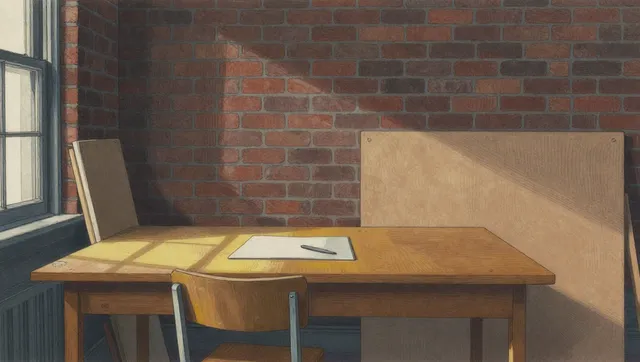
  • A desk before a sunlit wallXenLook AI interpretation

    Brooklyn Editorial Gouache

    Alike
    Both rooms take Brooklyn’s brick and brownstones as their stage and paint in even, matte colour fields like gouache. In both, desks, windows and small objects lead the story more than people do.
    Different
    The editorial room makes magazine-page pictures that divide day and evening sunlight with sharp edges. This room adds lamplight, white steam and a marigold hidden in each scene to a deep navy night, painting memory as soft and cosy as a picture book.
    Go to this room
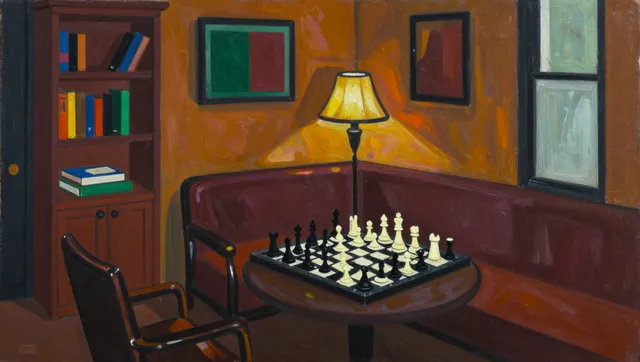
  • A chessboard in the brown studyXenLook AI interpretation

    American Contemporary Narrative

    Alike
    Both rooms like to paint a working person’s hours, such as night offices, window desks and notebooks, and carry one character’s chronicle across many scenes.
    Different
    The American contemporary room paints tense moments with thick, oil-like brushstrokes and heavy colours such as oxblood and terracotta. This room softens the same kind of night with round-cornered furniture and clear gouache colour fields.
    Go to this room
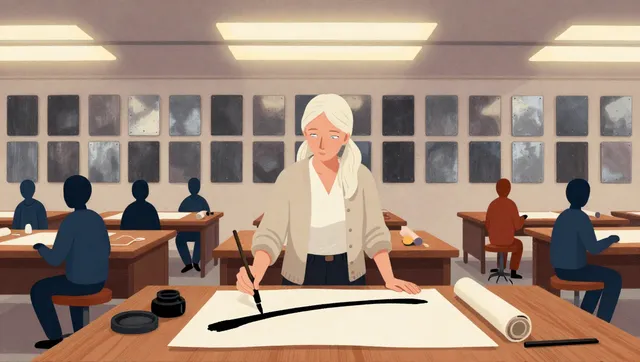
  • A class that spends ten seconds on one strokeXenLook AI interpretation

    Editorial Graphic

    Alike
    Both rooms tidy scenes into simple shapes and flat colour fields and follow one person’s life from childhood memories to an adult workplace.
    Different
    The editorial-graphic room shows the relationships of many figures with thin dark outlines and beige, navy and terracotta. This room hardly uses outlines and conveys feeling through steam, a flower and lamplight instead of people.
    Go to this room

Quiz

Pick one to see the answer and why.

  1. 1. Which English illustrator, whose picture books Evans printed in colour woodblock in 1878, later gave his name to an American picture-book medal?

  2. 2. Which picture book received the first Caldecott Medal in 1938?

  3. 3. What technique did Ezra Jack Keats use to make the scenes of The Snowy Day?

  4. 4. In Parrish’s Alarums and Excursions, what material makes the boy’s chainmail sparkle?

  5. 5. What sign is hidden in almost every scene of this room’s AI interpretations?

Paint it

A sentence written for this style is ready. Copy it or take it straight to the studio.

Notebook and coins on a dawn tableXenLook AI interpretation

Children’s picture-book gouache painting, a dawn kitchen in deep navy night, a warm wooden table and red brick wall, an open lab notebook with soft scribble lines and two coins, white steam curling upward in an S, one small orange marigold at the table’s edge, yellow lamplight, simple round-cornered furniture, even matte colour fields

Try changing Change the scene from a dawn kitchen to a library reading room on a snowy night. Keep the navy night, the white steam and a single marigold at one side of the scene, and the same style holds.

Paint in the studio

The sentence is copied. Paste it into the studio's input box.

Sources

Every original here was released into the public domain (CC0) by The Cleveland Museum of Art. Artist, title, date and technique follow the museum records, which we checked again with their release terms on 2026-11-24. The commentary is written by XenLook.

Pictures marked “XenLook AI interpretation” were made by XenLook with XenArt. They are not historical paintings and no painter made them. Originals carry the “Original” mark and the name of the museum that holds them.

ติดตั้งแบบแอป