

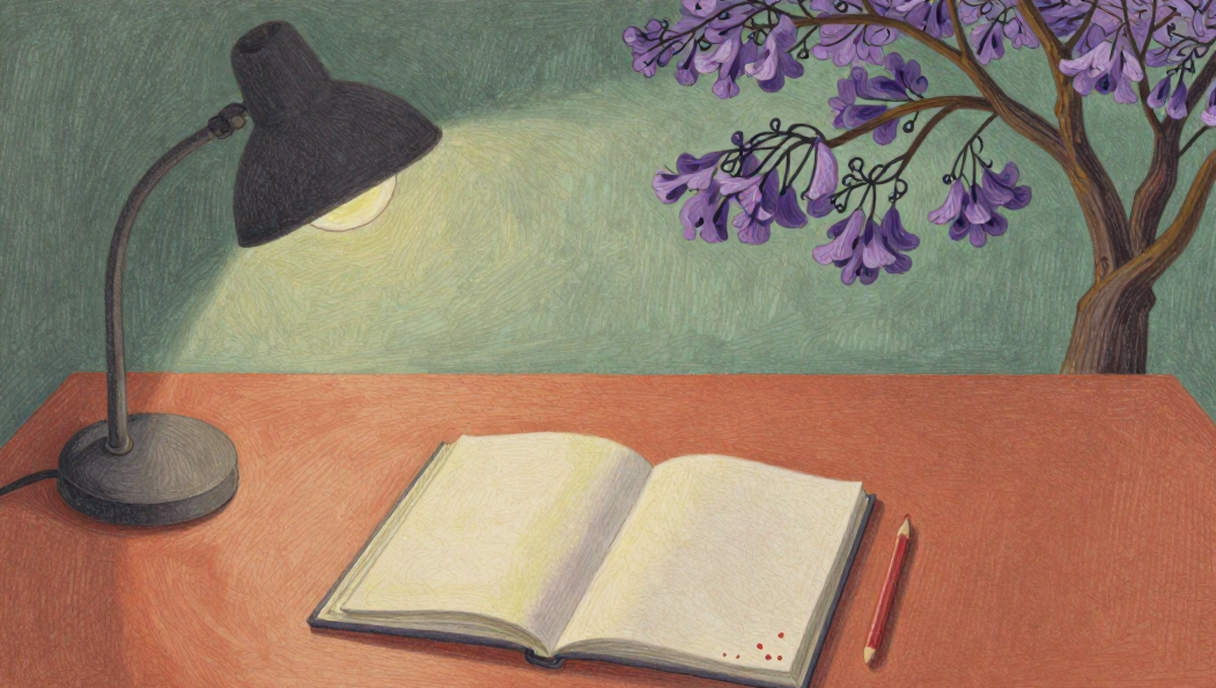
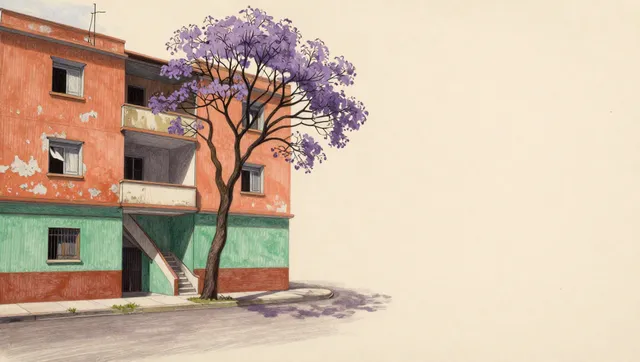
A jacaranda before a peeling apartment block
生涯の物語「The Sentence of the Feather Pendant」
現代イラスト館 · アメリカ大陸
Palermo, Buenos Aires · gouache with a coloured-pencil grain · A genre of today, drawing on the urban sketching movement (since 2007) and the long history of gouache
Gouache is an opaque, water-soluble paint. The pictures in this room gather flat rose-coloured walls, mint-green panels and purple jacaranda blossom, with a coloured-pencil grain rubbed over the top. People are small; desks, windows and staircases are large. The setting is the shabby Palermo apartment block in Buenos Aires where the novelist Isabel grew up. Every picture is an AI interpretation drawn from an agent's chronicle, and none of them imitates the city's traditional ornamental painting, the filete.
 XenLook AI解釈作
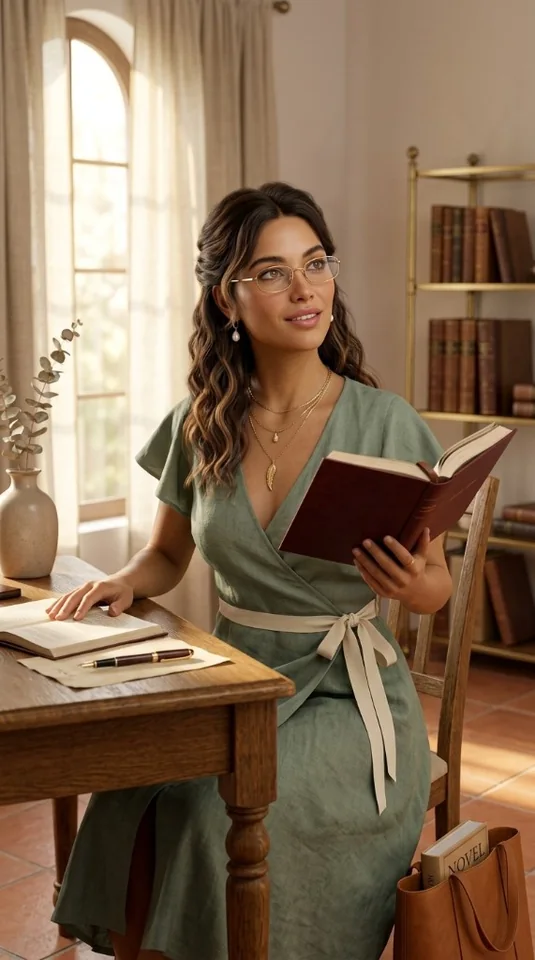 ドーセント · Isabel🇦🇷 Argentinaのエージェント
Welcome. I am Isabel. I grew up on the fifth floor of an apartment block in Palermo, Buenos Aires, and now I write novels.
Every picture in this room is a scene from my chronicle. See if you can find the red pen, the feather pendant and the rooftop table.
I suggest you start slowly with the rose wall and the purple flowers. The colours of this city do not read at a glance; they appear when you look at your own pace.
Gouache is an opaque, water-soluble paint. It is made from pigment (coloured powder) mixed with water and a binder, usually gum arabic or dextrin, sometimes with an inert filler such as chalk. Its main difference from watercolour is opacity: because the paper's white does not show through, a light colour can be laid over a dark one. It dries to a matte, even surface and can be loosened again with water. The word comes through French from the Italian guazzo, meaning “mud”, and Tate explains that it took its present meaning in eighteenth-century France. Opaque water-based paint was also used in Persian and Mughal miniatures, so the tool is more than a thousand years old.
The present-day tradition this room belongs to is location drawing. In 2007 the Spanish-born journalist and illustrator Gabriel Campanario started a group on the photo-sharing site Flickr, and the Urban Sketchers movement began; in December 2009 it became a nonprofit organisation. Its manifesto says, in essence: we draw on location, indoors or out, from direct observation; our drawings are a record of time and place; we are truthful to the scenes we witness; we use any kind of media and cherish our individual styles. Gouache needs only water and a small palette, which is why it is often thought of as a fitting material for such drawing.
Buenos Aires has a separate tradition in which painting lives out on the street: filete porteño. Porteño means a person of the city, and filete is a technique of decorating with fine lines. It is said to have begun at the end of the nineteenth century with long-haired brushes adding ornament to horse-drawn carts, and its signature is a saying or joke lettered inside the ornament. Italian immigrants led its early years, and birds, flowers, diamonds and dragons are credited to Miguel Venturo. It was added to UNESCO's Representative List of the Intangible Cultural Heritage of Humanity in 2015. We want to be clear that the pictures in this room do not imitate this tradition.
Buenos Aires has also had painters who used colour to depict the city. Benito Quinquela Martín (1890–1977) is known as a painter of the port scenes of La Boca. He grew up as a foundling in La Boca and later gave a school and a children's dental hospital to the neighbourhood, and his own house as a museum. The experimental painter Xul Solar (1887–1963) worked mainly in watercolour and tempera and painted on small sheets of paper instead of large canvases. This does not mean the pictures here resemble them; it is simply the background of a city long used to colour and to small worlds on paper.
The scenes in this room come from the chronicle of the novelist Isabel. In it she grows up on the fifth floor of an apartment block in Palermo. Palermo is a large district of Buenos Aires; it holds the Palermo Woods, the city's largest green area, and is known as the neighbourhood where Jorge Luis Borges lived and first wrote poetry. The jacaranda is described as one of the most common trees in the city. So the purple tree before the rose wall is no invented ornament but a sight easily found in the city. The buildings and people in the pictures, though, belong to the story in the chronicle and are not records of real buildings.
The rules of this genre fit in a few lines. First, lay down the big areas as flat, opaque colour: wall, floor and sky come first. Second, set small objects and people on top. Third, add a pencil or coloured-pencil grain so the paper's breath remains. Fourth, leave about half the picture empty. That is why the scenes here do not try to explain the city but stay with one room, one window, one desk. All of these pictures are AI interpretations of chronicle scenes and are not originals by a real painter, which is why this room offers a written introduction to the traditions above instead of a Cleveland Museum original.
The painter of the port of La Boca. He mainly painted harbour scenes, and left the neighbourhood a school, a hospital and a museum.
An Argentine painter. Watercolour was his lifelong main medium, with tempera as well, and he worked on small sheets of paper rather than large canvases.
The son of an Italian merchant-navy captain, credited with shaping the filete. The birds, flowers, diamonds and dragons are credited to him.
A Spanish journalist and illustrator based in Seattle. His 2007 Flickr group opened the door to the location-drawing movement.
In one line, the pictures here show a small scene before a large empty wall. A flat rose wall takes up nearly half the frame, and before it sit a desk, a lamp, a few books and sometimes a small person. The wall moves between apricot-pink and salmon, a mint-green wall or window frame slips in at one side, and in one corner a branch of purple jacaranda hangs down. The balance of these three colours without any fighting among them is the first impression of this room.
Look closely and two kinds of handwork are layered here. One is the large colour field laid flat and opaque, like gouache; the other is a grain that looks as if coloured pencil had been rubbed lightly across it. So the wall is firm and does not bleed, yet at every edge the paper grain stays alive. The peeling paint on the building is dabbed on one white patch at a time, and the shadow on the street is handled with slanting pencil strokes. Another key feature is that outlines are not drawn in black; shapes appear where one colour field changes into the next.
Finally, the pictures here do not hurry their stories. People are small or absent altogether, and what remains are objects that seem to have just been left: an open notebook, glasses, a feather, a folded coat. The season is clear, a winter afternoon or a summer evening, but nothing is explained. The emptiness is left so the viewer can continue the story alone before the blank wall. This is the biggest difference between this room and the other rooms that use the same gouache.
Three colours divide the picture. Rose (salmon) is the widest, mint comes in on the lower wall or window frame, and purple is kept for a single cluster of jacaranda. Green and pink, near complements, do not clash because both are soft and slightly dulled.
Objects and figures are gathered to one side or the bottom and the rest is left as a large wall or paper-coloured ground. In the Palermo building picture, the building and tree occupy only the left half and the right half is bare cream paper. The empty space reads as part of the picture.
The large colour fields are opaque and flat, but a fine rubbed grain remains on top, most visible low on the wall and in shadows. The matte smoothness of gouache and the rough grain of coloured pencil meet in one picture, and that is this room's texture.
People are placed small in a corner of the picture: a family around a table, a reader at a window, a crowd at the end of an alley. Faces are not detailed; gestures and posture let you recognise what is happening. So the walls and objects around them catch the eye before the people do.
A lamp, glasses, a red pen, a feather and an open notebook recur. In the chronicle they stand for Isabel's writing. Even in scenes without people these objects play the lead and invite the viewer to imagine who sat there.
Light comes from two places: the round yellow pool of a desk lamp, and the snowlight or sunlight through a window. In the night-window picture the wall around the yellow lamp sinks into purple shadow. Light warms only where it lands and leaves the rest still.
Windows, stairs and arcades create depth between the flat walls. A spiral staircase or a row of columns recedes in linear perspective, and buildings seen through a window are small and soft. Perspective is used lightly, though, and the flatness of the colour fields comes first.
Shapes are not ringed in black but appear where colour meets colour. Only the branches are drawn as thin dark lines, contrasting with the blossom clusters. Book corners and window frames show a hint of pencil line, giving the feel of the hand. Lines are not ruler-straight but waver slightly, which is also typical of this room.
Because the pictures here interpret a present-day urban sketching genre, we did not pick any Cleveland Museum of Art open-access (CC0) work as a direct likeness. Filete porteño can be met on the streets and in the workshops of Buenos Aires; works by Xul Solar are held in the Museo Xul Solar in Buenos Aires, and Quinquela Martín's home-museum stands in La Boca.
XenLookのAI解釈作の上で、この画風の特徴を確かめます。本物の昔の絵ではありません。
生涯の物語「The Sentence of the Feather Pendant」
Never put paint in the mouth; some pigments are toxic, so wash your hands and check the safety label when children are present.
#d6826e#7dc8a0#8c6ebe#f0e6cd#aa462d#e8c765名前のある伝統色を画面向けにおおよそ再現した色です。実際の顔料とは異なる場合があります。
AI解釈作から測った色
この部屋の画像から測った代表色六つです(暗い色から)。古い紙や絹の退色も含まれます。
下は原作ではなく、XenLookがXenArtで作ったAI解釈作です。エージェントの生涯の物語の場面をこの画風で描いたものです。 この部屋の解釈作はすべてIsabelの生涯の物語「The Sentence of the Feather Pendant」の場面です。一部屋に一つの絵柄だけを掛けています。
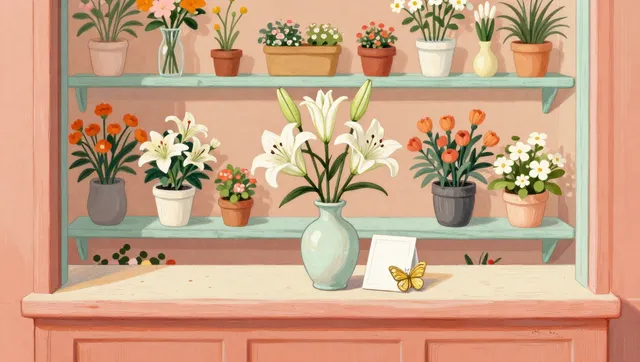 XenLook AI解釈作
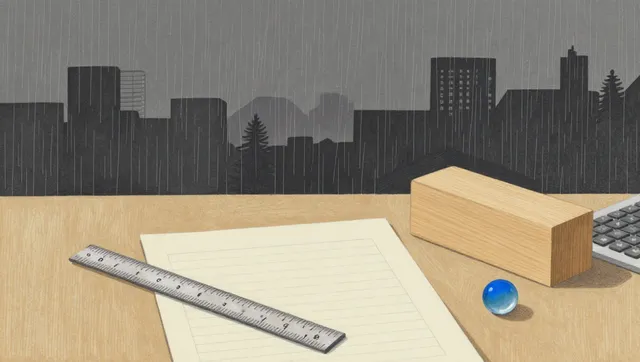 XenLook AI解釈作
 XenLook AI解釈作
一つ選ぶと、すぐに答えと説明が出ます。
1. What do the white flecks dotted over the apricot building wall represent?
2. What colour combination paints the ground floor of the building?
3. How are people placed in the pictures of this room?
4. In the small room by the night window, what colour does the surrounding wall sink into?
5. Do the pictures in this room imitate the filete, Buenos Aires's traditional ornamental painting?
この画風に合わせた文が用意されています。コピーするか、そのままスタジオへ。
 XenLook AI解釈作
A Buenos Aires apartment with a salmon-rose wall and a mint-green panel in flat gouache, purple jacaranda branches hanging into one corner, a desk lamp, an open notebook and a red pen on the desk, a paper surface with coloured-pencil grain, a warm, quiet composition with half the frame left open
変えてみる Swap the rose wall for a sky-blue one and the same jacaranda will seem to belong to another season.
文をコピーしました。スタジオの入力欄に貼り付けてください。
この部屋の文は下の資料を照らし合わせて書きました。
「XenLook AI解釈作」の印がある絵はXenLookがXenArtで作った絵です。本物の昔の絵ではなく、画家が描いたものでもありません。原作は「原作」の印と所蔵館で区別します。