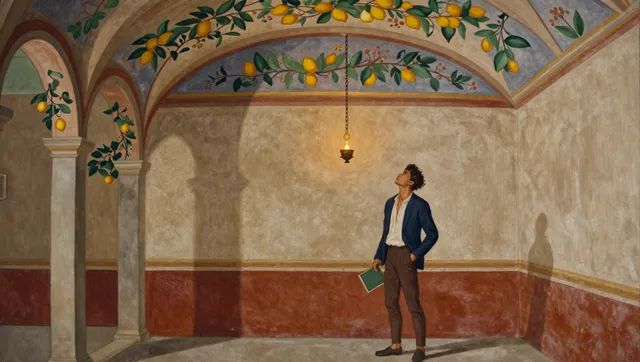
Transylvania is the broad land across central and north-western Romania today. In the Middle Ages it belonged to the Kingdom of Hungary, and three kinds of people lived on it: Catholic Hungarian nobles, the German-speaking settlers known as Saxons, and Orthodox Romanian villagers. The Saxons are said to have been invited in under King Géza II of Hungary (reigned 1141 to 1162) and to have founded villages there. The three groups differed in how they worshipped, in the shape of their churches and in the painting traditions they put on their walls. For that reason the murals of the region are hard to call a single style. Two currents, the Byzantine and the Gothic, meet village by village and sometimes inside one church. This room follows that meeting.
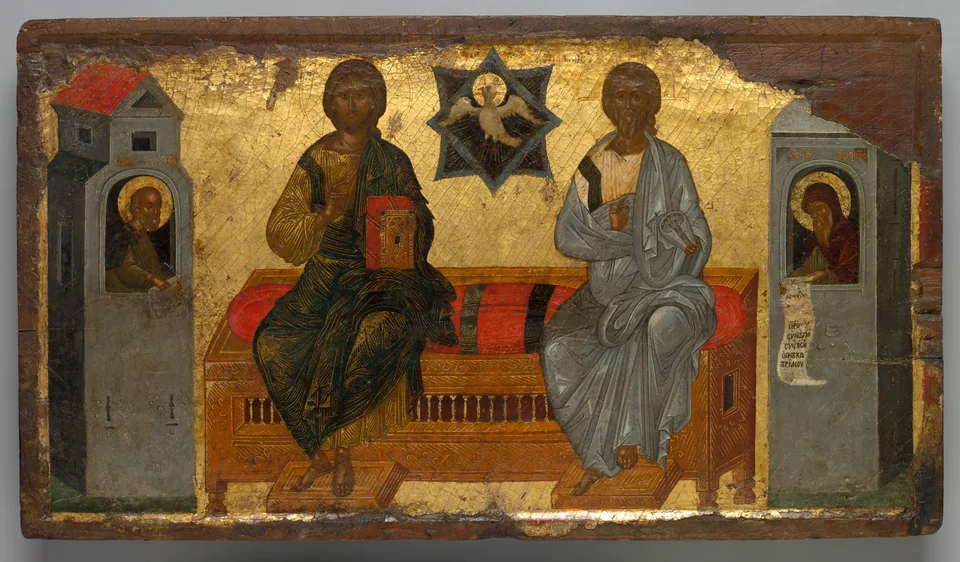
Byzantine art grew around Constantinople, the capital of the Eastern Roman Empire. After the veneration of holy images was restored in 843, the tradition of the icon, a painting of a sacred figure, took firm root. Figures stand stiffly facing the viewer, faces are long, and the background is gold. Who is shown, and how, was largely fixed, so painters carefully continued old models rather than inventing new ones. The tradition lived on in Orthodox lands after the empire fell in 1453. In Transylvania, Orthodox Romanian communities received it and filled the walls of small stone chapels. The saints on these walls look alike because they follow the same models.
Gothic began in the early twelfth century in the Île-de-France, the region around Paris. The rebuilding of the abbey church of Saint-Denis under Abbot Suger is counted as its first case. It was at first a name for architecture, but it soon spread to painting. Wall painting, panel painting, manuscript illumination and stained glass are the four branches of Gothic painting. Unlike Byzantine figures, Gothic bodies sway softly, drapery flows, and a story is divided into panels to be read in order. From the late fourteenth to the late fifteenth century the courtly International Gothic spread across much of Europe in a similar form. Through central Europe this current also reached the church walls of Transylvania.
One of the best places to see the Gothic side is the church at Mălâncrav, known in German as Malmkrog. The church was built in the early fourteenth century, and the nave murals are dated to about 1350. Creation and Genesis, the childhood of Christ, the Passion, the appearances after the Resurrection and the life of the Virgin follow one another in fine lines. The choir was enlarged between 1375 and 1405 and repainted in International Gothic, with Hungarian saints among the figures. The village was land of the Apafi family, who are said to have been buried in the church. Sources differ slightly on dates, so the safe reading is mid-fourteenth to early fifteenth century. It is also said that the paintings escaped damage in the Reformation.
Sighișoara is a citadel town founded by the Saxons. A stone inscription of 1429 confirms that work on the church on its hill had begun by then. Completion is given as about 1488 in one source and around 1525 in another, so it cannot be fixed. The murals are dated broadly to the fourteenth to sixteenth century, though most are thought to be fifteenth-century work. Surviving scenes include St George and the dragon in three scenes, the Archangel Michael weighing a soul, the Evangelist Matthew, the Veil of Veronica, the Last Judgement, and the instruments of the Passion with St Ursula. Painters mentioned are Valentinus Pictor, linked to the choir around 1483, and Jakobus Kendlinger, named in an inscription of 1488 in the west porch. Both attributions remain cautious.
Orthodox villages painted their walls in the same period. The Dormition of the Theotokos church at Strei was built at the end of the thirteenth century, and an inscription in the apse names a Grozie in the later fourteenth century. Scholars disagree on whether he was the founder, the head of the building work or the painter. The murals there are described as Byzantine iconography mixed with North Italian feeling and Romanesque influence. At the church of St George in Streisângeorgiu, research in 1975 found an inscription pointing to 1313 or 1314, naming the priest Naneș and a painter called Teofil. A votive painting of 1408 shows the local lord, or knez, Lațcu Cândreș and his wife. The patrons are said to have been local Orthodox Romanian knezes.
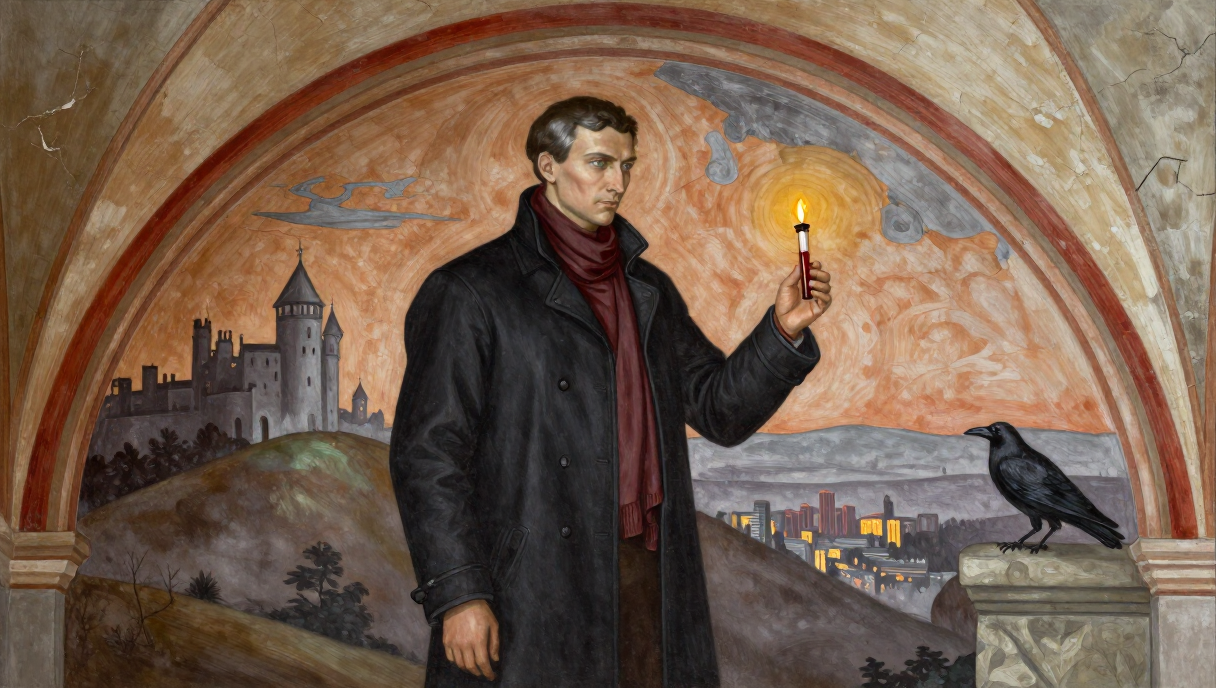
When the Reformation came in the sixteenth century, most Saxons followed Luther, and Paul Wiener was elected their first Lutheran superintendent in 1553. Wall paintings in many churches are said to have been covered with limewash, though when and why differs from place to place. For the church on the hill at Sighișoara, one source says it was covered in 1776 and another says in the Reformation period. Being covered also helped to protect the paintings. In 1934 a restoration team removed the lime and the colours reappeared. Colour laid on a dry wall is weak against damp, so these walls still need careful care. Seven of the Saxon fortified-church villages are UNESCO World Heritage sites. The pictures in this room are AI interpretations modelled on such walls, not originals.