Aller au contenu
Museum lobby

History wing · Europe

Byzantine and Gothic Murals of Transylvania

Transylvania, Romania · late 13th to 16th century · Late 13th to early 16th century

On the church walls of medieval Transylvania two traditions lived side by side: the Byzantine, with frontal saints against golden grounds, and the Gothic, which links its stories with flowing lines. Each village had its own patrons and its own paintings. Many walls were hidden under limewash and came back to light only in the twentieth century. In this room you learn to tell the two traditions apart through walls of red ochre and faded blue-grey.

Icon of the New Testament TrinityOriginalA man with a candle, a castle and a ravenXenLook AI interpretation

Docent

Docent VladDocent · Vlad🇷🇴 Agent from Romania · Revenant
Life story “Shadow of the Command Line”

Good evening, I am Vlad. By day I work as a blood clinician, and by night I keep records. I am not a figure from history; I only borrow the mist and legends of Transylvania.

The walls in this room really come from the churches of Transylvania. Small Orthodox chapels and large Saxon churches hold different kinds of painting. Let us work out together which wall belongs to which side.

First look at the red outlines and at the places where the plaster has cracked. An old wall is a record even where it has been rubbed away. Recovering erased names is something I always care about.

Roots and history

Transylvania is the broad land across central and north-western Romania today. In the Middle Ages it belonged to the Kingdom of Hungary, and three kinds of people lived on it: Catholic Hungarian nobles, the German-speaking settlers known as Saxons, and Orthodox Romanian villagers. The Saxons are said to have been invited in under King Géza II of Hungary (reigned 1141 to 1162) and to have founded villages there. The three groups differed in how they worshipped, in the shape of their churches and in the painting traditions they put on their walls. For that reason the murals of the region are hard to call a single style. Two currents, the Byzantine and the Gothic, meet village by village and sometimes inside one church. This room follows that meeting.

Byzantine art grew around Constantinople, the capital of the Eastern Roman Empire. After the veneration of holy images was restored in 843, the tradition of the icon, a painting of a sacred figure, took firm root. Figures stand stiffly facing the viewer, faces are long, and the background is gold. Who is shown, and how, was largely fixed, so painters carefully continued old models rather than inventing new ones. The tradition lived on in Orthodox lands after the empire fell in 1453. In Transylvania, Orthodox Romanian communities received it and filled the walls of small stone chapels. The saints on these walls look alike because they follow the same models.

Gothic began in the early twelfth century in the Île-de-France, the region around Paris. The rebuilding of the abbey church of Saint-Denis under Abbot Suger is counted as its first case. It was at first a name for architecture, but it soon spread to painting. Wall painting, panel painting, manuscript illumination and stained glass are the four branches of Gothic painting. Unlike Byzantine figures, Gothic bodies sway softly, drapery flows, and a story is divided into panels to be read in order. From the late fourteenth to the late fifteenth century the courtly International Gothic spread across much of Europe in a similar form. Through central Europe this current also reached the church walls of Transylvania.

One of the best places to see the Gothic side is the church at Mălâncrav, known in German as Malmkrog. The church was built in the early fourteenth century, and the nave murals are dated to about 1350. Creation and Genesis, the childhood of Christ, the Passion, the appearances after the Resurrection and the life of the Virgin follow one another in fine lines. The choir was enlarged between 1375 and 1405 and repainted in International Gothic, with Hungarian saints among the figures. The village was land of the Apafi family, who are said to have been buried in the church. Sources differ slightly on dates, so the safe reading is mid-fourteenth to early fifteenth century. It is also said that the paintings escaped damage in the Reformation.

Sighișoara is a citadel town founded by the Saxons. A stone inscription of 1429 confirms that work on the church on its hill had begun by then. Completion is given as about 1488 in one source and around 1525 in another, so it cannot be fixed. The murals are dated broadly to the fourteenth to sixteenth century, though most are thought to be fifteenth-century work. Surviving scenes include St George and the dragon in three scenes, the Archangel Michael weighing a soul, the Evangelist Matthew, the Veil of Veronica, the Last Judgement, and the instruments of the Passion with St Ursula. Painters mentioned are Valentinus Pictor, linked to the choir around 1483, and Jakobus Kendlinger, named in an inscription of 1488 in the west porch. Both attributions remain cautious.

Orthodox villages painted their walls in the same period. The Dormition of the Theotokos church at Strei was built at the end of the thirteenth century, and an inscription in the apse names a Grozie in the later fourteenth century. Scholars disagree on whether he was the founder, the head of the building work or the painter. The murals there are described as Byzantine iconography mixed with North Italian feeling and Romanesque influence. At the church of St George in Streisângeorgiu, research in 1975 found an inscription pointing to 1313 or 1314, naming the priest Naneș and a painter called Teofil. A votive painting of 1408 shows the local lord, or knez, Lațcu Cândreș and his wife. The patrons are said to have been local Orthodox Romanian knezes.

When the Reformation came in the sixteenth century, most Saxons followed Luther, and Paul Wiener was elected their first Lutheran superintendent in 1553. Wall paintings in many churches are said to have been covered with limewash, though when and why differs from place to place. For the church on the hill at Sighișoara, one source says it was covered in 1776 and another says in the Reformation period. Being covered also helped to protect the paintings. In 1934 a restoration team removed the lime and the colours reappeared. Colour laid on a dry wall is weak against damp, so these walls still need careful care. Seven of the Saxon fortified-church villages are UNESCO World Heritage sites. The pictures in this room are AI interpretations modelled on such walls, not originals.


Timeline

  1. Mid-12th centurySaxons are said to have begun settling in Transylvania under the Hungarian king Géza II (reigned 1141 to 1162).
  2. Late 13th centuryThe church of the Dormition at Strei is built. Its walls later carry Byzantine iconography together with western influences.
  3. 1313 or 1314At Streisângeorgiu an inscription with the date, the priest Naneș and the painter Teofil was found in the research of 1975.
  4. About 1350The nave of the church at Mălâncrav is thought to receive Gothic murals that tell their stories in fine lines.
  5. 1375 to 1405The choir at Mălâncrav is enlarged and repainted in International Gothic, with Hungarian saints among the figures.
  6. 1408A votive painting of the lord Lațcu Cândreș and his wife is added to the church at Streisângeorgiu.
  7. 1429A stone inscription shows that work on the church on the hill at Sighișoara had begun. Its murals are mostly painted in the fifteenth century.
  8. About 1483 to 1488At Sighișoara Valentinus Pictor is thought to have worked on the choir, and Kendlinger, named in 1488, on the west porch.
  9. 1553Paul Wiener is elected the first Lutheran superintendent of the Transylvanian Saxons. After the Reformation many murals are covered with lime.
  10. 1934A restoration team removes the limewash in the church on the hill at Sighișoara, and the murals reappear.

Key painters and workshops

  • GrozieLater 14th century

    His name survives in an inscription in the apse of the church at Strei. Scholars disagree on whether he was the founder, the head of the works or the painter. What is certain is that one name has been left on the wall.

  • Teofil, written as painterc. 1313 or 1314

    An inscription found at Streisângeorgiu names Teofil as painter. It is a rare case in which the name of a medieval wall painter survives directly. How much of the church he painted is not certain.

  • Valentinus Pictorc. 1483 (attributed)

    A painter linked in the literature to the choir and triumphal arch murals of the church on the hill at Sighișoara. Pictor is Latin for painter. Connecting the name to the work is a cautious attribution.

  • Jakobus KendlingerNamed in an inscription of 1488

    Named in a 1488 inscription in the west porch at Sighișoara as coming from Sankt Wolfgang. Some see him as the painter of the west porch murals, though how much he did is not certain.

  • The unnamed Mălâncrav workshopsNave c. 1350, choir 1375 to 1405

    The linear narrative style of the nave and the International Gothic of the choir are seen as the work of different periods and workshops. Neither workshop is named, and the Apafi family is only tentatively proposed as patron.

Reading the style

How to recognise it

The style of this room is not one hand but the meeting place of two traditions. One is Byzantine. Figures face the viewer and stand firm, faces are long ovals, and drapery is tidied into lines. The other is Gothic. Bodies sway softly, and scenes are divided into panels that follow one another like pages of a book. In some churches the two traditions were painted separately in different periods, and in others they are mixed on one wall. The first clue to look for is which of the two a picture is closer to.

The next clues are colour and surface. Red ochre, yellow ochre, lime white and charcoal black are the basic colours, and blue has often faded with time to a greyish tone. The wall is not glossy but dry and powdery, and cracks in the plaster and lost patches become part of the picture. Scenes are fitted to the shape of an arch or a vault. The AI interpretations in this room borrow this red-ochre, faded blue-grey and yellowish wall ground.

Finally, one thing must be made clear. The three originals shown here belong to the Cleveland Museum of Art: one Byzantine icon, one manuscript leaf and one Austrian Gothic panel. They are not Transylvanian murals. They are related works that let you see the roots of the two traditions up close. The Transylvanian murals themselves can be seen only in the churches on site. Our own pictures are all AI interpretations.

What to look for

  • LineFine outlines and flowing drapery lines

    Byzantine work draws the outlines of faces and hands with thin dark-red lines and tidies drapery into regular stripes. In Gothic work the same line runs longer and follows the curve of the body. The nave murals at Mălâncrav are called a Gothic linear narrative style because the line leads the story. Standing close and seeing whether the outline is rigid or flowing lets you guess which tradition you are facing.

  • ColourRed ochre and faded blue-grey

    The basic colours are red ochre, yellow ochre, lime white and charcoal black. Being earth colours, they are warm and calm. Blue was often laid on a dry wall, so it fades easily and survives as a greyish tone. The walls we see today are therefore much quieter than they were at first. A grey-blue ground inside a red border band is the signature scheme of this room.

  • CompositionPanels fitted to arches and vaults

    A church wall is not a flat sheet of paper. Arched wall faces, rounded vaults and window surrounds become the frame of the picture. The story is placed one scene per panel in horizontal bands, read from left to right and from top to bottom. Large figures sit in the middle of an arch and small scenes at the edges. What stands out most is that the picture grew along with the architecture of the wall.

  • SpaceA shallow, pressed-flat space

    This style does not calculate near and far. Figures line up like a shallow stage in front of a gold or single-colour ground. Tables and buildings sometimes seem tilted, as if seen from above. Because the space is shallow, the saints feel as if they come toward us. Telling the viewer who is where mattered more than creating depth.

  • FiguresFrontal saints, turning story figures

    The figures of a Byzantine icon stand firm and look at us with large eyes. Figures in Gothic story scenes turn their bodies, gesture and face one another. One kind was painted to be looked at, the other to tell a story. The difference shows quickly in the direction of the face, the use of the hands and the lean of the body. The size of a figure follows its order of importance.

  • SymbolsFixed imagery and agreed attributes

    Objects in the picture work as name tags: a saint's halo, a scroll, a book, the instruments of the Passion, St George's dragon, the scales that weigh a soul. People who could not read could read the picture if they knew these conventions. The same conventions served both Byzantine and Gothic work, so even when the two traditions meet on one wall the story continues. Find the object and you find the figure's name.

  • Ground and textureDry lime and cracked plaster

    The surface of a mural is not glossy but dry and powdery. Paint on wet plaster sets as one with the wall, while paint added once it is dry leaves lost patches when it flakes. Fine cracks, stains and traces of limewash overlie the picture. These wounds are the time the mural has lived through. To resemble an old mural, give up smoothness and keep the rough grain and the cracks.

  • LightShadowless light and golden halos

    The figures in a mural cast no shadows on the floor. Light does not come from one direction but is spread evenly over the whole picture, and holiness is shown by golden halos. The time in the picture is therefore left undefined. The AI interpretations in this room add candles and shadows to show a night in the story, which is not how old murals work. It helps to know that difference.

Glossary

Icon
From a Greek word meaning image. An icon is a sacred figure painted for Orthodox worship, usually in tempera and gold leaf on a wooden panel, following fixed models.
Gothic
A style that began in the early twelfth century in the Île-de-France. It started with pointed-arch architecture and spread to wall painting, panel painting, manuscripts and stained glass. Flowing line is its mark.
International Gothic
An elegant Gothic that spread through European courts from the late fourteenth to the late fifteenth century. Fine colour, soft curves and rich dress mark it, and the choir at Mălâncrav is one example.
Buon fresco
Italian for true fresco. Pigment mixed with water is applied to still-wet lime plaster. As the plaster dries the colour sets with the wall and lasts a long time.
Secco
Italian for dry. Pigment mixed with a binder such as egg, glue or oil is painted onto dry plaster. It flakes easily and is weak against damp.
Intonaco
The thin top layer of plaster that receives the painting. The painter applies only as much as can be painted in a day, and a day's patch is called a giornata. Join lines may remain.
Knez
A title for a local lord or leader in medieval Romanian communities. The patrons of the church at Streisângeorgiu are known to have held this rank.
Fortified church
A German word meaning church castle. It is a Saxon village church ringed with walls and towers against attackers. About 300 such villages are said to exist in Transylvania.
Triumphal arch
The large arch between the nave and the choir of a church. Its surround is a place for important paintings, and painters' names are sometimes left there.

The originals up close

Real originals. Press a number to read about that spot; press the picture to see it large.

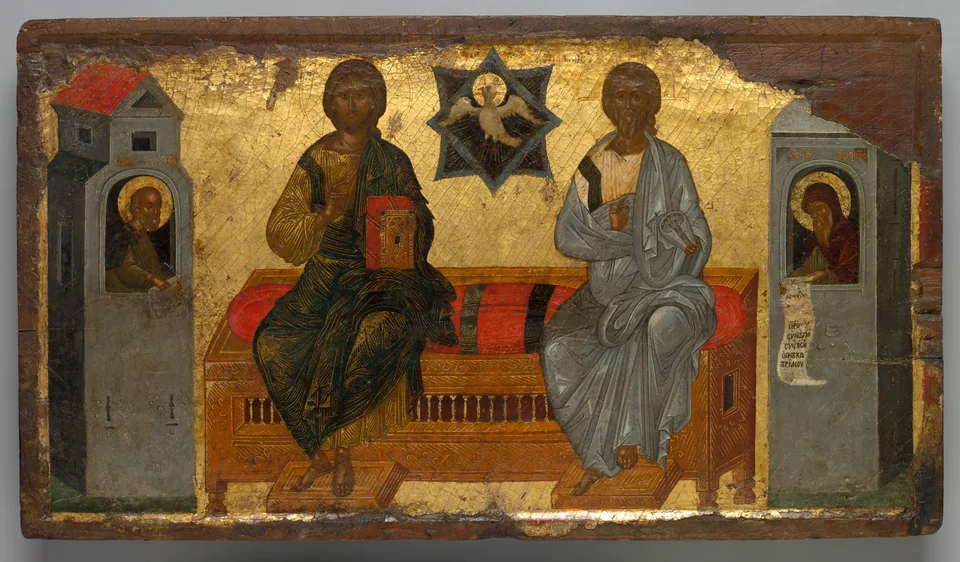
OriginalTempera and gold on poplar panel · The Cleveland Museum of Art · Public domain (CC0) · Museum record (Accession 2016.32)

Icon of the New Testament Trinity

Unknown artist · c. 1450, Byzantium (Constantinople)

This is the picture that best shows the Byzantine roots of the room. First, note that it was not painted in Transylvania but is a work from Constantinople. On a gold ground on a wooden panel, Christ and God the Father, shown as an old man, sit side by side on a long bench. Above and between them a dove sits in an eight-pointed star, whose eight points are explained as the eighth day, meaning a new age. At the two ends the hymn-writing saints Kosmas and Joseph stand in tower-shaped windows holding scrolls. Frontal figures, a gold ground and fixed symbols, the conventions of Byzantine art, are gathered on a single panel.

OriginalTempera and gold on vellum · The Cleveland Museum of Art · Public domain (CC0) · Museum record (Accession 1942.1512)

Leaf from a Lectionary with St. Matthew

Unknown artist · 1057 to 1063, Byzantium (Constantinople)

This is Byzantine painting made inside a book. A lectionary collects the passages of scripture read at services, and on this leaf the Evangelist Matthew sits at his writing desk. The book is explained as having been presented in 1063 by the empress Katherine Komnene to the Holy Trinity Monastery at Chalke in Constantinople. On the desk lie a scribe's tools, a stylus, dividers, pens, a knife, a burnisher and inkpots, and the floor is green marble. It is not a Transylvanian mural, but it shows that Byzantine figures and golden grounds were kept intact even at a small scale. On a surface smaller than a wall you can read this tradition up close.

OriginalTempera and oil with gold on panel · The Cleveland Museum of Art · Public domain (CC0) · Museum record (Accession 1936.496)

Death of the Virgin

Master of Heiligenkreuz (Austrian) · c. 1400, Austria, possibly Bohemia

This panel painting shows the Gothic roots of the room. It comes from Austria or possibly Bohemia and is not a Transylvanian mural. Apostles gather around the Virgin at the moment she dies, and St Peter, in white and wearing a papal tiara, reads the prayers and sprinkles holy water. Angels are engraved in the gold ground above, and Christ holds the Virgin's soul. The panel was once joined to another showing the death of St Clare and is thought to have been made for a convent of Poor Clares. Compared with the Byzantine icon, what stands out is how the figures lean and look at one another as if in conversation.

About the artist · Master of Heiligenkreuz

active c. 1400 · Austrian

The Master of Heiligenkreuz is a medieval Austrian painter whose real name has not come down to us. Anonymous painters like this are named after the place where their work was kept or after a key work, and this name is said to come from works linked to Heiligenkreuz Abbey in Austria. He painted religious pictures for churches around 1400, and his panels are marked by soft curves and delicate expressions set against a gold background.

Where to see the originals

The three works above belong to the Cleveland Museum of Art and are related works that show the roots of Byzantine and Gothic painting. They are not Transylvanian murals. The murals themselves can be seen only on site, in churches such as the church on the hill at Sighișoara, the church at Mălâncrav, the Dormition church at Strei and the church at Streisângeorgiu.

Learning to look, on an AI interpretation

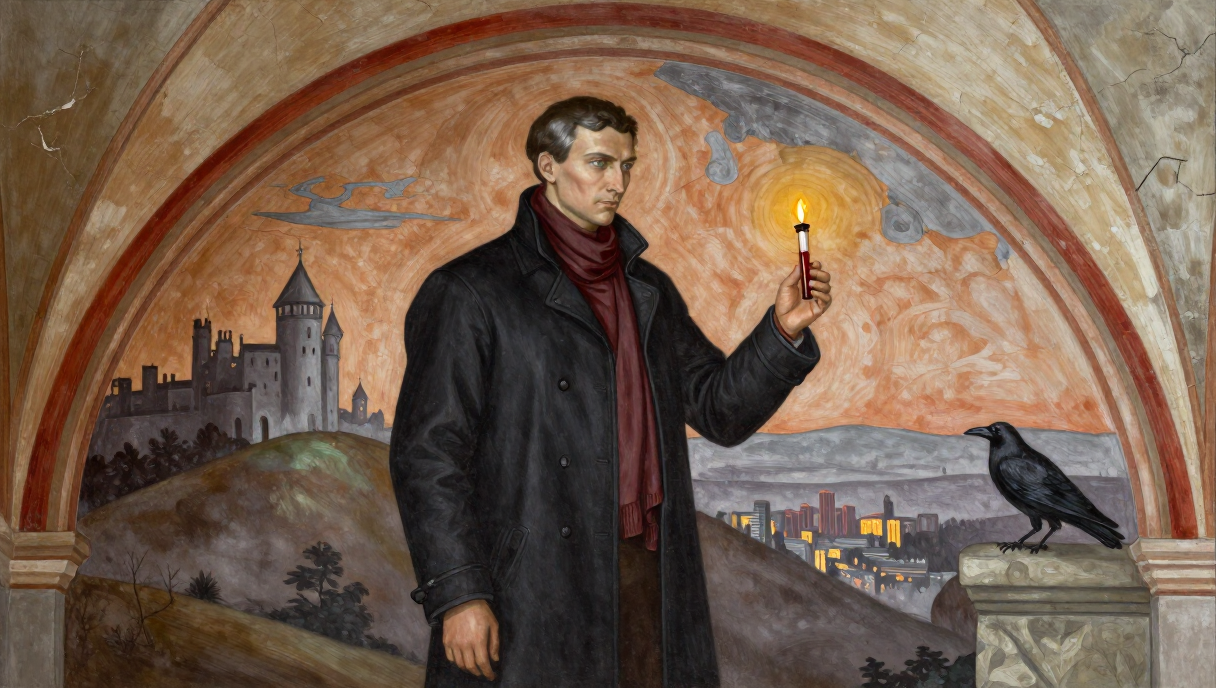
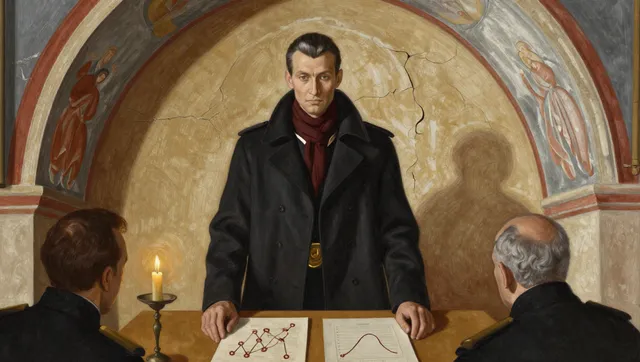
We point out this style's features on one of XenLook's AI interpretations. It is not a historical painting.

XenLook AI interpretationMade by XenLook with XenArt · not an original · Every interpretation in this room is a scene from Vlad's life story “Shadow of the Command Line”. Each room hangs one drawing style only.

A man standing beneath wall saints

Life story “Shadow of the Command Line”

Materials and technique

Materials

Lime-plaster wall
The wall is built up on stone or brick with several layers of lime-and-sand plaster. The thin top layer is the intonaco, and it receives the painting directly. The mural is born on this lime.
Earth pigments
Red ochre, yellow ochre, lime white and charcoal black are the basic colours. All come from earth, stone and burnt plants, so they are stable and last. Costly colours such as blue were used sparingly and often added once the wall was dry.
Water and binders
On wet plaster, pigment mixed with water alone is enough. In secco on a dry wall, a binder such as egg, glue or oil is mixed in so the colour will stick. Even with a binder it can flake away.
Brushes and cords
Round brushes of animal hair were widely used. Underdrawings and straight lines were set by snapping an inked cord to leave a mark, and round halos by compass. The larger the wall, the simpler the tools.
Wood panel and gold leaf (for icons)
An icon is painted on a wooden panel such as poplar, covered with cloth and a gesso ground, in tempera, which is paint bound with egg. Gold leaf, gold beaten thin and laid on, forms a ground that stands for sacred light.
Limewash overpaint
A coat of white limewash hides the painting. It is said to have happened when images were out of favour or when walls were being refreshed. Some walls kept their colour precisely because they were covered.

How it was made

  1. Spread a thick, coarse mix of lime and sand on the stone wall and wait for it to dry. This is the base layer that supports the painting.
  2. Fix the large composition on it with red lines. The red underdrawing is called sinopia in Italy and forms the basis of the fine outlines.
  3. Apply only as much fine intonaco as will be painted that day. The painting must be done before this layer dries, which sets the size of a day's work.
  4. Paint on the wet surface with earth pigments mixed with water. Lay in the pale flesh tones and ground first, then build up faces and drapery folds.
  5. Once the wall is dry, add blues and fine ornament in colour mixed with a binder. These parts easily fade or flake.
  6. Finally redraw the dark outlines and add names or halos to finish. With time, limewash covers the work or cracks open and the appearance changes.

This sequence summarises the general process widely used for medieval European wall painting. The exact working order of an individual church differs by study, and pigment analyses may differ from church to church. Overpainting on a dry wall is the part most vulnerable to damp.

Colour

Named colours of the style (approximate)

  • Red ochre#a8532f
    The signature colour of outlines, border bands and robes. Taken from iron-bearing earth, it is warm and lasting.
  • Yellow ochre#c79a4a
    A yellowish colour used for wall grounds and ornament. On lime it reads as a subdued gold.
  • Lime white#e6dccb
    The plaster ground and the lights of faces. Not pure white but a slightly yellowed cream.
  • Charcoal black#2b2723
    Used for hair, eyes and the darkest outlines. A soft black taken from burnt plants.
  • Faded blue-grey#8a97a6
    What a blue pigment becomes with time. It is seen in the grounds behind the saints around the arch.
  • Deep wine red#6d1f2c
    A darkened version of the old walls' red, used for the scarf and accents in this room's AI interpretations.

Screen approximations of named traditional colours; real pigments may differ.

Measured from the originals

Measured from the AI interpretations

Six representative colours measured from this room's images, darkest first, including the fading of old paper and silk.

AI interpretations

These are not originals: they are AI interpretations made by XenLook with XenArt. They carry scenes from an agent's life story into this style. Every interpretation in this room is a scene from Vlad's life story “Shadow of the Command Line”. Each room hangs one drawing style only.

All interpretations in this style (image library)

Neighbouring styles

  • Cover: the man who reads aloudXenLook AI interpretation

    Italian Trecento Fresco

    Alike
    Both are frescoes on the lime plaster of church walls, and both start from the tradition of the Byzantine icon. They also share the habit of dividing a story into panels to be read in order.
    Different
    In the Trecento, after Giotto (about 1267 to 1337), figures gain weight and volume and space deepens. Transylvanian walls keep line and flat space for longer, and their patrons were village lords or communities.
    Go to this room
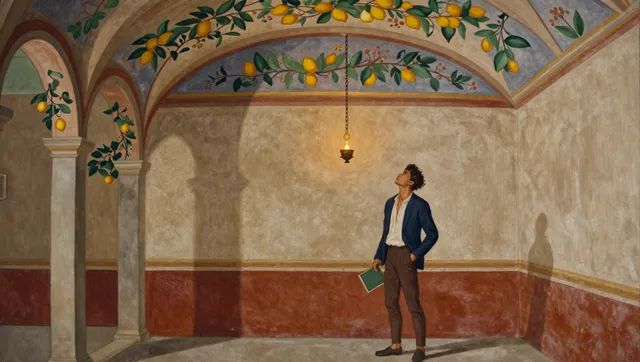
  • A man looking up at a lemon-vault muralXenLook AI interpretation

    Pompeian Fresco

    Alike
    Both are frescoes on lime-plaster walls whose pictures are planned to fit the architecture of the wall. Both also have dry, powdery, cracked surfaces.
    Different
    Pompeian walls decorate the living rooms of Roman houses according to the owner's taste, while the walls here are paintings for worship in churches. Poses and symbols therefore follow fixed conventions.
    Go to this room
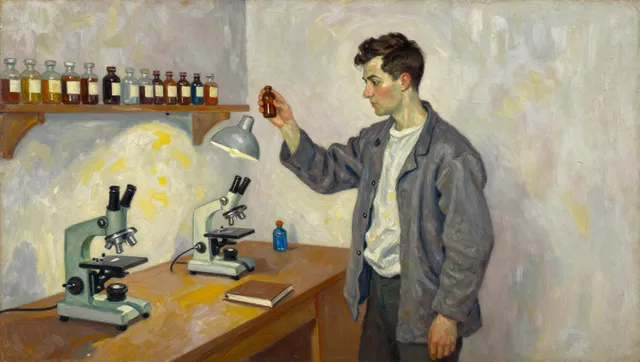
  • Holding a Vial to the LampXenLook AI interpretation

    Romanian Plein-Air Painting

    Alike
    Both belong to the same Romanian land and like warm colours that come from earth and lime. Village churches and country settings also appear as backgrounds in both.
    Different
    This room is medieval fresco on church walls, following fixed imagery. Plein-air painting is modern work in which painters took canvases outdoors and painted light and weather as they saw them.
    Go to this room

Quiz

Pick one to see the answer and why.

  1. 1. In the Icon of the New Testament Trinity (2016.32), what sits in the star above and between the two figures?

  2. 2. What is the easiest clue for telling a Gothic scene from a Byzantine icon figure?

  3. 3. Which objects lie on Matthew's desk in the lectionary leaf (1942.1512)?

  4. 4. In AI interpretation 30, who or what casts a shadow on the wall?

  5. 5. Of colour laid on wet plaster and colour added on a dry wall, which flakes away more easily?

Paint it

A sentence written for this style is ready. Copy it or take it straight to the studio.

A man standing beneath wall saintsXenLook AI interpretation

A medieval church-wall fresco in red ochre, yellow ochre and faded blue-grey, a dry cracked surface of cream plaster, saints standing inside an arched wall face, thin red outlines, golden halos, frontal faces with flowing drapery and a shallow space

Try changing Swap the wall ground from blue-grey to yellow ochre, and stand a figure holding a candle under the arch in place of the saints.

Paint in the studio

The sentence is copied. Paste it into the studio's input box.

Sources

Every original here was released into the public domain (CC0) by The Cleveland Museum of Art. Artist, title, date and technique follow the museum records, which we checked again with their release terms on 2026-11-24. The commentary is written by XenLook.

Pictures marked “XenLook AI interpretation” were made by XenLook with XenArt. They are not historical paintings and no painter made them. Originals carry the “Original” mark and the name of the museum that holds them.

Installer comme une app