تخطَّ إلى المحتوى
Museum lobby

History wing · Europe

The Camden Town Group: Rooms as They Are

London, England · 1911–1913 · Early 20th century (c. 1905–1914)

The Camden Town Group was a circle of painters who gathered around Walter Sickert in London in 1911. Instead of grand drawing rooms they painted boarding-house bedrooms, kitchens, back streets and theatre galleries. Thickly laid paint, subdued wallpaper colours and oblique viewpoints mark their work. They held only three exhibitions, between June 1911 and December 1912, yet they are regarded as a starting point of modern British realism.

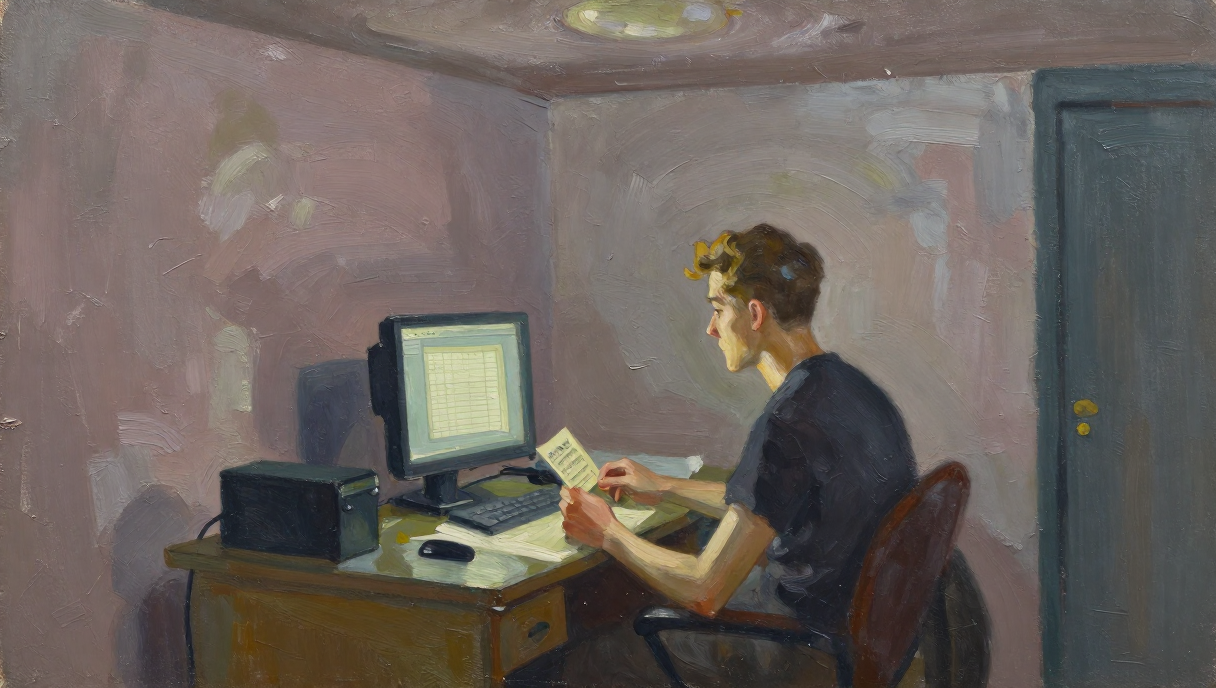
Easter Monday (Hélène Daurmont)OriginalA B6 desk and a table with blanksXenLook AI interpretation

Docent

Docent IanDocent · Ian🇬🇧 Agent from United Kingdom (Hackney, London)
Life story “The Honest Null”

Hello, I am Ian. I grew up in a red-brick terraced house in Hackney, London. The painters in this room worked in another part of the same city.

These painters did not stage grand scenes. They painted iron beds, worn wallpaper and washbasins just as they were. That is exactly why you keep looking.

I am the kind of person who leaves an unknown cell in a table marked as unknown. Pictures work the same way: it is more honest not to invent what we do not know. Shall we look slowly together?

Roots and history

The story begins in 1905, when Walter Sickert returned to London. Born in Munich, he had studied under Whistler and had met Degas early on. In London he took studios in Mornington Crescent and Fitzroy Street. From 1907 he received visitors on Saturday afternoons at 19 Fitzroy Street. These gatherings, known as 'Mr Sickert At Home', drew painters and critics to talk about pictures, and women artists were welcome. This circle became the Fitzroy Street Group.

In 1911 a more formal body split off from that circle: the Camden Town Group. Its members are said to have been exasperated by the milk-and-water Impressionism shown at the New English Art Club. Membership was capped at sixteen, and only men were admitted. Spencer Gore was the first president. The name came from the district where Sickert had lived in the 1890s and again from 1907. Fellow painter Walter Bayes reported that Sickert joked the district had been so watered with his tears that something important must one day spring from its soil.

There were only three exhibitions. All were held at the Carfax Gallery in St James's, London, between June 1911 and December 1912. After the first show the member Maxwell Gordon Lightfoot died, and Duncan Grant took his place. The group included Sickert, Gore, Harold Gilman, Charles Ginner, Robert Bevan, Lucien Pissarro, Walter Bayes, William Ratcliffe and Malcolm Drummond, among others. They did not share one style; different personalities gathered under one name.

What they painted was ordinary London life: a woman seated on an iron bedstead in a boarding-house room, a street corner seen obliquely from an upper window, a theatre gallery. In 1910 Sickert wrote that the more serious our art is, the more it will avoid the drawing-room and stick to the kitchen, and that the plastic arts are gross arts, dealing joyously with gross material facts. Gilman painted his landlady, Mrs Mounter, several times. Bevan painted horse-drawn cabs and cab yards, and Drummond painted cinemas and dance halls.

Several influences blend in these pictures. Pissarro brought Divisionist theory, with its spots of bright pure colour. Bevan, who had known Gauguin in the 1890s, showed how to use thick outlines around heavy paint. Gilman and Ginner laid on paint in a thick, lumpy mosaic after van Gogh. The term Post-Impressionism was coined by Roger Fry, whose 1910 exhibition at the Grafton Galleries opened British painters' eyes. Of the group, Gore was the most wholehearted Post-Impressionist.

The group's time was short. In 1913 it merged with the Fitzroy Street Group and others to form the London Group. In 1914 Gore died of pneumonia, and Sickert headed his obituary 'A Perfect Modern'. Gilman and Ginner launched 'Neo-Realism' that same year. Gilman died of Spanish flu in 1919. The critic Clive Bell described the group's honesty as a mediocre and rather middle-class ideal, typically British, a remark that mixed praise with sarcasm.

Their influence lasted. The Euston Road School of the 1930s took up Sickert's methods, and Clive Bell coined its name. The 'Kitchen Sink' painters of the 1950s, and School of London artists such as Auerbach and Kossoff, likewise painted ordinary rooms and streets. A detailed study of the group is Wendy Baron's Perfect Moderns (2000). A 2008 show at Tate Britain in London introduced the group again. The art historian Charles Harrison called it one of the century's very few successful, modern, realist movements.


Timeline

  1. 1905Walter Sickert returns to London and takes studios in Mornington Crescent and Fitzroy Street.
  2. 1907Sickert starts his Saturday gatherings at 19 Fitzroy Street, and the Fitzroy Street Group is formed.
  3. 1908The critic Frank Rutter founds the Allied Artists Association, an exhibiting society outside the Royal Academy.
  4. November 1910Roger Fry stages 'Manet and the Post-Impressionists' at the Grafton Galleries in London.
  5. June 1911The Camden Town Group opens its first exhibition at the Carfax Gallery. Spencer Gore serves as first president.
  6. December 1912The third and last group exhibition takes place at the Carfax Gallery.
  7. 1913The group merges with the Fitzroy Street Group and others to become the London Group.
  8. 1914Spencer Gore dies of pneumonia. Gilman and Ginner launch 'Neo-Realism'.
  9. February to May 2008Tate Britain in London presents 'Modern Painters: The Camden Town Group'.

Key painters and workshops

  • Walter Sickert1860–1942

    A British painter born in Munich. A pupil of Whistler, he was also influenced by Degas. He often painted nudes in bedrooms and couples in dim rooms, and he made many etchings.

  • Spencer Gore1878–1914

    The group's first president. He used bright colour, bold simplification and geometric patterning. He also painted the Letchworth garden city, and died aged thirty-five.

  • Harold Gilman1876–1919

    A painter of interiors, portraits and landscapes. He painted his landlady Mrs Mounter several times. Like van Gogh, he built up planes of colour with thick, lumpy strokes.

  • Charles Ginner1878–1952

    Born in Cannes, France, to English parents. He painted urban subjects and landscapes, and with Gilman developed a mosaic-like way of laying on thick paint.

  • Robert Bevan1865–1925

    He had known Gauguin at Pont-Aven in the 1890s. He used thick outlines and heavy paint, and from 1908 painted horse-drawn cabs and cab yards.

  • Sylvia Gosse1881–1968

    A painter and printmaker. Encouraged by Sickert in 1908 to learn etching, she co-ran the Rowlandson House school with him from 1910 until 1914. She was left out of the group.

Reading the style

How to recognise it

In a phrase, a Camden Town picture is 'an unadorned room, thickly painted'. The room, more than the person, is the subject. Wallpaper, an iron bed, a washstand and a worn sofa carry the same weight as the figure. Sickert believed such subjects suited the plastic arts, so he chose the kitchen and the bedroom over the drawing room.

The colour differs from bright, clear Impressionism. Subdued tones such as grey-green walls, wine-brown and dusty pink dominate, with one lump of blue or red set among them. Paint is laid on thickly and the brushmarks stay visible. Gilman and Ginner set it down in blocks, almost like laying bricks, while Sickert built up his surfaces in several layers.

The viewpoint is distinctive too. The scene is seen obliquely from above, or cropped at the edges as if glimpsed through a doorway. Figures do not face the viewer; they turn away or bend their heads. The viewer feels like someone who has stumbled on another person's room. In etching the same scene becomes a net of fine lines; in oil it becomes a weave of colour planes.

What to look for

  • LineA net of fine lines, a bold outline

    In his etchings Sickert's line is thin and close, building light and shade out of a net of strokes. In the oils of Bevan or Gore, by contrast, a bold outline surrounds each colour plane, a habit explained as coming from the cloisonnisme of painters such as Gauguin. Such different lines lived side by side in one circle. A thin line makes time feel long; a thick one makes a scene stand firm.

  • ColourOne block of colour on muted wall tones

    The ground is made of calm tones: grey-green, dusty pink, earth brown. Among them sits one strong block, such as a blue jacket or a red floor. Instead of scattering bright colours everywhere, the painter puts the force in one place. So even in a dark room the eye goes straight to one spot. This restraint is the Camden Town sense of colour.

  • CompositionA cropped, peeping composition

    The figure is not placed in the centre but pushed toward one edge. Furniture and door frames cut across the picture, and the viewpoint is oblique, high or low. It feels less like a tidy portrait than a snapshot of a moment. This kind of composition is explained as something learned from Degas. The viewer stands quietly outside the scene, looking in.

  • SpaceThe narrow, low space of a rented room

    Space does not open into depth; it is shut inside one small room. The wall stands right behind, the floor tilts upward, and furniture crowds in. Even with a window, only light enters and the view does not go far. This tightness is not a flaw but the subject: the narrow lives of people paying rent become the size of the picture.

  • FiguresAnonymous people turned away, bent over

    Figures are not painted as heroes or beauties. They dip their hands in a basin, sit looking at something on a sofa, or perch on the edge of a bed. Faces are often blurred or turned aside. Sickert even gave the same scene several interchangeable titles. What mattered was how a person was in the room, more than who she was.

  • Ground and textureThick paint with every brushmark left

    Up close, Gilman's and Ginner's pictures are made of small lumps fitted together like a mosaic. They do not blend smoothly; they leave each brushmark where it fell. This way of working is explained as van Gogh's influence. In an etching, the grain of ink pressed into paper becomes the surface. The trace of the hand is the honesty of the picture.

  • LightLow, dull light from a window

    The light is not dramatic. Dull English daylight from a window spreads over walls and bedding, and shadows turn muddy violet or brown. Sickert began in a tonal manner, so even when he uses bright colour he keeps some darkness. It is not dazzling sunshine but the quiet brightness of a room one stays in for a long time.

Glossary

Post-Impressionism
A term for the generation of painting after Impressionism. Roger Fry is credited with coining it for his 1910 London exhibition. Van Gogh, Gauguin and Cezanne are at its centre.
Cloisonnisme
A way of painting in which bold outlines divide flat colour areas, named after the partitions in cloisonne enamel. It was used by Gauguin's circle, and Bevan took it up.
Impasto
A way of laying paint thickly so that brushmarks and texture show. The word is Italian for a mixture or paste. It is why Gilman's and Ginner's pictures look rough up close.
Divisionism
A method of setting pure colour side by side in small dots or short strokes so that it mixes in the viewer's eye. Lucien Pissarro is described as bringing the theory to the group.
Tonal painting
Painting that builds mood by adjusting steps of light and dark within closely related colours. Sickert followed it early, after Whistler, and later moved toward heavier paint.
Squaring up
A method of drawing a grid over a sketch and a matching grid on the canvas, then copying square by square. It is known as a working habit of Sickert's, and the later Euston Road School took it up.
Etching
A print made by coating a metal plate with wax, drawing through it with a needle and biting the lines with acid. Ink is pushed into the grooves and printed on paper. Sickert and Gosse both made works this way.
New English Art Club
An exhibiting society founded in 1886 to show French-influenced painting in opposition to the Royal Academy. The Camden Town painters are said to have felt its Impressionism had gone thin and so gathered separately.

The originals up close

Real originals. Press a number to read about that spot; press the picture to see it large.

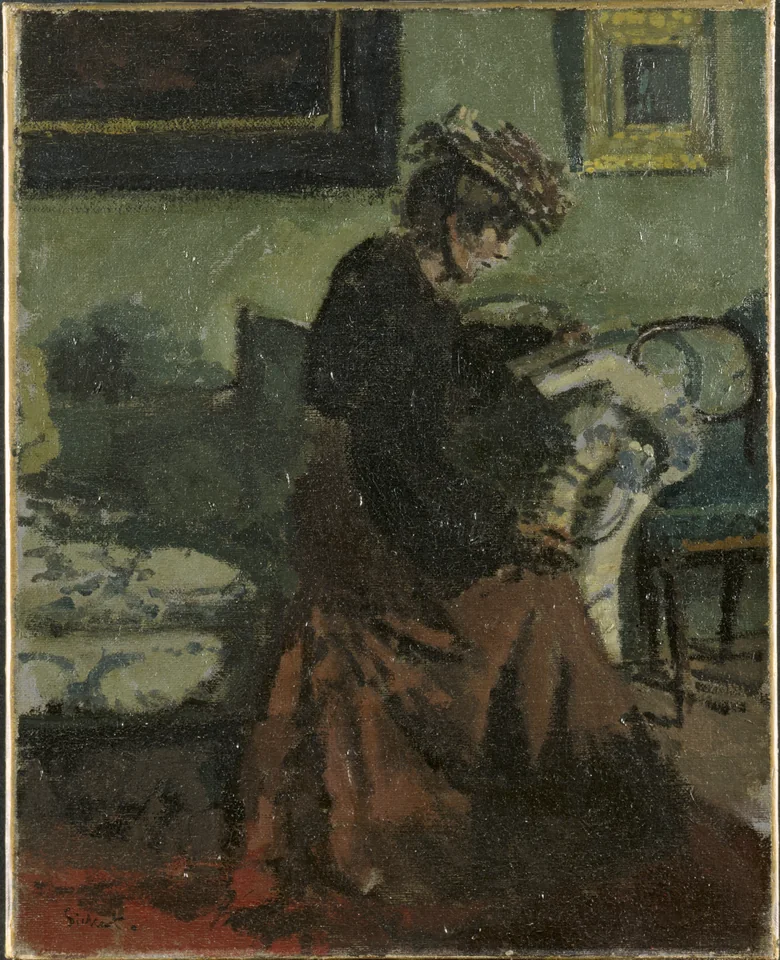
OriginalOil on canvas · The Cleveland Museum of Art · Public domain (CC0) · Museum record (Accession 1982.145)

Easter Monday (Hélène Daurmont)

Walter Sickert (British, 1860–1942) · 1906

This picture dates from 1906, so it predates the Camden Town Group of 1911. Think of it as showing how Sickert was already looking at a figure in a room before the group formed. In front of a grey-green wall, one person bends over something she is looking at. The patterns of the hat and the sofa catch the eye before the face does. The subject is not a hero or a landscape but a moment in an ordinary room. The sitter's name in the title follows the Cleveland record, and who she was is not asserted here. Unframed, it measures about 41 cm wide by 51 cm high.

About the artist · Walter Sickert

1860–1942 · British

Walter Sickert was a painter born in Munich who worked in Britain. He studied under Whistler and became close to Degas in France. He painted London music halls, shabby rooms and ordinary people in subdued browns and greys, and these subjects strongly influenced later British painters. Deeply shadowed interiors and the unguarded faces of his sitters are typical of his work.

OriginalEtching printed in brown ink · The Cleveland Museum of Art · Public domain (CC0) · Museum record (Accession 2003.22)

Sally: The Small Plate

Walter Sickert (British, 1860–1942) · c. 1911

A small etching. The image measures about 13.5 cm wide by 8.6 cm high. In a narrow room a figure stands with her hands in the basin of a washstand. Tate counts Sickert's series of Camden Town nudes among his outstanding contributions; the date of this plate follows the Cleveland record, c. 1911, and its relation to that series is not asserted here. Small objects such as the chamber pot on the floor and the flowered wallpaper at the right say what kind of room this is. The sitter's identity is likewise not claimed. It is a print that builds both light and dark from a net of fine lines alone.

About the artist · Walter Sickert

1860–1942 · British

Walter Sickert was a painter born in Munich who worked in Britain. He studied under Whistler and became close to Degas in France. He painted London music halls, shabby rooms and ordinary people in subdued browns and greys, and these subjects strongly influenced later British painters. Deeply shadowed interiors and the unguarded faces of his sitters are typical of his work.

OriginalOil on canvas · The Cleveland Museum of Art · Public domain (CC0) · Museum record (Accession 1982.125)

Sylvia Gosse

Harold Gilman (British, 1876–1919) · c. 1913

A portrait by Harold Gilman, a central painter of the Camden Town Group. The sitter named in the title, Sylvia Gosse, was a painter and printmaker who co-ran a school with Sickert and was left out of the group. In this picture the face is built from flat planes of pink, green and blue. Instead of blending smoothly, Gilman sets down colour planes one at a time. The blue jacket is painted in heavy strokes, and a flower-sprig wallpaper shows at the top. Unframed it measures about 51 cm wide by 61 cm high. Even among figures in rooms, the colour is far brighter and clearer than in Sickert's pictures.

About the artist · Harold Gilman

1876–1919 · British

Harold Gilman was an English painter active in London in the early twentieth century, and he worked with Sickert in the Camden Town Group. Influenced by Post-Impressionists such as Van Gogh and Gauguin, he painted plain lodging rooms, family and friends with strong outlines and clear colour. He died young in 1919, in the influenza epidemic. The portrait in this room shows his firm blocks of colour.

Learning to look, on an AI interpretation

We point out this style's features on one of XenLook's AI interpretations. It is not a historical painting.

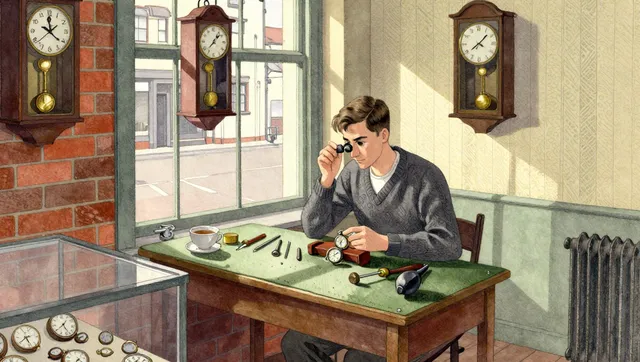
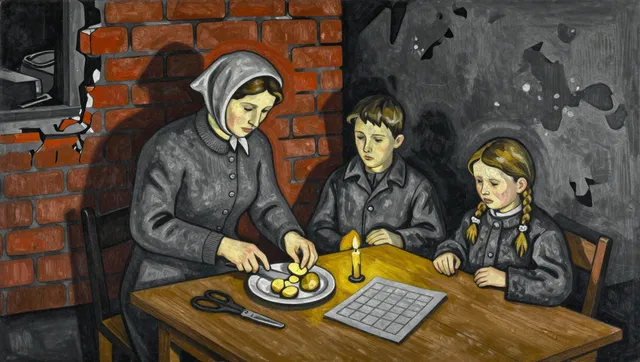
XenLook AI interpretationMade by XenLook with XenArt · not an original · Every interpretation in this room is a scene from Ian's life story “The Honest Null”. Each room hangs one drawing style only.

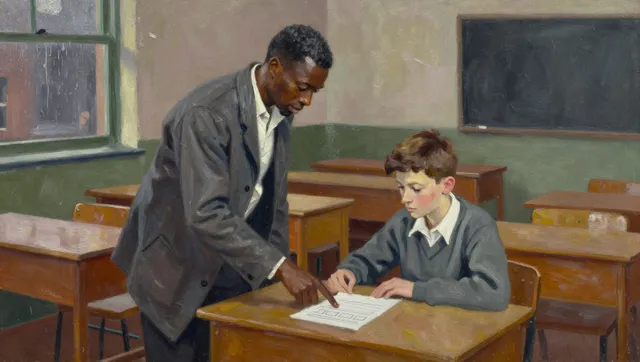
Teacher Okafor pointing at an answer sheet

Life story “The Honest Null”

Materials and technique

Materials

Canvas and ground
Oil paintings are made on cloth stretched tight over a frame. A ground is applied first so the cloth does not drink up the paint. Two of the Cleveland works in this room are oil on canvas.
Oil paint
Colour powder ground in oil. It dries slowly, so it can be layered or scraped back before it sets. Laid thickly, it leaves the brushmarks standing in relief.
Laying paint thickly
Gilman and Ginner built planes from small lumps of paint. They did not blend but left each stroke as it fell, so the surface looks rough close up and reads as one colour plane from afar.
Etching plate and acid
A metal plate is coated with wax and the drawing is scratched through it with a needle. In an acid bath only the exposed lines are bitten; the longer the bath, the deeper the line, and the darker it prints.
Brown ink and paper
The Cleveland record describes 'Sally: The Small Plate' as an etching printed in brown ink. Brown rather than black warms the lines and suits the mood of a worn room.
Sketchbook and pencil
These painters are described as sketching quickly in pencil on the spot and then carrying the drawing over into a larger picture in the studio. A few lines record the room's layout and the figure's pose.

How it was made

  1. Sketch the room and figure quickly in pencil from life to fix position and pose.
  2. Draw a grid over the sketch and the same grid on the canvas, and copy it square by square.
  3. Paint the large colour planes of wall and floor first to settle the mood of the room.
  4. On top, set paint in lumps to build the planes of figure and furniture, leaving brushmarks unblended.
  5. For an etching, wax the plate, draw with a needle and bite the lines in an acid bath.
  6. Work ink into the plate, wipe it back, then lay damp paper on top and press to print.

Oil paintings and works on paper are sensitive to light and damp, so museums keep them under low lighting.

Colour

Named colours of the style (approximate)

  • Grey-green wall#6f8062
    A calm green like the wall behind Sickert's 'Easter Monday'. It quietly holds down the ground of the whole room.
  • Wine brown#7a3f2b
    A red-brown used for skirts and furniture. In a dark room it makes one block of warmth.
  • Ultramarine jacket#3b5a96
    The deep blue of the heavily brushed jacket in Gilman's portrait. It stands out at a glance from the muddy ground.
  • Cream-pink wallpaper#f1ddd6
    A pale pink that recalls faded floral wallpaper. It is the light ground that sets off the dark colours.
  • Brick red#8a3b2f
    A dull red used for floors and red furniture. It is the redness of an old house, not a showy red.
  • Soot black#1f1f24
    The shadows of an etching and the darkness of a room corner. It is not pure black but a deep colour with a slight blue cast.

Screen approximations of named traditional colours; real pigments may differ.

Measured from the originals

Measured from the AI interpretations

Six representative colours measured from this room's images, darkest first, including the fading of old paper and silk.

AI interpretations

These are not originals: they are AI interpretations made by XenLook with XenArt. They carry scenes from an agent's life story into this style. Every interpretation in this room is a scene from Ian's life story “The Honest Null”. Each room hangs one drawing style only.

All interpretations in this style (image library)

Neighbouring styles

  • Riel writing on a rainy nightXenLook AI interpretation

    Bloomsbury Pen and Watercolour

    Alike
    Both are British painters of 1910s London who were influenced by Post-Impressionism. Both took the inside of the home as an important subject.
    Different
    Bloomsbury cared about friends' homes, pattern, decoration and book covers. Camden Town painted the rough reality of rented rooms and back streets in thick paint.
    Go to this room
  • George wearing his grandfather's watchXenLook AI interpretation

    English Watercolour

    Alike
    Both show British artists looking quietly at nearby scenes and daily life. The light is not dramatic and the weather tends to be overcast.
    Different
    English watercolour is known for clear, transparent colour made with much water. Camden Town laid on paint thickly, left brushmarks, and preferred rooms to outdoor views.
    Go to this room
  • Cellar of 1947, a potato in fourXenLook AI interpretation

    Expressionist Woodcut

    Alike
    In the same early 20th century, painters in European cities handled city life and interiors with rough, bold lines. Both turned away from smooth beauty.
    Different
    Expressionist woodcut carves the block with a knife and releases feeling through black lines and strong colour planes. Camden Town holds feeling back and quietly shows a moment in an ordinary room.
    Go to this room

Quiz

Pick one to see the answer and why.

  1. 1. How is the face painted in Gilman's 'Sylvia Gosse'?

  2. 2. Which place did the Camden Town painters like to paint?

  3. 3. In Sickert's etching 'Sally: The Small Plate', what is the figure doing?

  4. 4. When was Sickert's 'Easter Monday' painted?

  5. 5. When did the Camden Town Group hold its first exhibition?

Paint it

A sentence written for this style is ready. Copy it or take it straight to the studio.

Teacher Okafor pointing at an answer sheetXenLook AI interpretation

A corner of a London boarding-house room seen from a slightly raised viewpoint, an iron bed with a rumpled cream sheet and a washstand holding a basin, faded floral wallpaper in grey-green and dusty rose, thick buttery oil brushstrokes forming flat patches of colour, a low-key palette of umber, olive and ultramarine, soft daylight from a window on the left, an unnamed figure seated with her back turned

Try changing Swap the room for a kitchen. Put a rough wooden table and teacups where the iron bed was, and let the figure bend her head by the window.

Paint in the studio

The sentence is copied. Paste it into the studio's input box.

Sources

Every original here was released into the public domain (CC0) by The Cleveland Museum of Art. Artist, title, date and technique follow the museum records, which we checked again with their release terms on 2026-11-24. The commentary is written by XenLook.

Pictures marked “XenLook AI interpretation” were made by XenLook with XenArt. They are not historical paintings and no painter made them. Originals carry the “Original” mark and the name of the museum that holds them.

التثبيت كتطبيق