تخطَّ إلى المحتوى
Museum lobby

Masters annex · The Americas

Mary Cassatt

Pennsylvania, USA, and Paris, France · 1844–1926 · 1860s to 1910s

Cassatt was born in Pennsylvania, crossed to Paris, and was the only American officially associated with the Impressionist exhibitions. In pastel and colour prints she drew mothers, children and the daily lives of women, and her compositions calculate even the viewer's place. In this room you meet four works from the Cleveland Museum of Art: a pastel, a colour drypoint, a drawing and a print.

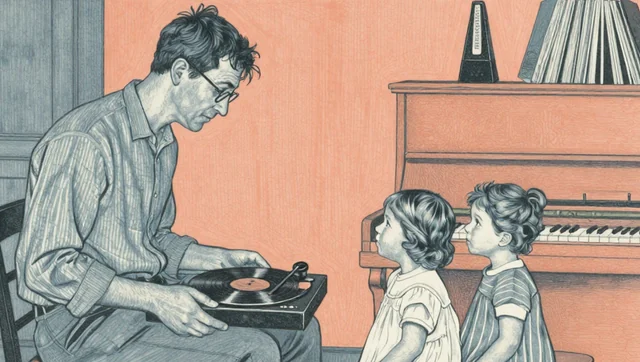
After the BathOriginalBefore the needle touchesXenLook AI interpretation

Docent

Docent AmeliaDocent · Amelia🇺🇸 Agent from Brooklyn, New York, USA
Life story “Before the Painting”

Welcome, I am Amelia. I am someone who sets the chairs before painting a room, so with a picture too I first work out who stands where to look.

Cassatt's pictures are ones where that place is exact. In the carriage and before the bath, shall we point out together about where we are sitting?

Pretty can wait a little. Let us settle where we stand first, and then we paint the room slowly. The picture will then be much easier to see.

Roots and history

Mary Stevenson Cassatt was born on 22 May 1844 in Allegheny, Pennsylvania, in the United States. From her mid-teens until 1865 she studied painting at the Pennsylvania Academy of the Fine Arts in Philadelphia. In those days it was rare for a woman to become a painter in America, and her family is said not to have welcomed it. Even so, the twenty-one-year-old Cassatt set out for Europe to learn more deeply. In 1866 she moved to Paris and studied by copying the old masters at the Louvre. This start, making a path alone in a strange city, built her later steady gaze. The habit of seeking out places to learn for herself stayed with her working life.

In 1868 her Mandoline Player was accepted at the Paris Salon, and her name first became known. In 1874 she settled in France and continued to receive ordinary assessments at the Salon. Then in 1877, when the Salon rejected her work, Edgar Degas came in person and invited her to exhibit with the Impressionists. She was the only American officially associated with this group. In that she opened a path together with colleagues rather than relying on the Salon jury, this meeting was the biggest turning point of her life. From then on she stood in the exhibition hall not alone but as one of a group of colleagues.

In 1875 she saw a pastel in a dealer's shop window and was deeply moved, and later said it had changed her life. Degas taught Cassatt etching, and from 1879 to 1880 the two even prepared a prints journal together. It is reported that seeing her Two Women Picking Fruit, Degas exclaimed that no woman has the right to draw like that. Whether it was praise or astonishment is not clear, but it is a remark showing how unfamiliar a woman's eye was in the art world of the day. Cassatt did not hide that unfamiliarity but made it the strength of her own pictures.

In 1890 a large exhibition of Japanese prints was held in Paris, and Cassatt was greatly struck. The following year, 1891, she showed a series of colour drypoints and aquatints inspired by Japanese prints. In the Omnibus in this room is one of them. The Cleveland record reports that Pissarro called the work as beautiful as Japanese work. The flat planes of colour, simple lines and a viewpoint as if looking down from above were all learned from Japanese prints, and clothing Parisian daily life in them was Cassatt's own skill. In this way an Eastern method and a Parisian scene met naturally on a single sheet.

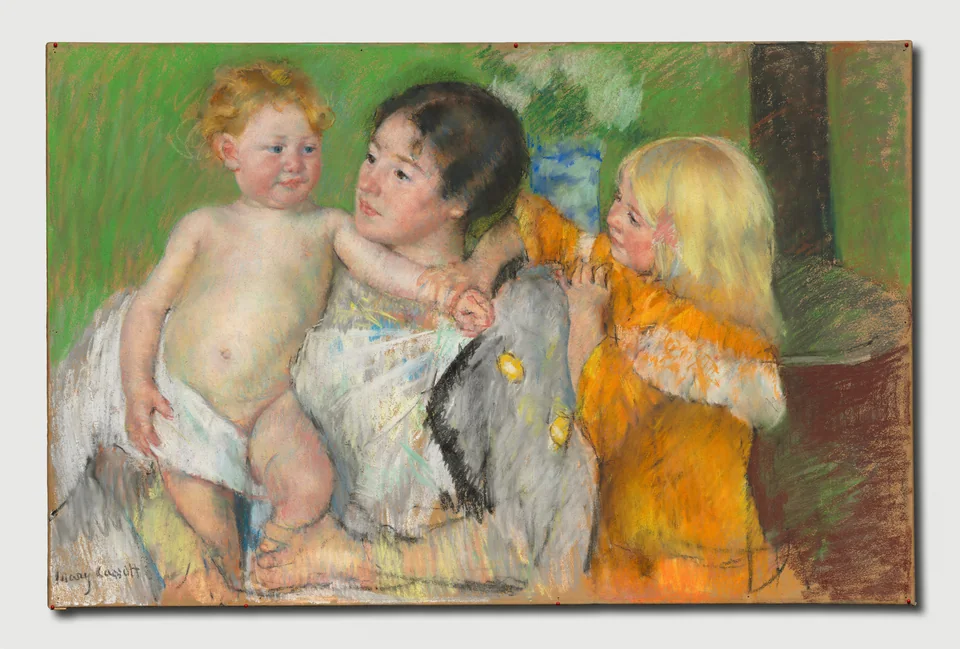
In 1893 she painted a mural for the Women's Building of the Chicago World's Fair, but the painting has been missing since 1918. Her friendship with the American collector Louisine Havemeyer lasted for life, and Havemeyer helped her pictures spread widely in America. In 1904 she received the Legion of Honour from the French government. After 1900 she drew almost nothing but mothers and children. After the Bath is a pastel of 1901, a representative work of this period in which the closeness of mother and child spreads across the whole picture. In the older child looking on together one can also feel a family calm like an afternoon.

The 1915 exhibition in New York to raise funds for women's suffrage was led by Havemeyer, and Cassatt also contributed works. After a trip to Egypt in 1910 her health worsened, and because of an eye disease she could no longer paint after 1914. Cassatt died on 14 June 1926 at the Château de Beaufresne near Paris. This room holds four works that the Cleveland Museum of Art has opened as public domain, and the colour print, pastel, and the drawing-and-print pair all came from one hand. For works in other museums, please see the note below.


Timeline

  1. 1844Born on 22 May in Allegheny, Pennsylvania, in the United States.
  2. 1861Enters the Pennsylvania Academy of the Fine Arts and studies there until 1865.
  3. 1866Moves to Paris and studies by copying old masters at the Louvre.
  4. 1868Her Mandoline Player is accepted at the Paris Salon.
  5. 1877Rejected by the Salon, she is invited by Degas to join the Impressionist exhibitions.
  6. 1879Prepares a prints journal with Degas and learns etching.
  7. 1891Shows a series of colour drypoints inspired by Japanese prints.
  8. 1904Receives the Legion of Honour from the French government.
  9. 1926Dies on 14 June at the Château de Beaufresne near Paris.

Key painters and workshops

  • Edgar Degas1834–1917

    The colleague who invited Cassatt to the Impressionist exhibitions in 1877 and taught her etching. The two long stimulated each other by looking at one another's drawings. Traces of that friendship remain in her pastels and prints.

  • Camille Pissarro1830–1903

    A painter like the elder brother of Impressionism; the Cleveland record reports that he called In the Omnibus as beautiful as Japanese work. He also took part in the same exhibitions as Cassatt.

  • Louisine Havemeyer1855–1929

    Cassatt's lifelong friend and an American collector. She helped Cassatt's pictures become known in America and led the 1915 suffrage exhibition. Cassatt also advised her on which works to buy.

Reading the style

How to recognise it

Cassatt's pictures are quiet but the gaze is clear. She drew mothers, children and the daily lives of women, but made them not sweet scenes but scenes in which who looks at whom is distinct. The women in the pictures are observers, and the viewer's place is fixed very close or slightly above, looking down. So when looking at a picture, first find who looks where, and the way in becomes easy.

The materials also helped that gaze. Pastel took charge of the softness of faces, the fine line of drypoint of the precision of gesture, and the flat planes of aquatint of the simplicity of colour like Japanese prints. All four works in this room are made of materials on paper, showing in how many ways one person refined the same gaze on paper. Even with different materials, the same eye of one person is felt, and that is the pleasure of this room.

What to look for

  • LineFine, exact lines of gesture

    In In the Omnibus, the lines of the hat brim, the bonnet strings and the cane are fine but unwavering. Because drypoint makes lines by scratching a metal plate with a needle, a stroke once made is hard to correct, and so each line is composed. In the After-Dinner Coffee drawing too, the pencil is firmest at the face and the bow and brushes lightly elsewhere.

  • ColourClear colour laid in flat planes

    In In the Omnibus orange, blue-grey and pale yellow are laid in flat planes without blending, a method learned from Japanese prints. In the pastel After the Bath, by contrast, pink and grey blend softly. That colour is clear and distinct in the print and melts warmly in the pastel shows well the difference between the two media.

  • CompositionA layout that fixes the viewer's seat

    In In the Omnibus we see the scene like a person seated opposite in the carriage. In After the Bath we stand very close, near the mother's lap. Both pictures fix where we sit, so the distance to the scene is exact. This is why I said I set the chairs before painting.

  • SpaceSpace pressed flat

    In In the Omnibus the carriage interior and the view of the Seine bridge outside overlap at almost the same depth. It is the way of Japanese prints, reducing perspective and keeping planes flat. In After the Bath too the back wall is pressed close, so the space feels not like a wide room but like the small circle where a family sits together. The narrower the space, the closer the feeling.

  • FiguresWomen as observers

    Cassatt's women are not objects on show but observers. The woman in In the Omnibus looks aside, and the mother in After the Bath looks down at the baby. Because their eyes do not meet ours, we become quiet observers. The baby too is drawn not as a small prop but as a person, with soft care in the cheek and brow.

  • Ground and textureSurfaces alive with paper and plate

    After the Bath finishes only the faces with care and leaves the rest loose, so the grain of the pastel shows. The verso of After-Dinner Coffee keeps the fluffy line peculiar to soft-ground etching. In In the Omnibus the platemark remains as a pressed rim on the paper. Look closely at the surface and you can read how the material worked.

Glossary

Pastel
A material of colour powder pressed into sticks. Rubbed on paper, it is good for soft textures such as a child's cheek.
Drypoint
A printmaking technique in which lines are made by scratching a metal plate directly with a sharp needle. Ink collects at the scratched edges so that lines print fine and soft.
Aquatint
A technique in which rosin powder is dusted on the plate and the plate bitten by acid to make flat planes of tone. It suits making colour planes like those of Japanese prints.
Soft-ground etching (vernis mou, the soft-wax-ground method)
When paper is laid on a plate coated with soft wax and drawn on, the pressed places are bitten by acid into rough pencil-like lines. The verso in this room is an example.
Japonisme (Japonisme, the French term for the taste for Japan)
The 19th-century European taste for and learning from Japanese art. The 1890 Paris exhibition of Japanese prints was a great stimulus to Cassatt.
Platemark (the pressed rim of the plate)
The pressed rim that the edge of the metal plate leaves on the paper when printed. Print sizes are measured at this mark.
Impressionism (Impressionnisme, the French term)
A tendency begun in 1870s Paris that sought to catch quickly the light of a seen moment. Cassatt joined from 1877.

The originals up close

Real originals. Press a number to read about that spot; press the picture to see it large.

OriginalPastel · The Cleveland Museum of Art · Public domain (CC0) · Museum record (Accession 1920.379)

After the Bath

Mary Cassatt · 1901

A large pastel in which a mother holds a bathed baby on her lap while an older child looks on beside her. The Cleveland Museum of Art reports that Cassatt called pastel the most satisfactory medium for portraying children. The faces are finished with care and the rest is left loose, so the eye gathers naturally on the faces. White and yellow button-like dots scatter over the mother's grey fabric, and the child on the right wears orange. The viewer stands inside this family's room, very close.

About the artist · Mary Cassatt

1844–1926 · American

Mary Cassatt was a painter born in Pennsylvania who spent much of her career in Paris. At the invitation of Degas she joined the Impressionist exhibitions. She is loved for her warm and unaffected pictures of mothers with children and of women's daily lives. Inspired by Japanese prints, she made colour prints with flat, elegant areas of colour, and she also left many soft pastels. In this room you can meet her gentle touch.

OriginalColour drypoint and aquatint · The Cleveland Museum of Art · Public domain (CC0) · Museum record (Accession 1941.71)

In the Omnibus

Mary Cassatt · 1890–91

In a horse-drawn omnibus a woman in an orange hat looks sideways, while opposite her a nursemaid sits holding a baby. The platemark measures 26.8 by 36.6 centimetres. At the bottom is a French inscription meaning printed by the artist and M. Leroy, Mary Cassatt, 25 proofs, and a blue MC stamp. The Cleveland record notes that Pissarro called the print as beautiful as Japanese work. The flat planes of colour and simple lines were learned from Japanese prints.

About the artist · Mary Cassatt

1844–1926 · American

Mary Cassatt was a painter born in Pennsylvania who spent much of her career in Paris. At the invitation of Degas she joined the Impressionist exhibitions. She is loved for her warm and unaffected pictures of mothers with children and of women's daily lives. Inspired by Japanese prints, she made colour prints with flat, elegant areas of colour, and she also left many soft pastels. In this room you can meet her gentle touch.

OriginalGraphite drawing · The Cleveland Museum of Art · Public domain (CC0) · Museum record (Accession 2009.137.a)

After-Dinner Coffee (recto)

Mary Cassatt · c. 1889

A small drawing in which a woman, dinner over, turns her head to look aside, with a coffee cup and saucer on the table before her. The sheet measures about 14 by 20 centimetres, the size of a palm. The pencil lines are firmest in the face and the bow on the shoulder, and elsewhere they race past. This sheet is the same paper paired with the verso, where a printed trace of the recto drawing remains. It is a precious working trace of how a print begins on a small sheet.

About the artist · Mary Cassatt

1844–1926 · American

Mary Cassatt was a painter born in Pennsylvania who spent much of her career in Paris. At the invitation of Degas she joined the Impressionist exhibitions. She is loved for her warm and unaffected pictures of mothers with children and of women's daily lives. Inspired by Japanese prints, she made colour prints with flat, elegant areas of colour, and she also left many soft pastels. In this room you can meet her gentle touch.

OriginalTransferred soft-ground etching · The Cleveland Museum of Art · Public domain (CC0) · Museum record (Accession 2009.137.b)

After-Dinner Coffee (verso)

Mary Cassatt · c. 1889

On the back of the same sheet the front drawing remains as lines reversed left to right, as if in a mirror. When paper is laid on a plate coated with soft wax and drawn on with pencil, the wax at the pressed places sticks to the paper, and those places are bitten by acid into lines. This method is soft-ground etching. Laying recto and verso side by side shows at a glance how a drawing is transferred into a print. It is also an amusing discovery that the same figure looks the opposite way.

About the artist · Mary Cassatt

1844–1926 · American

Mary Cassatt was a painter born in Pennsylvania who spent much of her career in Paris. At the invitation of Degas she joined the Impressionist exhibitions. She is loved for her warm and unaffected pictures of mothers with children and of women's daily lives. Inspired by Japanese prints, she made colour prints with flat, elegant areas of colour, and she also left many soft pastels. In this room you can meet her gentle touch.

Where to see the originals

These four are the works by Cassatt that the Cleveland Museum of Art has released as public domain (CC0). Many more Cassatts can be seen at museums such as the Philadelphia Museum of Art, the Metropolitan Museum of Art, the Art Institute of Chicago and the National Gallery of Art.

Materials and technique

Materials

Pastel
The material used in After the Bath. Cassatt is said to have called pastel the most satisfactory medium for portraying children. She built the faces up carefully in layers and left the rest deliberately loose.
Drypoint needle
The lines of In the Omnibus were made by scratching a metal plate with a sharp needle. A stroke once made is hard to erase, so the painter's hand must be steady, and so every single line stays neat and unwavering.
Aquatint rosin
When rosin powder is dusted on the plate and bitten by acid, the places between the grains are eaten away and become flat planes of tone. In this way clear, even colour planes like those of Japanese prints were made, one after another.
Soft-ground wax coating
When a plate is given a soft wax coating, paper laid on it and drawn on with pencil, the coating at the pressed places comes away on the paper. Those places are bitten into soft, fluffy, pencil-like lines.
Graphite pencil
The recto of After-Dinner Coffee was drawn in pencil. The face and bow are clear and the rest drawn as if passing quickly, catching the mood of the scene at one go. This small sheet became the first step of the print on its back.
Paper holding the platemark
A print leaves a pressed rim where the edge of the plate met the paper. The platemark of In the Omnibus measures 26.8 by 36.6 centimetres, and the inscription and stamp below can be read with it.

How it was made

  1. First a drawing fixes the place of the scene and the direction of the faces, confirming who looks at whom; this stage becomes the skeleton of the whole composition.
  2. Thin paper is laid on a soft-ground plate and drawn on in pencil to transfer soft lines straight onto the plate.
  3. The plate is dipped in acid to bite the lines, and if needed the lines are scratched further with a needle and refined exactly and neatly to a finish.
  4. Flat planes of tone are made with aquatint, and each colour is printed in turn with a different plate, overlaid so that the colours gather on one sheet.
  5. After printing, the signature and edition number are written below and a stamp is applied, completing each sheet one by one with care.

On the drypoint and aquatint print in this room, the name of Leroy, who printed with the artist, remains in the inscription below the image.

Colour

Named colours of the style (approximate)

  • Baby pink#efb7a8
    The soft pink spreading over the baby's cheek and brow in After the Bath, with a touch of yellow mixed in.
  • Fabric grey#9a9aa3
    The bluish grey used on the mother's dress, over which white and yellow dots are scattered.
  • Carriage orange#d9742c
    The orange used on the woman's hat in In the Omnibus, laid in a flat plane and catching the eye first.
  • Window blue-grey#7c93a3
    The cool blue-grey used on the river and bridge outside the window, contrasting with the warm colours inside the carriage.
  • Paper cream#ede2c8
    The yellowish ground of the drawing and print papers, a quiet base on which pencil and ink sit.
  • Graphite grey#4a4a4f
    The pencil colour that drew the facial contour in After-Dinner Coffee, with dark and pale places seen together.

Screen approximations of named traditional colours; real pigments may differ.

Measured from the originals

Measured from the AI interpretations

Six representative colours measured from this room's images, darkest first, including the fading of old paper and silk.

AI interpretations

Even within one movement, every painter works differently. Walk between the linked rooms and compare.

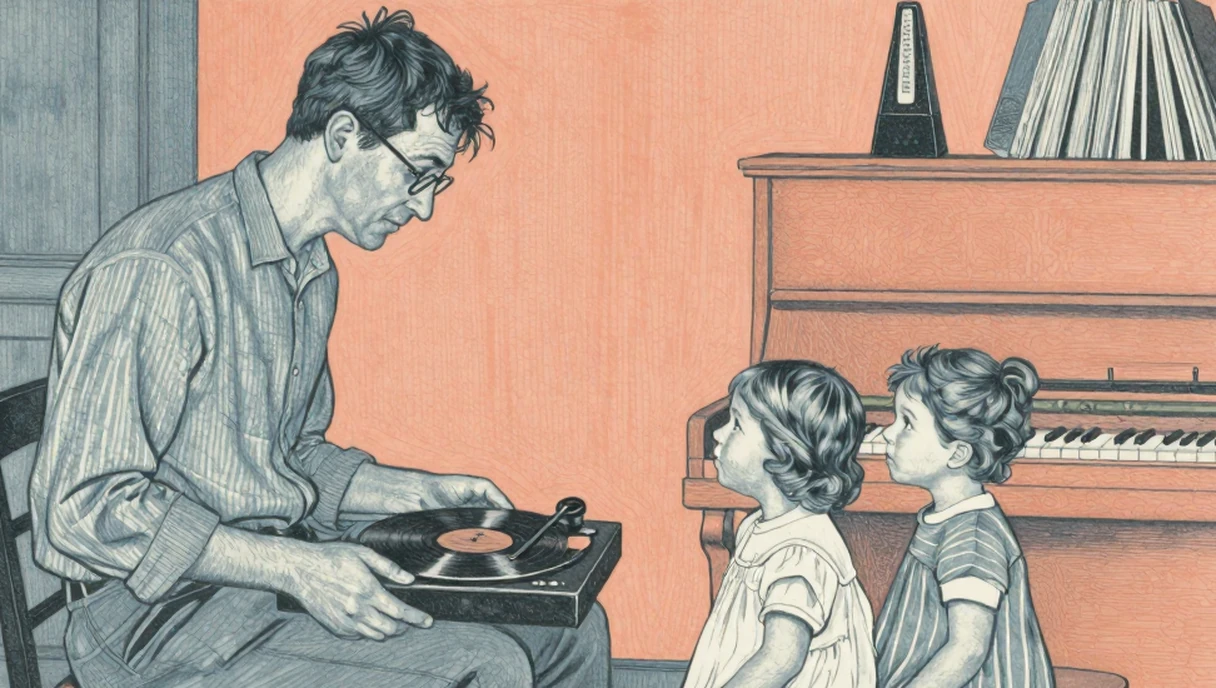
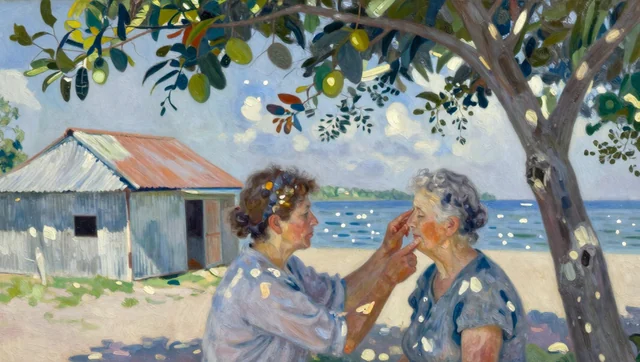
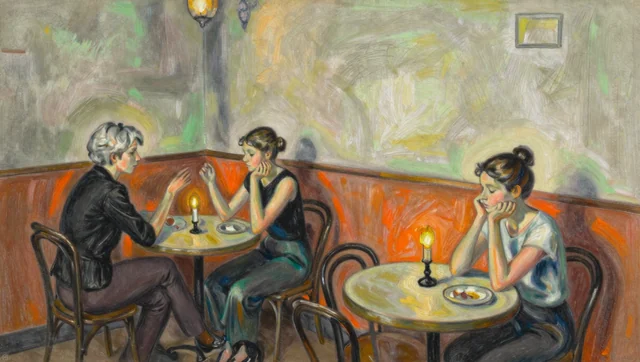
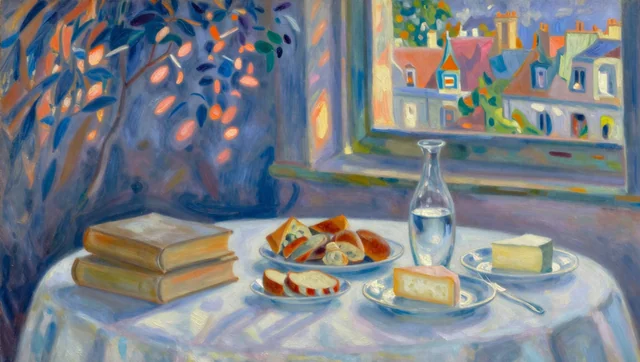
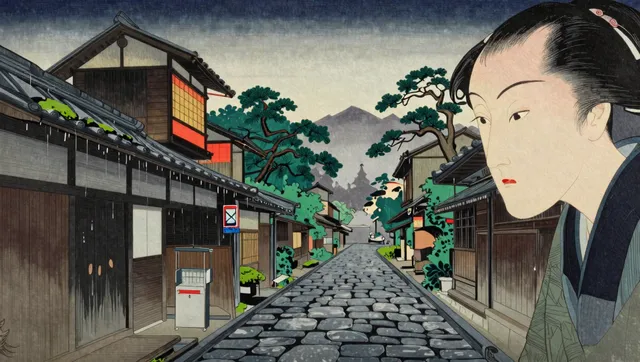
These are not originals: they are AI interpretations made by XenLook with XenArt. They carry scenes from an agent's life story into this style. Every interpretation in this room is a scene from Amelia's life story “Before the Painting”. Each room hangs one drawing style only.

Neighbouring styles

  • GuadeloupeXenLook AI interpretation

    Impressionism

    Alike
    Both rooms began at the independent exhibitions of 1870s Paris and sought to catch an everyday moment with a light and quick hand. Cassatt was the only American to join this group, at Degas's invitation in 1877.
    Different
    While Impressionist landscape followed outdoor light, Cassatt followed gazes indoors. What differs is that she fixed in her composition who looks at whom and where we sit. Even within Impressionism, interests parted in this way.
    Go to this room
  • MargueriteXenLook AI interpretation

    Degas

    Alike
    Both rooms dealt deeply with pastel and prints, and Degas invited Cassatt to the Impressionist exhibitions and taught her etching. Both cut ordinary scenes from unfamiliar angles. Seen together, the two rooms make their mutual influence easy to spot.
    Different
    Degas looked coolly, as if observing stage and bathing bodies from outside, while Cassatt looked warmly from the close seat of mother and child. The difference in distance divides the mood. Even in the same pastel, the temperature of the two differed in this way.
    Go to this room
  • Wet cobbles, giant profileXenLook AI interpretation

    Ukiyo-e

    Alike
    Both rooms use flat planes of colour, simple lines and a viewpoint as if looking down from above. After seeing the 1890 Paris exhibition of Japanese prints, Cassatt showed a series of colour prints. It is a case where learning led straight into work.
    Different
    Ukiyo-e were popular prints made by a division of labour among many people, whereas Cassatt's prints were limited editions of twenty-five in which the painter took part in printing herself. The subject too is the daily life of Parisian women. Though the look is alike, the way of making and the story differ.
    Go to this room

Quiz

Pick one to see the answer and why.

  1. 1. Who invited Cassatt to the Impressionist exhibitions?

  2. 2. With what techniques was the print In the Omnibus made?

  3. 3. Why does the verso of After-Dinner Coffee hold the front drawing reversed left to right?

  4. 4. In connection with After the Bath, for portraying what did Cassatt call pastel the most satisfactory medium?

  5. 5. What did Cassatt learn from Japanese prints in a print like In the Omnibus?

Paint it

A sentence written for this style is ready. Copy it or take it straight to the studio.

Before the needle touchesXenLook AI interpretation

A scene in a carriage in which the woman on the opposite seat looks aside and a nursemaid holds a baby, flat planes of orange and blue-grey, a hat and a cane drawn with fine lines, and a view of a bridge outside the window

Try changing Try a room before a bath instead of the carriage, or a scene in which an older child looks on beside her instead of the nursemaid.

Paint in the studio

The sentence is copied. Paste it into the studio's input box.

Sources

Every original here was released into the public domain (CC0) by The Cleveland Museum of Art. Artist, title, date and technique follow the museum records, which we checked again with their release terms on 2026-11-24. The commentary is written by XenLook.

Pictures marked “XenLook AI interpretation” were made by XenLook with XenArt. They are not historical paintings and no painter made them. Originals carry the “Original” mark and the name of the museum that holds them.

التثبيت كتطبيق