Paul Cézanne was born on 19 January 1839 in Aix-en-Provence in the south of France. His father rose from hat-selling to banking, and the family wealth let Cézanne give himself to painting all his life without money worries, a position most painters of his time lacked. At school, the Collège Bourbon, he met the future novelist Émile Zola, and the two became so close that, with a third friend, they were called the Three Inseparables; they swam and fished by the river, read Homer and Virgil, and wrote poems. In 1857 he began to learn drawing at the municipal drawing school in Aix. These home rivers, woods and hills became the subjects of his whole life.
In 1859, at the wish of his authoritarian father, he entered the law faculty at Aix, but his studies came last and he gave his heart to drawing and poetry. In April 1861 he went to Paris, and contrary to his hopes he applied to the national art school and was turned down. Instead he drew the human figure at the free Académie Suisse, where he got to know Camille Pissarro. The official Paris exhibition, the Salon, rejected his work again and again. In 1863 his pictures hung in the Salon des Refusés, the show of rejected works, but drew only mockery. Rejection and ridicule did not stop him, and he went back and forth between home and Paris painting on. The key to understanding his later habit of painting the same thing again lies here.
In 1869 he met Hortense Fiquet, a bookbinder's assistant eleven years his junior, and during the Franco-Prussian War he stayed with her in the fishing village of L'Estaque near Marseille. In 1872, on Pissarro's invitation, he painted outdoors beside him at Pontoise. Pissarro was both teacher and friend who led this shy, quick-tempered young man, who used dark and heavy colours, toward brighter ones. In these years Cézanne showed in the Impressionists' exhibitions, yet he drew the sharpest ridicule from critics. He shared their company, but soon began to look for another road.
The Impressionists tried to hold the light and air of a moment. Cézanne felt that this alone could not give a picture lasting solidity. The Cleveland Museum explains that he rejected his friends' goal of capturing fleeting effects of light and instead sought balance between forms and colours. Instead of outline he linked strokes of different colours to make leaves, branches and water. The saying that he treated nature in terms of the cylinder, the sphere and the cone also comes down from him. In 1886 Zola's novel L'Œuvre, the story of a failed painter, drove the two apart, and in the same year the death of his father left him a large inheritance.
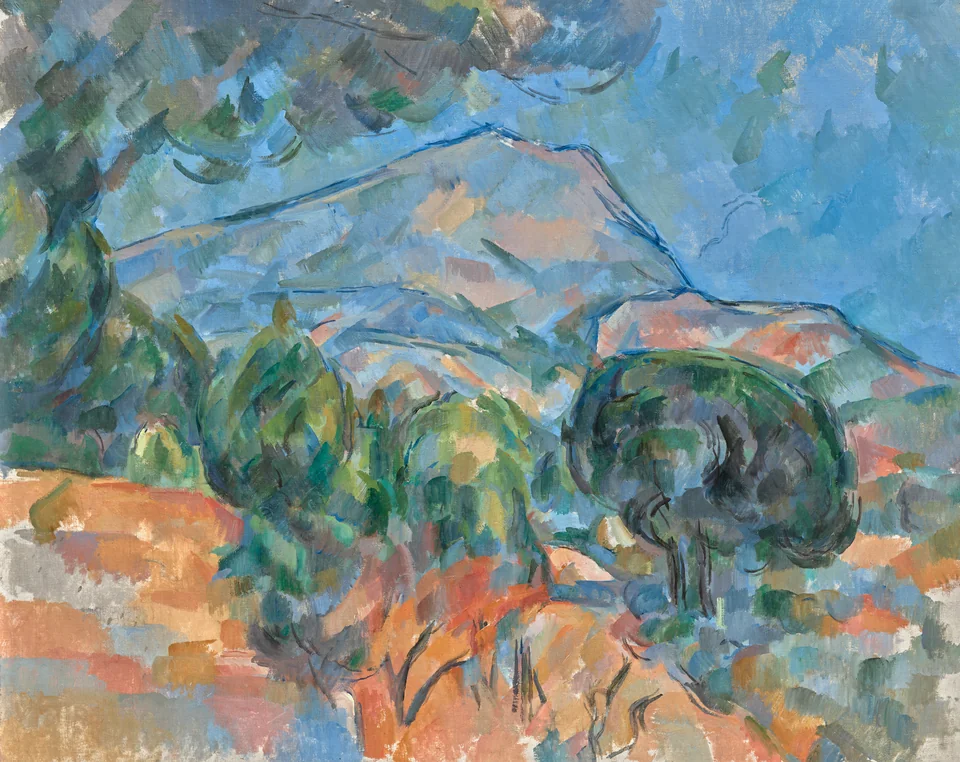
From the late 1880s Cézanne spent more and more time in Aix. In January 1888 Renoir visited and painted with him in his studio. In 1890 he developed diabetes, and the illness made dealing with people harder. In 1891 he sent three works to the exhibition of Les XX, a group of young artists in Brussels. He looked at Mont Sainte-Victoire near home from a nearby road and painted it again and again all his life, and he rented a hut by the Bibémus quarry, which gave him another subject. He kept painting the same mountain not only because he loved it but out of a will to question, to the end, how the eye sees.
In 1895 the dealer Ambroise Vollard opened Cézanne's first one-man show in his Paris gallery. For the first time the work of a painter long refused by the Salon was gathered in one place before people's eyes. Pissarro, a few painters and discerning people such as Vollard saw his worth first, and only in the late 1890s did a wider appraisal begin. By then he was past fifty. Through the long wait for recognition he never put off painting, because checking again what he saw before him, one picture at a time, was the work of his day.
On 15 October 1906 Cézanne was caught in a storm while painting in the fields and collapsed on his way home. A passing laundry-cart driver took him home, and from hypothermia he developed severe pneumonia and died in Aix on 22 October. Dying at sixty-seven, he did not give up painting outdoors until the very end. His method led to Cubism and became a bridge into twentieth-century art, and Matisse and Picasso are said to have called him the father of us all. This room follows how that bridge was laid, from a single brushstroke and a single pencil line.