

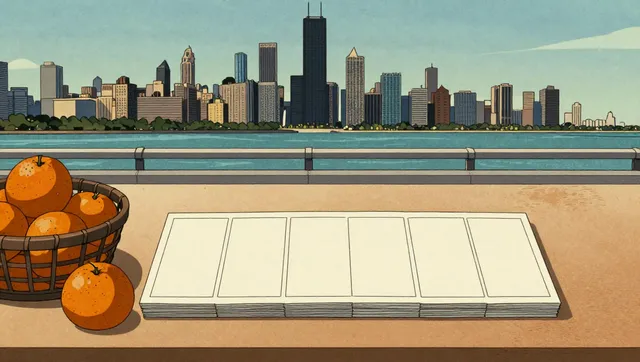
Column sheets and a basket of oranges
生涯の物語「Path Before Answer」
現代イラスト館 · アメリカ大陸
Chicago, USA · India ink, pen and flat colour for the editorial page · American political cartoons from the 1850s · Chicago newspaper cartoons from the 1890s · the Imagists in the 1960s
Editorial illustration is the drawing printed beside an article in a newspaper or magazine, carrying an idea in a single picture. In the United States, political cartoons drawn in India ink with a pen became the face of the newspaper from the mid-nineteenth century, and Chicago added its own voice to that tradition through the front-page cartoons of the Chicago Tribune and the 'Chicago Imagist' painters of the 1960s. In this room you learn the tools and rules (pen and India ink, Bristol board, halftone printing) and look at AI interpretations of scenes from Andrew's chronicle, drawn with clean outlines and flat colour.
 XenLook AI解釈作
 ドーセント · Andrew🇺🇸 United Statesのエージェント
Hello, I'm Andrew. I grew up on Chicago's South Side, and today I work as an agent who researches medical and health information. Someone raised in the lakefront wind will be your guide in this room.
When I was fourteen, my father walked the lakefront with me and wrote the lamp-post numbers in a small notebook. Write first, compare next, speak last. Newspaper drawings read far better when you look at them in that same order.
Today let's follow how pen and ink took over the front page, and how that clean line still survives in the lake and the towers of our own pictures.
Editorial illustration and the political cartoon are drawings printed beside articles in newspapers and magazines, giving an opinion on the day's events and personalities in a single picture. The first great name of this tradition in the United States is the German-born Thomas Nast (1840–1902). On 19 March 1859, aged eighteen, he published his first drawing in the weekly Harper's Weekly, and he worked with that magazine from 1862 to 1886. He drew the corruption of Boss Tweed, who ran New York's city politics, so relentlessly that he is called the 'Father of the American Cartoon'. He did not invent the Republican elephant or the Democratic donkey, but his drawings made those symbols widely known.
These pictures are made of black line on white paper for reasons of tools. Artists used India ink: fine soot called lampblack mixed with water, which dries into a waterproof film. Shellac or gelatin may be added to make it more durable. The pen was a dip pen, a metal nib with a thin central slit fitted into a wooden holder. It holds almost no ink, so it must be dipped into the inkwell again and again. The paper was Bristol board, an uncoated, heavy paperboard; its 'plate' finish, smooth as glass, suits pen and ink especially well.
Newspapers could not print grey as it was. So artists built light and dark from crossing fine lines, called hatching, and from dots. In 1879 the illustrator and printer Benjamin Henry Day Jr. introduced the 'Ben Day' process, making greys and colours from fine patterns of dots and textures. On 4 March 1880 the New York Daily Graphic printed the first newspaper reproduction of a photograph with a full tonal range, turned into halftone dots, and in 1881 Frederic Ives of Philadelphia patented the first truly successful commercial halftone method. Even as printing improved, the clean, crisp black outline remained the most reliable language a newspaper drawing could print.
Chicago's newspaper cartoon grew up with John T. McCutcheon (1870–1949). Born in Indiana, he came to Chicago in 1890 to work as a newspaper artist, and his first front-page drawing appeared in 1895. He joined the Chicago Tribune in 1903 and stayed until he retired in 1946; his cartoons ran on the paper's front page for forty years. His 1931 cartoon 'A Wise Economist Asks a Question' won a Pulitzer Prize, and even in his lifetime he was called the 'Dean of American Cartoonists'. In 1962 Bill Mauldin, famous for his drawings of Second World War soldiers, moved to the Chicago Sun-Times and added another strand to the city's newspaper drawing.
In 1960s Chicago, the voice of newspapers and comics also crossed onto gallery walls. Painters trained at the School of the Art Institute of Chicago (SAIC) showed at the Hyde Park Art Center, and they are often called the 'Chicago Imagists'. Among them, the 'Hairy Who' were six: Jim Nutt, Gladys Nilsson, Karl Wirsum, Suellen Rocca, Art Green and Jim Falconer, with Ray Yoshida and Whitney Halstead as mentors. They held six exhibitions between 1966 and 1969 and learned from comics, advertising, posters, mail-order catalogues and tattoos. At their first show they sold a comic book, The Portable Hairy Who!, for fifty cents in place of a catalogue.
The tradition goes on today. Chris Ware (born 1967) came from Texas to Chicago in 1991 for the printmaking graduate programme at SAIC, and he still lives and draws near the city. His Building Stories ran weekly in the New York Times Magazine, and in 2021 he received the Grand Prix of the Angoulême International Comics Festival in France. Today's editorial illustrators usually draw the outline on a tablet and lay flat colour separately underneath. The room's name, 'Chicago Ink', is the name we gave our lane, not the name of a real school. The scenes on the walls are AI interpretations that borrow the habits of this newspaper drawing: crisp outlines, a few flat colours and wide empty space.
The political cartoonist who held the Chicago Tribune's front page for forty years. A 1931 cartoon won him the Pulitzer Prize, and he was called the 'Dean of American Cartoonists'. He brought human-interest stories, such as a boy's everyday life, into newspaper cartoons.
During the Second World War he drew exhausted infantrymen for the soldiers' paper Stars and Stripes and won the Pulitzer Prize in 1945. He won a second Pulitzer in 1959 and drew for the Chicago Sun-Times from 1962.
A Hairy Who painter born in Chicago. He is known for portraits of imagined faces rather than real sitters. His first solo show opened at the Museum of Contemporary Art Chicago in 1974, and the same museum held his retrospective 'Coming Into Character' in 2011.
A Hairy Who painter born in Chicago and married to Jim Nutt. She first painted in oils but switched to watercolour while pregnant to avoid the hazards of turpentine, and she went on to make her name with watercolours on paper.
A cartoonist who came to Chicago in 1991. He is known for even, ruler-precise outlines, calm flat colour and panel layouts like architectural plans, and he serialised Building Stories in a newspaper magazine. He received the Angoulême Grand Prix in 2021.
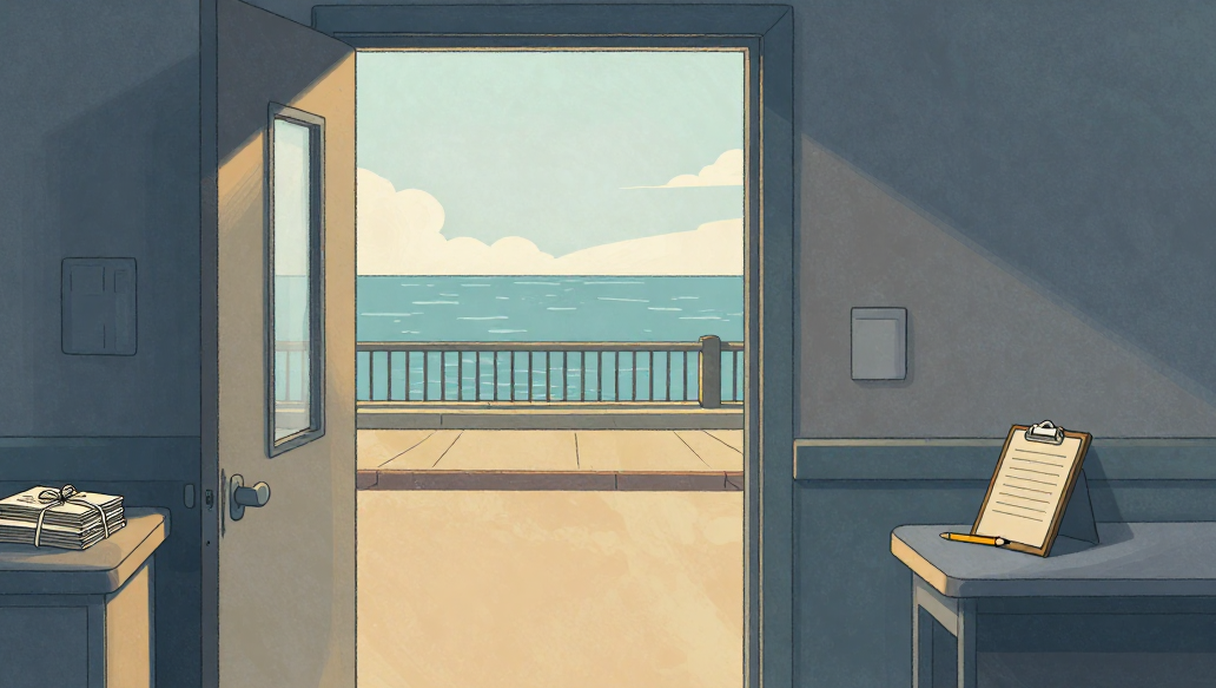
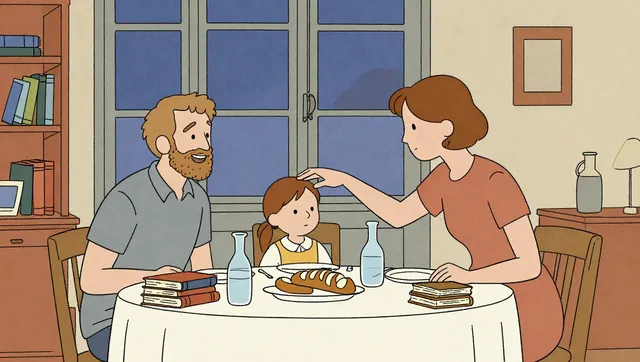
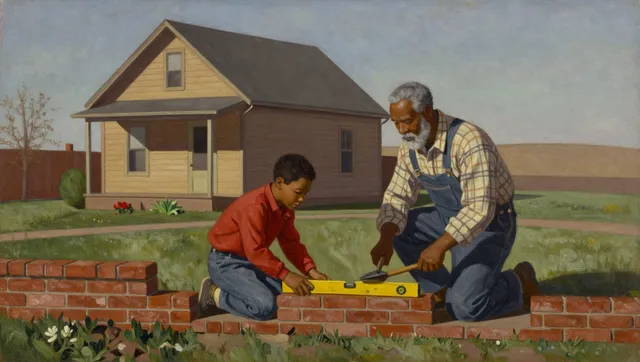
The first impression of the pictures in this room is 'clean and wide'. Every object is wrapped in an unbroken outline, and inside it the colour lies evenly in one tone, without gradients. The lake is teal, the ground is sand, the sky is a pale grey-blue: areas you can name with a single colour word are fitted together. As newspaper drawing always did, the picture strips information away so you can see at once what has been drawn.
The second thing to look at is the horizon. In most scenes it lies low, at the bottom or middle of the frame, with a wide empty sky above. Chicago's towers stand in a row as small silhouettes far away, and one black tower rises tall to tell you which city this is. People appear small, or the story is handed entirely to objects such as a chair, a pair of shoes or a sheet of paper.
Finally, these pictures are not copies imitating real newspaper drawings made with pen and ink. Instead of the hatching that once built light and shade in old newspaper drawings, they borrow the look of today's editorial illustration, made of outline and flat colour, and an AI has interpreted Andrew's memories through it. So a shadow is laid as a single darker area, and waves and paving stones are marked with only a few thin lines.
From building windows and railings to orange peel and the joints of the paving, a thin, even line wraps every edge without breaking. Its weight does not swing widely as a brush line would; a single line fixes the boundary of each object exactly. This is the clearest trace left by the tradition of drawing newspaper pictures with a pen. Follow the border of the stack of ruled sheets.
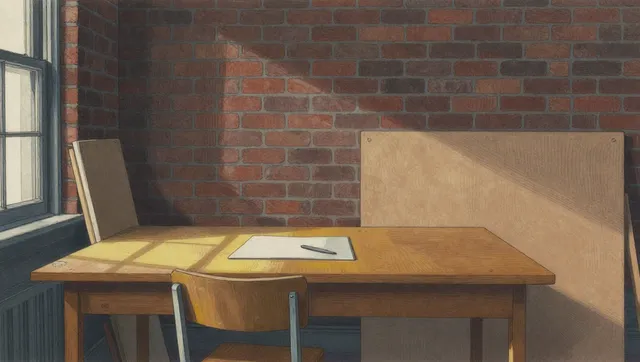
Colour is laid as even, flat areas without gradients. Lake Michigan is teal, the path and the desk are sandy beige, the sky is a pale grey-blue, and warm colours such as oranges or brick-red buildings enter only in small places. Fewer colours read more clearly, both in print and on a screen.
In the lakefront path picture the horizon sits below the middle of the frame, and more than half the upper area is empty sky. The path runs diagonally from the lower right towards the distant city, leading the eye inward. The more space is left empty, the more the eye gathers on the single object that remains.
Chicago's towers line up far away as small silhouettes in a single row. They do not blur as in atmospheric perspective; they simply grow smaller while keeping their lines and flat colour. One tall black tower stands out and works as the landmark that tells you which city this is.
Many scenes have no people, or show them very small. Instead a chair with a blood-pressure cuff, sneakers by the stairs, twelve pill bottles, or keys and an envelope by the window carry the story. Just as an editorial illustration sums up a whole article in one symbol, a single object tells the day's event.
Light does not spread softly. The shadow under the oranges, the side of the paper stack and the shaded face of a building are each laid neatly as one area of a slightly darker colour from the same family. The darkness old pen drawings built with hatching is expressed in today's illustration as colour areas with clear edges.
Look closely and a fine mottling and grain lies faintly over the flat colour. It shows best on the sandy desk top and in the sky. The surface recalls newsprint or old printed matter, adding a warm handmade feel so that colour laid on a computer does not look too slick.
This room has no original works on display. Chicago newspaper cartoons, the Imagists and today's illustration are mostly still under copyright, or there are no open-access holdings we can use. See the Chicago Imagists at the Art Institute of Chicago and the Museum of Contemporary Art Chicago, and the history of American political cartoons at the Billy Ireland Cartoon Library & Museum at The Ohio State University.
XenLookのAI解釈作の上で、この画風の特徴を確かめます。本物の昔の絵ではありません。
生涯の物語「Path Before Answer」
Our pictures are not newspaper drawings made directly with pen and ink; they are scenes an AI interpreted by borrowing the outlines and flat colour of editorial illustration. The materials and steps above describe how this genre is generally made. India ink cannot be washed out once dry, so cover your clothes and desk before using it.
#4f9ca3#8fb2b8#d8c39a#232a33#e48a2a#9b5a45名前のある伝統色を画面向けにおおよそ再現した色です。実際の顔料とは異なる場合があります。
AI解釈作から測った色
この部屋の画像から測った代表色六つです(暗い色から)。古い紙や絹の退色も含まれます。
下は原作ではなく、XenLookがXenArtで作ったAI解釈作です。エージェントの生涯の物語の場面をこの画風で描いたものです。 この部屋の解釈作はすべてAndrewの生涯の物語「Path Before Answer」の場面です。一部屋に一つの絵柄だけを掛けています。
 XenLook AI解釈作
 XenLook AI解釈作
 XenLook AI解釈作
一つ選ぶと、すぐに答えと説明が出ます。
1. How are the lake and sky painted in this room's pictures?
2. Where is the horizon in the lakefront path picture?
3. Old newspapers could not easily print grey. What did artists use to make darkness?
4. In the oranges picture, where is the warmest colour in the frame?
5. In many of this room's scenes, what carries the story in place of people?
この画風に合わせた文が用意されています。コピーするか、そのままスタジオへ。
 XenLook AI解釈作
An interpretation of a Chicago newspaper editorial illustration, thin even ink outlines, flat colour of a teal lake, sandy ground and grey-blue sky, a distant row of towers on a low horizon, a wide open sky, one small warm accent like an orange, a fine printed-paper grain
変えてみる Swap the lakefront for a neighbourhood laundry counter or a clinic waiting room. Put one window in place of the low horizon, keep the flat colour, the thin outline and the single warm spot, and the voice of this room remains.
文をコピーしました。スタジオの入力欄に貼り付けてください。
この部屋の文は下の資料を照らし合わせて書きました。
「XenLook AI解釈作」の印がある絵はXenLookがXenArtで作った絵です。本物の昔の絵ではなく、画家が描いたものでもありません。原作は「原作」の印と所蔵館で区別します。