Edgar Degas was born in Paris on 19 July 1834. He was christened Hilaire-Germain-Edgar De Gas and later joined the spelling into Degas. He was the eldest of five children, and his father was a banker. His mother, Célestine Musson, came from a Creole family of New Orleans and died when he was thirteen. The boy attended the elite Lycée Louis-le-Grand and grew up close to books and pictures. Raised in a well-off family, he kept for a long time the ease of one who did not have to sell his paintings in order to live.
In 1853 he entered the university to study law but put little effort into it; he had already decided to become a painter. In 1855 he met Ingres, whom he revered, and Ingres told him, "Draw lines, young man, and still more lines." The words became a lifelong habit. In April of that year he was admitted to the École des Beaux-Arts. From 1856 he stayed in Italy for about three years, copying the old masters, and in 1858 in Naples he began the first studies for the family portrait The Bellelli Family, which would be finished only in 1867.
In the 1860s Degas gave up his plan to paint history and began to paint the people of contemporary Paris. He got to know Édouard Manet around 1864 and showed at the Salon for the first time in 1865. Jockeys and horses at the racecourse and an orchestra at the opera appear in these years. When war broke out in 1870 he joined the National Guard, and during training his eyesight was found to be poor. From 1872 to the next year he stayed with relatives in New Orleans, his mother's home city. His eyes would worry him for the rest of his life.
The turning point came around 1874. That year his father died, family debts came to light, and Degas had to start selling his work. In the same year, young painters disappointed with the Salon opened an independent exhibition, and Degas joined them. It would later be called the first Impressionist exhibition. He took part in all but one of the eight shows held up to 1886. Yet he disliked the label Impressionist and wished to be called a realist. He said, "no art was ever less spontaneous than mine."
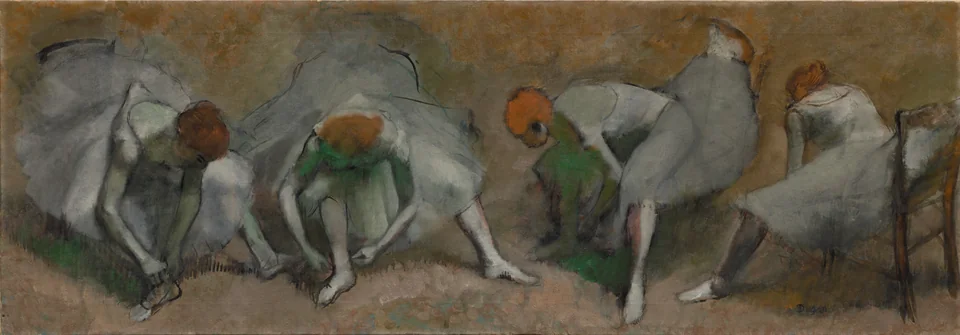
Dancers became his signature subject. Ballet pictures increased from about 1870, and more than half of his surviving works show dancers. The important point is that he liked to paint not the applauded moment on stage but backstage and rehearsal scenes. The dancers in his pictures look not like fairies of myth but like professionals at work: fixing a toe, loosening an arm, waiting for their turn. It resembles so closely the time behind the stage where I, Sylvie, grew up that my breath always drops low before a Degas.
From around 1880 he developed a way of layering pastel one coat on another. He began etching in the mid-1870s and made some 300 monotypes, prints that can be pulled only once. He hardly ever showed his sculpture. Only The Little Dancer Aged Fourteen was shown, in 1881, and people were shocked by the realism of this wax figure dressed in a cloth skirt with real hair. After his death about 150 waxes were found in the studio, and from 1919 to 1936 seventy-four of them were cast in bronze.
After 1890 his sight grew worse. He seems to have stopped working in 1912, when the house he lived in was to be demolished and he had to move. He never married, and in his last years, nearly blind, he wandered the streets of Paris until he died in September 1917. He also helped younger painters. He invited the American painter Mary Cassatt to the 1877 exhibition and opened to her the paths of pastel and printmaking. While one man's eyes dimmed, the memory of bodies he painted remains today on the walls of the Cleveland Museum of Art.