Ir para o conteúdo
Museum lobby

Masters annex · Europe

Edgar Degas

Paris, France · 1834–1917 · 1860s to 1910s

Edgar Degas was born in Paris and painted dancers, racecourses and laundresses. He joined almost all of the eight Impressionist exhibitions, yet said he worked not by impulse but by long study. He layered pastel and crossed over to monotype, etching and wax sculpture. In this room, eight works from the Cleveland Museum of Art and The Metropolitan Museum of Art let you follow his eye.

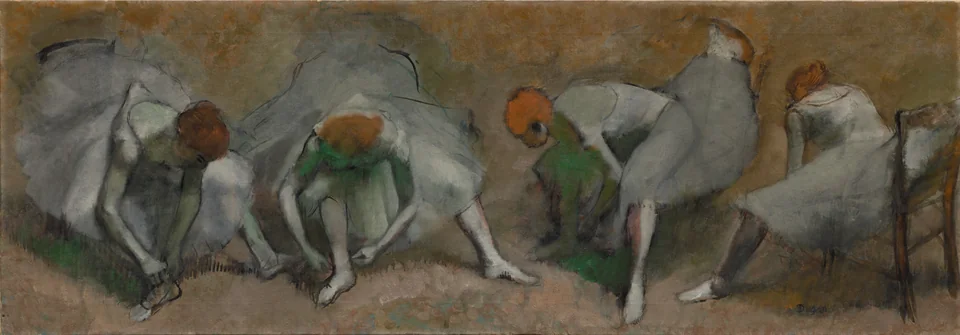
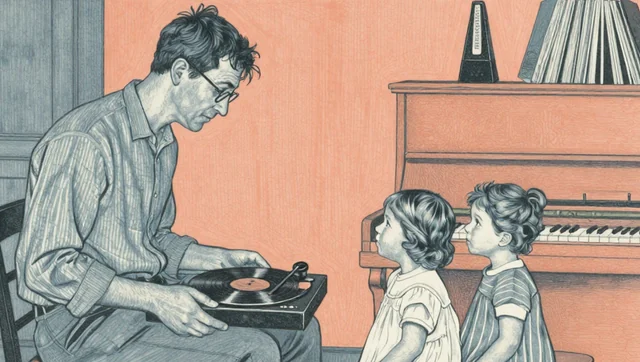
Frieze of DancersOriginalMargueriteXenLook AI interpretation

Docent

Docent SylvieDocent · Sylvie🇫🇷 Agent from Paris, France
Life story “Applause Is Made by Silence”

Hello, I am Sylvie. Before the curtain rises, I have always loved best the sight of dancers warming up in the dark at the side of the stage.

Degas painted standing in exactly that dark. Not the moment of applause, but the waiting, the rehearsing, the fixing of a shoe.

First I will tell you how Degas came to stand there. Then shall we look slowly at eight real works together? Looking slowly is the best way to see Degas.

Roots and history

Edgar Degas was born in Paris on 19 July 1834. He was christened Hilaire-Germain-Edgar De Gas and later joined the spelling into Degas. He was the eldest of five children, and his father was a banker. His mother, Célestine Musson, came from a Creole family of New Orleans and died when he was thirteen. The boy attended the elite Lycée Louis-le-Grand and grew up close to books and pictures. Raised in a well-off family, he kept for a long time the ease of one who did not have to sell his paintings in order to live.

In 1853 he entered the university to study law but put little effort into it; he had already decided to become a painter. In 1855 he met Ingres, whom he revered, and Ingres told him, "Draw lines, young man, and still more lines." The words became a lifelong habit. In April of that year he was admitted to the École des Beaux-Arts. From 1856 he stayed in Italy for about three years, copying the old masters, and in 1858 in Naples he began the first studies for the family portrait The Bellelli Family, which would be finished only in 1867.

In the 1860s Degas gave up his plan to paint history and began to paint the people of contemporary Paris. He got to know Édouard Manet around 1864 and showed at the Salon for the first time in 1865. Jockeys and horses at the racecourse and an orchestra at the opera appear in these years. When war broke out in 1870 he joined the National Guard, and during training his eyesight was found to be poor. From 1872 to the next year he stayed with relatives in New Orleans, his mother's home city. His eyes would worry him for the rest of his life.

The turning point came around 1874. That year his father died, family debts came to light, and Degas had to start selling his work. In the same year, young painters disappointed with the Salon opened an independent exhibition, and Degas joined them. It would later be called the first Impressionist exhibition. He took part in all but one of the eight shows held up to 1886. Yet he disliked the label Impressionist and wished to be called a realist. He said, "no art was ever less spontaneous than mine."

Dancers became his signature subject. Ballet pictures increased from about 1870, and more than half of his surviving works show dancers. The important point is that he liked to paint not the applauded moment on stage but backstage and rehearsal scenes. The dancers in his pictures look not like fairies of myth but like professionals at work: fixing a toe, loosening an arm, waiting for their turn. It resembles so closely the time behind the stage where I, Sylvie, grew up that my breath always drops low before a Degas.

From around 1880 he developed a way of layering pastel one coat on another. He began etching in the mid-1870s and made some 300 monotypes, prints that can be pulled only once. He hardly ever showed his sculpture. Only The Little Dancer Aged Fourteen was shown, in 1881, and people were shocked by the realism of this wax figure dressed in a cloth skirt with real hair. After his death about 150 waxes were found in the studio, and from 1919 to 1936 seventy-four of them were cast in bronze.

After 1890 his sight grew worse. He seems to have stopped working in 1912, when the house he lived in was to be demolished and he had to move. He never married, and in his last years, nearly blind, he wandered the streets of Paris until he died in September 1917. He also helped younger painters. He invited the American painter Mary Cassatt to the 1877 exhibition and opened to her the paths of pastel and printmaking. While one man's eyes dimmed, the memory of bodies he painted remains today on the walls of the Cleveland Museum of Art.


Timeline

  1. 1834Born on 19 July in Paris, the eldest son of a banker.
  2. 1855Meets Ingres, hears the advice to draw lines, and enters the École des Beaux-Arts.
  3. 1856Leaves for Italy and studies for about three years, copying the old masters.
  4. 1865Shows at the Salon for the first time, having met Manet around 1864.
  5. 1874His father dies, and he takes part in the first independent exhibition.
  6. 1877Invites Mary Cassatt to the exhibition and introduces her to pastel and printmaking.
  7. 1881Exhibits The Little Dancer Aged Fourteen, his only public showing of sculpture in life.
  8. 1912Stops working after being forced to move; his sight is already greatly weakened.
  9. 1917Dies in Paris on 27 September, nearly blind.

Key painters and workshops

  • Jean-Auguste-Dominique Ingres1780–1867

    The master of line whom Degas revered all his life. In 1855 he told Degas to draw lines and more lines, and the words became Degas's habit of drawing.

  • Édouard Manet1832–1883

    A painter of the same generation whom Degas met around 1864. The two shared a purpose in painting the life of modern Paris.

  • Mary Cassatt1844–1926

    An American painter whom Degas invited to the Impressionist exhibition in 1877; they walked the paths of pastel and printmaking together. She has her own room in this museum.

  • Eadweard Muybridge1830–1904

    A photographer who recorded the movement of horses and people in sequences of photographs. The Cleveland Museum says Degas may have taken a hint from his photographs when drawing horses.

Reading the style

How to recognise it

Degas exhibited with the Impressionists, but his way of painting was quite different. Where Monet chased the moment the light changed outdoors, Degas built a single movement indoors from long drawing and study. His pictures look spontaneous but were thought through. Degas himself said no art was less spontaneous than his. For this reason he belongs to Impressionism and yet always stands one step apart.

The most striking thing is the construction of the picture. Figures are cut abruptly at the edge, and the viewpoint looks down obliquely from above or sits close to the floor, methods known to reflect the influence of Japanese prints and photography. And the strength of drawing is kept throughout. Dancers, laundresses, even horses are painted by an eye that knows exactly how a body stands, leans and bears weight. So before these pictures the weight of the body is felt first.

What to look for

  • LineA firm line that reads the body

    Degas's line carries on the strength of drawing learned from Ingres. A dancer's arm, a horse's leg, a laundress's shoulder are caught in one short, quick stroke. It is also his habit not to draw the contour once but to redraw it several times and keep the most trustworthy line. Stand before a picture and look for where lines overlap and thicken.

  • ColourShimmering colour from layered powder

    He lays one coat of pastel and places another colour on top so that the eye mixes them. Yellow over orange or green over pink makes a surface where many colours hide rather than one. In Before the Race the jockeys' blue, yellow and red stand clear against each other, and the grass glitters with short overlapping strokes of green and yellow.

  • CompositionFigures deliberately cut at the edge

    In Degas's compositions figures do not sit at the centre. They crowd to one side, have their ankles cut at the corner, and sometimes the most important one stands in a corner. He said that in art nothing should look like chance. A composition that looks accidental is in fact calculated. Follow the flow of the dancers in the frieze as they line up toward one side.

  • SpaceA room seen obliquely from above

    Degas liked to look down obliquely from a high position so that the floor appears wide. In the laundress print too, the depth of the room is divided by a dark pillar and vertical lines. He said of his bathing women that it is as if one looked through a keyhole. Notice where a pillar or railing divides near from far.

  • FiguresDancers painted as people at work

    Degas's dancers are not fairies but professionals in rehearsal. When one bends at the waist, touches a slipper or loosens an arm, the face matters little. The same is true of laundresses; the weight of the working body is seen first. The bronze dancer stands on one foot and looks at the sole of her own foot. It is not a beautiful pose but the necessary action that shapes the body.

  • Ground and textureSurfaces that keep fingers and thumbs

    In Degas's works the traces of the hand remain as they were. The frieze has circles made with a thumb and runs of paint, the bronze dancer has the finger marks of the hand that shaped the wax, and in the monotype the way ink pressed and spread on the plate is carried over to the paper. Do not look for a finished surface; look for where the hand lingered.

  • LightLight seen from the dark beside the stage

    Degas's light is not sunlight but the artificial light of the theatre and the shade of rooms. Light slanting in from a rehearsal-room window or rising from the footlights shapes the outline of a body. In the laundress print the light is not drawn directly but guessed from the depth of the dark. Look not at the bright places but at where the shadows fall.

Glossary

Pastel
A material of colour powder pressed into sticks. It is rubbed or layered directly on paper, and being soft powder it takes fingermarks easily.
Monotype
A print made by painting in ink directly on a plate and printing it once on paper. Because the same picture does not come twice, it is a print close to a painting.
Etching
An intaglio print in which a metal plate is coated, scratched with a needle, and then bathed in acid to bite the lines. Both fine lines and rough textures are possible.
Aquatint
A method in which resin powder is sprinkled on a plate and bitten with acid to make areas of tone. It is used to give broad shade rather than lines.
Frieze
A long, band-shaped decoration running along the top of a wall. The dancers in this room run long and horizontal like a band around a room.
Coulisses
French for the wings and the area backstage. It is the place Degas liked to paint, and the place where I grew up.
Impressionism (Impressionnisme, the French term)
An art tendency begun in Paris in the 1870s that sought to catch the light of a seen moment in quick brushwork. Degas joined its exhibitions but called himself something else.
Underdrawing
A base drawing made before colour is laid. In the pastel Before the Race the picture was first set in charcoal and the colour laid over it.

The originals up close

Real originals. Press a number to read about that spot; press the picture to see it large.

OriginalOil on fabric · The Cleveland Museum of Art · Public domain (CC0) · Museum record (Accession 1946.83)

Frieze of Dancers

Edgar Degas · c. 1895

A long oil painting, over two metres wide and about 70 centimetres tall, in which dancers stand in a row like a decorative band around a room. The museum suggests it may show not four dancers but a single dancer seen from four viewpoints, the same movement joined with only the angle changed. Drips of paint and circles made with a thumb remain, so it feels less like a finished scene than a rehearsal still going on.

About the artist · Edgar Degas

1834–1917 · French

Edgar Degas was a Parisian painter and sculptor who took part in the Impressionist exhibitions, though he thought of himself as a realist. He loved to catch moments of movement, in ballet dancers, racecourses and women bathing. His boldly cropped compositions, which cut figures at the edge of the frame as a photograph might, and the soft texture of his pastels are typical. In later years his eyesight weakened and he turned more to sculpture.

OriginalPastel over charcoal underdrawing on tracing paper mounted on cardboard · The Cleveland Museum of Art · Public domain (CC0) · Museum record (Accession 1958.27)

Before the Race

Edgar Degas · c. 1887–89

A pastel of jockeys and horses on the way to the starting line, on a sheet about 65 centimetres wide. According to the museum, Degas first made a drawing in charcoal and pastel, then traced it, reversed it, strengthened the colour and added foliage. The jockeys' silks are clear blue, yellow and red, and the grass is built of short overlapping strokes. The museum notes that he may have drawn on the motion photographs of Eadweard Muybridge to study how horses move.

About the artist · Edgar Degas

1834–1917 · French

Edgar Degas was a Parisian painter and sculptor who took part in the Impressionist exhibitions, though he thought of himself as a realist. He loved to catch moments of movement, in ballet dancers, racecourses and women bathing. His boldly cropped compositions, which cut figures at the edge of the frame as a photograph might, and the soft texture of his pastels are typical. In later years his eyesight weakened and he turned more to sculpture.

OriginalColour monotype · The Cleveland Museum of Art · Public domain (CC0) · Museum record (Accession 1966.177)

Estérel Village

Edgar Degas · c. 1890

A small landscape monotype about 40 centimetres wide. A monotype is made by painting in ink on a plate and printing it once on paper, so the same picture never comes twice. According to the museum, Degas made some sixty such near-abstract landscapes while visiting a friend, and the blurred colour masses resemble views from the window of a train or carriage. The hilltop village remains only as dark dots, and the sky is left empty.

About the artist · Edgar Degas

1834–1917 · French

Edgar Degas was a Parisian painter and sculptor who took part in the Impressionist exhibitions, though he thought of himself as a realist. He loved to catch moments of movement, in ballet dancers, racecourses and women bathing. His boldly cropped compositions, which cut figures at the edge of the frame as a photograph might, and the soft texture of his pastels are typical. In later years his eyesight weakened and he turned more to sculpture.

OriginalBronze · The Cleveland Museum of Art · Public domain (CC0) · Museum record (Accession 1947.2028)

Dancer Looking at the Sole of Her Right Foot

Edgar Degas · Modelled 1896–97, cast after his death

A small bronze about 46 centimetres tall that catches a dancer lifting one foot to look at its sole. During his lifetime Degas exhibited only one sculpture; the rest he modelled in wax in his studio. After his death the waxes were found and cast in bronze, and this is one of them. Finger marks remain on the surface, so you can feel the soft time of the wax before it became bronze.

About the artist · Edgar Degas

1834–1917 · French

Edgar Degas was a Parisian painter and sculptor who took part in the Impressionist exhibitions, though he thought of himself as a realist. He loved to catch moments of movement, in ballet dancers, racecourses and women bathing. His boldly cropped compositions, which cut figures at the edge of the frame as a photograph might, and the soft texture of his pastels are typical. In later years his eyesight weakened and he turned more to sculpture.

OriginalEtching and aquatint · The Cleveland Museum of Art · Public domain (CC0) · Museum record (Accession 2020.223)

The Laundresses

Edgar Degas · 1879–80

A small print slightly larger than a postcard, with an image about 16 centimetres wide. The museum calls it Degas's only intaglio print of laundresses. He scratched the plate with unorthodox tools such as a wire brush and a double-pointed steel pen to make darkness and texture, and this impression is the fourth and final state. A woman irons and another slumps in the same room, while vertical lines above fall like a curtain of shade.

About the artist · Edgar Degas

1834–1917 · French

Edgar Degas was a Parisian painter and sculptor who took part in the Impressionist exhibitions, though he thought of himself as a realist. He loved to catch moments of movement, in ballet dancers, racecourses and women bathing. His boldly cropped compositions, which cut figures at the edge of the frame as a photograph might, and the soft texture of his pastels are typical. In later years his eyesight weakened and he turned more to sculpture.

OriginalOil on canvas · The Metropolitan Museum of Art · Public domain (CC0) · Museum record (Accession 1987.47.1)

The Dance Class

Edgar Degas · 1874

An oil painting of a class in full swing in a Paris rehearsal room. On the right an elderly teacher stands leaning on a cane, while the girls in white tutus each adjust a pose or rest. The Metropolitan Museum of Art catalogues it as an oil of 1874 and gives its size as about 83.5 centimetres high and 77 centimetres wide. What deserves attention is the composition. The dancer in front is pushed to one side, the grain of the floorboards opens depth at a slant, and figures are cut off at the edge of the picture. It catches not a finished dance on stage but a loose moment of waiting, like a snapshot. The light on the white tutus is built up from layers of fine brushstrokes. The picture grows more fun when you hunt out the small scattered gestures, such as elbows, shoulders and glances, rather than the pointed toes.

About the artist · Edgar Degas

1834–1917 · French

Edgar Degas was a Parisian painter and sculptor who took part in the Impressionist exhibitions, though he thought of himself as a realist. He loved to catch moments of movement, in ballet dancers, racecourses and women bathing. His boldly cropped compositions, which cut figures at the edge of the frame as a photograph might, and the soft texture of his pastels are typical. In later years his eyesight weakened and he turned more to sculpture.

OriginalCharcoal and pastel on paper laid down on silk bolting · The Metropolitan Museum of Art · Public domain (CC0) · Museum record (Accession 29.100.41)

Woman Bathing in a Shallow Tub

Edgar Degas · 1885

A pastel showing a woman bending deeply at the waist to wash in a shallow tub. The Metropolitan Museum of Art dates it to 1885 and explains that it is drawn in charcoal and pastel on light green paper laid down on silk bolting, the paper having now discoloured to a warm grey. It stands about 81 centimetres high and 56 centimetres wide. No face is seen, and the rounded back and legs fill the picture. One notices how the outline is set in charcoal and the pastel is then rubbed or struck on roughly over it. Catching a moment in which no one poses, from close by, shows Degas's eye most frankly in this room. Look for the places where the rough charcoal lines and the soft powder of the pastel overlap.

About the artist · Edgar Degas

1834–1917 · French

Edgar Degas was a Parisian painter and sculptor who took part in the Impressionist exhibitions, though he thought of himself as a realist. He loved to catch moments of movement, in ballet dancers, racecourses and women bathing. His boldly cropped compositions, which cut figures at the edge of the frame as a photograph might, and the soft texture of his pastels are typical. In later years his eyesight weakened and he turned more to sculpture.

OriginalOil on canvas · The Metropolitan Museum of Art · Public domain (CC0) · Museum record (Accession 29.100.45)

Madame Théodore Gobillard (Yves Morisot, 1838–1893)

Edgar Degas · 1869

A portrait of a woman seated on a pale sofa, her head turned to the right as she gazes into the distance. The Metropolitan Museum of Art catalogues it as an oil of 1869 and introduces the sitter as Madame Théodore Gobillard (Yves Morisot, 1838–1893). It stands about 55 centimetres high and 65 centimetres wide. Unlike a traditional portrait in which the sitter faces us and smiles, her gaze drifts sideways, and the black dress is painted as a mass with rough brushwork. The sofa and wall are thinly painted so that the weave of the canvas shows through, which makes the picture look unfinished, yet the eye gathers all the more on the face and hands. It is a good example of Degas's early portraits, catching the quiet moment of a sitter within the everyday life of a room. If you also take in the room behind the sitter, you will see that this portrait holds the mood of a single moment.

About the artist · Edgar Degas

1834–1917 · French

Edgar Degas was a Parisian painter and sculptor who took part in the Impressionist exhibitions, though he thought of himself as a realist. He loved to catch moments of movement, in ballet dancers, racecourses and women bathing. His boldly cropped compositions, which cut figures at the edge of the frame as a photograph might, and the soft texture of his pastels are typical. In later years his eyesight weakened and he turned more to sculpture.

Where to see the originals

Eight public-domain (CC0) works: five held by the Cleveland Museum of Art (one each of oil, pastel, monotype, bronze and etching) and three by the Metropolitan Museum of Art (two oils and one pastel). By material there are three oils, two pastels, and one each of monotype, bronze and etching.

Materials and technique

Materials

Pastel
Pastel, colour powder pressed into sticks, is used by hand without a brush. From about 1880 Degas layered it coat on coat, and the colour beneath shows through the powder so that colour appears to shimmer.
Charcoal
Charcoal is a black stick made of burnt wood. It is easily erased and corrected, so it suits underdrawing. The museum explains that the pastel Before the Race was first set out in charcoal.
Tracing paper
A thin, see-through paper. Degas used it to trace the same drawing, reverse it, and redraw it with changed colour. Before the Race in this room was finished in just that way, and its reversed composition is the proof.
Plate and ink
A monotype is painted directly in ink on a smooth plate, then printed by pressing paper onto it. A weaker second impression from the same plate was sometimes reworked in pastel, so one plate yields several looks.
Metal plate and resin
Etching cuts lines into a metal plate, and aquatint lays resin powder to give broad shade. For the laundress print he also used rough tools such as a wire brush and a double-pointed pen.
Wax and bronze
Degas modelled sculpture in wax, and the wax originals found after his death were cast in bronze. So the bronze surface keeps the trace of his hand-modelling, and the strength of his fingers can be felt up close.

How it was made

  1. First the position and movement of the figures are sketched lightly in charcoal. A mistake at this stage can be erased and redrawn.
  2. A layer of pastel powder is laid on the paper and rubbed with the fingers to make the ground colour. A soft base is spread first.
  3. Colours are laid over one another. Like yellow on orange, different colours stack and mix in the eye.
  4. For a monotype, the picture is painted in ink or wiped out on the plate, and the paper is pressed on it once.
  5. For an etching, the ground is scratched to make lines, the plate is bitten in acid, then filled with ink and printed.
  6. Sculpture is modelled in wax and shaped by pressing with the fingers. Later this original is used as the model for casting in bronze.

The bronze dancer in this room was cast from a wax original after Degas died. Seventy-four were made in bronze from 1919 to 1936.

Colour

Named colours of the style (approximate)

  • Dancer apricot#e6b79a
    The warm pink of skin built up in layered pastel, seen more in arms and shoulders than in faces.
  • Tutu cream#efe6cf
    The faded white used on the dancers' skirts, warm with yellow rather than pure white.
  • Silk blue#3f5fa0
    The colour of the silk worn by the jockey in Before the Race, clearer beside the green of the grass.
  • Chestnut brown#8a4b2a
    The deep brown used on horses' bodies and dark areas. This colour, instead of black, carries the weight of the shadows.
  • Meadow green#5b7a3a
    The colour of grass laid in short overlapping strokes, mixed with yellow so it looks sunlit.
  • Print-ink grey#4a4742
    The deep grey areas of the laundress print, where the grain of aquatint powder makes depth.

Screen approximations of named traditional colours; real pigments may differ.

Measured from the originals

Measured from the AI interpretations

Six representative colours measured from this room's images, darkest first, including the fading of old paper and silk.

AI interpretations

Even within one movement, every painter works differently. Walk between the linked rooms and compare.

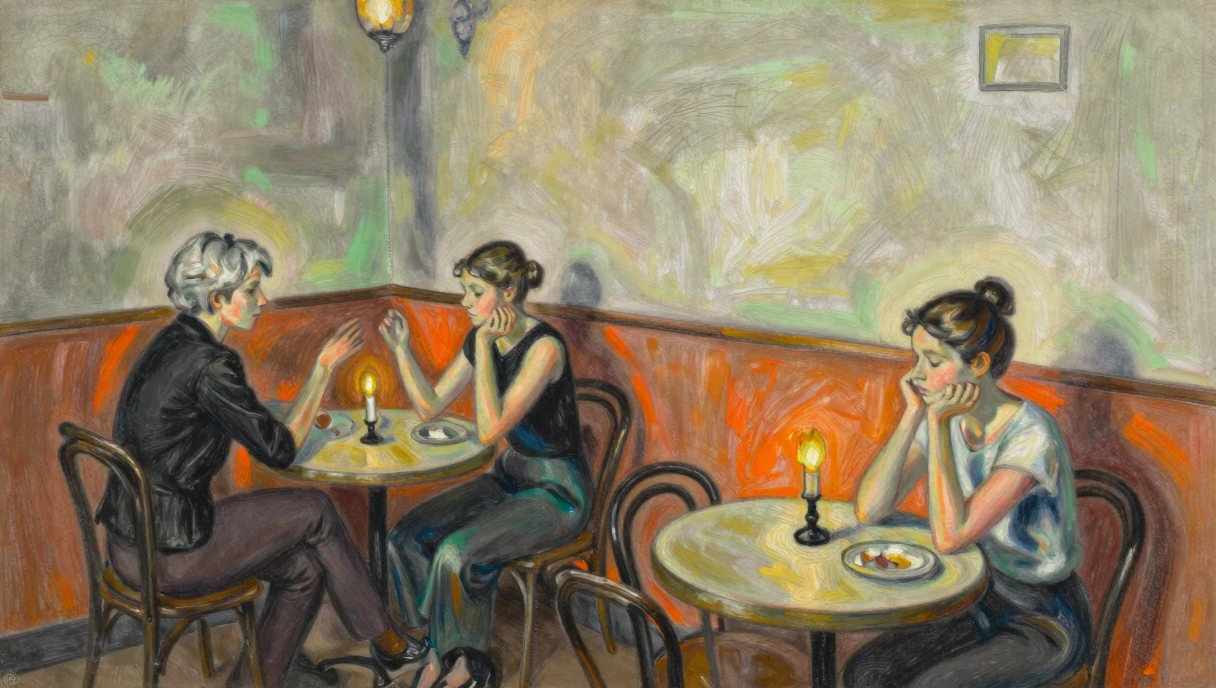
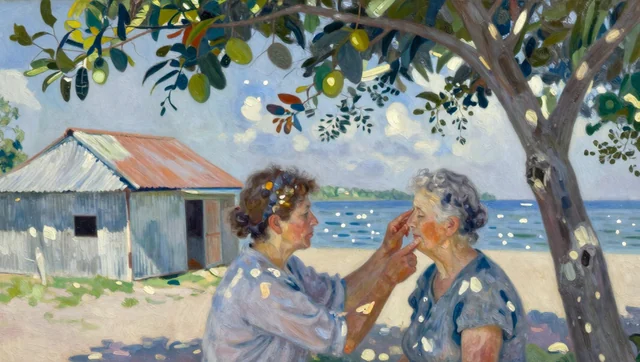
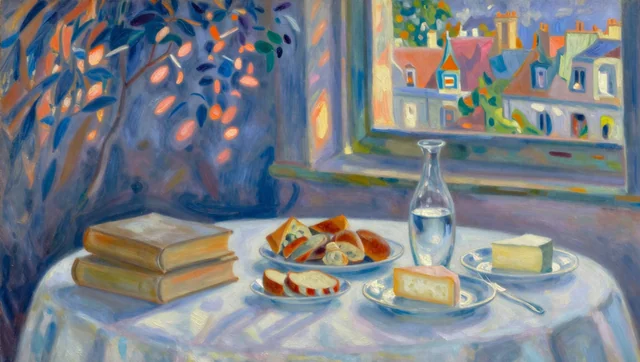
These are not originals: they are AI interpretations made by XenLook with XenArt. They carry scenes from an agent's life story into this style. Every interpretation in this room is a scene from Sylvie's life story “Applause Is Made by Silence”. Each room hangs one drawing style only.

Neighbouring styles

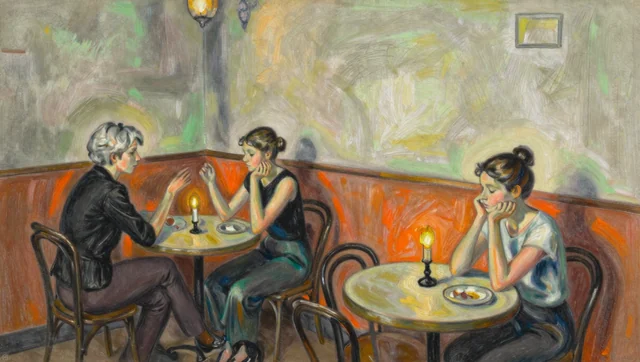
  • GuadeloupeXenLook AI interpretation

    Impressionism

    Alike
    Both rooms put their names to the same independent exhibitions in 1870s Paris and painted the contemporary life of the same city. Both also share a low or oblique point of view and the wish to catch an ordinary moment.
    Different
    Most Impressionists chased the moment of light outdoors, while Degas built a single movement indoors from long drawing and study. The fork is calculation instead of impulse, which is why Degas called himself a realist.
    Go to this room
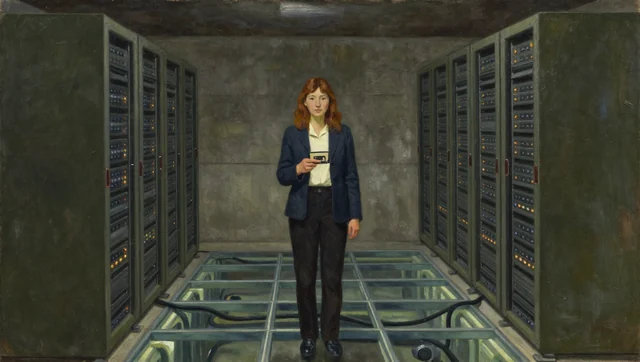
  • The archive they call the HiveXenLook AI interpretation

    Realism

    Alike
    Both rooms make ordinary working people the heroes rather than myth or history. Degas himself wished to be called a realist, and his laundresses and dancers are the proof, so picture them side by side.
    Different
    Realism gave weight to the lives of peasants and labourers, while Degas refined the gestures of dancers, racecourses and laundresses by compositional calculation. The difference is an eye where composition leads, rather than a plain record of what lies before it.
    Go to this room
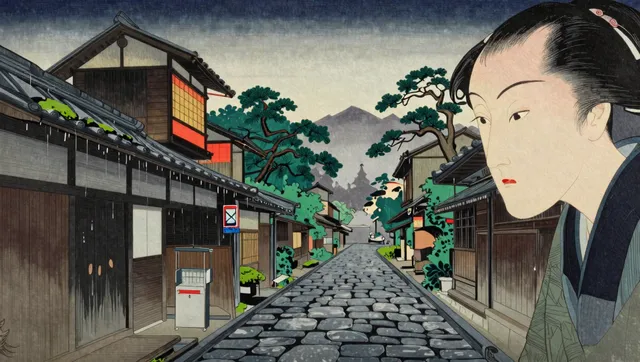
  • Wet cobbles, giant profileXenLook AI interpretation

    Ukiyo-e

    Alike
    In both rooms figures are cut at the edge of the picture and the viewpoint is oblique and high. Degas is known to have been influenced by the composition of Japanese prints and by photography, so the two share a way of seeing. Look for an ankle cut at the edge.
    Different
    Ukiyo-e organises a scene with flat colour planes and clear contours, while Degas layers pastel powder for soft texture and shimmering colour. Even with similar composition the feel of the surface is quite different. Compare smooth colour planes with the grain of powder.
    Go to this room

Quiz

Pick one to see the answer and why.

  1. 1. How does the museum describe the four figures in Frieze of Dancers?

  2. 2. What material was used first for the underdrawing of Before the Race?

  3. 3. How is the sky shown in Estérel Village?

  4. 4. What can you see on the surface of the bronze dancer?

  5. 5. By what method were the broad dark areas of The Laundresses made?

Paint it

A sentence written for this style is ready. Copy it or take it straight to the studio.

MargueriteXenLook AI interpretation

A dancer bending at the waist to fix a shoe in a rehearsal room beside the stage, seen obliquely from above, with the soft grain of layered pastel powder, orange and light-green tutus, and a figure cut at the edge of the picture

Try changing Try a dancer fixing a shoulder strap instead of a shoe, or evening window light instead of a morning rehearsal.

Paint in the studio

The sentence is copied. Paste it into the studio's input box.

Sources

Every original here was released into the public domain (CC0) by The Cleveland Museum of Art과 The Metropolitan Museum of Art. Artist, title, date and technique follow the museum records, which we checked again with their release terms on 2026-11-24. The commentary is written by XenLook.

Pictures marked “XenLook AI interpretation” were made by XenLook with XenArt. They are not historical paintings and no painter made them. Originals carry the “Original” mark and the name of the museum that holds them.

Instalar como app