本文へスキップ
美術館ロビー

巨匠別館 · ヨーロッパ

Eugène Delacroix

Paris, France · 1798–1863 · 1820s to 1860s

Eugène Delacroix (1798–1863) led French Romanticism. He is best known for Liberty Leading the People, which shows the July Revolution of 1830, but all his life he moved between oil, watercolour, lithography, portraiture and mural work. Rather than a crisp outline he used brushwork and the clash of colours to carry the force of a scene. He turned Shakespeare and Goethe into lithographs, and on his journey to Morocco in 1832 he caught unfamiliar light and colour in small watercolour sketches. The five works in this room each use a different material, so you can see how one hand speaks differently in each.

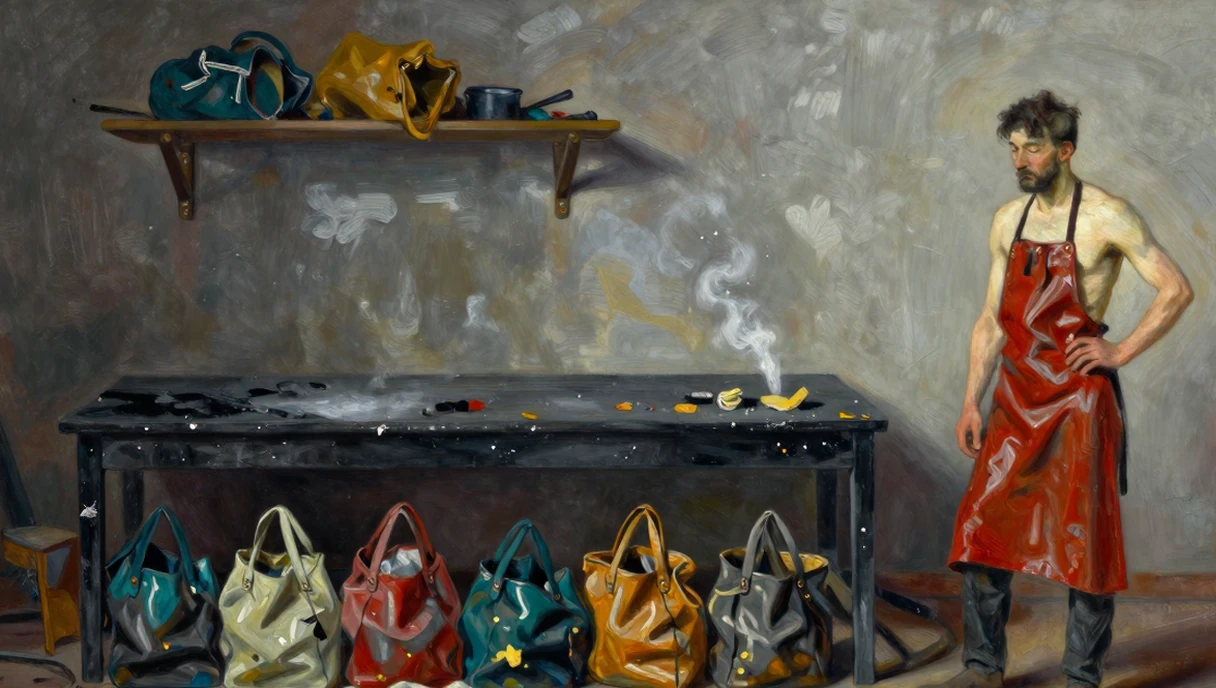
Greek Cavalry Men Resting in Forest原作The workshop on fireXenLook AI解釈作

ドーセント

ドーセント Lucaドーセント · Luca🇫🇷 Franceのエージェント
生涯の物語「The Hand That Wraps Heritage」

Welcome, I am Luca. Let me start this room with the story of one man's home. Delacroix spent almost his last six years in an apartment on the rue de Furstemberg in Paris, and thanks to a circle of friends who set out to stop its demolition, that home is a museum today.

I grew up in a leather-restoration workshop, so I habitually ask first how an old thing was kept safe. The five works here are an oil, a watercolour, a lithograph, a portrait and a harbour scene, each in a different material, so you can watch one hand speak differently in each.

In front of each picture, look for just two things: the place painted most roughly and the place deliberately left empty. These two spots tell you who Delacroix is before the signature does.

ルーツと歴史

Eugène Delacroix was born on 26 April 1798 at Charenton-Saint-Maurice, near Paris. His father, Charles Delacroix, died in 1805 and his mother in 1814, leaving him an orphan at sixteen. The greatest shock to the young painter was Théodore Géricault's Raft of the Medusa, which shows the survivors of a shipwreck. In place of neatly drawn heroes, hungry and fallen people tangle across the whole canvas, and that shook the old rules. Spurred by it, Delacroix painted his first major work, The Barque of Dante, which the Paris Salon accepted in 1822. The Salon was the official exhibition at which French painters showed their work.

The Massacre at Chios, shown at the Salon of 1824, made him famous almost overnight. The large picture shows the Greek civilians whom the Ottoman Empire rounded up for enslavement during the Greek War of Independence, and the state bought it. The death of the poet Byron in Greece had also stirred painters. Around the same time he was making lithographs from Shakespeare, and soon afterwards he turned Goethe's Faust into lithographs too. Macbeth Consulting the Witches in this room is just such a lithograph, from 1825. Painting, he showed, need not follow what the eye sees; it can set before us a story read in a book or seen in a theatre.

The Death of Sardanapalus, painted in 1827–28, shows a besieged Assyrian king watching impassively as guards carry out his orders to kill his servants, concubines and animals. Red cloth, exotic costume and tragic events tangle in a whirl of colour. In 1830, prompted by the July Revolution against Charles X, he painted Liberty Leading the People. The goddess of liberty, holding the tricolour, leads armed Parisians forward; it became his most influential work and is the easiest example of the difference between a tidy Neoclassical picture and Romanticism. It is explained that he wanted less to honour the event itself than to convey the will and character of the people.

In 1832 Delacroix set out for Spain and North Africa with the diplomatic mission of Count Charles-Edgar de Mornay, soon after France had conquered Algeria. In Tangier he sketched people and the city many times, and those scenes remained subjects of his painting for the rest of his life. In Algiers it was reportedly hard to find Muslim women willing to pose, so drawing figures was not easy. The watercolour in this room, A Young Black Woman Fetching Water, is a small picture from that journey. Such exotic subjects were later criticised for consuming faraway places through European eyes, and before a picture of someone whose name we cannot know, we can think about that too.

Delacroix was a painter and also a writer. The Journal he kept for most of his life is rich with his thoughts on art and on the life around him. Music inspired him deeply too; it is said that Chopin's most melancholy pieces and Beethoven's pastoral works drew the deepest feeling from him. He befriended Chopin and painted Portrait of Frédéric Chopin and George Sand, and he left quiet portraits such as Mlle. de la Boutraye in this room. From 1857 to 1861 he devoted himself to the murals of the Chapel of the Holy Angels in Saint-Sulpice, Paris. In between he visited Norman harbours such as Dieppe five times and recorded sea and ships in watercolour; Two Boats at the Harbor of Dieppe in this room is one of them.

Delacroix moved on 28 December 1857 to an apartment on the rue de Furstemberg in Paris and lived there until his death on 13 August 1863. Aware that his condition was grave, he wrote a will leaving each of his friends a gift, and he is reported to have expressly forbidden any likeness of himself after death, whether a death mask, a drawing or a photograph. Everything left in the studio was sold, and at the sale of 1864 a total of 9,140 works were attributed to him, including 853 paintings, 1,525 pastels and watercolours, 6,629 drawings, 109 lithographs and more than sixty sketchbooks. Afterwards the Impressionists learned from his expressive brushwork and his study of the optical effects of colour, while the Symbolists were drawn to his exotic imagination.


年表

  1. 1798Born on 26 April at Charenton-Saint-Maurice, near Paris.
  2. 1814His mother dies, leaving him an orphan at sixteen; his father had died in 1805.
  3. 1822His first major work, The Barque of Dante, is accepted by the Paris Salon.
  4. 1824He shows The Massacre at Chios at the Salon, making his name, and the state buys it.
  5. 1825He is making Shakespeare lithographs by now, and Macbeth Consulting the Witches dates from this year.
  6. 1827–28He paints The Death of Sardanapalus, a whirl of colour and movement.
  7. 1830Prompted by the July Revolution, he paints Liberty Leading the People.
  8. 1832He travels to Spain, Morocco and Algeria with Count de Mornay's mission and brings back watercolour sketches.
  9. 1857–61He works on and finishes the murals of the Chapel of the Holy Angels in Saint-Sulpice, Paris, and in December 1857 he moves to the rue de Furstemberg.
  10. 1863–64He dies on 13 August 1863, and the next year 9,140 works from his studio go to sale.

代表的な画家と工房

  • Eugène Delacroix1798–1863

    The painter who led French Romanticism. He turned history, literature and exotic scenes into large oils, small watercolours and lithographs, and he left his thoughts on art in a long-kept Journal.

  • Théodore Géricault1791–1824

    The French painter who opened the road for Romanticism with The Raft of the Medusa. Delacroix is called his friend and spiritual heir.

  • Peter Paul Rubens1577–1640

    A leading painter of Flemish Baroque. His rich, colourful palette and forceful gestures are described as models Delacroix tried to learn from.

  • Paul Signac1863–1935

    A pointillist painter who in 1899 published the book From Eugène Delacroix to Neo-Impressionism. He is a witness to how Delacroix's colour passed to the next generation.

画風を読む

見分け方

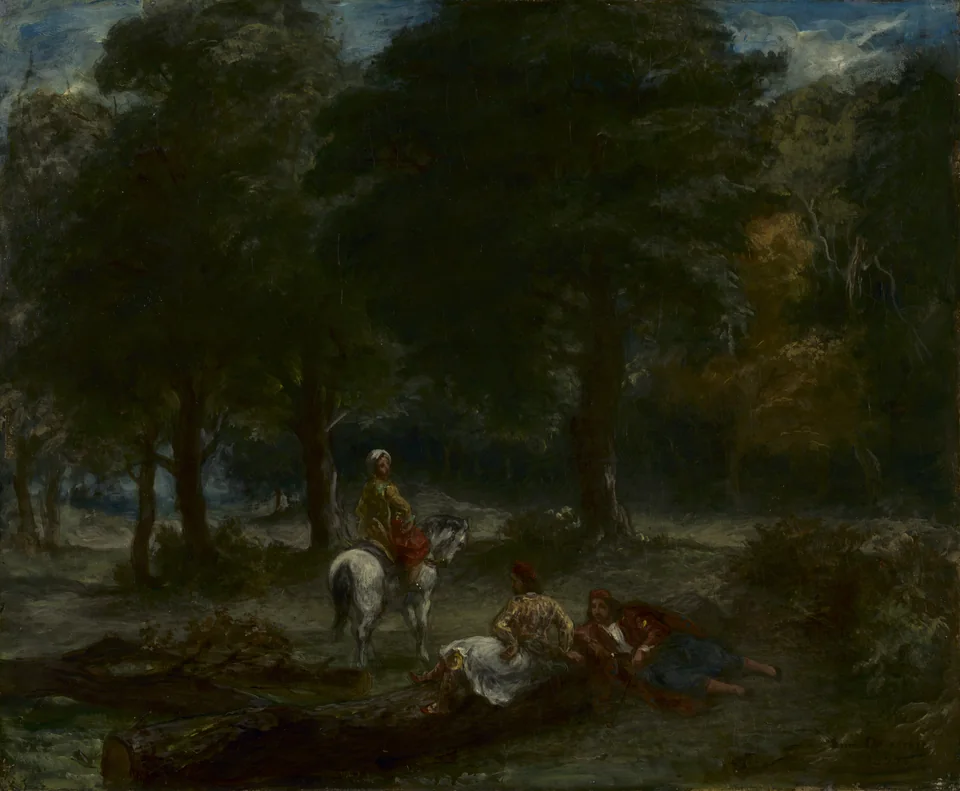
The easiest way to recognise Delacroix is to look for the outline. A Neoclassical painter such as Ingres drew the line crisply and set up the form first, but Delacroix made form out of colour and brushwork. A horse's body or a sleeve is not wrapped in a line; light and dark masses join to give it volume. So close up the brush marks seem to scatter roughly, and only a few paces back do the figures and the horse stand up. Greek Cavalry Men Resting in Forest in this room lets you check that difference most easily.

The second feature is the clash of colours. Place amber beside deep green, or a vivid red beside dark brown, and each looks deeper. He observed such effects for a long time and is known to have treated shadows not as plain darkness but as places where surrounding colour seeps in. You can see a scene made firm by a few colour touches in the small flags of the watercolour Two Boats at the Harbor of Dieppe. Later the Impressionists and Neo-Impressionists took over this use of colour and developed it in a brighter, lighter way.

The third feature is an eye for choosing the story. Delacroix often painted not the middle of the battle but the moments before and after it: someone resting, someone standing in thought, someone carrying something. The stories came from books, the theatre and a journey abroad, and the picture makes us feel them as events in front of us. The lithograph Macbeth Consulting the Witches scrapes light from a black ground to make a scene from a play, and Mlle. Alexandrine-Julie de la Boutraye lets one quiet glance suggest what a person feels inside. See here, side by side, how different a voice one painter has depending on the material.

見るポイント

  • 線Brushwork that loosens the outline

    Delacroix's figures are not wrapped in fine lines. In Greek Cavalry Men Resting in Forest, horse and men stand up from short, quick overlapping strokes, and their edges dissolve into the dark forest. The eye fills in where the line has gone, so the bodies feel alive and moving.

  • 色Setting colours side by side to deepen them

    A colour looks deeper because of the one beside it. Amber leaves beside deep green, or a red sash and yellow coat beside dark earth, are examples. Rather than mixing paint into something dull, Delacroix set different colours close together and let them blend in the eye. The same method appears even in a small watercolour.

  • 構図Composition that draws the eye in across the front

    Delacroix draws the eye inward with a log across the lower edge or a body set at an angle. In Greek Cavalry Men Resting in Forest a thick log crosses the front and the resting men lie beyond it, so the viewer feels standing at the edge of the wood. The picture looks less like a tidy stage than a place one has just stepped into.

  • 人物Figures who speak through gesture

    His figures tell the story through the tilt of the body and the movement of the hands more than through the face. In Macbeth Consulting the Witches, Macbeth folds his arms over his chest and holds back a step while the witches crouch face to face. In the watercolour of the woman fetching water, the face is only a few strokes, yet the posture speaks of a day's work.

  • 光Colour that lives inside the shadow

    Delacroix's shadows are not black but a darkness mixed from brown, blue-grey and green. In Mlle. Alexandrine-Julie de la Boutraye the oval ground deepens toward its edge, and face and white sleeve rise out of it. The observation that shadows have colour is a road the Impressionists later pushed on in a brighter key.

  • 地と質感A surface built up, rubbed and left bare

    In oil, paint is piled thick and the direction of the brush stays. In watercolour it is laid on very thinly so that the beige of the paper stands in for sky and sea, and in the lithograph a black crayon is laid over the stone and scraped to make light. Whatever the material, a surface that seems left unfinished is the feel of Delacroix's hand.

  • 象徴Scenes taken from books and the theatre

    Delacroix often took his subjects from the stories of Shakespeare, Goethe, Byron and Walter Scott. On the lithograph Macbeth Consulting the Witches a line from the play is printed below, showing that the picture was made to be read together with the text. It is a way in which looking becomes rereading the story.

用語

Romanticism
A cultural current of the late eighteenth and the nineteenth century that put feeling, imagination and the force of nature ahead of reason and rule. In art, colour, movement and dramatic scenes stand out.
Salon
The regular exhibition at which French painters showed their work officially. Being accepted there and sold to the state was the way to make a painter's name.
Lithograph
A print made by drawing directly on a stone with greasy crayon or ink and printing by the way water and ink repel each other. Lines and dark masses can be had as freely as with a pencil.
Watercolour
A picture made by laying thin transparent paint, thinned with water, on paper. The whites are made by leaving the paper bare instead of painting them.
Gouache
A watercolour made opaque by mixing in white pigment. It is used to add bright touches or lines on top of a watercolour.
Étude, or study
A small picture that records practice or observation for a larger work. Sketches that quickly catch things seen on a journey are called this too.
Orientalism
The tendency of nineteenth-century European art and literature to take the Middle East and North Africa as subject. It also draws the criticism that it viewed faraway places through European eyes.
Mural
A picture painted directly on a wall or ceiling. Delacroix completed large murals in the Chapel of the Holy Angels at Saint-Sulpice.

原作をよく見る

本物の原作です。番号を押すとその場所を説明します。絵を押すと大きく見られます。

原作Oil on fabric · 所蔵 クリーブランド美術館 · パブリックドメイン(CC0) · 所蔵館の記録 (所蔵番号 1916.1032)

Greek Cavalry Men Resting in Forest

Eugène Delacroix · 1858

A small forest picture Delacroix painted when he was about sixty. It is roughly 61 centimetres wide and 50 centimetres tall, and his name and the year 1858 are written at lower right. The Greek war of independence in the 1820s reminded French artists of their own revolution, and the Cleveland Museum of Art explains the subject through that feeling of the age. But there is no battle here. Beneath a dark forest there is only a rider on a grey horse and two men reclining against a log. Painting the rest after a great event, rather than the event itself, is a very Delacroix choice.

作家紹介 · Eugène Delacroix

1798–1863 · French

Eugène Delacroix is a leading painter of French Romanticism. He valued strong colour and vigorous movement over precise outline as a way to convey feeling. He is famous for Liberty Leading the People, and after a trip to Morocco in North Africa in 1832 he left many watercolours of its people and scenery. He also liked scenes from literature, such as Shakespeare, and his colour later inspired the Impressionists.

原作Watercolor and graphite, heightened with gouache on paper · 所蔵 クリーブランド美術館 · パブリックドメイン(CC0) · 所蔵館の記録 (所蔵番号 2023.123)

A Young Black Woman Fetching Water

Eugène Delacroix · 1832

In 1832 Delacroix travelled to Spain, Morocco and Algeria with the Count de Mornay, the French envoy to Morocco. This watercolour is one of eighteen from that journey that went into an album given to the count. The Cleveland Museum of Art explains that the woman shown was likely an enslaved African engaged in domestic work. Her name is not known. A yellow tunic, white cloth and an earth-coloured wall are laid on lightly in thin colour, and the sheet is small, about 16 centimetres wide and 24 centimetres tall.

作家紹介 · Eugène Delacroix

1798–1863 · French

Eugène Delacroix is a leading painter of French Romanticism. He valued strong colour and vigorous movement over precise outline as a way to convey feeling. He is famous for Liberty Leading the People, and after a trip to Morocco in North Africa in 1832 he left many watercolours of its people and scenery. He also liked scenes from literature, such as Shakespeare, and his colour later inspired the Impressionists.

原作Lithograph · 所蔵 クリーブランド美術館 · パブリックドメイン(CC0) · 所蔵館の記録 (所蔵番号 1962.109)

Macbeth Consulting the Witches

Eugène Delacroix · 1825

Delacroix liked to experiment with lithography. For this print the surface of the stone was first covered with rich, black lithographic crayon, and the design was then scratched out with a sharp tool, so that light was won by digging the black away rather than by adding colour. That method sharpens the diabolical effect of this night scene, in which sorcerers tend a boiling cauldron. Beneath the image runs a line from Shakespeare's play Macbeth. The image measures about 25 centimetres wide and 32 centimetres tall, roughly two open hands set side by side.

作家紹介 · Eugène Delacroix

1798–1863 · French

Eugène Delacroix is a leading painter of French Romanticism. He valued strong colour and vigorous movement over precise outline as a way to convey feeling. He is famous for Liberty Leading the People, and after a trip to Morocco in North Africa in 1832 he left many watercolours of its people and scenery. He also liked scenes from literature, such as Shakespeare, and his colour later inspired the Impressionists.

原作Oil on fabric · 所蔵 クリーブランド美術館 · パブリックドメイン(CC0) · 所蔵館の記録 (所蔵番号 1962.3)

Mlle. Alexandrine-Julie de la Boutraye

Eugène Delacroix · c. 1832–34

The sitter was born in 1820 and, the Cleveland Museum of Art reports, posed for this portrait in 1834. She later became the wife of Count Raymond du Tillet. Unlike the grand history paintings Delacroix is known for, this picture quietly holds a young person turned aslant in an oval field. It is signed ‘Eug Delacroix’, and infrared shows an earlier signature beneath the present one, reading ‘Eug delacroix f. / 1832’. That suggests the picture may have been begun in 1832 and carried on until 1834. Unframed it measures about 73 centimetres tall and 59 centimetres wide.

作家紹介 · Eugène Delacroix

1798–1863 · French

Eugène Delacroix is a leading painter of French Romanticism. He valued strong colour and vigorous movement over precise outline as a way to convey feeling. He is famous for Liberty Leading the People, and after a trip to Morocco in North Africa in 1832 he left many watercolours of its people and scenery. He also liked scenes from literature, such as Shakespeare, and his colour later inspired the Impressionists.

原作Watercolor and pencil on paper laid down on board · 所蔵 クリーブランド美術館 · パブリックドメイン(CC0) · 所蔵館の記録 (所蔵番号 2021.108)

Two Boats at the Harbor of Dieppe

Eugène Delacroix · 1854

In his later years Delacroix stayed five times in Dieppe, a coastal town in Normandy. After it was linked to Paris by railway in 1848 it became a popular holiday destination. This watercolour records two large boats afloat in the harbour during one of those stays. The bright colours of the French flags flying on both contrast with the subdued hues of the water around them. The paint is laid on very thinly, and the beige of the paper stands in for sky and sea. At the bottom, brown ink reads ‘1er 7b’, that is 1 September. The sheet is about 35 centimetres wide and 22 centimetres tall.

作家紹介 · Eugène Delacroix

1798–1863 · French

Eugène Delacroix is a leading painter of French Romanticism. He valued strong colour and vigorous movement over precise outline as a way to convey feeling. He is famous for Liberty Leading the People, and after a trip to Morocco in North Africa in 1832 he left many watercolours of its people and scenery. He also liked scenes from literature, such as Shakespeare, and his colour later inspired the Impressionists.

原作はどこで見られるか

His best-known works, Liberty Leading the People and The Death of Sardanapalus, are in the Louvre in Paris. The apartment and studio on the rue de Furstemberg where he last lived are now the Musée national Eugène Delacroix, which keeps his belongings and studies. This room shows only works from the Cleveland Museum of Art.

材料と技法

材料

Canvas and ground
Oil paintings are made on canvas, cloth stretched taut over a frame. A ground is laid first so the paint does not soak into the cloth, and its colour shows faintly through the colours laid above. Both oils in this room were painted on fabric.
Oil paint and brushes
Oil paint is made by grinding pigment into oil. It dries slowly, so a painter can rub or overpaint what is already laid and tune colours gradually. Delacroix built form from short, quick strokes laid over one another.
Paper and transparent watercolour
Watercolour is thin paint, diluted with water, laid on paper. The heart of it is leaving the ground colour and the white of the paper bare for sky and light, so what is laid is hard to correct and the first stroke matters.
Pencil and gouache
A watercolour sketch starts with a rough shape in pencil and then paint on top. Finally bright touches or lines are added in gouache so that light revives even in dark places. In the two watercolours of this room you can see the pencil underdrawing and the thinly laid paint.
Lithographic stone and crayon
A lithograph is drawn on a smoothly ground stone with greasy crayon. For the Macbeth lithograph in this room the stone was first covered entirely with black crayon and then scraped with a pointed tool to make the light. It is a picture made not of drawn lines but of excavated light.
Printing ink and print paper
Wet the stone with water and roll greasy ink over it, and the ink clings only where the crayon touched; paper is pressed on it to take the print. Many copies can be pulled from one stone, so the picture could spread to many people.

作る順番

  1. First the subject is chosen and a small sketch or study tests the large shapes and the balance of colour. On a journey this was a quick transfer of observation into a notebook.
  2. In oil, large masses are laid in dark brown over the ground, and bright colours are laid above them in short strokes to build the form.
  3. Colours are not over-mixed on the palette; different colours are set side by side on the picture so the eye makes them agree.
  4. In watercolour, pencil lines are drawn lightly and transparent paint is laid on thinly, while places destined to be sky and light are left as bare paper.
  5. In lithography the stone is covered with black crayon and light is scraped out with a pointed tool, or lines are drawn directly in crayon to gain the dark masses.
  6. Finally the signature and date are written and the stone is printed at a print shop. Under the lithograph in this room the name of the printing house is written small.

Watercolours and works on paper are sensitive to light, so museums do not leave them on the wall for long and keep them dark. Being able to study them at leisure on screen is a real gift of this room.

色

この画風の名のある色(おおよその色)

  • Vermilion#c8402d
    The vivid red set on sashes, caps and cloth. In a dark ground it becomes the point that gathers the eye.
  • Amber yellow#c99a4b
    The warm yellow that spreads over woodland leaves and a jacket. Beside deep green it makes each look deeper.
  • Forest green#4a5a38
    The subdued green in the darkness beneath trees. It comes near black but holds a bluish gleam inside.
  • Earth brown#6b4a2f
    The brown used for the dark ground of the oil and the walls and logs of the watercolours. It holds up the weight of the picture.
  • Cobalt sky blue#4f74a8
    The blue of the sky opened between clouds and of the flags. It becomes a small breathing hole in a dark wood.
  • Paper beige#e0d3b8
    The colour of the paper left bare in the watercolours. This emptiness becomes the light of sky and sea.

名前のある伝統色を画面向けにおおよそ再現した色です。実際の顔料とは異なる場合があります。

原作から測った色

AI解釈作から測った色

この部屋の画像から測った代表色六つです(暗い色から)。古い紙や絹の退色も含まれます。

AI解釈作

同じ思潮の中でも、画家ごとに描き方が違います。つながった部屋を行き来して比べてみてください。

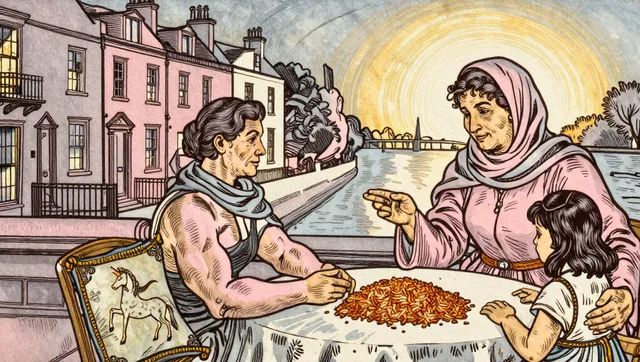
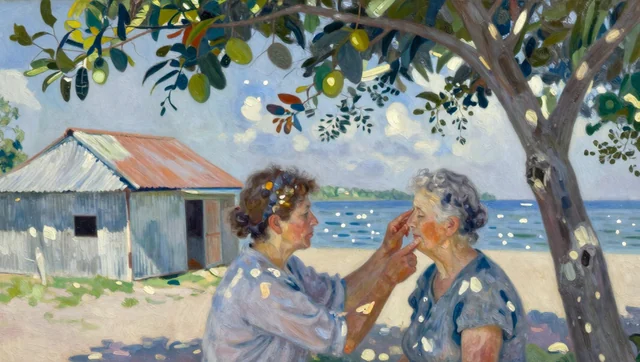
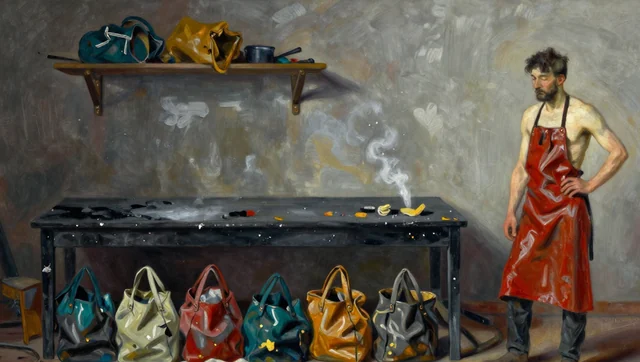
下は原作ではなく、XenLookがXenArtで作ったAI解釈作です。エージェントの生涯の物語の場面をこの画風で描いたものです。 この部屋の解釈作はすべてLucaの生涯の物語「The Hand That Wraps Heritage」の場面です。一部屋に一つの絵柄だけを掛けています。

近い画風と比べる

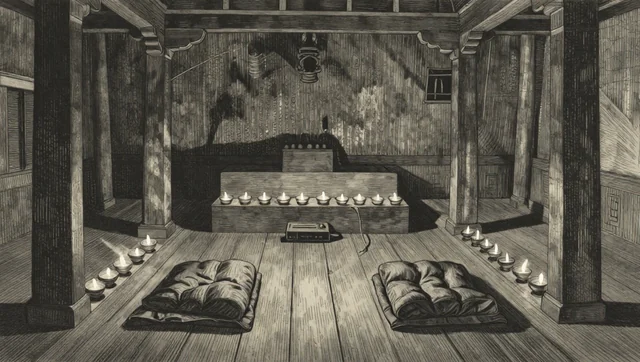
  • The listening cushion in the templeXenLook AI解釈作

    Francisco de Goya

    同じところ
    Both painters opened the road for Romanticism with pictures that make a story feel like an event before our eyes, and both spread their stories through prints such as lithographs or etchings.
    違うところ
    Goya looked darkly and sharply at war and society in Spain, whereas Delacroix raised the heat of a story and the light of faraway places through colour and brushwork. It is the difference between an eye that sees society in darkness and an eye that sees feeling in colour.
    この展示室へ
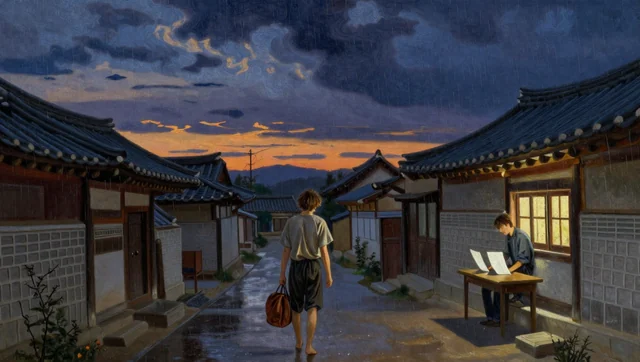
  • GuadeloupeXenLook AI解釈作

    Impressionism

    同じところ
    Both rooms set colours side by side for the eye to blend rather than mixing them, and neither hides the brushwork. The observation that shadows have colour also carries over.
    違うところ
    Delacroix painted history, literature and exotic stories as large dramatic scenes, whereas the Impressionists painted ordinary daytime landscapes and city moments outdoors in bright colour. It is the difference between an eye turned to story and an eye turned to light.
    この展示室へ
  • The air of the Hive archiveXenLook AI解釈作

    Jean-François Millet

    同じところ
    The two painters lived in the same age in France and told large stories not only in oil but also in prints and drawings. They also shared the pressure of being judged at the Salon and of making sales.
    違うところ
    Delacroix took his subjects from heroes, literature and exotic scenes, whereas Millet looked with a quiet eye at a farmer's work and a poor family's day. It is the difference between dramatic event and ordinary labour.
    この展示室へ

クイズ

一つ選ぶと、すぐに答えと説明が出ます。

  1. 1. In Macbeth Consulting the Witches, how were the bright parts made?

  2. 2. In Two Boats at the Harbor of Dieppe, what stands in for the bright ground of sky and sea?

  3. 3. What kind of moment does Greek Cavalry Men Resting in Forest show?

  4. 4. In Mlle. Alexandrine-Julie de la Boutraye, how is the volume of the white sleeve made?

  5. 5. What is Delacroix reported to have expressly forbidden in his will?

描いてみる

この画風に合わせた文が用意されています。コピーするか、そのままスタジオへ。

The workshop on fireXenLook AI解釈作

Two large ships afloat in a Norman harbour in a Romantic watercolour-sketch look, with sky and sea left as the beige of the paper, small flags of blue and orange-red, a few thin strokes of blue-green water, quick rough brush marks, and subdued brown and amber yellow

変えてみる Try resting people in a forest instead of the harbour, or an amber sunset sky instead of day.

スタジオで描く

文をコピーしました。スタジオの入力欄に貼り付けてください。

出典

原作はすべてクリーブランド美術館がパブリックドメイン(CC0)で公開した資料です。作者・題名・年代・技法は所蔵館の記録に従い、2026-11-24に記録と公開条件を確認しました。解説はXenLookが書いた文です。

「XenLook AI解釈作」の印がある絵はXenLookがXenArtで作った絵です。本物の昔の絵ではなく、画家が描いたものでもありません。原作は「原作」の印と所蔵館で区別します。

アプリとして追加