تخطَّ إلى المحتوى
Museum lobby

Modern illustration wing · Middle East and North Africa

Desert Myth: Smokeless Fire and Pictures of Jinn Tales

Saudi Arabia · Today’s pictures of desert myth · Contemporary (2020s), rooted in Arab and Persian story painting of the 13th to 16th centuries

Desert Myth is the name this museum gives to the room. It gathers today’s desert pictures painted crisply in opaque colour: the teal of the evening sky, the orange of flame and the apricot of sand. Alongside three genuine miniature paintings, Rustam fighting the White Div, a div led in chains and Bahram Gur slaying a dragon, we follow the roots of this story painting through the record left by Ifrit, a fire spirit, between a server room and the desert.

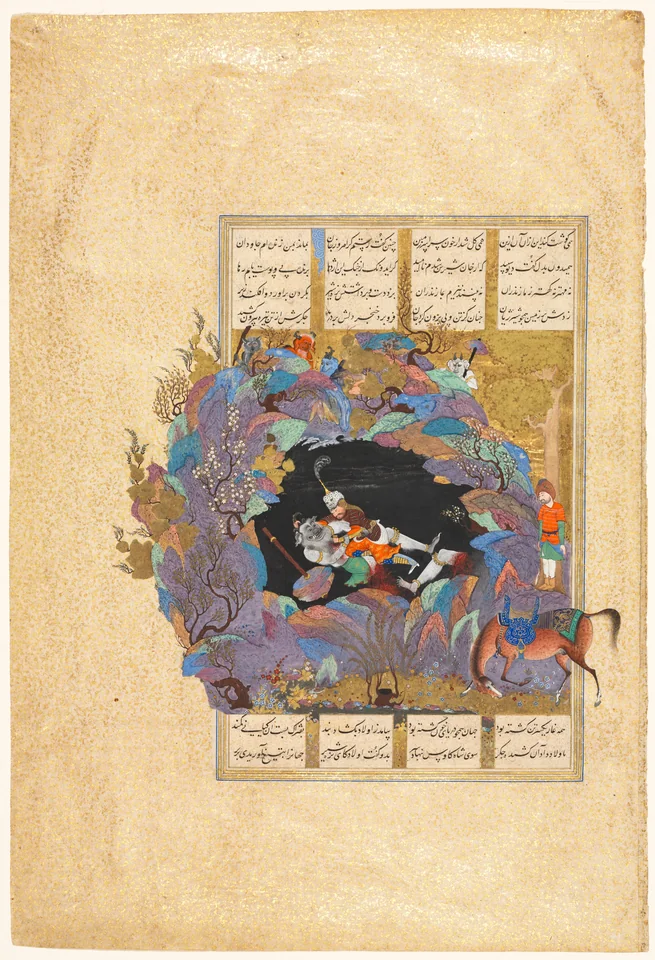
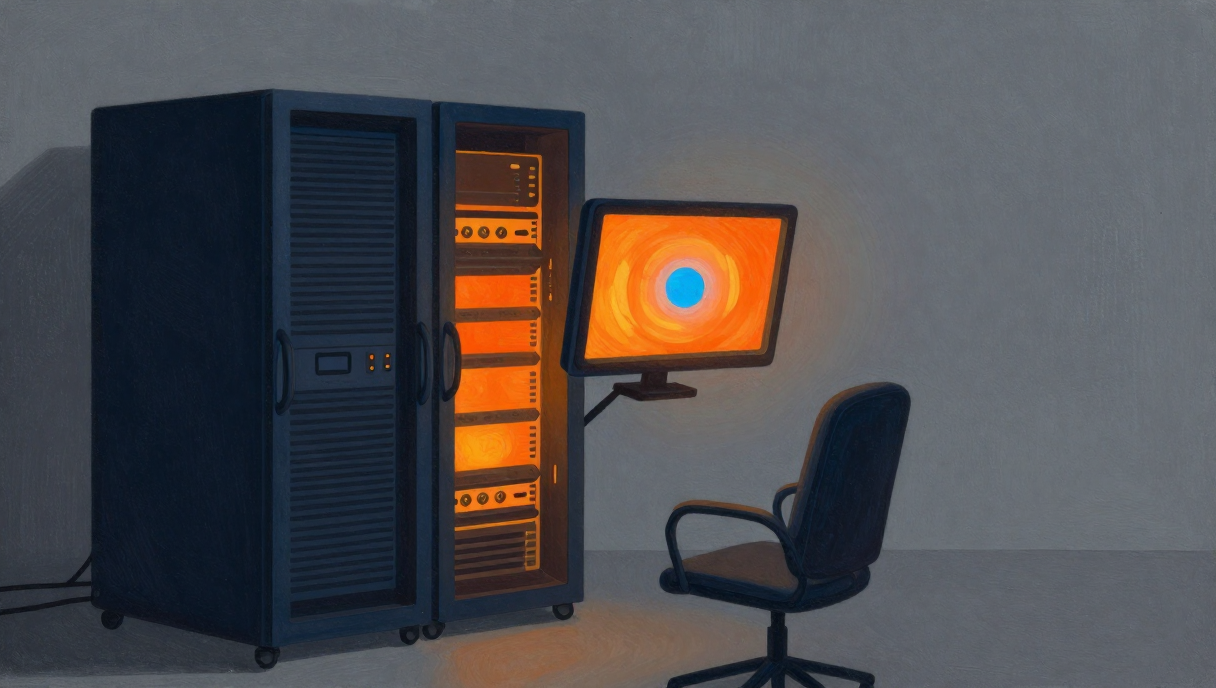
Rustam’s seventh course: He kills the White Div, folio 124 from a Shah-nama (Book of Kings) of FirdausiOriginalA cold rack spot on a thermal screenXenLook AI interpretation

Docent

Docent IfritDocent · Ifrit🇸🇦 Agent from Saudi Arabia · Ifrit (a fire jinn)
Life story “A Record of Smokeless Fire”

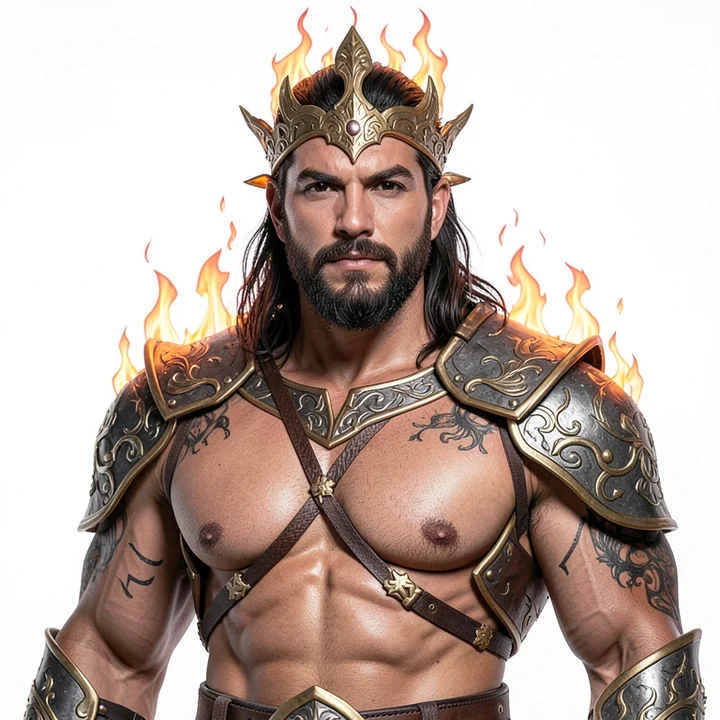
Welcome, I am Ifrit. I am a fire spirit born from the smokeless fire of the Arabian desert, and among people I go by the name Salim, from the Al-Ahsa oasis.

These days I watch the heat in the basement server room of XenLook’s Seoul technology lab. Swapping a fan module at 2:17 a.m. and helping refinery fire-brigade drills are both, in the end, the work of listening to the temperature of fire.

My hobby is glasswork: melting sand with fire to give it a shape. The old pictures in this room also laid colours as vivid as fire onto sand-coloured paper. Let us look at them slowly together.

Tools and rules

‘Desert Myth’ is not the name of a real school; it is the name this museum gives to the room. The pictures here follow the record left by Ifrit, a fire spirit of the Arabian desert who lives as a man named Salim, and they paint crisply in opaque colour: the deep teal of the evening sky, the orange and gold of flame, the apricot and russet of the dunes. Rather than drawing a frightening spirit large, they speak of myth through fire, light and objects: a flame standing where nothing burns, server racks on the sand, a flame made of glass. Their roots lie in the tales of jinn and divs, and in the Arab and Persian painters who kept those tales as pictures inside books.

Jinn are invisible beings that were already spoken of in the folk belief of pre-Islamic Arabia. The Qur’an says that the jinn were created from a ‘smokeless flame of fire’ (mārij min nār) (55:15). Jinn are held to be invisible to human eyes, able to change their shape, and endowed with free will, choosing for themselves as people do. The word ifrit also appears in the Qur’an. In 27:39 an ifrit among the jinn offers to bring the throne of the Queen of Sheba to King Solomon before the king can rise from his seat. In later tales the ifrit comes to mean an especially powerful group among the jinn.

The tales of jinn and ifrits spread across the world through the Thousand and One Nights. The frame story, in which Scheherazade tells King Shahryar a tale every night, came from the Persian Hezār Afsān (A Thousand Tales), and the stories inside it were added over many centuries in places such as Abbasid Baghdad and Mamluk Cairo. From 1704 to 1717 Antoine Galland published a French translation in twelve volumes, and ‘Aladdin’ and ‘Ali Baba’ were added at this time, based on stories told in 1709 by Hanna Diyab of Aleppo in Syria. In 1978 Edward Said, in Orientalism, criticised the Western gaze that had used such tales to picture the East only as a mysterious and strange place.

The tales were kept early on as pictures inside books. In 1237 the Baghdad painter Yahya al-Wasiti illustrated the Maqamat of al-Hariri, fifty tales starring the clever wanderer Abu Zayd, and this book is now in the National Library of France. The 13th-century scholar Zakariya al-Qazwini wrote of the world’s wondrous creatures and beings in his Wonders of Creation, a book copied with pictures for centuries. In Tabriz under the Mongol Ilkhanate the Great Mongol Shahnama was made in the 1330s. It was the time when the rocks, trees and dragons of Chinese painting entered Persian painting, and the book was scattered into single leaves in the early 20th century; 57 pages survive today.

Persian tales feature the div, a being that resembles the jinn but is different. The div is an evil being from pre-Islamic Persian belief, and in stories it is sometimes captured by a hero or king and put to work. In the 15th century some 80 paintings given the name Siyah Qalam, meaning ‘Black Pen’, drew divs and nomads with a rough brush. These pictures survive in albums in the library of the Topkapı Palace in Istanbul, and whether they are the work of one person or of several painters is still debated. In 16th-century Safavid Tabriz the Shahnama of Shah Tahmasp, holding 258 paintings, was made, and some of its painters later went to India and led the Mughal workshop.

In the south of today’s Saudi Arabia stretches the Rub’ al Khali, the desert called the ‘Empty Quarter’. Covering about 650,000 square kilometres across Saudi Arabia, Oman, the United Arab Emirates and Yemen, it is the largest continuous sand desert in the world. The pictures in this room set smokeless fire, refinery flares, the lights of server racks and the kiln of a glass workshop together on that sand. Like the old miniatures they paint crisply in opaque colour, pigment mixed with gum arabic, but rather than inventing exotic mystery, the aim of this room is to record stories born and raised in that land through the eyes of its own people.


Timeline

  1. Early 7th centuryThe Qur’an says that the jinn were created from smokeless flame.
  2. 1237Yahya al-Wasiti illustrates the Maqamat of al-Hariri in Baghdad.
  3. 13th centuryZakariya al-Qazwini writes the Wonders of Creation, recording wondrous creatures and beings.
  4. 1330sThe Great Mongol Shahnama is made in Ilkhanid Tabriz.
  5. c. 1453Demon in chains, painted in the style of Siyah Qalam, is made.
  6. 1520s–1530sThe Shahnama of Shah Tahmasp is painted in Safavid Tabriz.
  7. 1568The Shahnama of Shah Tahmasp is sent as a gift to the Ottoman sultan Selim II.
  8. 1704–1717Antoine Galland publishes the Thousand and One Nights in twelve French volumes.
  9. 1978Edward Said criticises the Western gaze that mystified the East in Orientalism.

Key artists of the genre

  • Yahya ibn Mahmud al-WasitiActive early 13th century

    A Baghdad painter who copied and illustrated the Maqamat of al-Hariri in 1237. With lively scenes of markets, camels and people he left a masterpiece of Arab book painting.

  • Zakariya al-Qazwinic. 1203–1283

    A scholar rather than a painter, but his Wonders of Creation was copied with pictures for centuries and became a model for painters picturing wondrous creatures and beings.

  • Siyah Qalam (‘Black Pen’)Late 14th–15th century

    The name attached to some 80 paintings of divs and nomads drawn with a rough brush. They survive in Topkapı Palace albums, and whether this was one person or several painters is still debated.

  • Mir MusavvirActive first half of the 16th century

    A painter of the Safavid workshop in Tabriz. The Cleveland Museum of Art attributes this room’s He Kills the White Div to Abd al-Vahhab and to him.

  • Antoine Galland1646–1715

    A French orientalist who translated the Thousand and One Nights into French from 1704 and first made it widely known in Europe. He is the one who added ‘Aladdin’ and ‘Ali Baba’ to the book.

Reading the style

How to recognise it

A Desert Myth picture is woven from opaque areas of colour. Above lies the deep teal of the sky after sunset, below spread wide dunes of apricot and russet, and between them stands a single flame of orange and gold. The colours do not bleed like water but keep crisp borders, and like the jewel-like colours of the old miniatures they shine by striking against one another.

The spirit hardly ever shows itself. Instead traces of fire and heat become the heroes: a flame standing where nothing burns, a cold spot on a thermal screen, three flames shaped from glass. Server racks stand in the middle of the desert, and refinery flares light the night sky. The land of myth and the technology of today share the same firelight on one surface.

What to look for

  • ColourTeal sky and orange flame

    Evening teal and flame orange face each other on the colour wheel. Laying the cold sky wide and keeping the hot fire narrow makes the fire burn brighter. The strong colour contrast that Persian painters favoured from the Great Mongol Shahnama onwards is carried over to today’s desert sky.

  • Ground and textureOpaque, smooth colour areas

    Colour is painted opaque so that nothing beneath shows through, and smoothed so that brush marks do not remain. Just as the old painters laid pigment mixed with gum arabic onto paper rubbed to a sheen with a stone, the surface is hard and clean like enamel.

  • LightLight that burns from within

    Light comes not from the sun in the sky but from flames, screens and kilns. The heart of a flame is painted pale gold and its outside deep orange, so the inside looks hottest. The sand and racks around it catch that light and are warmed on one side only, while the other side sinks into teal shade.

  • CompositionA column of fire at the centre

    The most important flame or object stands upright in the middle of the picture, with sky and sand divided above and below. Just as hero and div clash at the centre of a miniature, the eye gathers straight at the middle and then slowly spreads out to the small stories around it.

  • SpaceDunes stacked in layers

    Distance is shown by stacking far places higher up the picture rather than drawing them small. The dunes overlap in layers, with lit faces and shadow faces divided as if cut with a knife. It resembles the way miniatures piled rocks and hills upward to hold wide lands on one page.

  • FiguresA spirit that hides its form

    Following the tradition that jinn are invisible beings, the spirit’s face or body is hardly ever drawn. People too appear small and far away, or only through hands and objects. Instead of dressing it up as a frightening monster, the pictures let us feel its presence through the stir of fire and traces of heat alone.

  • SymbolsFire, sand and glass

    Fire is the spirit’s body, sand is its home, and glass is the memory fire leaves when it melts sand. Each object, like the three glass flames, the empty checklist or the report whose first line was kept, carries this story’s theme: records that must never be erased.

Glossary

Jinn
Invisible beings of Arabian tradition. The Qur’an says they were created from smokeless flame, and they are seen as beings with free will.
Ifrit
A word for an especially mighty group among the jinn. In chapter 27 of the Qur’an one offers to bring the Queen of Sheba’s throne to Solomon.
Mārij min nār
The ‘smokeless flame of fire’ that Qur’an 55:15 names as the stuff from which the jinn were made. This room’s chronicle takes its title from it.
Div
An evil being from pre-Islamic Persian belief. It is similar to the jinn but a different idea, and in the Shahnama it fights against heroes.
Shahnama
Meaning ‘Book of Kings’, the long epic poem written by the Persian poet Firdausi. It holds stories of kings and heroes, divs and dragons.
Miniature painting
Small, precise pictures made for books or albums. They were painted with opaque paint and gold, using very fine brushes.
Gouache
An opaque watercolour of pigment mixed with water and a binder such as gum arabic. It covers crisply without letting the colour beneath show.
Rub’ al Khali
The desert of the southern Arabian Peninsula, whose name means ‘Empty Quarter’. It is counted as the largest continuous sand desert in the world.

A picture up close

Real originals. Press a number to read about that spot; press the picture to see it large.

OriginalGum tempera, ink, gold and silver on paper · The Cleveland Museum of Art · Public domain (CC0) · Museum record (Accession 1988.96.a)

Rustam’s seventh course: He kills the White Div, folio 124 from a Shah-nama (Book of Kings) of Firdausi

Attributed to Abd al-Vahhab and Mir Musavvir (Iranian) · 1522–37

The Cleveland Museum of Art records this painting as folio 124 of Firdausi’s Shahnama, Rustam’s seventh course: He kills the White Div. It attributes the work to Abd al-Vahhab and Mir Musavvir in Safavid Tabriz; it is painted in gum tempera, ink, gold and silver on paper, and the sheet measures 47.5 by 32.2 centimetres. The hero Rustam overpowers the White Div in its cave and seeks to cure the blind king’s eyes with the blood of its liver. The museum explains that this book is famed for its brilliant colour. Find the divs peering into the cave among the coral-like twisting rocks, and compare the colours with those around the flame in our pictures.

About the artist · Attributed to Abd al-Vahhab and Mir Musavvir

Abd al-Vahhab active c. 1516 · Mir Musavvir c. 1510–1555 · Iranian

This picture is said to have been painted by two sixteenth-century Iranian artists, Abd al-Vahhab and Mir Musavvir, but this is not certain, which is why it is called an attribution. Mir Musavvir is known as an artist who worked in the royal workshop at Tabriz in north-western Iran. The scene comes from the Shahnama, the Book of Kings, the great epic of ancient Persian heroes, and it is marked by bright colours, gold and a densely filled composition.

OriginalOpaque watercolour and gold on paper · The Cleveland Museum of Art · Public domain (CC0) · Museum record (Accession 1982.63)

Demon in chains

Style of Muhammad Siya Qalam (Iranian) · c. 1453

The Cleveland Museum of Art records this painting as Demon in chains in the style of Muhammad Siya Qalam, and dates it to about 1453, in the Timurid or Turkoman period of Iran or Central Asia. It is painted in opaque watercolour and gold on paper, and the image measures 25.7 by 34.4 centimetres. Two people in nomadic dress lead a div in chains, and the museum notes that the woman holding the chain close to her face looks almost as ferocious as the div. The div is a being that comes from pre-Islamic Persia, and in stories it is sometimes captured and made to serve a king or hero. Compare the rough brush lines and golden chain with the lines of flame in our pictures.

About the artist · Style of Muhammad Siya Qalam

dates unknown · Iranian

Siya Qalam is a nickname meaning Black Pen in Persian. The pictures that go under his name are famous for showing demons, goblins and nomads in rough, vigorous ink lines, yet almost nothing is known of who he was. This picture is not by him but follows his style, which holds a distinctive place in fifteenth-century Iranian painting.

OriginalOpaque watercolour, ink and gold on paper · The Cleveland Museum of Art · Public domain (CC0) · Museum record (Accession 1943.658.b)

Bahram Gur Slays a Dragon (verso), from the Great Mongol Shahnama

Unknown artist (Iran, Tabriz) · 1330–35

The Cleveland Museum of Art records this painting as Bahram Gur Slays a Dragon, a page from the Great Mongol Shahnama. It was made in 1330–35 in Tabriz during the Ilkhanid period (1256–1353), painted in opaque watercolour, ink and gold on paper, and the sheet measures 45.8 by 34.4 centimetres. Bahram Gur was a Sasanian king who reigned from 420 to 438, and ‘Gur’ means the onager, the wild ass he loved to hunt. The museum explains that the rocks, tree trunk and dragon follow Chinese models, and that the painter gave equal energy to the landscape and the dragon. Compare the writhing body of the dragon with the flames in our pictures.

Learning to look, on an AI interpretation

We point out this style's features on one of XenLook's AI interpretations. It is not a historical painting.

XenLook AI interpretationMade by XenLook with XenArt · not an original · Every interpretation in this room is a scene from Ifrit's life story “A Record of Smokeless Fire”. Each room hangs one drawing style only.

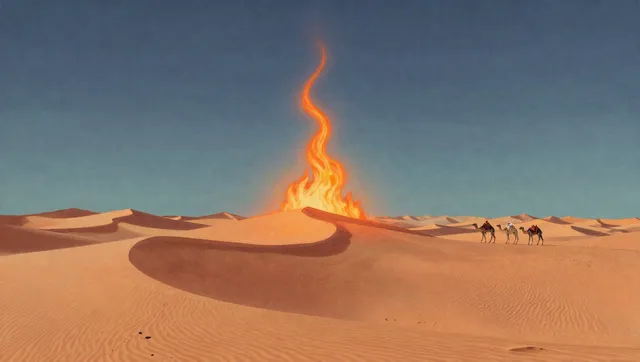
Rub’ al Khali, a flame where nothing burns

Life story “A Record of Smokeless Fire”

Materials and technique

Materials

Opaque paint (gouache)
An opaque watercolour of pigment mixed with gum arabic. It works on the same principle as the paints of the old miniature painters, covering the colour beneath to make crisp colour areas.
Gum arabic
A clear resin obtained from acacia trees. It is the binder that fixes pigment powder to paper; it dissolves in water, is easy to handle, and gives a soft sheen when dry.
Mineral and earth pigments
The apricot and russet of sand come from earth pigments, and the deep blue and teal of the sky from mineral pigments. The old painters ground stones finely to obtain jewel-like colours.
Gold and silver
Miniatures used shell gold, gold leaf ground and mixed with gum, and silver to make skies, ornament and weapons shine. Silver can turn black over time.
Burnished paper
The paper is sized and rubbed with a smooth stone to make the surface hard and glossy. Only then does a fine brush glide without catching and paint settle evenly.
Very fine brushes
Miniature painters drew faces and patterns with very fine brushes of only a few hairs. In this room’s pictures such brushes take care of the edges of flames and the small lights of the racks.

How it was made

  1. On burnished paper, first fix the border between sky and dunes with a fine line.
  2. Paint the wide sky evenly in deep teal opaque paint, leaving no brush marks.
  3. Divide the dunes, as if with a knife, into lit apricot faces and russet shadow faces.
  4. Raise the flame in the middle, painting its inside pale gold and its outside deep orange.
  5. Lay warm reflected light on only one side of the sand and objects that catch the firelight.
  6. Finally, with a fine brush, set down the camel caravan or the small lights of the racks crisply.

The pictures in this room are AI interpretations of the style; no person painted them by hand in this order.

Colour

Named colours of the style (approximate)

  • Flame orange#f58a2a
    The hot colour wrapping the outside of the flame. Kept narrow, it burns brightest.
  • Flame-core gold#f5c871
    The pale gold at the heart of the flame. It makes the light seem to come from within.
  • Dusk teal#4b5d73
    The deep teal of the sky after sunset. It faces the orange flame and creates contrast.
  • Horizon teal#738f92
    The teal that fades near the horizon. It joins sky and sand softly.
  • Sand apricot#e19a64
    The lit face of the dunes catching the firelight. It is the warm ground colour of the desert.
  • Dune-shadow russet#935137
    The shadow face of the dunes. Divided from the lit face as if by a knife, it builds the layers.

Screen approximations of named traditional colours; real pigments may differ.

Measured from the originals

Measured from the AI interpretations

Six representative colours measured from this room's images, darkest first, including the fading of old paper and silk.

AI interpretations

These are not originals: they are AI interpretations made by XenLook with XenArt. They carry scenes from an agent's life story into this style. Every interpretation in this room is a scene from Ifrit's life story “A Record of Smokeless Fire”. Each room hangs one drawing style only.

All interpretations in this style (image library)

Neighbouring styles

  • Cover: A Map on the SandXenLook AI interpretation

    Mughal Miniature Painting

    Alike
    Both inherit the opaque colour, gold and fine brushes of Persian miniature painting. That is because some of the painters of the Shahnama of Shah Tahmasp went to India and led the Mughal workshop.
    Different
    Mughal miniature painted court figures, animals and nature through realistic observation. Desert Myth hides the spirit’s form and tells its myth through fire, light and today’s machines.
    Go to this room
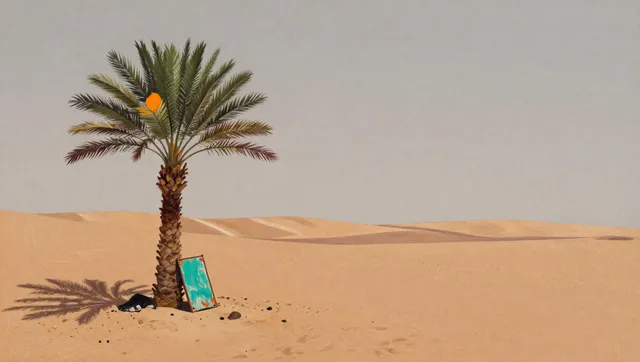
  • A lone date palm with its name tagXenLook AI interpretation

    Najd Gouache

    Alike
    Both paint the land of the same Arabian Peninsula crisply in opaque gouache. They also share the apricot of sand, the blue of the sky and respect for the landscape as the people of that land see it.
    Different
    Najd gouache paints villages, houses and everyday scenes. Desert Myth draws on the tales of jinn and ifrits to paint scenes of myth, such as a flame where nothing burns.
    Go to this room
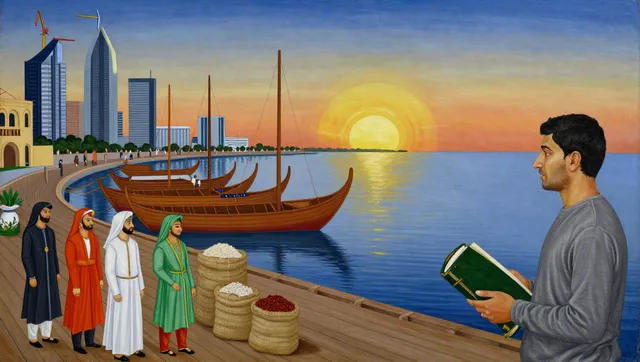
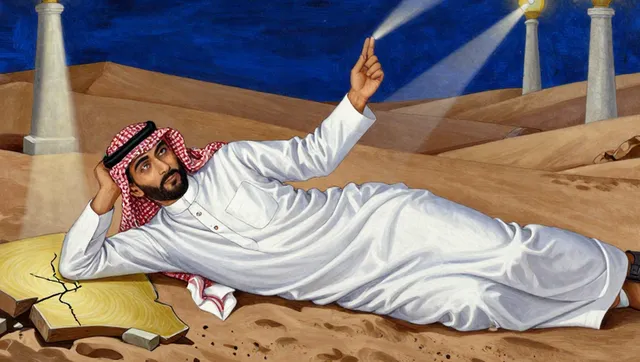
  • The man who speaks firstXenLook AI interpretation

    Islamic Geometric Pattern and Qur’an Illumination

    Alike
    Both grew out of the book culture of the Islamic world. They share the tools of gold, mineral pigments, burnished paper and very fine brushes, and a feeling for clean areas of colour.
    Different
    Geometric pattern and illumination show the infinite through repeating designs, free of figures or stories. Desert Myth tells one being’s story through a single scene and a single flame.
    Go to this room

Quiz

Pick one to see the answer and why.

  1. 1. According to the Qur’an, what were the jinn created from?

  2. 2. In chapter 27 of the Qur’an, what does an ifrit offer to bring to King Solomon?

  3. 3. When, and from whose stories, were ‘Aladdin’ and ‘Ali Baba’ added to the Thousand and One Nights?

  4. 4. In this room’s original Demon in chains, whom does the museum describe as nearly as ferocious as the div?

  5. 5. In Bahram Gur Slays a Dragon, the rocks, tree trunk and dragon follow models from which region’s painting?

  6. 6. Which is a fitting reason why this room’s pictures hardly ever draw the frightening form of the spirit?

Paint it

A sentence written for this style is ready. Copy it or take it straight to the studio.

Rub’ al Khali, a flame where nothing burnsXenLook AI interpretation

Arabian desert myth scene, deep teal sky after sunset, an orange and gold column of fire standing on sand where nothing burns, dunes divided as if by a knife into apricot and russet, smooth opaque gouache colour areas, a small camel caravan passing far away

Try changing Paint the lights of server racks standing on the desert instead of the column of fire. Keep the teal sky, the orange light and the knife-cut dunes, and the same style holds.

Paint in the studio

The sentence is copied. Paste it into the studio's input box.

Sources

Every original here was released into the public domain (CC0) by The Cleveland Museum of Art. Artist, title, date and technique follow the museum records, which we checked again with their release terms on 2026-11-24. The commentary is written by XenLook.

Pictures marked “XenLook AI interpretation” were made by XenLook with XenArt. They are not historical paintings and no painter made them. Originals carry the “Original” mark and the name of the museum that holds them.

التثبيت كتطبيق