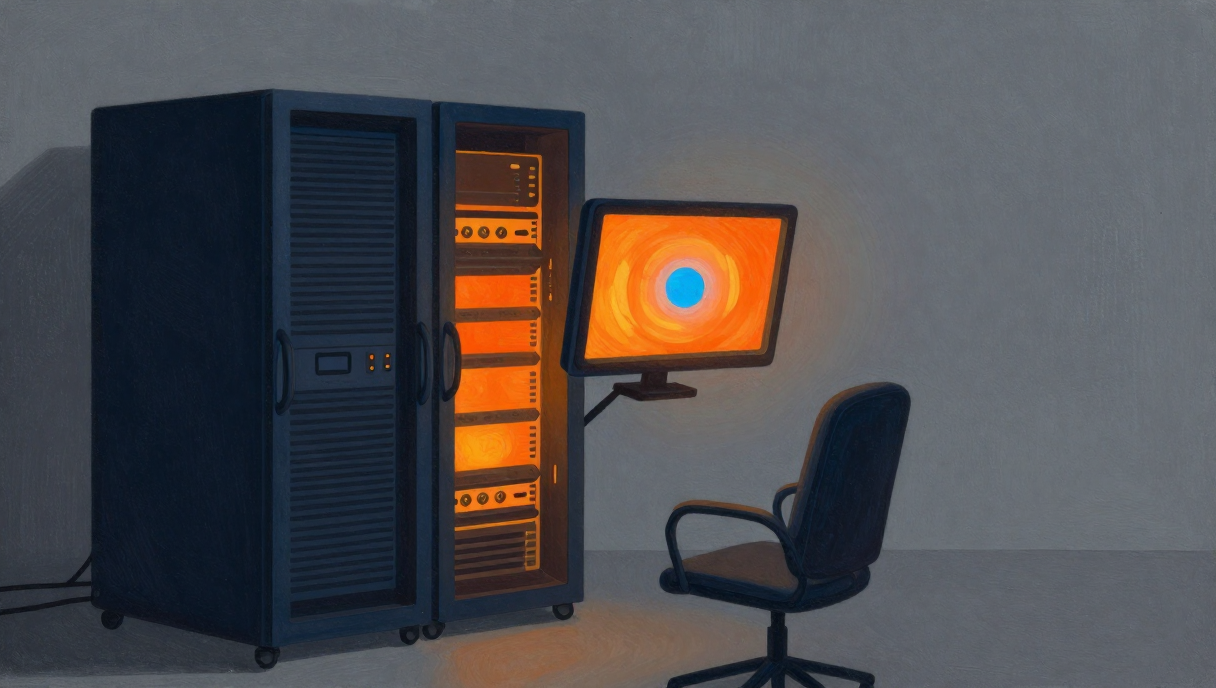
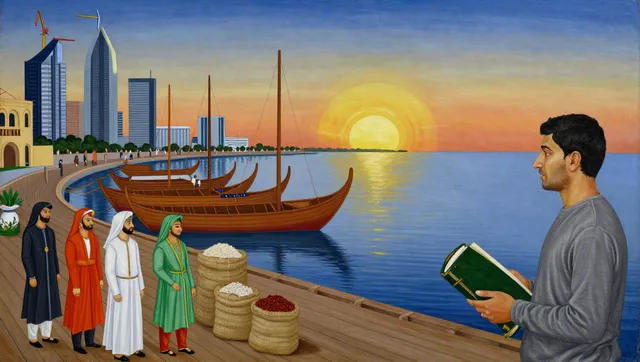
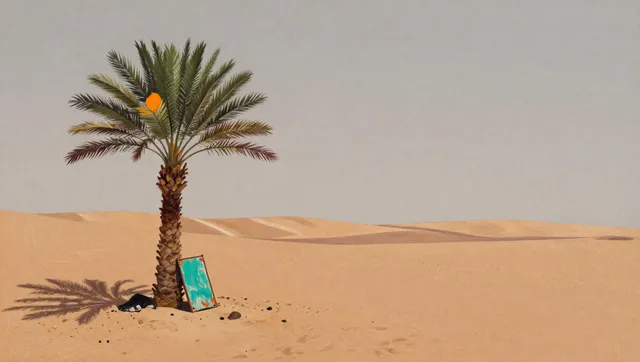
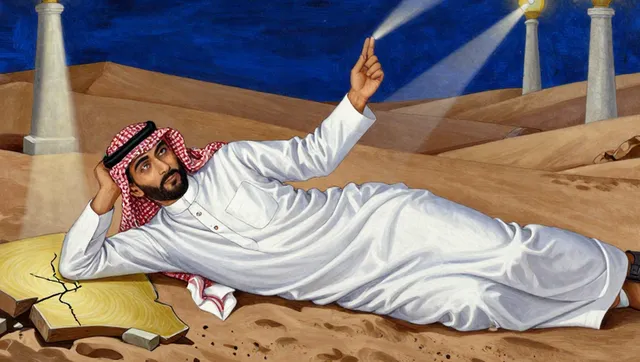
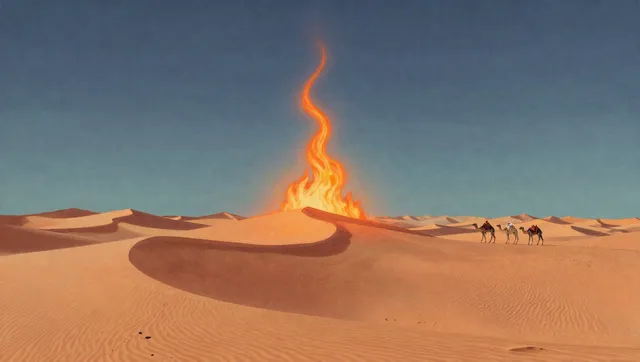
‘Desert Myth’ is not the name of a real school; it is the name this museum gives to the room. The pictures here follow the record left by Ifrit, a fire spirit of the Arabian desert who lives as a man named Salim, and they paint crisply in opaque colour: the deep teal of the evening sky, the orange and gold of flame, the apricot and russet of the dunes. Rather than drawing a frightening spirit large, they speak of myth through fire, light and objects: a flame standing where nothing burns, server racks on the sand, a flame made of glass. Their roots lie in the tales of jinn and divs, and in the Arab and Persian painters who kept those tales as pictures inside books.
Jinn are invisible beings that were already spoken of in the folk belief of pre-Islamic Arabia. The Qur’an says that the jinn were created from a ‘smokeless flame of fire’ (mārij min nār) (55:15). Jinn are held to be invisible to human eyes, able to change their shape, and endowed with free will, choosing for themselves as people do. The word ifrit also appears in the Qur’an. In 27:39 an ifrit among the jinn offers to bring the throne of the Queen of Sheba to King Solomon before the king can rise from his seat. In later tales the ifrit comes to mean an especially powerful group among the jinn.
The tales of jinn and ifrits spread across the world through the Thousand and One Nights. The frame story, in which Scheherazade tells King Shahryar a tale every night, came from the Persian Hezār Afsān (A Thousand Tales), and the stories inside it were added over many centuries in places such as Abbasid Baghdad and Mamluk Cairo. From 1704 to 1717 Antoine Galland published a French translation in twelve volumes, and ‘Aladdin’ and ‘Ali Baba’ were added at this time, based on stories told in 1709 by Hanna Diyab of Aleppo in Syria. In 1978 Edward Said, in Orientalism, criticised the Western gaze that had used such tales to picture the East only as a mysterious and strange place.
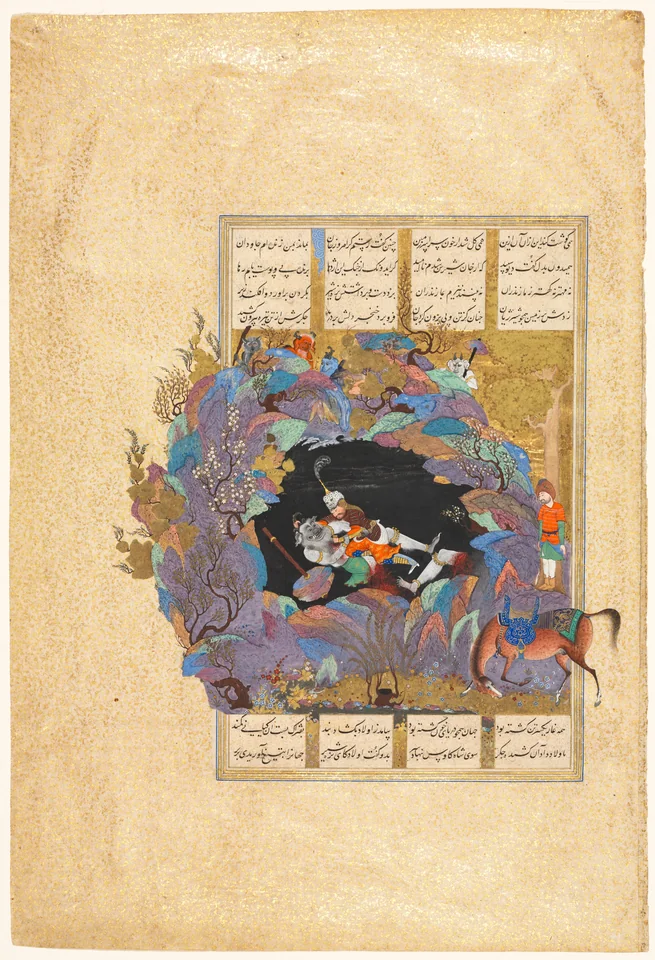
The tales were kept early on as pictures inside books. In 1237 the Baghdad painter Yahya al-Wasiti illustrated the Maqamat of al-Hariri, fifty tales starring the clever wanderer Abu Zayd, and this book is now in the National Library of France. The 13th-century scholar Zakariya al-Qazwini wrote of the world’s wondrous creatures and beings in his Wonders of Creation, a book copied with pictures for centuries. In Tabriz under the Mongol Ilkhanate the Great Mongol Shahnama was made in the 1330s. It was the time when the rocks, trees and dragons of Chinese painting entered Persian painting, and the book was scattered into single leaves in the early 20th century; 57 pages survive today.
Persian tales feature the div, a being that resembles the jinn but is different. The div is an evil being from pre-Islamic Persian belief, and in stories it is sometimes captured by a hero or king and put to work. In the 15th century some 80 paintings given the name Siyah Qalam, meaning ‘Black Pen’, drew divs and nomads with a rough brush. These pictures survive in albums in the library of the Topkapı Palace in Istanbul, and whether they are the work of one person or of several painters is still debated. In 16th-century Safavid Tabriz the Shahnama of Shah Tahmasp, holding 258 paintings, was made, and some of its painters later went to India and led the Mughal workshop.
In the south of today’s Saudi Arabia stretches the Rub’ al Khali, the desert called the ‘Empty Quarter’. Covering about 650,000 square kilometres across Saudi Arabia, Oman, the United Arab Emirates and Yemen, it is the largest continuous sand desert in the world. The pictures in this room set smokeless fire, refinery flares, the lights of server racks and the kiln of a glass workshop together on that sand. Like the old miniatures they paint crisply in opaque colour, pigment mixed with gum arabic, but rather than inventing exotic mystery, the aim of this room is to record stories born and raised in that land through the eyes of its own people.