Albrecht Dürer was born on 21 May 1471 in Nuremberg, Germany. His father was a goldsmith who had settled there after moving from the Hungarian side, so from early on Dürer saw at close quarters the precision of a hand that works metal. Nuremberg was a free imperial city where merchants and craftsmen gathered, and printing houses and the book trade flourished. In 1486, at the age of fifteen, Dürer entered the workshop of Michael Wolgemut, a painter and the master of a printmaking workshop. Wolgemut's shop made many woodcut illustrations for books. There Dürer learned with his own body how a drawing is carried onto a woodblock and into the pages of a book.
After his training, from 1490 Dürer travelled and learned in several cities, as journeymen customarily did. In 1492 he went to Colmar in Alsace. The printmaker he admired, Martin Schongauer, had already died, but his brothers are said to have welcomed Dürer. He also stayed for a time in Basel. On 7 July 1494 he married Agnes Frey in his home town, and soon afterwards he crossed the Alps to Venice. Seeing Italian paintings and prints in person later became a great force in driving Dürer to pursue proportion and perspective to the end. In 1495 he returned to Nuremberg and opened his own workshop.
Around 1495 Dürer met the humanist Willibald Pirckheimer. Well versed in Latin and the classics, this friend became for life both his conversation partner and a solid patron. Having opened a workshop, Dürer put printmaking at the centre of his work. In 1498 he issued the Apocalypse, the Book of Revelation set out in a title page and fifteen large woodcuts. According to the museum's account it counts as the first book both published and illustrated by an artist. From one block the same picture could be printed many times and shared cheaply, and Dürer cut the AD monogram into each block so that his name became the sign of quality.
From 1505 to 1507 Dürer stayed in Venice for the second time. There he met painters such as Giovanni Bellini, and he began to use a method of laying light with brush and white paint on bluish paper. One of the leading works of this period is the Arm of Eve in this room. After his return he took on work for Emperor Maximilian I of the Holy Roman Empire. From this connection, running from about 1512, came such works as the huge Triumphal Arch, printed from 192 blocks. In 1515 he also made the first printed star charts in the West.
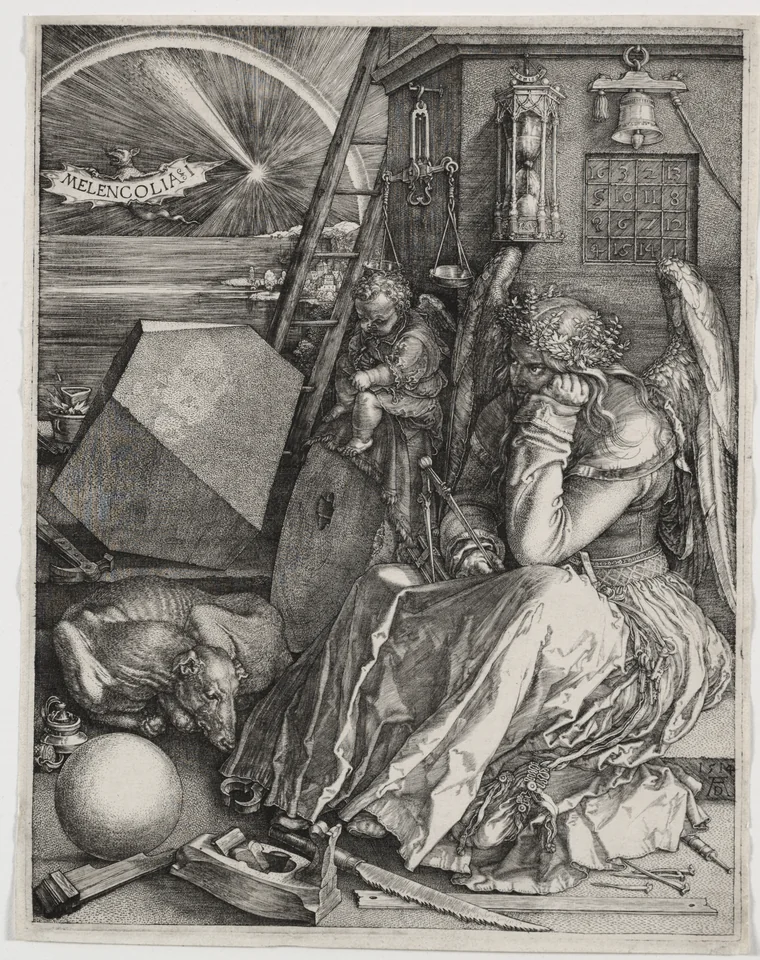
In 1513 and 1514 Dürer engraved in quick succession three works that are called the peak of copper engraving: Knight, Death and the Devil (1513), and Saint Jerome in His Study and Melencolia I (both 1514). These three are commonly grouped as the Meisterstiche, the master engravings. Many suppose the knight picture to be related to Erasmus's Handbook of the Christian Knight. 1514 is also the year Dürer's mother died, and some read the dark mood of Melencolia I in connection with that, but there is no firm basis, so it should be taken with caution. What is certain is that in all three he wove light and darkness out of very fine lines on a copper plate.
In July 1520 Dürer set out with his wife for the Netherlands. Passing through Antwerp, he is said to have tried to have the pension Maximilian had paid renewed by the new emperor, Charles V. It is also said that around this time his heart may have leaned towards Martin Luther's reform. In 1525 he published a geometry book, Instruction in Measurement, and in 1528, the year of his death, Four Books on Human Proportion appeared. Dürer died on 6 April 1528 at the age of fifty-six. The prints he left were copied and printed again across Europe for centuries. A line that began in one person's hand travels by paper and reaches many places, and Dürer carried that power of printmaking into the middle of art.