The starting point of American editorial picture-making is the illustrated weekly of the mid-nineteenth century. Harper’s Weekly, which Harper & Brothers began publishing in New York in 1857, carried news, fiction and humour alongside pictures, and by 1860 its circulation had reached 200,000. During the Civil War it printed illustrations of the war on a large scale. Because there was as yet no way to print photographs, professional engravers cut the artist’s drawing into a wooden block, which was printed together with the type. Making lines and scenes that could be read at a glance, for pages that many people opened once a week, became a profession from this time on.
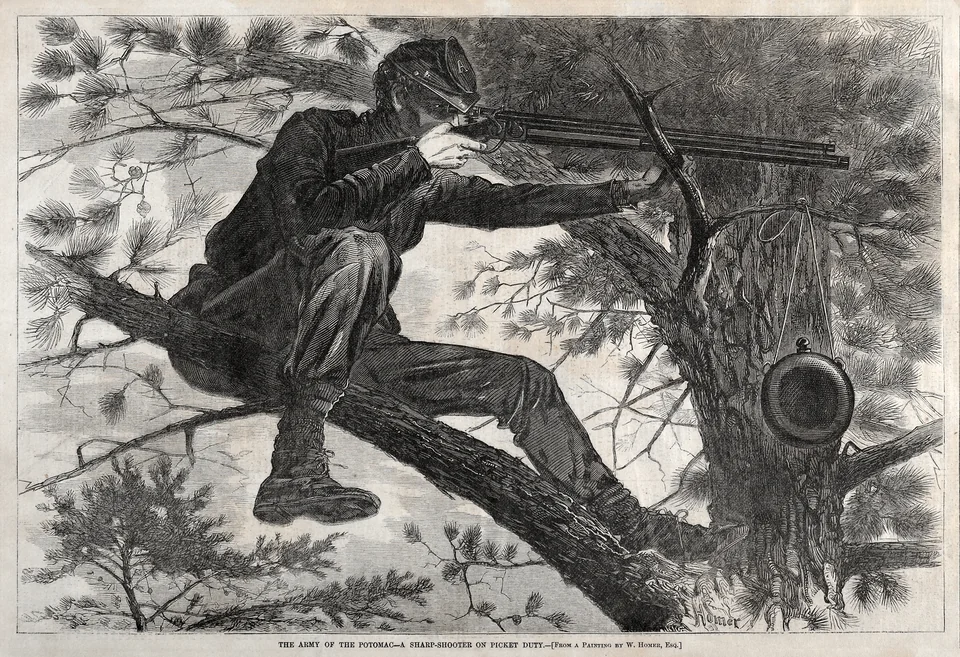
Winslow Homer, born in Boston in 1836, was largely self-taught. At nineteen he was apprenticed to a Boston commercial lithographer, working on jobs such as sheet-music covers, and from 1857 he sent pictures to Harper’s Weekly and other magazines as a freelance illustrator. When the war began in 1861, the magazine sent him to Virginia, where he candidly drew the everyday life and camps of soldiers rather than actual fighting. The Army of the Potomac – A Sharpshooter on Picket Duty (1862) and Dad’s Coming! (1873), which hang in this room, are ancestor works from those magazine wood engravings. He later became more famous as a painter, but his career as an illustrator lasted nearly twenty years.
From the late nineteenth century into the early twentieth, American illustration enjoyed a ‘Golden Age’. Howard Pyle (1853–1911) of Wilmington, Delaware, made his name with a double-page picture in Harper’s Weekly in 1878 and drew historical and adventure stories for Harper’s Monthly and the children’s magazine St. Nicholas. From 1894 he taught illustration at the Drexel Institute in Philadelphia, and after 1900 he opened his own school. The scholar Henry C. Pitz later called the artists of the Brandywine region who had studied with Pyle the ‘Brandywine School’. His teaching, which chose the most dramatic moment of a story and built it into a single scene, carries on in narrative illustration today.
Pyle’s student N. C. Wyeth (1882–1945) took his first step as an illustrator with a bucking bronco on the cover of The Saturday Evening Post on 21 February 1903. From 1911 he illustrated Treasure Island for Scribner’s, a series counted among his finest work, which made him famous. Over his life he illustrated 112 books, 25 of them for Scribner’s classics series. In this period, when magazine covers and book illustrations reached the eyes of millions, pictures became more than decoration for words: they were the face that showed the story first. The way this room’s AI interpretations set up the hands and gestures of their figures clearly in every scene also connects with this tradition.
George Bellows (1882–1925) was born in Columbus, Ohio, came to New York in 1904 and studied painting with Robert Henri. From 1911 he served on the editorial board of the socialist magazine The Masses, contributing many drawings and prints, and in 1916 he installed a lithographic press in his studio. Lithography is printmaking in which one draws on stone with a greasy crayon and prints by using the way oil and water repel each other; it was invented in 1796 by the German Alois Senefelder. This room’s Business Men’s Class (1916) is a lithograph from that same year, satirically showing office men clumsily copying the movements of an instructor. Gathering many figures in one picture to show society resembles the crowded scenes of this room.
On 21 February 1925 Harold Ross and Jane Grant founded The New Yorker in New York. The magazine became widely known for its topical yet witty illustrated covers. The cover of the first issue was drawn by the art editor Rea Irvin and showed a dandy peering at a butterfly through a monocle; the figure later took the name ‘Eustace Tilley’. The tradition of covers that do not explain an article but convey the mood of a season or the city in a single picture became an important branch of American editorial art. Because these covers are not among the Cleveland Museum of Art’s CC0 holdings, this room introduces them in words only.
In 1954 Seymour Chwast (born 1931) and Edward Sorel, Cooper Union classmates fired from Esquire on the same day, set up a studio in New York, and a few months later Milton Glaser (1929–2020), back from studying in Bologna, Italy, on a Fulbright, joined them. The name came from The Push Pin Almanack, a mailing piece the two had been publishing. Push Pin Studios reinterpreted historical styles such as Victorian, Art Nouveau and Art Deco, making cheerful pictures and lettering unlike rigid modernism, and in 1970 it held the exhibition ‘The Push Pin Style’ at the Museum of Decorative Arts of the Louvre in Paris. Glaser left the 1966 Bob Dylan poster and the ‘I ❤ NY’ logo, and in 1968 he co-founded New York magazine.