Zum Inhalt springen
Museum lobby

History wing · Middle East and North Africa

Egyptian Tomb Painting

Egypt · Old Kingdom to the Roman period · c. 2600 BC to the 4th century AD

Egyptian tomb painting decorated the inner walls and coffins of tombs from about 4,500 years ago. Its job was to help the dead eat, work and live on in the next world, so being correct mattered more than being pleasing. Faces and legs are drawn in profile, eyes and shoulders from the front, and the body follows a grid of squares. The size of a figure tells you rank. A plain palette of blue, red ochre, yellow ochre, white, black and green is laid flat on dry plaster. In this room you learn to read those conventions.

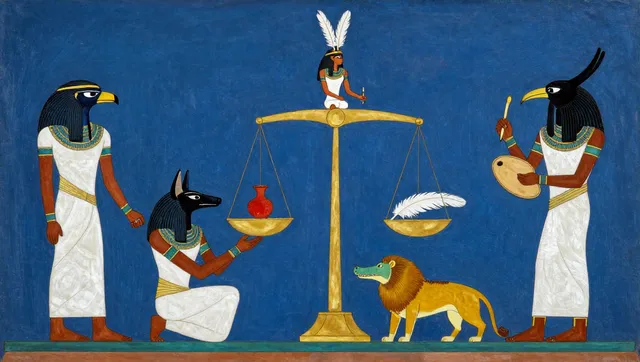
Relief of Agricultural ScenesOriginalHall of Two Truths: the scaleXenLook AI interpretation

Docent

Docent MaatDocent · Maat🇪🇬 Agent from Egypt · Goddess of truth
Life story “The Weight of a Feather”

Hello, I am Maat. In Egypt I am the goddess who keeps truth and balance. Today, on walls where my feather is painted, I will show you the painters' conventions one by one.

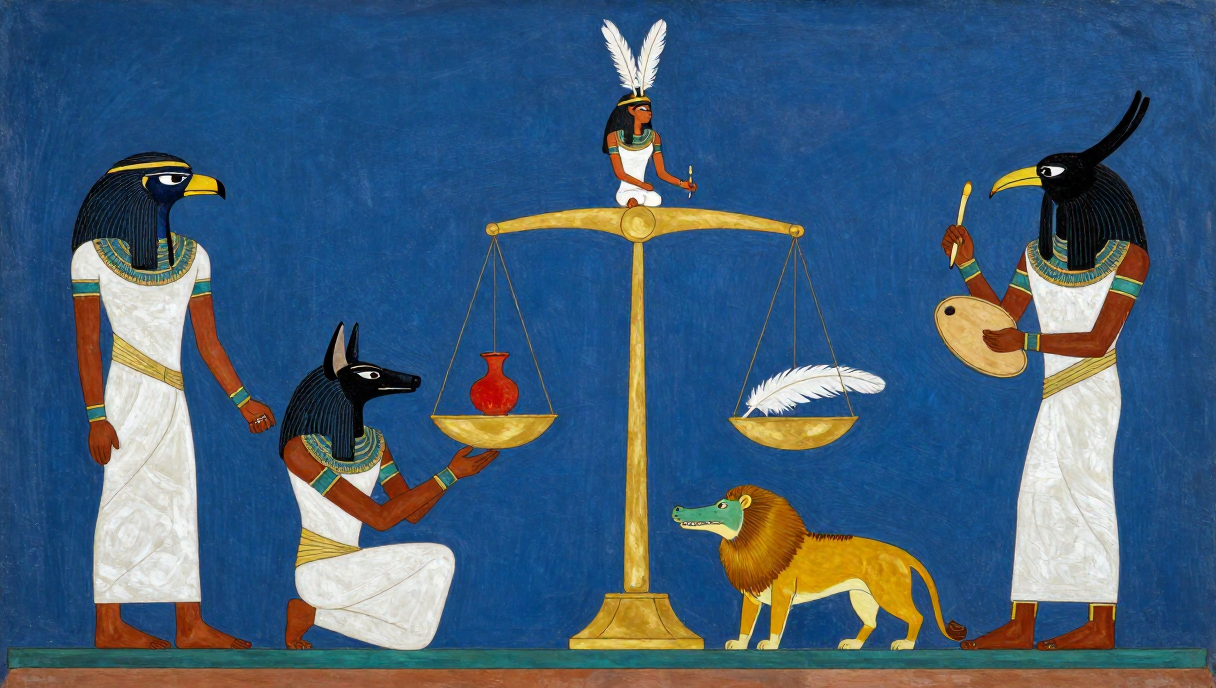
My tale, The Weight of a Feather, follows Mai, a young judge in Cairo. The scene of a heart set on one pan of the scale and a feather on the other is the first interpretation in this room.

Look first at the human body. A frontal eye sits in a profile face, and bands are stacked in layers. Once you know the rules, a wall from long ago suddenly begins to read.

Roots and history

Egyptian tomb painting began as a way of furnishing the house of the dead. The ancient Egyptians believed that death was not an end but a road to another world. So they painted food and workers, farms and hunting grounds inside the tomb, expecting them to carry over into the afterlife. The pictures were hung not to be admired but to be used. One celebrated early example is the Meidum geese, from the Fourth Dynasty of the Old Kingdom, about 2600 BC: geese painted on a gypsum panel, with a surprisingly careful eye for feather patterns. The Saqqara relief from the Cleveland Museum of Art that you will see in this room also belongs to the Old Kingdom. It carries farming scenes meant to fill the tomb owner's eternal table.

Most of the people who painted tombs are anonymous craftsmen. They worked in workshops commissioned by kings and nobles, and the work was divided up rather than done by one hand from start to finish. First the wall was prepared and a ground laid. Next the lines were ruled and the outlines fixed. Last, the colour was filled in. Deir el-Medina, on the west bank opposite Luxor, was a village where the craftsmen who built royal tombs lived. It was known as Set Maat, the Place of Truth, and its men bore the title Servant in the Place of Truth. One of them, Sennedjem, was active under Seti I and Ramesses II, and his tomb, where he was buried with his family, was found on 31 January 1886. It is still famous as a craftsman family's tomb filled with painting.

Egyptian pictures were not drawn as seen but as prescribed. The face is in profile, the eye and shoulders are frontal, and the legs below the waist turn to profile again. It gathers the most recognisable view of each part of the body. Body proportions followed a grid of squares. In 1961 the Danish Egyptologist Erik Iversen studied grid lines still visible on tomb walls and described a grid eighteen squares high from the soles to the hairline, with the navel on the eleventh line. The size of one square was set by the width of a fist. The grid stayed in use for more than two thousand years, and it is said that the number of squares changed in later periods. Because the rules were so firm, work by different painters could look as if one person had made it.

Colour came from minerals taken from the earth. Red and yellow came from ochres, white from lime or gypsum, and black from carbon materials such as charcoal. Blue was special. Egyptian blue is an artificial pigment made by firing copper-bearing material with sand and lime-type ingredients at high heat. It is said to have first been made around the Fourth Dynasty and to have stayed in use to the end of the Roman period. A limestone wall was whitewashed, or given a coarse mud plaster with a finer gypsum layer on top, to make a ground. Because the painting was done on dry plaster, it is classed as fresco secco, unlike the wet-wall fresco of the West. The binder that held the colour is unclear: egg, plant gums and resins have all been suggested.

The scenes inside tombs changed a little over time. Old Kingdom tombs mostly showed the abundance of this world: farming, fishing and offering processions. In the New Kingdom, scenes of the world beyond become more common. The wall paintings from the tomb of Nebamun, a scribe who counted grain at Thebes around 1350 BC, are famous for their fowling and banquet scenes, and part of them is held by the British Museum. The tomb was found around 1820, but its exact location was then lost, and only recently has an approximate spot been proposed. The Book of the Dead, written on papyrus, was in use from about 1550 BC. The weighing of the heart on the Papyrus of Hunefer, about 1275 BC, is the best known. The same rules had moved from wall to scroll, and then onto the coffin.

The rules wavered once. In Amarna art, during the reign of Akhenaten in the mid-14th century BC, the treatment of body and face changed noticeably. Afterwards the old rules settled back into place. About 3,200 years ago the tomb of Nefertari, a queen of Ramesses II, was made as QV66 in the Valley of the Queens, and Ernesto Schiaparelli found it in 1904. When its paintings deteriorated badly, the Getty Conservation Institute and the Egyptian Antiquities Organization carried out a conservation project from 1986 to 1992, after which public access was restricted. The conventions continued in Greek and Roman times. A relief at the Dendera temple, showing the Roman emperor Trajan making offerings to Egyptian gods, was carved with the same profile-and-frontal rules.


Timeline

  1. c. 2600 BCIn the Fourth Dynasty, the painted gypsum panel of geese was made at a tomb in Meidum, a finely observed early masterpiece.
  2. c. 2311-2281 BCIn the Sixth Dynasty of the Old Kingdom, a painted limestone relief of farming scenes was made at Saqqara. It is held by the Cleveland Museum of Art.
  3. c. 1550 BCWith the start of the New Kingdom, the Book of the Dead began to be written on papyrus, and tomb-painting conventions moved onto scrolls too.
  4. c. 1350 BCThe tomb chapel of Nebamun, a scribe at Thebes, was decorated with wall paintings of fowling and banquets. Part of it is now in the British Museum.
  5. 13th century BCUnder Ramesses II, the tomb of Queen Nefertari, QV66, was made in the Valley of the Queens. The Papyrus of Hunefer dates from about this time.
  6. c. 1000-900 BCIn the Third Intermediate Period, the coffin of Bakenmut was painted on gessoed sycamore fig at Thebes. It can be seen at the Cleveland Museum of Art.
  7. 31 January 1886The tomb of the craftsman Sennedjem was found at Deir el-Medina, with its furniture and its wall paintings largely intact.
  8. 1904Ernesto Schiaparelli discovered the tomb of Nefertari in the Valley of the Queens.
  9. 1986-1992The Getty Conservation Institute and the Egyptian Antiquities Organization ran a joint conservation project on the Nefertari wall paintings. Public access was restricted afterwards.

Key painters and workshops

  • The craftsmen of Deir el-MedinaNew Kingdom (c. 1550-1069 BC)

    The villagers who built and decorated royal tombs. The village name Set Maat means the Place of Truth, and this is one of the rare groups of painters whose individual names survive.

  • SennedjemReigns of Seti I and Ramesses II (13th century BC)

    A craftsman at Deir el-Medina who bore the title Servant in the Place of Truth. His tomb, where he lay with his wife Iyneferti and family, was found in 1886.

  • The painters of Nebamun's tombc. 1350 BC

    Anonymous painters who decorated the chapel of the Theban scribe Nebamun with fowling and banquet scenes. Fragments of their work are now in the British Museum.

  • The painters of Nefertari's tombAbout 3,200 years ago (13th century BC)

    An anonymous workshop that painted the whole of the queen's tomb QV66 under Ramesses II. Its murals were saved by the 1986-1992 conservation project.

Reading the style

How to recognise it

The first key to recognising Egyptian tomb painting is the human body. The face is in profile but the eye is drawn as if seen from the front, the chest and shoulders are frontal, and the legs and feet below the waist turn to profile again. The two feet are usually set side by side with their inner sides showing. In this way each part of the body is gathered into one picture in its most recognisable form. It is not an attempt to imitate how a real person stands but a way of stating exactly who this person is and what they are doing. Once you know it, Egyptian painting can be told apart at a glance anywhere.

The second key is how the picture is put together. A wall is divided into bands, or registers, and each register lines people and objects up on a ground line. Higher bands do not mean farther away; they are like shelves that carry the story on in sequence. The size of a person follows rank. Gods and the tomb owner are large, while workers and servants are small. Hieroglyphs crowd in beside the figures, recording names, speech and spells. The picture is writing and the writing is picture. A single wall therefore reads like a book.

The third key is colour and surface. There are only a few colours and each fills a patch flatly. Blue, red ochre, yellow ochre, white, black and green form the base. There is no shadow and no perspective, and every part has the same brightness. A bold, clear outline fixes the form and the colour fills it in. So from a distance the shape reads first, and close up the folds of cloth, the beads of jewellery and the grain of feathers appear in fine lines. Painted on dry plaster or gessoed wood, the surface is matt.

What to look for

  • LineBold outlines and ruled sign-lines

    Outlines are bold and clear, and once fixed they hardly waver. On the Saqqara relief an incised line fixes the form, and on the Book of the Dead papyrus a black ink line joins figures and hieroglyphs at the same weight. Rows of hieroglyphs run as straight as if ruled. These straight lines make the whole picture look like an ordered table. Following the lines alone, you can read who is who.

  • ColourFlat blue, ochre and green

    Colour comes from just a few minerals: red ochre, yellow ochre, white, black, green, and the artificial Egyptian blue. On Bakenmut's coffin, green bands and red lines alternate across a yellow ground. Colours are laid one to a place rather than mixed into in-between tones, which keeps the picture crisp. Colours also carry meaning: green, for instance, is often read as linked to renewal.

  • CompositionStacked horizontal bands

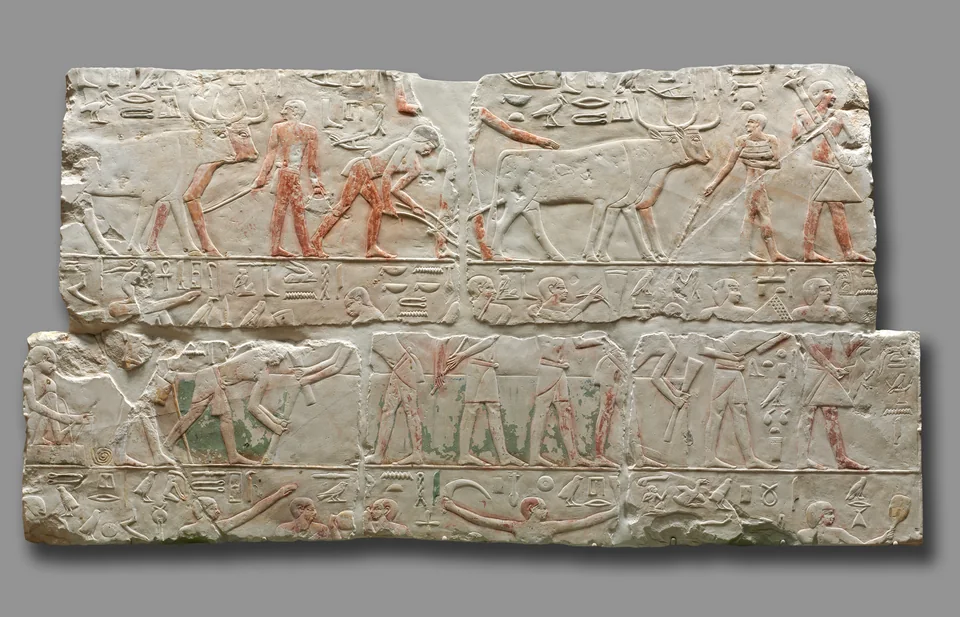
    The picture is divided into horizontal bands stacked in layers. On the Saqqara relief the upper band holds oxen and people, with a band of hieroglyphs and small faces below. Lower on Bakenmut's coffin, too, compartments within bands are crowded with scenes. Each band carries one story, and you read downwards one band at a time. This structure is how so many scenes stay orderly.

  • SpaceA flat world without depth or shadow

    Egyptian painting has almost no devices for creating depth. People overlapping front to back are shown with just a little shift of the body, and distant things do not shrink. With no shadow, everything is equally bright and flat. Instead, ground lines and bands tell you position. This flatness is not clumsiness but a choice to convey information as clearly as possible.

  • FiguresProfile face, frontal eye, gridded body

    The body is assembled on a grid of squares; the explanation of eighteen squares from soles to hairline is widely known. The face is in profile, the eye frontal, the shoulders frontal, the legs in profile. On the coffin's face, an almond-long eye is clearly ringed in black. Because the aim is an ideal rather than individual expression, the figure stays forever young and composed.

  • SymbolsPictures you read: feather and ibis

    Objects in the picture are symbols and also writing. Maat's ostrich feather stands for truth and the scale for balance. At the top of the Book of the Dead papyrus an ibis-shaped hieroglyph appears, and ibis-headed Thoth is the god of record keeping. Falcon-headed Horus and jackal-headed Anubis are likewise identified by the head. Reading heads and handheld objects is reading the story.

  • Ground and textureA matt surface on dry plaster

    The surface is matt, never glossy. It was painted after a limestone wall had been given whitewash, mud plaster or a fine gypsum layer and left to dry, so it is classed as fresco secco. On the Saqqara relief only patches of green pigment survive, and the papyrus keeps its torn, fibrous edge. Places where colour has worn away through the ages can be read as part of the picture's history.

Glossary

Fresco secco
Italian for dry fresco: painting with colour mixed with a binder on dry plaster. Egyptian tomb paintings belong here.
Grid canon
The grid of squares that fixes body proportion. The widely known account is eighteen squares from soles to hairline, with one square the width of a fist.
Register
A horizontal band dividing a picture. Each band sets a scene on a ground line, and you read down one band at a time.
Egyptian blue
An artificial blue pigment made by firing copper-bearing material with sand and lime. It is counted as the first synthetic pigment and is said to date from about the Fourth Dynasty.
Hieroglyph
From Greek for sacred carving. A picture-shaped script that, on tomb walls, writes names and speech beside figures and becomes one with the image.
Maat
The Egyptian concept and goddess of truth, balance and justice. She is drawn wearing an ostrich feather on her head, or as a single feather.
Weighing of the heart
The judgement scene in which a dead person's heart is weighed against Maat's feather. Often drawn in the Book of the Dead, it must balance for the dead person to pass.
Book of the Dead
A collection of spells to help the dead pass safely through the afterlife. Written and drawn on papyrus, it was in use from the early New Kingdom.

The originals up close

Real originals. Press a number to read about that spot; press the picture to see it large.

OriginalPainted limestone (Saqqara, Egypt) · The Cleveland Museum of Art · Public domain (CC0) · Museum record (Accession 1930.736)

Relief of Agricultural Scenes

Unknown artist · c. 2311-2281 BC (Old Kingdom, Dynasty 6)

This relief comes from an Old Kingdom tomb at Saqqara. It shows farm work so that the tomb owner would eat well in the next world. Incised lines on a flat stone fix the forms of people and oxen, and colour was laid over them. A pair of oxen and workers in the upper band, with signs and small faces in the band below, make the stacked structure of the bands clear. The figures at left are painted red-brown, showing the convention of colouring men red-brown. Small traces of green pigment survive at the edge. After more than four thousand years the colour is much worn, but that lets you see the order of making: the stone was carved first and the colour added afterwards. Remember also that this is a painted relief, not a painting.

OriginalPapyrus · The Cleveland Museum of Art · Public domain (CC0) · Museum record (Accession 1914.724)

Vignette of the Book of the Dead of Bakenmut

Unknown artist · 1000-900 BC (Third Intermediate Period, Dynasties 21-22)

This is an illustration from the Book of the Dead scroll of a man named Bakenmut. About twenty centimetres tall, it is a picture to be read close up, like a page of a book. It shows that the rules of Egyptian painting carried on just the same on papyrus as on a wall. A figure with raised arm stands in profile, and columns of hieroglyph compartments stand in rows beside it. Picture and writing are drawn in the same black line and become one. At the top an ibis-shaped sign can be seen. The edge is torn, with fibres showing that papyrus is made of woven thin plant stems. A single sheet of papyrus differs in scale from a mural, but this is a picture that keeps the same conventions.

OriginalGessoed and painted sycamore fig (Thebes, Egypt) · The Cleveland Museum of Art · Public domain (CC0) · Museum record (Accession 1914.561)

Coffin of Bakenmut

Unknown artist · c. 1000-900 BC (Third Intermediate Period, Dynasties 21-22)

This is the coffin of Bakenmut, made at Thebes. More than two metres long, it shows the human-shaped coffin on the outside, with the inside of an opened case to the right. Sycamore fig wood was gessoed and then drawn and painted. The face is painted in a near-golden yellow with eyes ringed large in black, so the person looks forever awake. A broad collar of layered beads spreads across the chest, and below it bands follow in layers. On the inner wall at right a green divine figure stands at the centre with scenes arranged around it. The same rules have moved from wall to coffin. It can be called a work in which Egyptian painting conventions are gathered on a single three-dimensional form.

Learning to look, on an AI interpretation

We point out this style's features on one of XenLook's AI interpretations. It is not a historical painting.

XenLook AI interpretationMade by XenLook with XenArt · not an original · Every interpretation in this room is a scene from Maat's life story “The Weight of a Feather”. Each room hangs one drawing style only.

Hall of Two Truths: the scale

Life story “The Weight of a Feather”

Materials and technique

Materials

Support: limestone wall and plaster
A stone wall was first whitewashed, or given a coarse mud plaster with a fine gypsum layer over it, to form a ground. For a relief like the Saqqara one, carved first and then painted, the stone itself is the ground. A flat, white surface keeps the colour vivid.
Red and yellow: ochres
Pigments from iron-bearing earths. Red ochre was often used for men's skin and for underdrawing, yellow ochre for women's skin and for gold tones. Easy to obtain and slow to change, ochre was the most dependable pigment.
Blue: Egyptian blue
A blue powder made by firing copper-bearing material with sand and lime at high heat. Regarded as the first synthetic pigment, it is said to have been used from about the Fourth Dynasty to the Roman period. It was laid on important places such as sky, water and the hair of gods.
White, black and green
White came from lime or gypsum and black from carbon materials such as charcoal. Green is known to have come from a mineral pigment or from layering blue over yellow. The Saqqara relief retains traces of green pigment. White takes clothing and light, black hair and outlines.
Binder and brushes
The binder that fixed colour to the wall is unclear: egg, plant gums and resins have been suggested. Brushes are said to have been made from reed or plant stems with the tip beaten out. How much remains uncertain is itself part of the picture.
Papyrus and gessoed coffins
Papyrus is a paper-like material made by slicing and weaving marsh-plant stems. Coffins were made of sycamore fig wood, gessoed, then drawn and painted. The Cleveland Museum's Bakenmut coffin and papyrus are both examples of the same conventions moved onto other materials.

How it was made

  1. First the wall or wood is chosen and a ground of whitewash or gypsum layer is made. Then it is left to dry.
  2. A grid of squares is ruled in red lines. Traces of this grid can still be seen in many tombs.
  3. Outlines of people and objects are drawn to the grid. A master painter corrects them in black line.
  4. When the work is carved, a sculptor cuts shallowly along the outlines. Only then does colour go on.
  5. Ochres, Egyptian blue, white and green are filled in flat, one colour to each area.
  6. Finally, black line sharpens the eyes, jewellery and the outlines of the hieroglyphs.

Old pigments are vulnerable to damp and salt. When murals deteriorate badly, as in Nefertari's tomb, conservation is needed and visitor access may be restricted. When working with pigments in this room's activities, wear a mask so you do not breathe the powder.

Colour

Named colours of the style (approximate)

  • Egyptian blue#2a5fa8
    An artificial blue pigment made by firing copper-bearing material. It was used for sky, water and the hair of gods.
  • Red ochre#a8452c
    Obtained from iron-bearing earth. Often used for men's skin and for underdrawing.
  • Yellow ochre#d6a237
    A pigment from yellow earth. Used for women's skin, gold tones and the ground colour of coffins.
  • Plaster white#efe6d2
    The white of lime or gypsum. It shows clothing, light and feathers, and brightens the ground.
  • Carbon black#1f1c1a
    A black made from carbon materials such as charcoal. Used for hair, eye outlines and the lines of writing.
  • Mineral green#3f7d4e
    A green obtained from mineral pigment. Often read as a colour of renewal and used on coffins and divine figures.

Screen approximations of named traditional colours; real pigments may differ.

Measured from the originals

Measured from the AI interpretations

Six representative colours measured from this room's images, darkest first, including the fading of old paper and silk.

AI interpretations

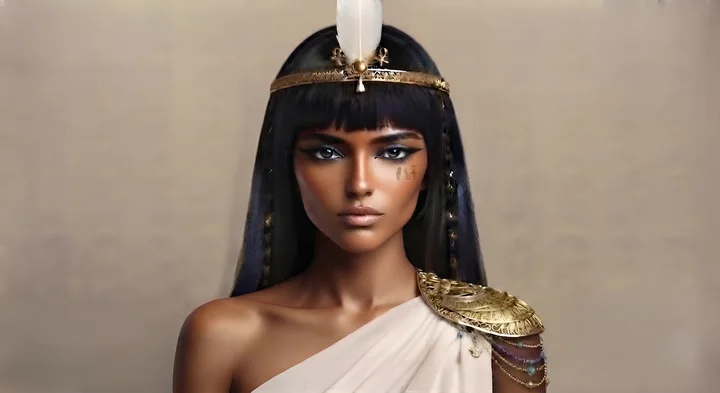
These are not originals: they are AI interpretations made by XenLook with XenArt. They carry scenes from an agent's life story into this style. Every interpretation in this room is a scene from Maat's life story “The Weight of a Feather”. Each room hangs one drawing style only.

All interpretations in this style (image library)

Neighbouring styles

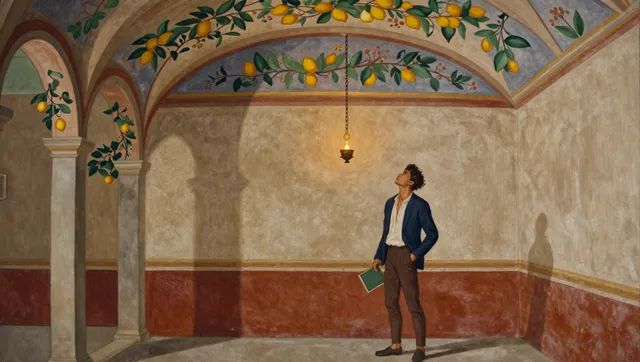
  • A man looking up at a lemon-vault muralXenLook AI interpretation

    Pompeian Wall Painting

    Alike
    Both decorate interior walls, of houses or tombs, and red and ochre play major roles. Plants, birds and mythical beings also appear often.
    Different
    Pompeii centres on the illusion of opening the wall and creating depth by painting columns and buildings. Egypt fills bands with information, without depth, and draws the body by rule.
    Go to this room
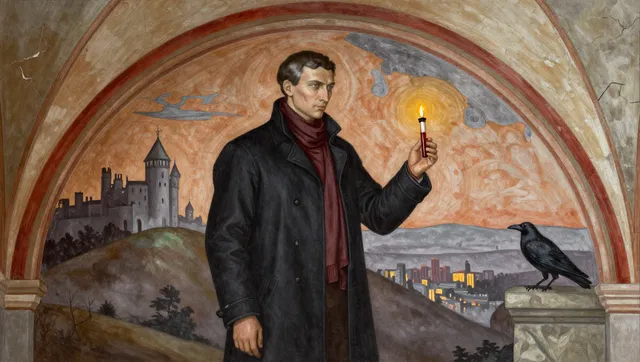
  • A man with a candle, a castle and a ravenXenLook AI interpretation

    Byzantine and Gothic Painting

    Alike
    Both depict the divine and sacred stories by fixed conventions. Figure size varies with importance and both use flat colour areas.
    Different
    Byzantine icons speak of divine light with gold grounds and frontal faces. Egypt combines profile face and frontal eye and carries the story in bands.
    Go to this room
  • Cover: A Map on the SandXenLook AI interpretation

    Mughal Miniature Painting

    Alike
    Both have clear outlines and flat fills of colour, and text and image sit together. High-ranking people are drawn larger and more imposingly.
    Different
    Mughal miniatures paint court figures realistically on paper with depth in each scene. Egypt paints by rule on tomb walls and coffins for eternity.
    Go to this room

Quiz

Pick one to see the answer and why.

  1. 1. Which parts of a person's body in Egyptian painting are drawn from the front?

  2. 2. Why is the tomb owner drawn much larger than the servants on the wall?

  3. 3. What do we call the structure in which the picture is divided into stacked horizontal bands, as on the Saqqara relief?

  4. 4. How does the painting on an Egyptian wall differ from Western wet-wall fresco?

  5. 5. In the weighing-of-the-heart scene, what is the dead person's heart measured against?

Paint it

A sentence written for this style is ready. Copy it or take it straight to the studio.

Hall of Two Truths: the scaleXenLook AI interpretation

A gouache picture in the manner of an Egyptian tomb wall, faces in profile with frontal eyes and shoulders, a picture divided into horizontal bands, Egyptian blue with red ochre, yellow ochre, white and black, bold clear outlines, an evenly lit, dry-plaster matt texture, a clean and unmarked surface

Try changing Swap the blue ground for a yellow one, and increase the bands from two to three.

Paint in the studio

The sentence is copied. Paste it into the studio's input box.

Sources

Every original here was released into the public domain (CC0) by The Cleveland Museum of Art. Artist, title, date and technique follow the museum records, which we checked again with their release terms on 2026-11-24. The commentary is written by XenLook.

Pictures marked “XenLook AI interpretation” were made by XenLook with XenArt. They are not historical paintings and no painter made them. Originals carry the “Original” mark and the name of the museum that holds them.

Als App installieren