Saltar al contenido
Museum lobby

Art movements wing · Europe

English Landscape

Landscapes of home where cloud and weather become the lead · England · Mid-18th to early 19th century

A current from the later eighteenth to the early nineteenth century in which English painters made the mountains, ponds, fields and sky of their own places the leading characters of landscape itself. Wilson and Gainsborough set the frame, Cozens and Girtin grew watercolour, and Constable caught cloud and weather outdoors. In this room you follow the road along which cloud and light flow, before nine real works by Wilson, Gainsborough, Constable, Cozens, Bonington and Turner, and by Lorrain, the French master English painters took as their model.

Cader Idris, with the Mawddach RiverOriginalPrologue: the three-place tableXenLook AI interpretation

Docent

Docent SophiaDocent · Sophia🇬🇧 Agent from Croydon, England
Life story “The Way Back”

Hello. I am Sophia, from Croydon in England. I work in finance and investment analysis, so I know well how much numbers and time can hurry a person.

That is why I like the way of looking at the sky. Clouds pass without hurry even for a person in a hurry. English landscape painting is the painting that read those clouds and that weather longest and most seriously.

First I will tell you how this painting began, and then, before nine real works, shall we follow together where cloud and light flow?

Roots and history

Until the seventeenth century, landscape in Western painting stayed in the background of portraits and of religious, mythological and history paintings, it is said. Landscape grew more popular in the eighteenth century, but the classical ideal landscape of the seventeenth-century painter Lorrain was still the standard. Richard Wilson is counted with George Lambert as a pioneer who opened landscape for its own sake. A Welshman, he stayed in Italy from 1750 to 1757 and is said to have become a landscape painter on the advice of Francesco Zuccarelli.

In December 1768 Wilson became a founder-member of the Royal Academy of Arts. Thomas Gainsborough was also a founding member, and from 1769 he sent works to its exhibitions. Born at Sudbury in Suffolk as the youngest son of a weaver and maker of woollen goods, Gainsborough painted many portraits but is said to have found greater satisfaction in landscapes. In the 1780s he used a device called a Showbox, setting up landscapes and lighting them from behind glass to refine his compositions.

In eighteenth-century England, ideas on how to look at landscape also spread. In the mid-eighteenth century Edmund Burke called the strong emotion that comes from overwhelming nature the sublime. William Gilpin introduced the ideal of the picturesque to England in 1782 with his account of a tour of the River Wye, and Uvedale Price published a work on the concept in 1794. Travellers in the Lake District carried tinted portable mirrors, used to frame the view and darken it, named after Lorrain.

Watercolour became another centre of English landscape in this current. John Robert Cozens made sketches on two long journeys to the Alps and Italy, and the wealthy collector William Beckford had him work those sketches up into watercolours. The young Thomas Girtin and Turner are said to have learned by copying Cozens's pictures, paid by Dr Monro. Girtin lived from 1775 to 1802, and played a key part in making watercolour a respected art.

There was also a new movement in Norwich. In 1803 John Crome and Robert Ladbrooke formed the Norwich Society of Artists, and this is called the first provincial art movement in Britain. Crome lived all his life in Norwich, learned by copying Gainsborough and the Dutch painter Hobbema, and died in 1821. John Sell Cotman, also born in Norwich, spent the three summers of 1803 to 1805 in Yorkshire and painted the River Greta.

John Constable was born in 1776 at East Bergholt in Suffolk, on the River Stour. In 1821 he wrote to a friend, I should paint my own places best, painting is but another word for feeling. He observed clouds at length and, influenced by the meteorologist Luke Howard's classification of clouds, is said to have known the vocabulary of weather. He became a member of the Royal Academy at fifty-two, and his work sold better in France than in England and is said to have inspired the Barbizon school.

Richard Parkes Bonington was born in 1802 at Arnold in Nottinghamshire, and in 1818 moved with his family to Paris. In 1820 he entered the École des Beaux-Arts in Paris and became friends with Eugène Delacroix. In 1826 he visited northern Italy and stayed about a month in Venice, and in 1828 he died in London at twenty-five. His life was short, but he became a bridge between English and French landscape, and kept a watercolour lightness even in oil.


Timeline

  1. 1750–1757Wilson stays in Italy and becomes a landscape painter on the advice of Zuccarelli.
  2. December 1768The Royal Academy is founded, with Wilson and Gainsborough among its founding members.
  3. 1782Gilpin's account of the River Wye appears and introduces the picturesque to England.
  4. 1794Uvedale Price publishes an essay setting the picturesque beside the sublime and the beautiful.
  5. 1801–1802Girtin spends five and a half months in Paris painting watercolours.
  6. 1803Crome and Ladbrooke form the Norwich Society of Artists and a provincial art movement begins.
  7. 1803–1805Cotman spends three summers in Yorkshire and paints the River Greta in watercolour.
  8. 1821Constable paints The Hay Wain and writes to a friend that painting is another word for feeling.
  9. 1826Bonington travels in northern Italy and stays about a month in Venice.
  10. 1828Bonington dies in London at the age of twenty-five.

Key painters and workshops

  • Richard Wilson1714–1782

    A Welshman who, returning from Italy, painted English scenery in classical composition. Counted a pioneer of landscape for its own sake, he was a founder-member of the Royal Academy.

  • Thomas Gainsborough1727–1788

    A portraitist born at Sudbury in Suffolk, said to have found greater satisfaction in landscape. He laid soft strokes and light on imagined woodland scenes.

  • John Constable1776–1837

    Born at East Bergholt on the River Stour, he painted the places he knew. He observed clouds and weather at length, and his work was prized in France and is said to have inspired the Barbizon school.

  • John Robert Cozens1752–1797

    He made poetic watercolours from sketches gained on journeys to the Alps and Italy. His pictures are said to have been copied and learned from by young painters such as Girtin and Turner.

  • Thomas Girtin1775–1802

    He died at twenty-seven but played a key part in making watercolour a respected art. From late 1801 he stayed in Paris painting watercolours, and he was the dominant member of the sketching society the Brothers.

  • Richard Parkes Bonington1802–1828

    A painter born in England and trained in Paris, a friend of Delacroix. In a short life of twenty-five years he painted coasts and cities lightly and brightly.

Reading the style

How to recognise it

The first characteristic of English landscape is the sky. In many pictures clouds take nearly half the surface, and the shape of clouds and the direction of light set the mood. For these painters landscape is not a stage on which events happen but a place through which weather and time pass. The same hill becomes an entirely different picture before rain and after it clears.

The second characteristic is attachment to a place. Wilson painted the mountains of Wales, Constable the Stour and Hampstead, Crome and Cotman Norwich and Yorkshire. Beginning from carrying the classical composition learned in Italy into English scenery, the painters gradually move toward looking directly at and painting the weather and light of land they know. So warm, quiet scenes stay for a long time, even from afar.

What to look for

  • LightLight descending through gaps in the cloud

    In Constable's Hampstead study a bright gap opens between dark clouds, and the light reaches the far hill in a shaft. Only where the light touches does the green come alive, and the rest sinks in shade. The moment of changing weather becomes the story of the picture.

  • SpaceA wide open sky and layered distance

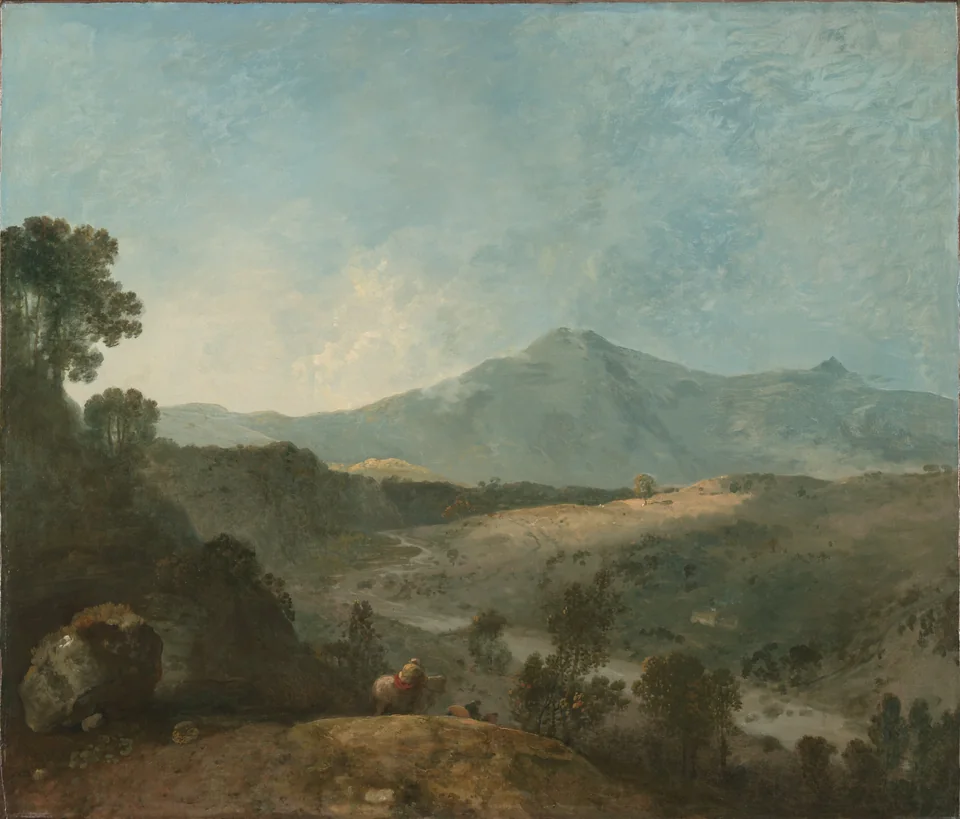
    In Wilson's Cader Idris, dark trees in front, a river in the middle and a mountain standing far away step back in turn to form deep space. In Cozens's watercolour blue mountains and a lake spread into mist. It is a way in which distance is read through the paleness of colour.

  • CompositionThe frame of ideal landscape and the eye of one's own place

    Gainsborough's woodland scene uses the old frame that ringed both sides with dark trees to lead the eye inward. Within that frame come English rock, pond and a flock of sheep. It is a way of showing one's own countryside by borrowing classical composition.

  • ColourA low register of grass green and earth

    Constable's Branch Hill Pond lets white clouds and the red of a roof rise small over a low register of deep green and brown. Instead of showy colour the colours of the ground lead the surface, and a single red point gathers the eye. Restrained colour makes the change of weather felt all the larger.

  • Ground and textureFast thick brush and transparent wash

    Turner's Burning of the Houses of Lords and Commons has a rough surface of thickly rubbed paint where the speed of the brush stays as it was. Cozens's watercolour makes mist with thin layers through which the white of the paper shows. The same landscape breathes quite differently in thick oil and transparent wash.

  • FiguresPeople set small in the landscape

    Wilson's rider in red, Constable's horse and cart and Bonington's small figure in a red cap are all set small within the landscape. The people become gauges for distance and size rather than leading a story. This smallness makes the breadth of nature felt all the larger.

Glossary

Landscape
A genre of picture that appreciates nature for its own sake. Until the seventeenth century it mostly stayed in the background of figure and history paintings.
Picturesque
An ideal of landscape that is beautiful yet mixed with roughness and has artistic appeal. Gilpin introduced it to England in 1782.
Sublime
The strongest emotion that comes from a greatness beyond measure, set out as a theory by Edmund Burke in the mid-eighteenth century.
Watercolour
Painting with transparent water-soluble paint, usually on paper. Its mark is that the white of the paper shows through so the colour glows softly.
Oil sketch from nature
A small oil painted quickly outdoors, with which Constable left clouds and landscape on paper. It holds a moment of weather.
Royal Academy
An artists' body and school founded in London in 1768. Wilson and Gainsborough were founding members.
Norwich School
The first provincial art movement in Britain, which began in 1803 with the Norwich Society of Artists. Crome and Cotman led it.
Tinted mirror for framing views
A small tinted mirror that frames a view and darkens it. Travellers seeking the picturesque carried it in the Lake District.

The originals up close

Real originals. Press a number to read about that spot; press the picture to see it large.

OriginalOil on canvas · The Cleveland Museum of Art · Public domain (CC0) · Museum record (Accession 1989.52)

Cader Idris, with the Mawddach River

Richard Wilson · c. 1774

A landscape of the mountain Cader Idris and the Mawddach River in north-west Wales. In the middle the mountain stands high, half hidden by cloud, and in front dark trees and rocks ring the left of the picture. The river flows curving softly across the bottom, and sunlight touches the hillside at the right and shines bright. On the road a rider in red is set small and tells the size of the landscape. On a surface more than a metre wide, the classical composition learned in Italy has been carried to a Welsh mountain.

About the artist · Richard Wilson

1714–1782 · British

Richard Wilson, a Welshman, was one of the painters who opened the way for landscape painting in Britain. He began as a portrait painter but turned to landscape during his years in Italy. Like the French painter Claude Lorrain, he set his scenes in calm, golden light, and he brought the same eye to the mountains and lakes of Britain and Wales. He was also a founder member of the Royal Academy in 1768.

OriginalOil on canvas · The Cleveland Museum of Art · Public domain (CC0) · Museum record (Accession 1984.59)

Rocky, Wooded Landscape with a Dell and Weir

Thomas Gainsborough · c. 1782–83

A picture of a landscape with a dell and a small weir in the middle of woods. At the left great trees rise in soft masses of foliage, and in the middle a white rock is bright in the sun. In front of it a few sheep graze, and at lower right water falls over a weir. Far off, misty mountains and a small building are faintly seen, and pale light settles on the road. On a surface about 70 centimetres high, an imagined landscape gathers into one breathing scene.

About the artist · Thomas Gainsborough

1727–1788 · British

Thomas Gainsborough was born in Suffolk and earned his living painting society portraits in Bath and London. What he loved most, however, was landscape, and he painted woods and lanes whenever he could. His light, feathery brushwork and soft colours give a sense of air among trees and sky. The wooded scene in this room shows that light touch. He was also a founder member of the Royal Academy in 1768.

OriginalOil on canvas · The Cleveland Museum of Art · Public domain (CC0) · Museum record (Accession 1972.48)

Branch Hill Pond, Hampstead

John Constable · 1828

A picture of a pond on Hampstead Heath, north of London. At upper left dark storm cloud hangs low, and beneath it a curtain of rain can be seen. At the right a white cumulus floats bright, and on the sandy bank a white house with a red roof is seen small. Near the pond is a horseman, at lower right a horse and cart, and at the left tall poplars stand. On a surface about 78 centimetres wide, a moment of weather has been caught.

About the artist · John Constable

1776–1837 · British

John Constable was born in the Stour valley in Suffolk and loved the landscape of his home all his life. He went outdoors to watch clouds and weather and made quick oil sketches, which let him capture the movement of the sky with great life. The Hay Wain is his best-known work. In the picture of Hampstead Heath, north of London, shown in this room, the cloudy sky and the light on the water are likewise alive.

OriginalOil on canvas · The Cleveland Museum of Art · Public domain (CC0) · Museum record (Accession 1942.647)

The Burning of the Houses of Lords and Commons, 16 October 1834

Joseph Mallord William Turner · 1835

On the night of 16 October 1834 the Palace of Westminster on the Thames in London burned. Turner watched the fire that night and made sketches, and the next year he painted the same event in two oils. This picture is one of them; the other is in the Philadelphia Museum of Art. In the middle orange and yellow flames whirl up into the sky, and their light is reflected long in the river below. The bridge across the river and the tower in the haze at the right melt into smoke and light and turn blurred. On the near left bank a watching crowd, and at lower right boats carrying people, are set small. On a surface about 1.2 metres wide, a real event has become a picture of light and atmosphere.

About the artist · Joseph Mallord William Turner

1775–1851 · British

J. M. W. Turner was born in London, the son of a barber, and entered the Royal Academy Schools at fourteen, a prodigy among painters. In oils, watercolours and prints he painted storms, fire, misty seas and skies filled with spreading light. He is known to have witnessed and painted the burning of the Houses of Parliament in 1834. In his later years form seems to dissolve into light and colour, which later influenced the Impressionists.

OriginalWatercolour over graphite · The Cleveland Museum of Art · Public domain (CC0) · Museum record (Accession 1997.137)

Italian Landscape

John Robert Cozens · c. 1790–92

A large watercolour of an Italian lake and mountains. At the top a pale sky opens wide, and far off blue mountains stand overlapping in mist. In the middle a calm lake mirrors light, and the far plain spreads off in pale colour. At lower right under a large tree is a small house, and below are seen small people driving sheep and oxen. On paper about 67 centimetres wide, thin layers of watercolour make misty air.

About the artist · John Robert Cozens

1752–1797 · British

John Robert Cozens was an English watercolourist who travelled in the Swiss Alps and Italy and recorded grand mountains and lakes. He is known for laying thin, clear washes of colour over one another to express the depth of mist and light, and he aimed to paint the mood of a place rather than just its objects. Younger artists such as Turner and Girtin learned from his pictures, and John Constable called him the greatest genius in landscape.

OriginalOil on millboard · The Cleveland Museum of Art · Public domain (CC0) · Museum record (Accession 1985.56)

The Doge's Palace, Venice

Richard Parkes Bonington · 1826

A small oil looking at the Doge's Palace from the lagoon at Venice. Light cloud flows in the sky, and at the right the pink and white palace stands bright. In the middle a boat with a white sail floats, and below it the dark hull is mirrored on the water. A small figure in a red cap is on the boat, and a calm lagoon fills the bottom. At the left domes are seen far off. On a panel about 43 centimetres wide, he gave oil a watercolour lightness.

About the artist · Richard Parkes Bonington

1802–1828 · British

Richard Parkes Bonington was born in England but went to France at a young age to study and work there. He was a friend of the French Romantic painter Delacroix. He painted the sea, the coast and the buildings of Venice with light, transparent touches, and although he died at twenty-five he left a deep mark on both British and French painters. The Venetian view in this room has the same clear light.

OriginalOil on canvas (without frame 208 × 152.5 cm) · The Cleveland Museum of Art · Public domain (CC0) · Museum record (Accession 1962.151)

Rest on the Flight into Egypt

Claude Lorrain · Early 1640s

This is exactly the kind of picture that English landscape painters took as their model. Lorrain, a Frenchman, was called the master of the 'ideal landscape'. The Cleveland Museum of Art notes that lush foliage, a tranquil atmosphere and a mood that calls to mind an idyllic imagined past are his hallmarks, and that his scenes are arranged more harmoniously than nature itself. Here the Holy Family rests on a shady bank while kneeling angels offer fruit to the Christ child. Wealthy European collectors, we are told, wanted such scenes as a calm retreat from busy lives. The great tree at left wraps the picture like a frame, and a lake, a bridge, a city and blue far mountains lead back into the distance. Without its frame it measures 208 × 152.5 cm. Meet here first the story that Constable and Turner carry on in this room.

About the artist · Claude Lorrain

1604–1682 · French

Claude Lorrain was born in the Lorraine region of France, went to Rome as a young man and worked there for the rest of his life as a landscape painter. His name Lorrain means a person from Lorraine. Using stories from ancient myth or the Bible as a setting, he painted ideal landscapes in which sea, trees and buildings sit together in the soft golden light of dawn or sunset. Later painters in Europe, and in Britain above all, took his pictures as their model.

OriginalEtching and mezzotint, first of four states (plate 20.8 × 29.1 cm; sheet 29.2 × 43.2 cm) · The Metropolitan Museum of Art · Public domain (CC0) · Museum record (Accession 28.97.61)

The Tenth Plague of Egypt, part XII, plate 61 from Liber Studiorum

Joseph Mallord William Turner · Published 1 January 1816

Turner's Liber Studiorum, the 'Book of Studies', is a set of landscape prints modelled on Lorrain's Liber Veritatis. This scene shows the tenth plague visited upon Egypt in the Bible, with frightened women beneath a stormy sky split by lightning. The inscription states that the design and etching were by Turner himself and the engraving by W. Say, and that Turner published it at Queen Ann Street on 1 January 1816. After the outline was etched, mezzotint was used to deepen the darkness, so that lightning and shadow stand in strong contrast. The Metropolitan Museum of Art records this impression as the first of four states. The plate measures 20.8 × 29.1 cm. Compare it with the Lorrain painting and you will feel how the same ideal landscape has turned into rough emotion.

About the artist · Joseph Mallord William Turner

1775–1851 · British

J. M. W. Turner was born in London, the son of a barber, and entered the Royal Academy Schools at fourteen, a prodigy among painters. In oils, watercolours and prints he painted storms, fire, misty seas and skies filled with spreading light. He is known to have witnessed and painted the burning of the Houses of Parliament in 1834. In his later years form seems to dissolve into light and colour, which later influenced the Impressionists.

OriginalEtching and mezzotint · The Cleveland Museum of Art · Public domain (CC0) · Museum record (Accession 1930.567)

Liber Veritatis: No. 160, Tobias and the Angel

Richard Earlom, after Lorrain · 1776

Lorrain made a drawing of each of his paintings, so that his work could not be confused with fakes, and gathered them into the Liber Veritatis, the 'Book of Truth'. The British printmaker Richard Earlom engraved these drawings in mezzotint and had them published in London. This set of prints was the way English audiences came to know Lorrain's landscapes, which is why it cannot be left out when we speak of the roots of English landscape painting. This scene shows the story from the Book of Tobit in which Tobias catches a fish with the help of an angel. The angel and the dog at lower left, the boat on the river, the cattle on the bridge, the round temple at left, the clouds and sunbeams, and the great tree at right all sit together in a single picture. The Cleveland Museum of Art records that the print carries accession number 1930.567 and is English work of the eighteenth century. Notice how the soft gradations of black and white spread like sunlight.

About the artist · Richard Earlom (after Claude Lorrain)

1743–1822 · British

Richard Earlom was an eighteenth-century English printmaker. This work is not his own design but a print reproducing a picture by the seventeenth-century French painter Claude Lorrain. Lorrain left a book of drawings recording his paintings, called the Liber Veritatis, or Book of Truth, and Earlom turned those designs into prints. He used mezzotint, a technique in which the plate is roughened and then smoothed to create soft tones, to bring out a gentle, misty light.

Where to see the originals

Nine original works hang in this room. Eight are from the collection of the Cleveland Museum of Art, and one, a print from Turner's Liber Studiorum, is from the Metropolitan Museum of Art. Turner's other picture of the same fire is in the Philadelphia Museum of Art. Constable's outdoor oil sketch on paper, Hampstead Heath, Looking Toward Harrow (c. 1821), can be seen in the Cleveland Museum of Art's collection, and more works by both painters are at Tate Britain and the National Gallery in London.

Materials and technique

Materials

Oil on canvas
The large landscapes of Wilson and Gainsborough were painted in oil on cloth canvas. Building bright parts over a dark ground makes deep space.
Oil sketch on paper
Constable quickly left clouds and landscape in oil on paper, which was later mounted on canvas for preservation. The moment of weather stays on the picture as it was.
Watercolour over graphite
Cozens set the outline in pencil and then layered thin washes. The white of the paper shows through and makes the misty light of mountains and lake.
Oil on millboard
Bonington painted small pictures in oil on thick, firm millboard. The smooth ground lets the brush slide lightly and leaves colour vivid.
Small outdoor sketchbook
Cozens left many sketches on his travels in line and grey wash. These sketches were later remade as watercolours in the studio.
Showbox and studio composition tests
Gainsborough made small landscapes in a device called a Showbox and lit them from behind glass. With it he first tested the placing of trees and rocks.

How it was made

  1. Outdoors, first settle the large proportion of sky and ground and note the direction of the clouds in short lines.
  2. On paper or a small panel, lay the colour of the sky thinly first in oil or watercolour to make the base of the weather.
  3. On the ground side build deep green and brown in a low register, and push far mountains back in pale blue.
  4. Lay bright colour only where light touches, reducing the places where the eye gathers to one or two.
  5. Put in small people or animals to make a gauge of distance, and add small spots of colour such as the red of a roof.
  6. In the studio, look at the outdoor study to recompose the large picture, and write the signature and year.

Colour

Named colours of the style (approximate)

  • Mountain grey-blue#6f7f94
    The pale blue-grey seen in Wilson's Cader Idris and Cozens's far mountains. It grows paler the farther off, and tells distance.
  • Grass green#5b7a3c
    The low-register green seen in Constable's Hampstead slope and Gainsborough's wood. It comes alive bright where light touches.
  • Earth brown#6b4f35
    The brown seen in tree trunks and the sandy bank. It carries the low register of the picture and contrasts with the bright colour of the sky.
  • Cloud white#ece6d8
    The warm white seen in Constable's cumulus and Bonington's sail. It is not pure white but has yellow and grey seeping in.
  • Roof red#b5432f
    The red seen in Constable's house roof and several small figures. It is the small point that gathers the eye in a low-register landscape.
  • Storm violet#4d4660
    The deep violet-grey seen in Constable's low storm cloud. It announces the weight of the rain to come.

Screen approximations of named traditional colours; real pigments may differ.

Measured from the originals

Measured from the AI interpretations

Six representative colours measured from this room's images, darkest first, including the fading of old paper and silk.

AI interpretations

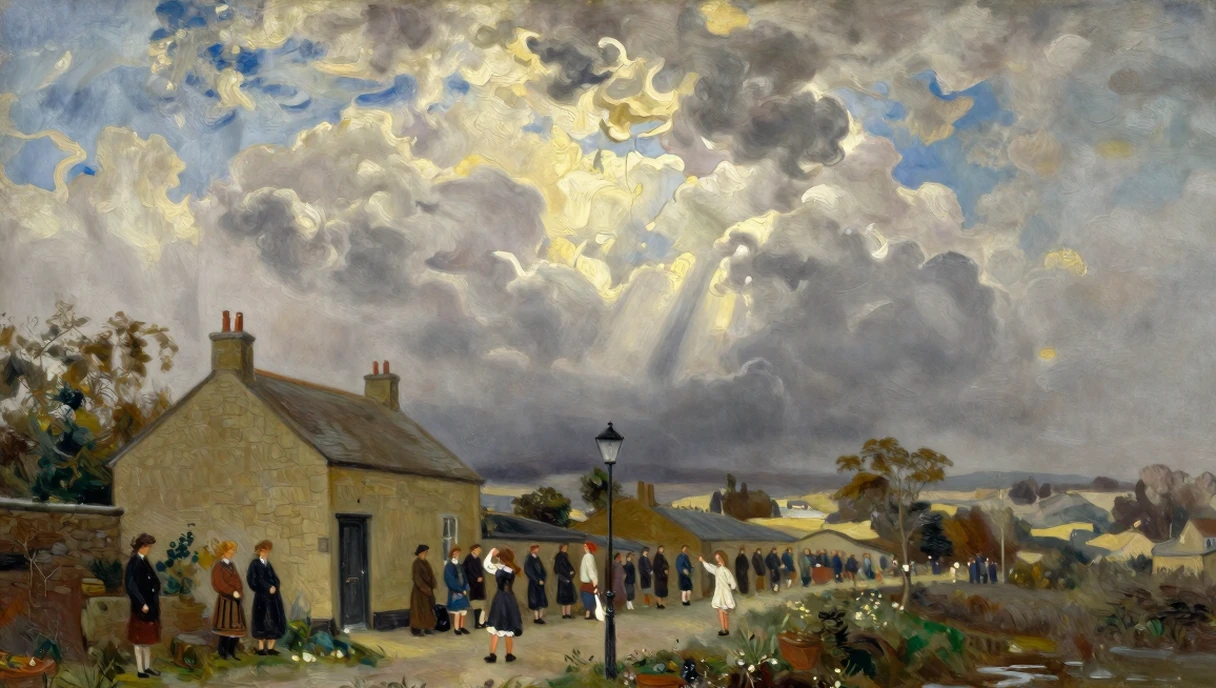
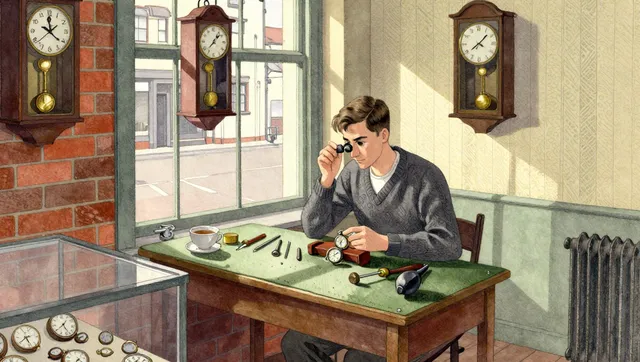
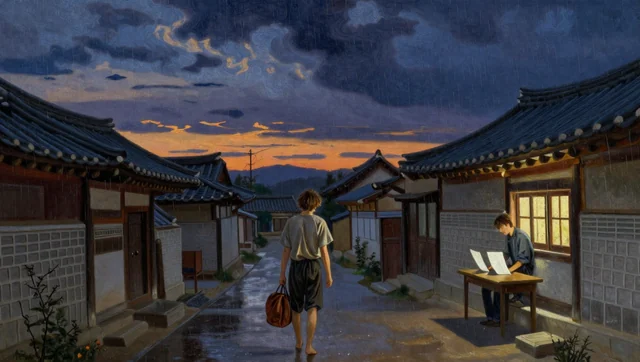
These are not originals: they are AI interpretations made by XenLook with XenArt. They carry scenes from an agent's life story into this style. Every interpretation in this room is a scene from Sophia's life story “The Way Back”. Each room hangs one drawing style only.

Neighbouring styles

  • George wearing his grandfather's watchXenLook AI interpretation

    English Watercolour

    Alike
    Both rooms value English sky and weather and the landscape of one's own place. Painters such as Cozens and Girtin link the two rooms.
    Different
    The room of English landscape treats both oil and watercolour and looks at large canvas and composition, while the English Watercolour room centres on transparent paint and the light of paper.
    Go to this room
  • Two cities that smell of rainXenLook AI interpretation

    Romanticism

    Alike
    Both rooms see nature as overwhelming and stirring feeling. Constable and Turner are counted as painters who led Romanticism in Britain.
    Different
    The room of English landscape reads specific places such as clouds, hills and ponds, while the Romanticism room treats a wider range including storms, history and fantasy.
    Go to this room
  • Ground-floor rules in the brownstoneXenLook AI interpretation

    Hudson River School

    Alike
    Both rooms make landscape itself the leading character and put their feeling into broad sky and light. English landscape painting carried across the Atlantic to American painters.
    Different
    English landscape often shows the friendly scenery of fields and ponds long tended by people, while the Hudson River School shows wide, still-wild nature on grand surfaces.
    Go to this room

Quiz

Pick one to see the answer and why.

  1. 1. What does Turner's The Burning of the Houses of Lords and Commons show?

  2. 2. Who is said to have advised Wilson to become a landscape painter?

  3. 3. In Cozens's Italian Landscape, how do far mountains look far away?

  4. 4. What was the society that Crome and Ladbrooke formed at Norwich in 1803?

  5. 5. Where did Bonington study art, and with whom did he become friends?

Paint it

A sentence written for this style is ready. Copy it or take it straight to the studio.

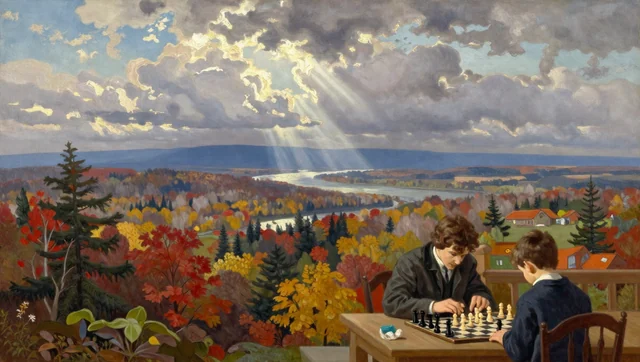
Prologue: the three-place tableXenLook AI interpretation

A hill and small pond in the English countryside under great drifting clouds, in an English Romantic landscape look, shafts of light descending between the clouds, a low register of grass green and earth colours, fast thick oil brushwork

Try changing Try a seaside cliff and white waves instead of the hill and pond, or a clearing evening after rain instead of clear midday.

Paint in the studio

The sentence is copied. Paste it into the studio's input box.

Sources

Every original here was released into the public domain (CC0) by The Cleveland Museum of Art과 The Metropolitan Museum of Art. Artist, title, date and technique follow the museum records, which we checked again with their release terms on 2026-11-24. The commentary is written by XenLook.

Pictures marked “XenLook AI interpretation” were made by XenLook with XenArt. They are not historical paintings and no painter made them. Originals carry the “Original” mark and the name of the museum that holds them.

Instalar como app