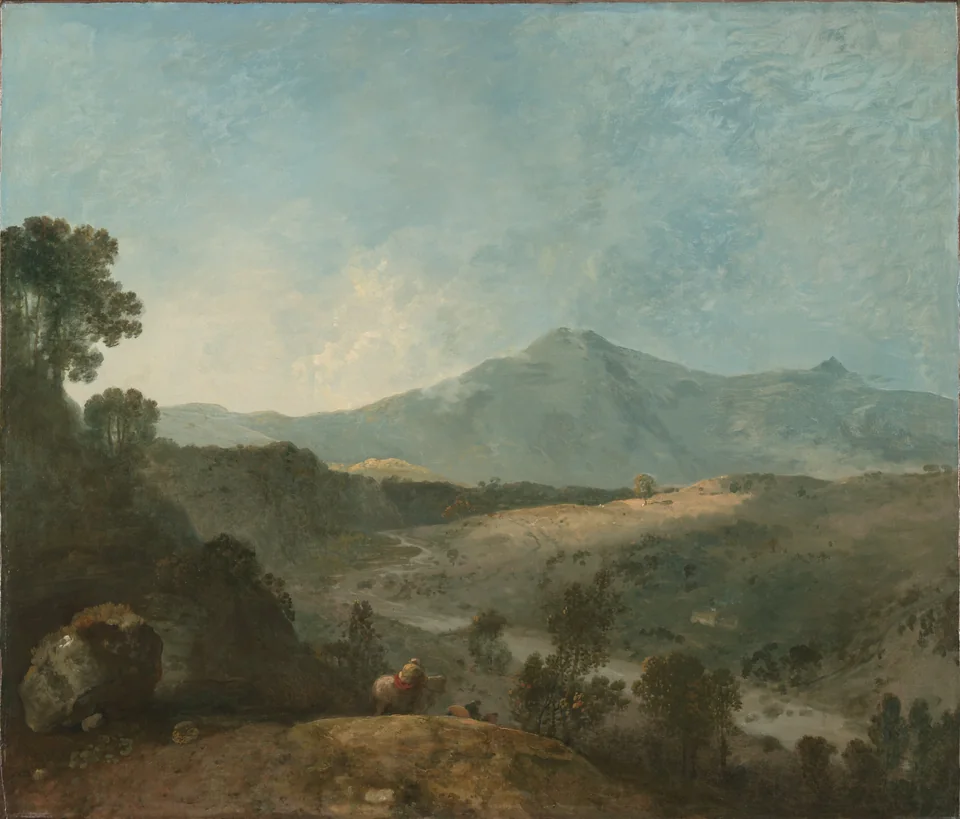
Until the seventeenth century, landscape in Western painting stayed in the background of portraits and of religious, mythological and history paintings, it is said. Landscape grew more popular in the eighteenth century, but the classical ideal landscape of the seventeenth-century painter Lorrain was still the standard. Richard Wilson is counted with George Lambert as a pioneer who opened landscape for its own sake. A Welshman, he stayed in Italy from 1750 to 1757 and is said to have become a landscape painter on the advice of Francesco Zuccarelli.
In December 1768 Wilson became a founder-member of the Royal Academy of Arts. Thomas Gainsborough was also a founding member, and from 1769 he sent works to its exhibitions. Born at Sudbury in Suffolk as the youngest son of a weaver and maker of woollen goods, Gainsborough painted many portraits but is said to have found greater satisfaction in landscapes. In the 1780s he used a device called a Showbox, setting up landscapes and lighting them from behind glass to refine his compositions.
In eighteenth-century England, ideas on how to look at landscape also spread. In the mid-eighteenth century Edmund Burke called the strong emotion that comes from overwhelming nature the sublime. William Gilpin introduced the ideal of the picturesque to England in 1782 with his account of a tour of the River Wye, and Uvedale Price published a work on the concept in 1794. Travellers in the Lake District carried tinted portable mirrors, used to frame the view and darken it, named after Lorrain.
Watercolour became another centre of English landscape in this current. John Robert Cozens made sketches on two long journeys to the Alps and Italy, and the wealthy collector William Beckford had him work those sketches up into watercolours. The young Thomas Girtin and Turner are said to have learned by copying Cozens's pictures, paid by Dr Monro. Girtin lived from 1775 to 1802, and played a key part in making watercolour a respected art.
There was also a new movement in Norwich. In 1803 John Crome and Robert Ladbrooke formed the Norwich Society of Artists, and this is called the first provincial art movement in Britain. Crome lived all his life in Norwich, learned by copying Gainsborough and the Dutch painter Hobbema, and died in 1821. John Sell Cotman, also born in Norwich, spent the three summers of 1803 to 1805 in Yorkshire and painted the River Greta.
John Constable was born in 1776 at East Bergholt in Suffolk, on the River Stour. In 1821 he wrote to a friend, I should paint my own places best, painting is but another word for feeling. He observed clouds at length and, influenced by the meteorologist Luke Howard's classification of clouds, is said to have known the vocabulary of weather. He became a member of the Royal Academy at fifty-two, and his work sold better in France than in England and is said to have inspired the Barbizon school.
Richard Parkes Bonington was born in 1802 at Arnold in Nottinghamshire, and in 1818 moved with his family to Paris. In 1820 he entered the École des Beaux-Arts in Paris and became friends with Eugène Delacroix. In 1826 he visited northern Italy and stayed about a month in Venice, and in 1828 he died in London at twenty-five. His life was short, but he became a bridge between English and French landscape, and kept a watercolour lightness even in oil.