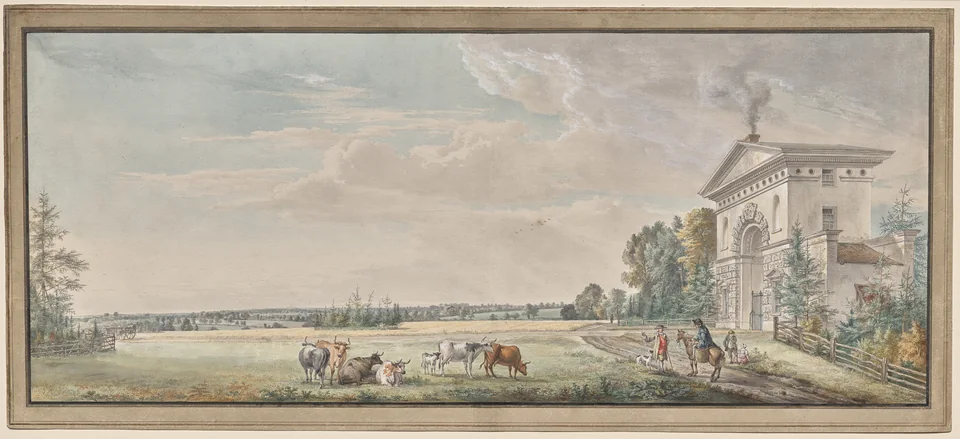
In eighteenth-century Britain watercolour was first a practical tool. The army needed exact records of forts, coasts and mountain roads, and landowners wanted the buildings and fields of their estates set down in pictures. Drawing an outline in pen and laying thin washes of dilute paint over it was quick, light and accurate. Paul Sandby began his career around 1745 in the military drawing office at the Tower of London, drawing maps. In 1768 he became a founding member of the Royal Academy, and in the same year chief drawing master at the Royal Military Academy at Woolwich, where he taught cadets to draw landscape until 1799.
In Sandby's hands the record gradually became a picture. While drawing estate buildings exactly, he left the sky clear and placed cattle and people in the fields to hold the air of the day. In 1775 he published views from his travels in Wales as prints in a method called aquatint, carrying the spreading quality of watercolour into print. In the same years Alexander Cozens taught a method of dropping random blots on paper and then imagining a landscape out of them. Two branches, exact record and free spreading, grew up together at this time.
The paint changed too. Until then painters had to buy pigment from an apothecary or a colourman and mix it with gum arabic themselves. In 1781 the brothers William and Thomas Reeves made a moist cake of watercolour that dissolved as soon as a wet brush touched it, and won the Silver Palette of the Society of Arts. It became easy to carry a paint box out into the fields. The paper changed as well. Wove paper, thought to have been first made by the Kent papermaker James Whatman, had no marks from the wire mould, so its surface was even and smooth and took broad washes without blotches.
In the 1790s two young men changed the scale and weight of watercolour. They were Thomas Girtin, born in Southwark, London, into a family of brushmakers, and J. M. W. Turner, born in the same year. Girtin cut back the pen outline and covered sky and earth at once with broad strokes of the brush, laying warm browns over cool blue-greys to paint heavy clouds and wide fields. In 1802 he showed the Eidometropolis, a huge panorama that wrapped around London, but he died that year at the age of twenty-seven. Turner is reported to have said later, 'Had Tom Girtin lived I should have starved.'
Watercolour painters felt that the Royal Academy ranked their pictures below oil paintings. So in 1804, around William Frederick Wells, they founded the Society of Painters in Water Colours and held exhibitions of watercolour alone. The society received a royal charter in 1881 and continues today as the Royal Watercolour Society. John Sell Cotman of Norwich spent three summers in Yorkshire from 1803 to 1805 and painted watercolours of the River Greta built from flat areas of colour fitted together, and David Cox, from Deritend in Birmingham, painted windy weather with quick, rough strokes of the brush.
By the mid-nineteenth century watercolour had become a way of painting light itself. Turner made his last visits to Switzerland in 1841 and 1844, in his sixties, and in the watercolours of those years he melted lake, mountain and town into violet mist and swirling light. The critic John Ruskin, in Modern Painters (1843–1860), held Turner up as the painter who had looked at nature most honestly. Samuel Palmer, meanwhile, met William Blake in 1824 and then painted the countryside at Shoreham in Kent with friends known as the Ancients, and after moving to Redhill in Surrey in 1862 he painted sunset hills in gold and purple.