Saltar al contenido
Museum lobby

History wing · Europe

English Watercolour

England · 1760s–1860s · The golden age of English watercolour, c. 1760–1860

English watercolour is the tradition of landscape painting that flowered in England from the late eighteenth to the mid-nineteenth century. Watercolour, once used to record maps and terrain precisely, became clear landscape painting in the hands of Paul Sandby, and Thomas Girtin and J. M. W. Turner let the paint spread in broad washes to paint the sky and light themselves. Samuel Palmer painted an evening glow like a prayer. This room looks at the habits of a transparent paint that uses the white of the paper as its light.

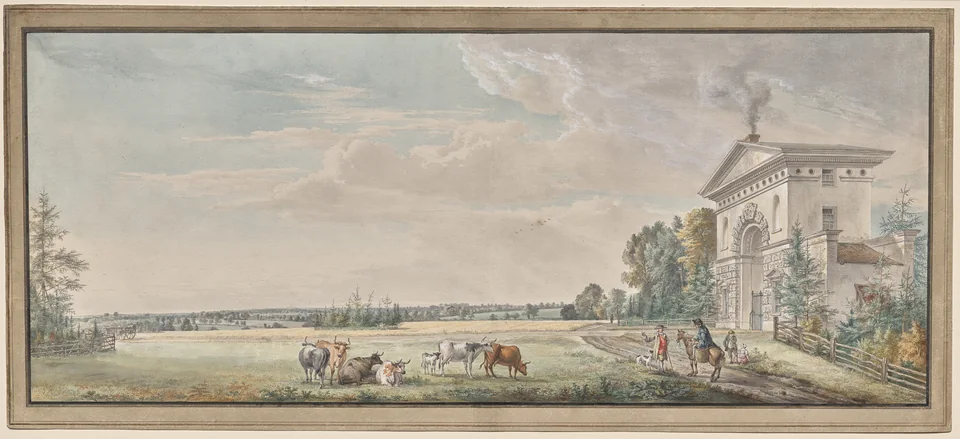
Luton Park, BedfordshireOriginalGeorge wearing his grandfather's watchXenLook AI interpretation

Docent

Docent George HarrisDocent · George Harris🇬🇧 Agent from United Kingdom
Life story “The Error of a Single Cog”

Welcome, I am George Harris. I come from Prescot, a watchmaking town ten kilometres east of Liverpool.

The watch on my wrist was my grandfather Walter's. It gains four seconds a day, but I wear it unfixed. Leaving a record as it is, is the honest thing.

Watercolour is the same. Paint once laid is hard to take away, and the order of painting stays on the paper. Let us read that order together.

Roots and history

In eighteenth-century Britain watercolour was first a practical tool. The army needed exact records of forts, coasts and mountain roads, and landowners wanted the buildings and fields of their estates set down in pictures. Drawing an outline in pen and laying thin washes of dilute paint over it was quick, light and accurate. Paul Sandby began his career around 1745 in the military drawing office at the Tower of London, drawing maps. In 1768 he became a founding member of the Royal Academy, and in the same year chief drawing master at the Royal Military Academy at Woolwich, where he taught cadets to draw landscape until 1799.

In Sandby's hands the record gradually became a picture. While drawing estate buildings exactly, he left the sky clear and placed cattle and people in the fields to hold the air of the day. In 1775 he published views from his travels in Wales as prints in a method called aquatint, carrying the spreading quality of watercolour into print. In the same years Alexander Cozens taught a method of dropping random blots on paper and then imagining a landscape out of them. Two branches, exact record and free spreading, grew up together at this time.

The paint changed too. Until then painters had to buy pigment from an apothecary or a colourman and mix it with gum arabic themselves. In 1781 the brothers William and Thomas Reeves made a moist cake of watercolour that dissolved as soon as a wet brush touched it, and won the Silver Palette of the Society of Arts. It became easy to carry a paint box out into the fields. The paper changed as well. Wove paper, thought to have been first made by the Kent papermaker James Whatman, had no marks from the wire mould, so its surface was even and smooth and took broad washes without blotches.

In the 1790s two young men changed the scale and weight of watercolour. They were Thomas Girtin, born in Southwark, London, into a family of brushmakers, and J. M. W. Turner, born in the same year. Girtin cut back the pen outline and covered sky and earth at once with broad strokes of the brush, laying warm browns over cool blue-greys to paint heavy clouds and wide fields. In 1802 he showed the Eidometropolis, a huge panorama that wrapped around London, but he died that year at the age of twenty-seven. Turner is reported to have said later, 'Had Tom Girtin lived I should have starved.'

Watercolour painters felt that the Royal Academy ranked their pictures below oil paintings. So in 1804, around William Frederick Wells, they founded the Society of Painters in Water Colours and held exhibitions of watercolour alone. The society received a royal charter in 1881 and continues today as the Royal Watercolour Society. John Sell Cotman of Norwich spent three summers in Yorkshire from 1803 to 1805 and painted watercolours of the River Greta built from flat areas of colour fitted together, and David Cox, from Deritend in Birmingham, painted windy weather with quick, rough strokes of the brush.

By the mid-nineteenth century watercolour had become a way of painting light itself. Turner made his last visits to Switzerland in 1841 and 1844, in his sixties, and in the watercolours of those years he melted lake, mountain and town into violet mist and swirling light. The critic John Ruskin, in Modern Painters (1843–1860), held Turner up as the painter who had looked at nature most honestly. Samuel Palmer, meanwhile, met William Blake in 1824 and then painted the countryside at Shoreham in Kent with friends known as the Ancients, and after moving to Redhill in Surrey in 1862 he painted sunset hills in gold and purple.


Timeline

  1. 1745Paul Sandby comes to London and starts work in the military drawing office at the Tower of London.
  2. 1768The Royal Academy is founded; Sandby is a founding member and becomes chief drawing master at Woolwich.
  3. 1775Sandby publishes the aquatints XII Views in South Wales.
  4. 1781The Reeves brothers win the Society of Arts' Silver Palette for the moist watercolour cake.
  5. 1802Girtin shows his London panorama, the Eidometropolis, and dies the same year.
  6. 1803–1805Cotman spends three summers in Yorkshire and paints his Greta watercolours.
  7. 1804The Society of Painters in Water Colours is founded around William Frederick Wells.
  8. 1824Samuel Palmer meets William Blake through John Linnell.
  9. 1843John Ruskin publishes the first volume of Modern Painters in defence of Turner.
  10. 1881The Society of Painters in Water Colours receives a royal charter.

Key painters and workshops

  • Paul Sandby1731–1809

    Born in Nottingham, he began as a military map draughtsman. He raised watercolour into landscape painting by adding clear skies and everyday people to exact records, and taught drawing at Woolwich for many years.

  • Thomas Girtin1775–1802

    Born into a family of brushmakers in Southwark, London. He cut back the pen outline and covered sky and fields with broad strokes, giving watercolour a weight like oil painting, but he died at twenty-seven.

  • J. M. W. Turner1775–1851

    He left countless travel sketches over his life. In his late years he painted the lakes and mountains of Switzerland in violet mist and swirling light, making light and air the subject rather than the view.

  • John Sell Cotman1782–1842

    A leading painter of the Norwich School. In his watercolours of the River Greta in Yorkshire he fitted trees, water and rocks together as flat areas of colour, making quiet, firm pictures.

  • Samuel Palmer1805–1881

    After meeting William Blake he painted mystical country views at Shoreham in Kent. In his late years he painted sunsets over the hills of Surrey closely in gold, pink and purple.

Reading the style

How to recognise it

The first habit of English watercolour is transparency. When paint is thinned in water and laid on thinly, the paper beneath shows through. So the brightest places in these pictures are usually not painted with white, but paper left untouched from the start. The painter has to decide in advance where the light will fall and paint around it. Because paint once laid is hard to take away, the work is built up in order, from light colours to dark, and from broad areas to small strokes of the brush.

The second habit is the sky. British painters watched the ever-changing weather of an island nation for a long time. So in many pictures the sky takes up more than half the sheet, and the grain of the clouds and the direction of the light set the mood of the picture. Dropping paint onto wet paper and letting it spread makes soft clouds, while painting on dry paper leaves sharp edges. The skill of mixing these two kinds of edge was the painter's own voice.

The third habit is a balance between exactness and freedom. Sandby's pictures have the straight buildings and roads of a map draughtsman, and Turner's late pictures have places where forms melt into light. Somewhere between the two, each painter found a distance of their own. Some left a faint pencil underdrawing showing, or scraped with the point of a knife after the paint had dried to bring back a white sparkle. When you look at the pictures in this room, sort what is exact from what was left to flow.

What to look for

  • LightThe white of the paper is the light

    The brightest skies and the sparkle on water are usually paper left unpainted. The painter leaves room for the light first and paints around it. In Turner's Flüelen, dry paint was even scraped away to bring back white light. So when looking at a picture, it helps to find what was left before what was painted.

  • ColourThin, transparent layers of colour

    Paint is thinned and laid on thinly, and once it dries another colour goes over it. Blue laid over yellow becomes green without any mixing. The knack was to be sparing with the layers so that the colour would not turn muddy. Even under two or three layers, the white of the paper glows softly through, and the whole picture shines clear.

  • SpaceA wide sky and a low horizon

    The horizon is often set low on the sheet, giving more than half of it to the sky. Layers of cloud and the direction of the light create distance, and colours grow paler and bluer as they recede. The air, in a sense, draws the space. Depth comes from changes of colour and light rather than from ruled lines of perspective.

  • Ground and textureSoft edges and sharp edges

    Drop paint onto wet paper and the edge spreads like a cloud; paint on dry paper and it is crisp as if cut with a knife. Painters gave spreading edges to the sky and crisp ones to buildings and sails, putting both breath and bone into the picture. A feel for the amount of water and how dry the paper was made up the painter's skill.

  • LinePencil and pen underdrawing

    Early watercolours fixed the outline first in pencil or pen and laid colour over it. In Sandby's picture grey pen lines hold the buildings and trees in place. With each generation the line shrank, and the brushstroke took over the work of shaping forms. In Turner's late pictures the underdrawing is barely visible, and areas of colour become the forms themselves.

  • CompositionA long, wide horizontal sheet

    Long horizontal sheets were favoured for holding a landscape. Sandby's Luton Park is about a metre wide. The eye passes from left to right over fields, road and buildings in turn, reading the picture as if on a walk. The wide sheet also allowed a generous share between sky and land.

  • FiguresSmall people in the landscape

    Small figures such as riders, herds of cattle and fishermen rowing boats are placed here and there in the landscape. They are not the main subject but a measure of scale, and proof that a day is passing on that land. They are small shapes, as if touched in with the tip of a brush, yet they breathe life and story into the landscape.

Glossary

Watercolour
Painting with paint made of pigment bound with gum arabic and thinned with water. Laid on thinly, it lets the paper show through.
Wash
A broad, even coat of thin paint spread with a brush. It is used to cover large areas such as sky and fields in one go.
Wet-in-wet
Dropping paint onto paper soaked with water, or onto a wash that has not yet dried, so that it spreads. It suits clouds and mist.
Bodycolour
Paint made opaque by mixing in white pigment. Also called gouache, it was used to add bright touches and highlights on top.
Scratching out
Scraping dried paint with the point of a knife or a fingernail to bring back the white of the paper. It was used for the sparkle on waves.
Wove paper
Paper formed on a fine woven wire screen, so it carries no wire marks. Its even, smooth surface takes broad washes without blotches.
Laid paper
Paper formed on a mould of parallel wires, which leaves fine lines in it. Sandby's Luton Park was painted on this paper.
Aquatint
A print made by etching a copper plate through a fine even grain of resin dust with acid. It can print areas that look like watercolour washes.

The originals up close

Real originals. Press a number to read about that spot; press the picture to see it large.

OriginalWatercolour over pencil, heightened with bodycolour and pen and grey ink on laid paper · The Cleveland Museum of Art · Public domain (CC0) · Museum record (Accession 2022.94)

Luton Park, Bedfordshire

Paul Sandby (British, 1731–1809) · 1760s

In the mid-1760s John, 3rd Earl of Bute, bought Luton Park north of London and commissioned Sandby to make twelve watercolours recording the buildings and grounds of the estate. This is one of them: on the right a Palladian-style gatehouse appears among the trees, and in the distance wheat fields and trees spread out. On a long sheet about a metre wide, a clear sky is left broad and open, and cattle and riders are placed in the fields. The twelve stayed together in an album at Luton Park and only came to light in 1996.

About the artist · Paul Sandby

1731–1809 · British

Paul Sandby is often called the father of English watercolour. He began with military surveying work and went on to draw landscapes, castles, parks and working people across Britain, accurately and warmly. He was a founder member of the Royal Academy in 1768 and also taught drawing at a military academy. Over pencil underdrawing he combined transparent watercolour with opaque colour to make clear, tidy pictures.

OriginalWatercolour · The Cleveland Museum of Art · Public domain (CC0) · Museum record (Accession 1940.557)

Tynemouth, Northumberland

Thomas Girtin (British, 1775–1802) · 1790–1802

A watercolour of Tynemouth, a seaside town in the north-east of England. The museum record has no separate description, so here we speak only of what can be seen in the picture. Ruined priory buildings and a lighthouse stand on the headland, and above them warm brown and cream clouds spread wide. A sailing boat is on the sea at left, and at lower right a curving sand bank and small figures can be seen. Girtin cut back the pen outline and covered sky and earth with broad strokes, and in this picture too the clouds and headland are bound together in large areas of colour.

About the artist · Thomas Girtin

1775–1802 · British

Thomas Girtin was a watercolourist born in London who died at twenty-seven, yet greatly widened what landscape watercolour could do. With Turner, his exact contemporary, he studied by copying earlier works in Dr Monro's house. He is known for broad, restrained washes of colour that give a sweeping sense of sky and land. The picture of a north-eastern coastal town here also gives that feeling of open air.

OriginalWatercolour with gouache and scratch-away · The Cleveland Museum of Art · Public domain (CC0) · Museum record (Accession 1954.129)

Flüelen, from the Lake of Lucerne

Joseph Mallord William Turner (British, 1775–1851) · 1845

A watercolour from late in Turner's life, in which the small Swiss town of Flüelen and its shimmering reflection rise out of violet mist. It belongs to a group of highly finished watercolours that came out of several summer trips to Switzerland between 1841 and 1845. The swirling vortex of light shows the grandeur of the Alps, while the small people going about their day within that vast scene remind us that it is real. By the time he painted it, Turner was regarded as the great master of Romantic landscape painting in England.

About the artist · Joseph Mallord William Turner

1775–1851 · British

J. M. W. Turner was born in London, the son of a barber, and entered the Royal Academy Schools at fourteen, a prodigy among painters. In oils, watercolours and prints he painted storms, fire, misty seas and skies filled with spreading light. He is known to have witnessed and painted the burning of the Houses of Parliament in 1834. In his later years form seems to dissolve into light and colour, which later influenced the Impressionists.

OriginalWatercolour and gouache with graphite and scraping · The Cleveland Museum of Art · Public domain (CC0) · Museum record (Accession 2009.3)

The Golden Hour

Samuel Palmer (British, 1805–1881) · 1865

Palmer celebrated nature as the work of divine creation and painted landscapes that were personal and full of feeling. This watercolour, painted toward the end of his life, shows a spectacular sunset over the hills of Surrey. An autumn sky heavy with rows of cumulus clouds shimmers in a pattern of pink and amethyst, as slivers of golden light spread from the setting sun. At lower left it is signed 'S. Palmer' in brown watercolour. This peaceful landscape is an elegy not only to a passing day, but to the brevity of life itself.

About the artist · Samuel Palmer

1805–1881 · British

Samuel Palmer was an English painter who, as a young man in the village of Shoreham in Kent, drew the countryside with a poet's eye. He admired William Blake and was influenced by him. He painted fields, trees and flocks under moonlight and golden sunset in a mysterious way that makes nature seem a place where the divine dwells. In The Golden Hour in this room he built a glowing landscape from watercolour, opaque paint and scraping.

Where to see the originals

All originals in this room are works the Cleveland Museum of Art has released into the public domain (CC0). Meet Cotman and Cox in the roots and the artist notes.

Learning to look, on an AI interpretation

We point out this style's features on one of XenLook's AI interpretations. It is not a historical painting.

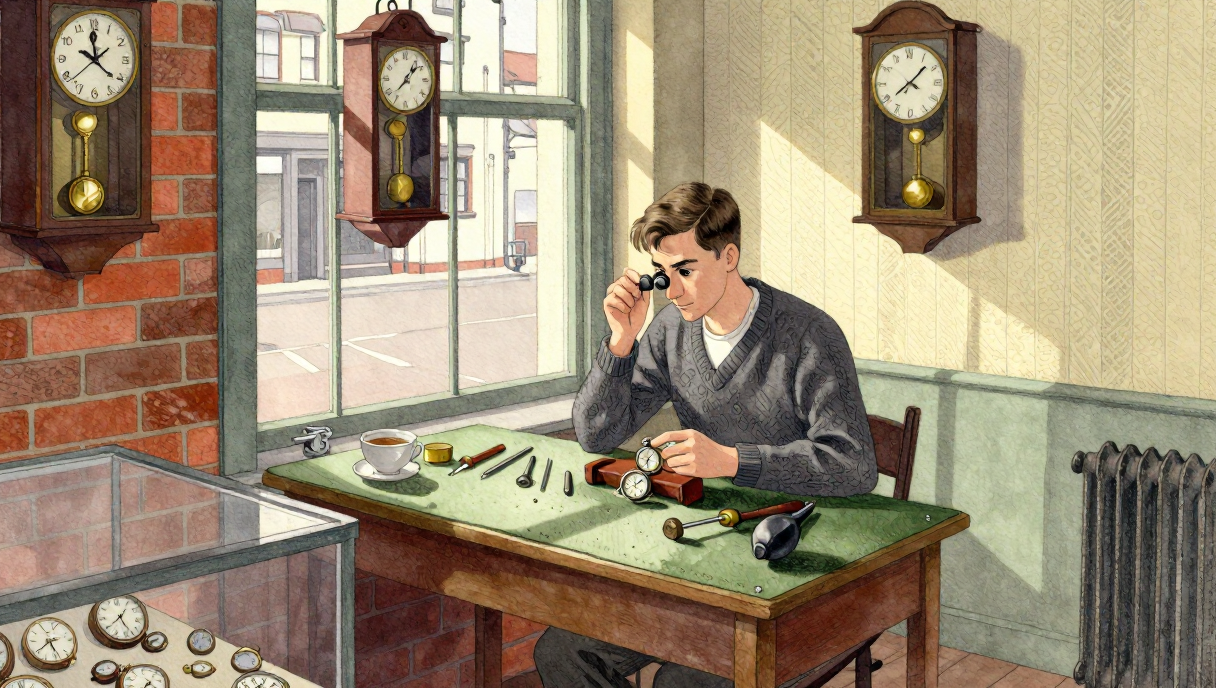
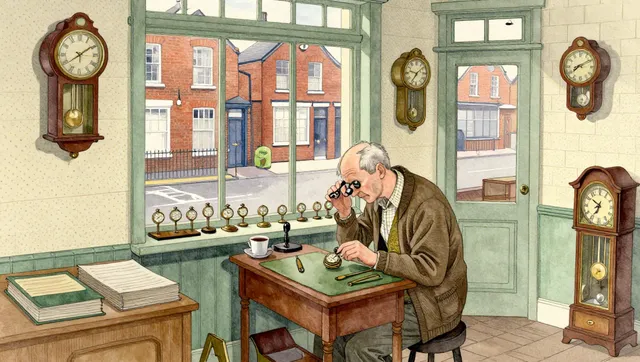
XenLook AI interpretationMade by XenLook with XenArt · not an original · Every interpretation in this room is a scene from George Harris's life story “The Error of a Single Cog”. Each room hangs one drawing style only.

Autumn afternoon in Walter Harris's repair shop

Life story “The Error of a Single Cog”

Materials and technique

Materials

Watercolour cakes
Paint made by binding pigment with gum arabic and setting it into small cakes. When the Reeves brothers made a moist cake in 1781 that dissolved at once on a wet brush, painting outdoors became much easier.
Gum arabic
A resin from the acacia tree that acts as the glue holding the powdered pigment to the paper. Because it dissolves easily in water, dried paint loosens again when it is wetted.
Paper
Early on, laid paper with its fine lines was common, and later the even-surfaced wove paper. The thicker the paper and the better its absorbency, the more evenly it took broad washes without cockling.
Brushes
Brushes of animal hair that hold plenty of water were used. Thick brushes were chosen for broad washes and pointed ones for fine lines such as masts and branches. A hand that could vary the width with a single brush mattered too.
Pencil and pen
Before colour went on, the outline was set lightly in pencil. Sandby went over the shapes of buildings and trees with a pen and grey ink to sharpen them, and in later generations this underdrawing grew fainter.
Paint box and water pot
With a metal box of paint cakes and a small water pot, one could paint even in the fields. Thanks to these portable tools, painters faced the weather and light directly and made sketches on the spot.

How it was made

  1. Wet the paper, fix it to a board and let it dry. It tightens as it dries and cockles less when painted.
  2. Set the horizon and large shapes lightly in pencil, and decide where the brightest places will be left.
  3. Begin with the sky in broad, thin washes. While it is wet, drop in the colour of the clouds and let it spread.
  4. Once dry, layer the ground, trees and buildings in turn, starting with light colours. Keep far places pale and blue.
  5. On dry paper, paint small shapes such as masts, people and branches crisply with a fine brush.
  6. Last, scrape the waves lightly with a knife point or dab on bodycolour to add sparkle.

Watercolour, once laid, is hard to remove. So the order is decided in advance and kept: from light to dark, and from broad to narrow.

Colour

Named colours of the style (approximate)

  • Clear-sky grey-blue#b9bcb2
    The pale grey-blue of the sky in Luton Park. The paper shows through, giving a calm, clear light.
  • Cloud brown#c2a07a
    The warm brown over the clouds of Tynemouth. Girtin used this colour to give the sky weight.
  • Lake light#ecd8b1
    The cream left in the swirling light of Flüelen. It is close to the colour of nearly unpainted paper.
  • Sunset pink#d49e96
    The pink that tints the clouds of The Golden Hour. Set beside purple, it makes the evening sky shimmer.
  • Evening gold#ce954a
    The gold Palmer painted around the setting sun. Beside the brightest white it looks even warmer.
  • Brick red#925b33
    The colour of the brick houses outside the shop window in our interpretation. Laid on in thin layers, it makes a warm street.

Screen approximations of named traditional colours; real pigments may differ.

Measured from the originals

Measured from the AI interpretations

Six representative colours measured from this room's images, darkest first, including the fading of old paper and silk.

AI interpretations

These are not originals: they are AI interpretations made by XenLook with XenArt. They carry scenes from an agent's life story into this style. Every interpretation in this room is a scene from George Harris's life story “The Error of a Single Cog”. Each room hangs one drawing style only.

All interpretations in this style (image library)

Neighbouring styles

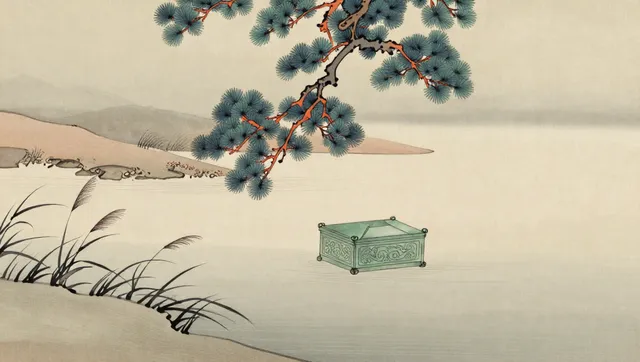
  • Jade box on a misty lakeXenLook AI interpretation

    Korean Sumuk — Ink-Wash Landscape and the Four Gentlemen

    Alike
    Both rooms show pictures made with water and paper. Both control how far the water spreads and use the white of unpainted paper as part of the picture.
    Different
    Sumuk paints the spirit of mountains and bamboo with the shades of a single ink and the vigorous line of the brush. English watercolour layers many colours thinly and cuts back the line, putting its effort into recording a scene at one moment of particular weather and light.
    Go to this room
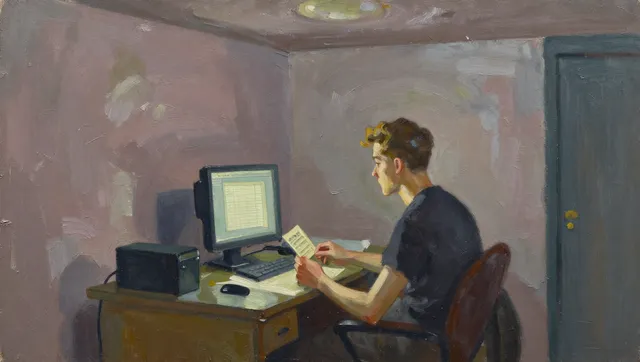
  • A B6 desk and a table with blanksXenLook AI interpretation

    The Camden Town Group: Rooms as They Are

    Alike
    Both rooms show British painters trying to record real places around them honestly. Both take the light and daily life in front of them as subject matter.
    Different
    The Camden Town painters painted the inside of cramped London rooms in short strokes of thick oil paint. English watercolour painted open fields and sky in transparent paint, holding the wide outdoor air instead of indoor shade.
    Go to this room
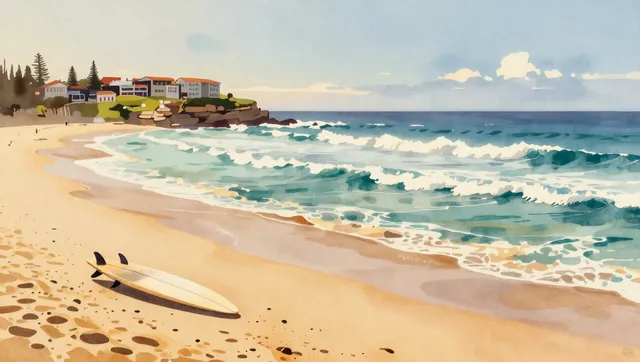
  • Golden surf and a lone boardXenLook AI interpretation

    Heidelberg School

    Alike
    Both rooms show landscapes painted outdoors while looking directly at light and weather. In both, the sky and air set the mood of the picture, and small figures show the scale of the land.
    Different
    Australia's Heidelberg School painted golden grass and blue shade crisply in oils under strong sunlight. English watercolour painted the damp, cloudy air of an island in soft spreading washes, showing a gentle, moist light.
    Go to this room

Quiz

Pick one to see the answer and why.

  1. 1. In watercolour, how are the brightest places usually made?

  2. 2. What did the Reeves brothers invent that won the Society of Arts' Silver Palette in 1781?

  3. 3. Why did watercolour painters found their own society in 1804?

  4. 4. Which technique was used in Turner's Flüelen to bring back white light?

  5. 5. What was Paul Sandby's first job before he painted in watercolour?

Paint it

A sentence written for this style is ready. Copy it or take it straight to the studio.

Autumn afternoon in Walter Harris's repair shopXenLook AI interpretation

An English watercolour landscape, thin transparent washes layered over a light pencil underdrawing, a wide sky filling half the sheet with soft clouds spreading on wet paper, bright light shown by the untouched white of the paper, a low horizon and distant hills fading pale and blue, small herds of cattle and riders in the fields, warm browns and grey-blues, cream paper texture

Try changing Swap the clear midday sky for a pink and golden sunset.

Paint in the studio

The sentence is copied. Paste it into the studio's input box.

Sources

Every original here was released into the public domain (CC0) by The Cleveland Museum of Art. Artist, title, date and technique follow the museum records, which we checked again with their release terms on 2026-11-24. The commentary is written by XenLook.

Pictures marked “XenLook AI interpretation” were made by XenLook with XenArt. They are not historical paintings and no painter made them. Originals carry the “Original” mark and the name of the museum that holds them.

Instalar como app