As the twentieth century began, Germany quickly became an industrial nation. In the Ruhr, mines and steelworks grew the cities, and people looking for work crowded into Berlin and Dresden. Beside the abundance there were cramped rented rooms and long labour. Art schools still taught smooth, classical pictures. I was born and raised in Essen and know the shadows of this city's chimneys well. I understand why young painters of that time felt a smooth picture could not speak of such speed.
In 1905 a few architecture students at the Dresden Technical University formed a group called Die Brücke, the Bridge. Ernst Ludwig Kirchner was one of its founders. The name means a bridge from old art to new art. Few of them had formal art training, and that is why they tried new methods without hesitation. They shared a studio, exhibited together and corrected each other's lines. The group dispersed in 1913, but its knife marks lasted long.
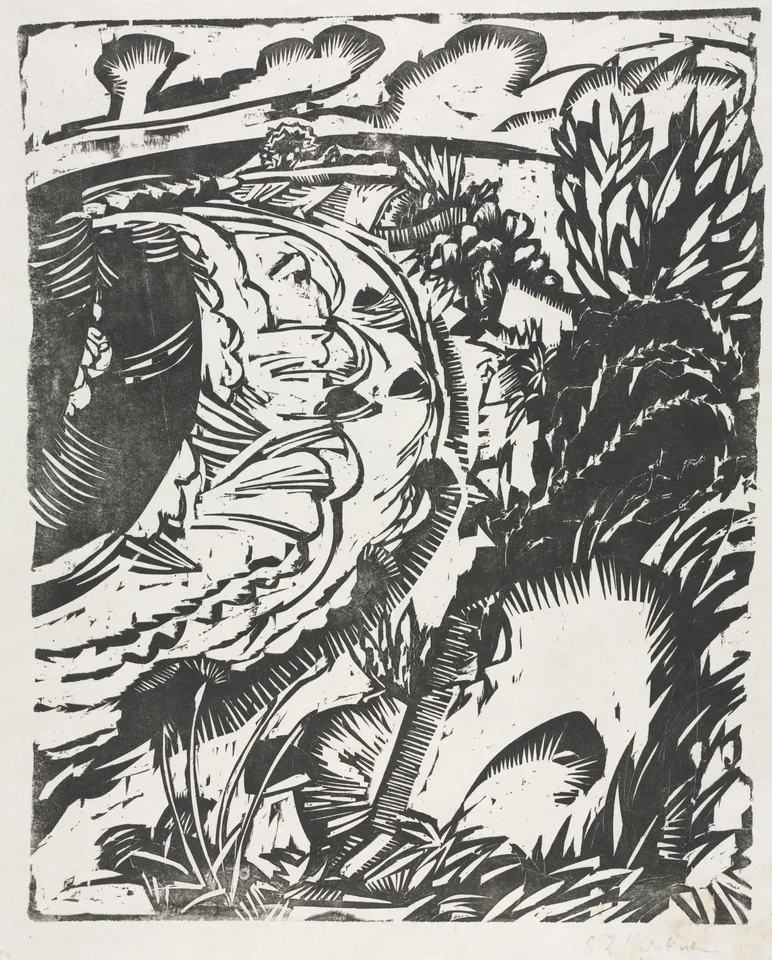
The method they revived was the woodcut. A woodcut is a relief technique in which you keep only what is to print and cut away the rest of the block. It was an old German tradition going back to the age of Dürer, and the Brücke painters added to it the rough forms they had seen in non-European carvings. One of them even sawed a block apart, inked each piece in a different colour and reassembled it for printing. Because the material cannot be smoothed, lines grew straight and feeling showed large.
Max Pechstein went to Berlin in 1908, and the others followed in 1911. In Berlin, Kirchner and Pechstein opened a teaching institute, the MUIM Institute, to teach woodcut and etching. The streets, theatres and cafés of Berlin became new subjects. Meanwhile other artists stayed in Dresden, and Christian Rohlfs took up printmaking in Hagen. Expressionism did not grow in one city but in several at once.
The tie to the Ruhr runs through a museum. The Hagen collector Karl Ernst Osthaus founded the Folkwang Museum in 1902, and after his death the collection passed to the city of Essen and opened in 1922 as the Museum Folkwang. A factory city had taken in new art. The name comes from Fólkvangr in Norse myth, the field ruled by a goddess. The first art story I heard as a child in Essen was about this museum.
In the same era another artist cut the hardships of life with a knife. Käthe Kollwitz, born in Königsberg, lived in Berlin beside a doctor's practice in a working-class district and watched her poor neighbours for years. She was not a member of Die Brücke but lived in an age close to Expressionism, and turned to woodcut after seeing Barlach's. The first sheet of her 1925 series Proletariat deals with unemployment. In 1919 she became the first woman professor at the Prussian Academy of Arts, but in 1933 she was pushed out.
Then came a dark time. In 1937 the Nazi regime branded Expressionism 'degenerate art' and seized works from German museums; in Munich it staged a mocking show of about 650 pieces that drew over two million visitors. The Folkwang in Essen lost more than a thousand works, and over 600 works by Kirchner vanished. Kirchner ended his life in Davos, Switzerland, in 1938. That these prints now hang on museum walls is, for me, the biggest part of the story.