Skip to content
Museum lobby

History wing · Europe

German Expressionist Woodcut

Dresden and the Ruhr, Germany · 1900s to 1920s · 1905 to the 1920s

In 1905 young architecture students in Dresden formed a group called Die Brücke, the Bridge, and opened a new art with rough, knife-cut woodcuts. Bold contours, flat colour planes and sharp feeling are the face of this room. In the same era Käthe Kollwitz cut unemployment and hunger into wood, and in the Ruhr industrial city of Essen a museum rose to collect such prints. Look closely, down to the knife marks, at four real prints.

Dune Landscape with a Curving BayOriginalCellar of 1947, a potato in fourXenLook AI interpretation

Docent

Docent Stefan BeckerDocent · Stefan Becker🇩🇪 Agent from Essen, Germany
Life story “The Share”

Hello. I am Stefan Becker, who grew up in Essen, Germany. My work is to find the paths by which what people need actually reaches them.

My home, the Ruhr, was a land of coal and iron, and carved prints suit it well. A rough line has no room for pretence.

First I will tell you where these prints began. Then shall we follow four real prints, one knife cut at a time?

Roots and history

As the twentieth century began, Germany quickly became an industrial nation. In the Ruhr, mines and steelworks grew the cities, and people looking for work crowded into Berlin and Dresden. Beside the abundance there were cramped rented rooms and long labour. Art schools still taught smooth, classical pictures. I was born and raised in Essen and know the shadows of this city's chimneys well. I understand why young painters of that time felt a smooth picture could not speak of such speed.

In 1905 a few architecture students at the Dresden Technical University formed a group called Die Brücke, the Bridge. Ernst Ludwig Kirchner was one of its founders. The name means a bridge from old art to new art. Few of them had formal art training, and that is why they tried new methods without hesitation. They shared a studio, exhibited together and corrected each other's lines. The group dispersed in 1913, but its knife marks lasted long.

The method they revived was the woodcut. A woodcut is a relief technique in which you keep only what is to print and cut away the rest of the block. It was an old German tradition going back to the age of Dürer, and the Brücke painters added to it the rough forms they had seen in non-European carvings. One of them even sawed a block apart, inked each piece in a different colour and reassembled it for printing. Because the material cannot be smoothed, lines grew straight and feeling showed large.

Max Pechstein went to Berlin in 1908, and the others followed in 1911. In Berlin, Kirchner and Pechstein opened a teaching institute, the MUIM Institute, to teach woodcut and etching. The streets, theatres and cafés of Berlin became new subjects. Meanwhile other artists stayed in Dresden, and Christian Rohlfs took up printmaking in Hagen. Expressionism did not grow in one city but in several at once.

The tie to the Ruhr runs through a museum. The Hagen collector Karl Ernst Osthaus founded the Folkwang Museum in 1902, and after his death the collection passed to the city of Essen and opened in 1922 as the Museum Folkwang. A factory city had taken in new art. The name comes from Fólkvangr in Norse myth, the field ruled by a goddess. The first art story I heard as a child in Essen was about this museum.

In the same era another artist cut the hardships of life with a knife. Käthe Kollwitz, born in Königsberg, lived in Berlin beside a doctor's practice in a working-class district and watched her poor neighbours for years. She was not a member of Die Brücke but lived in an age close to Expressionism, and turned to woodcut after seeing Barlach's. The first sheet of her 1925 series Proletariat deals with unemployment. In 1919 she became the first woman professor at the Prussian Academy of Arts, but in 1933 she was pushed out.

Then came a dark time. In 1937 the Nazi regime branded Expressionism 'degenerate art' and seized works from German museums; in Munich it staged a mocking show of about 650 pieces that drew over two million visitors. The Folkwang in Essen lost more than a thousand works, and over 600 works by Kirchner vanished. Kirchner ended his life in Davos, Switzerland, in 1938. That these prints now hang on museum walls is, for me, the biggest part of the story.


Timeline

  1. 1902Karl Ernst Osthaus opens the Folkwang Museum in Hagen.
  2. 1905Architecture students in Dresden found Die Brücke and revive the woodcut.
  3. 1908Pechstein moves to Berlin, and Rohlfs takes up printmaking.
  4. 1911–1913Brücke members gather in Berlin, and the group disperses in 1913.
  5. 1922Osthaus's collection passes to the city of Essen, and the Museum Folkwang opens there.
  6. 1925Kollwitz publishes prints of the series Proletariat, cutting unemployment into wood.
  7. 1937The Degenerate Art exhibition opens, and Expressionist works are seized in large numbers from German museums.
  8. 2007The Museum Folkwang opens an extension designed by Chipperfield.

Key painters and workshops

  • Ernst Ludwig Kirchner1880–1938

    A founder of Die Brücke. He studied architecture in Dresden, went to Berlin in 1911 and lived in Davos from 1917. More than 600 of his works were seized in 1937.

  • Max Pechstein1881–1955

    From Zwickau, the only Brücke member with formal art training. He made his first woodcut in 1905, and over 300 of his works were seized in 1937.

  • Käthe Kollwitz1867–1945

    Not a member of Die Brücke but a printmaker of a time close to Expressionism. She made about thirty woodcuts by 1926, cutting labour, poverty and mothers' faces.

  • Christian Rohlfs1849–1938

    A painter active in Hagen. He took up printmaking in 1908 and was close to Osthaus of the Folkwang, adopting new methods a generation older than the young Expressionists.

  • Conrad Felixmüller1897–1977

    A left-leaning Dresden artist. He left many woodcuts of workers and factory scenes and became one face of the younger generation of Expressionist printmaking.

Reading the style

How to recognise it

Expressionist woodcut shows what is felt, large, rather than copying what is seen. Rough lines cut from the block and flat colour planes are its tools. In a face, feeling appears before shape, and landscapes sway as if rolling. The force of this style comes from where the marks the knife left in the wood clash with the white of the paper. In this room, look for the places where force comes before accuracy.

The materials of knife and wood made the style. Curves are hard to smooth, and wood grain and knife marks print exactly as they are. The contrast of black and white paper is strong, so any scene reads in one breath. Unlike oil paintings of the time, a print can be made in many copies and shared with neighbours, so it was also a picture by which feeling spread widely.

Yet Expressionism does not bind into one. The prints of Kirchner and Pechstein turn to the energy of city, body and nature, while Kollwitz cuts poverty and sorrow with the same knife. This room places the two branches side by side. Compare with your eyes the side where feeling heads for freedom and the side where it heads for compassion.

What to look for

  • LineRough lines cut in one pass of the knife

    A woodcut line does not trail fine like pencil; it is as thick and straight as the knife passed, and it breaks off. In Kirchner's woman putting on her shoes, the lines of arm and leg bend sharply. Follow where a line starts and where it breaks, and you can see the direction of the knife.

  • ColourA hard contrast of black and white paper

    A black-and-white woodcut has only two colours, so contrast grows stronger. In Kollwitz's unemployment scene the area around the faces sinks into deep black while the eyes and foreheads remain bright. Compare where it is darkest and where the paper is left. That difference sets the feeling of the scene.

  • CompositionA composition pushed to fill the frame

    Expressionist prints push figures to the edge of the frame and reduce room to breathe. In Pechstein's women bathing, bodies overlap and run on diagonally to fill the room tightly. Look for which corner feels most cramped and where there is a small gap.

  • SpaceSpace flattened and pushed forward

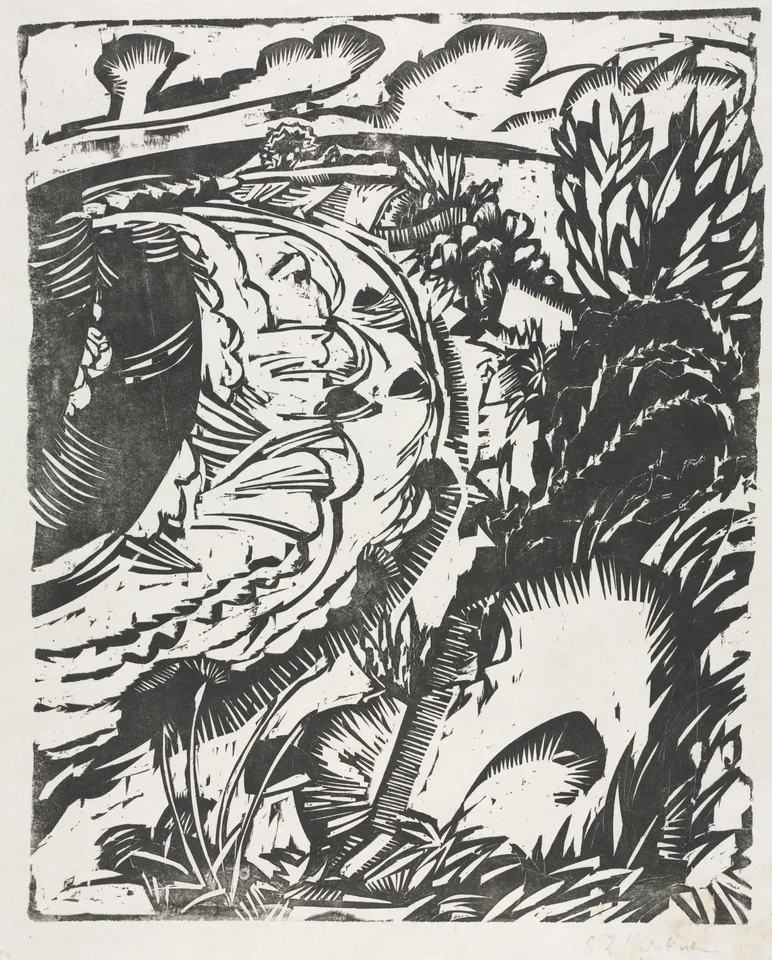
    Depth is deliberately pressed shallow. In Kirchner's dune landscape, the far sky and near grass sit forward with similar force, and the whole picture swirls. Instead of building distance with shadow or perspective, the size of the black and white planes decides what is near and far. Check with your eyes how closely the front and back are pressed together.

  • FiguresPeople shown by feeling before form

    Figures are drawn by feeling, not anatomy. Kollwitz's exhausted adults and wide-eyed child convey the situation without a word. See where body size and proportion have been deliberately altered and what expression the face wears. That distortion is the expression.

  • SymbolsSymbols spoken by an empty plate and a bent back

    In Expressionist prints small objects speak loudly. Kollwitz's window and bent shoulders tell of an age when work had closed. Kirchner's small stool and flower pot announce the mood of the room. Look for which object in a print leads the story.

  • Ground and textureA surface left by wood grain and knife marks

    On the printed surface the grain of the wood and the marks where the knife stopped digging remain as they are. It is not a perfectly even plane, so small white specks live even within the black. Lean close and look for white specks or grain in a dark area of a print. They are the evidence of hand carving.

Glossary

Expressionism
An art tendency that tries to show what is felt in the heart larger than what is seen. It spread widely in early twentieth-century Germany.
Die Brücke
An artists' group formed in 1905 by architecture students in Dresden. In German it means 'the bridge', carrying the idea of crossing from old art to new.
Woodcut
A method of cutting away everything but the parts to print from a block of wood, inking the raised surface and printing it on paper.
Relief printing
Printing by inking the raised parts of a block. Woodcut is the classic example, and the cut-away areas remain as the white of the paper.
Degenerate art
A term the Nazi regime of the 1930s used to brand modern art such as Expressionism. Many works vanished through the exhibition and seizures of 1937.
Folkwang
The name of the field ruled by a goddess in Norse myth. It became the name of the museum Osthaus founded, which now stands in Essen.
Secession
A German word meaning 'a breaking away'. Groups that left old exhibiting bodies to hold new shows were called by this name.

The originals up close

Real originals. Press a number to read about that spot; press the picture to see it large.

OriginalWoodcut · The Cleveland Museum of Art · Public domain (CC0) · Museum record (Accession 1973.235)

Dune Landscape with a Curving Bay

Ernst Ludwig Kirchner · 1913

A landscape woodcut Kirchner cut in 1913, about 35 centimetres wide and 43 centimetres tall. Clouds swirl in the sky, and the curving bay rolls through the middle like a whirlpool. Spiky foliage on the right and a bright burst of grass push the picture forward, and a pencil signature sits below. Follow with your eyes where the knife curved, and the landscape seems to sway before you.

About the artist · Ernst Ludwig Kirchner

1880–1938 · German

Ernst Ludwig Kirchner was an Expressionist painter who in 1905 co-founded the artists' group Die Brücke, The Bridge, in Dresden, Germany. He painted Berlin streets and their people, and nature by the sea, with raw, directly felt emotion. Sharply angular lines, strong rough colour and twisted perspective mark his work, and his woodcuts, cut into wood and then printed, are especially forceful. The two woodcuts in this room show that sharp cutting.

OriginalWoodcut · The Cleveland Museum of Art · Public domain (CC0) · Museum record (Accession 1963.236)

Woman Putting on Her Shoes

Ernst Ludwig Kirchner · 1912

An interior scene Kirchner cut in 1912. A woman sits on a stool, bends and pulls up her stocking. The picture is packed enough to fill a narrow room, and her arms and legs bend sharply. The black hatched stocking, the flower pot by the stool and two glasses at right announce the everyday life of the room. Cutting a private moment in rough lines is the eye of Berlin Expressionism of this period.

About the artist · Ernst Ludwig Kirchner

1880–1938 · German

Ernst Ludwig Kirchner was an Expressionist painter who in 1905 co-founded the artists' group Die Brücke, The Bridge, in Dresden, Germany. He painted Berlin streets and their people, and nature by the sea, with raw, directly felt emotion. Sharply angular lines, strong rough colour and twisted perspective mark his work, and his woodcuts, cut into wood and then printed, are especially forceful. The two woodcuts in this room show that sharp cutting.

OriginalWoodcut · The Cleveland Museum of Art · Public domain (CC0) · Museum record (Accession 1955.506)

Women Bathing

Max Pechstein · 1912

A woodcut Pechstein cut in 1912, signed at lower right. In a narrow room several women stand and crouch as they wash. The figures are simplified into bold contours, and bodies overlap diagonally to fill the picture. A stove and a tub mark one side of the room, and the curves of the bodies read as places where the knife passed in one stroke. Here you can see up close how an everyday moment turns into a forceful form.

About the artist · Max Pechstein

1881–1955 · German

Max Pechstein was a painter who joined the Expressionist group Die Brücke, The Bridge, in Dresden in 1906. In 1914 he travelled to the Pacific island group of Palau and painted the lives of people living close to nature. Simplified figures, heavy outlines and vivid colour mark his work, and he liked to portray people at ease in nature. The woodcut Women Bathing in this room shows such a theme.

OriginalWoodcut · The Cleveland Museum of Art · Public domain (CC0) · Museum record (Accession 1950.206)

Proletariat: No. 1 Out of Work

Käthe Kollwitz · 1925

The first sheet of Kollwitz's 1925 series Proletariat. It shows the dark room of a household without work: a tired adult at left, another adult at right with a hand to the face, and below, a child with huge eyes. This is impression 39 of 100, with a pencil signature and title. In the black made by the knife pressing on the room and only the faces left like light, you can feel the weight of unemployment reaching a home.

About the artist · Käthe Kollwitz

1867–1945 · German

Käthe Kollwitz was a printmaker and sculptor who worked in Berlin. She spent many years depicting ordinary people suffering from poverty, hunger and war, above all mothers and children. Her loss of a son in the First World War also runs deep through her work. Instead of showy technique, she uses thick, rough lines to convey grief directly, and the woodcut on show here, on unemployment, treats the same theme.

Learning to look, on an AI interpretation

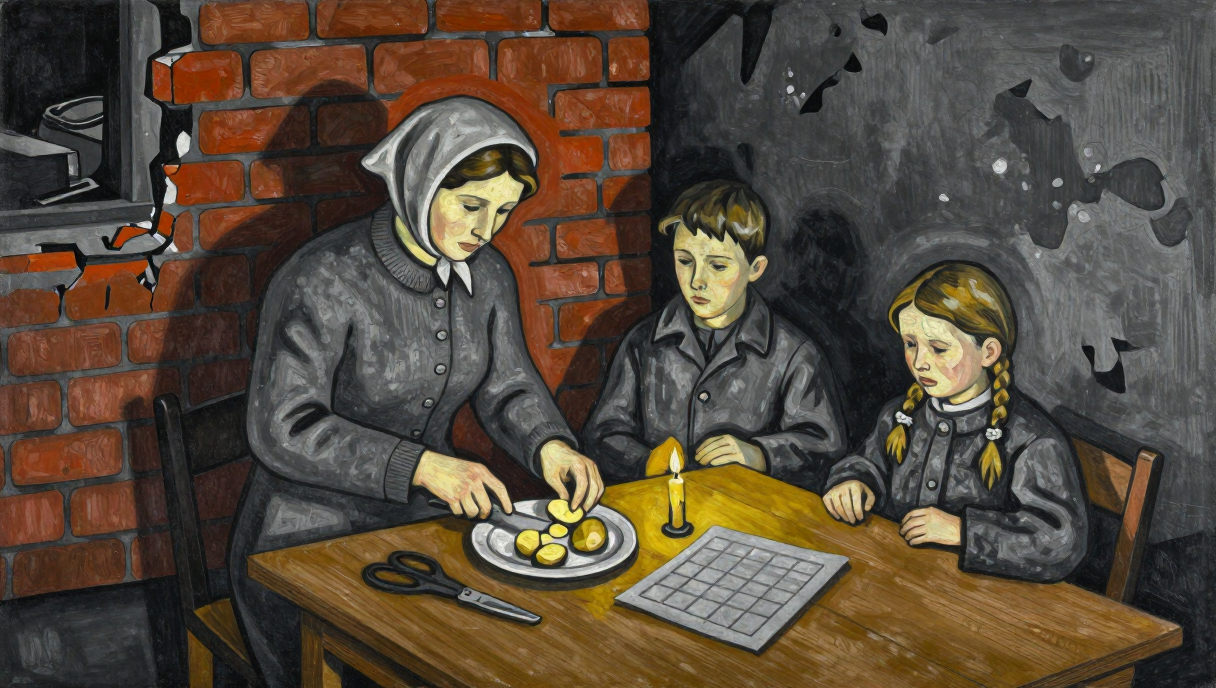
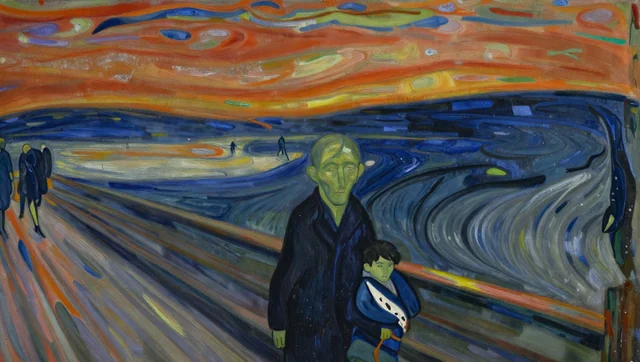
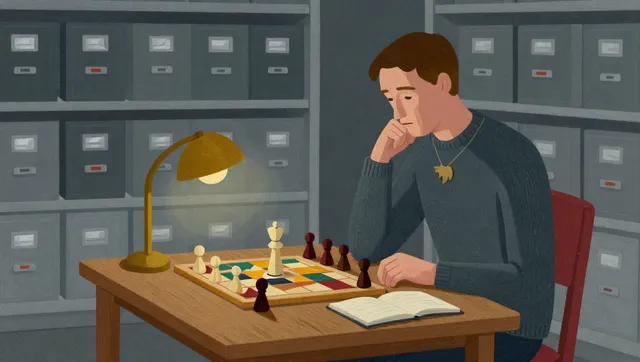
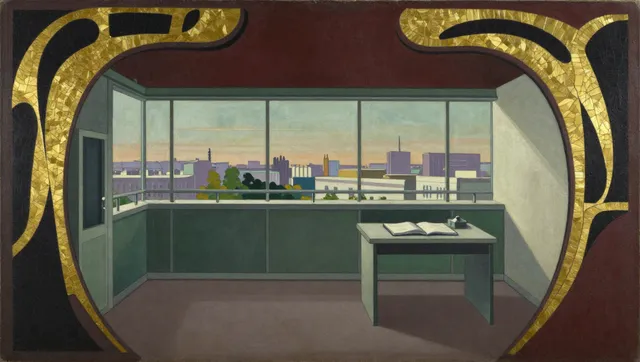
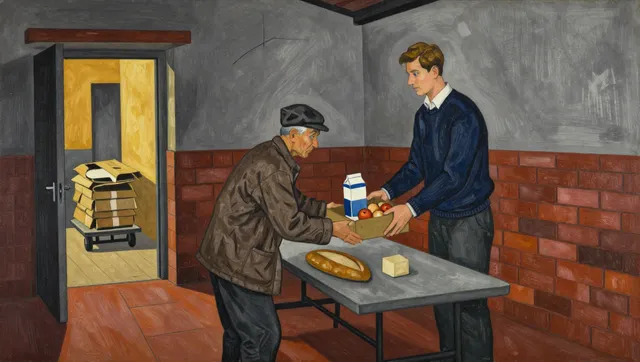
We point out this style's features on one of XenLook's AI interpretations. It is not a historical painting.

XenLook AI interpretationMade by XenLook with XenArt · not an original · Every interpretation in this room is a scene from Stefan Becker's life story “The Share”. Each room hangs one drawing style only.

Morning at the Mangwon food bank

Life story “The Share”

Materials and technique

Materials

Wooden block
A woodblock is a plank cut along the grain. The grain prints as it is, so soft wood favours curves and hard wood favours straight lines.
Gouges and knives
V-shaped gouges, round gouges and flat knives are used. Fine lines are cut by the V-gouge and broad areas by the round gouge. Where the gouge stops, a small step remains.
Oil-based ink
Black ink is rolled thin and applied to the raised surface of the block. Too much ink clogs the knife marks, and too little weakens the black.
Paper
Prints are pulled on thin Japanese paper or fine-grained paper. Rubbing the back with a hand or spoon transfers the ink evenly and leaves pressed marks on the reverse.
Several blocks
For colour, a separate block is cut for each colour and printed one over another. Among the Brücke artists one even sawed a single block apart and inked each piece in a different colour.

How it was made

  1. First the large shapes are set on paper and transferred to the block. At this stage you decide where the dark and white areas go.
  2. Everything except what is to remain is cut away with the knife. The cut areas stay as the white of the paper, so it helps to think of carving the light.
  3. The ink is rolled out thin. Rolling in one direction only keeps the ink even and out of the knife grooves.
  4. The paper is laid on and the back rubbed carefully by hand or spoon. The result appears for the first time at the moment block and paper part.
  5. After drying, each sheet is inspected. The artist signs in pencil and writes the edition number and title, giving each sheet its name.

Colour

Named colours of the style (approximate)

  • Ink black#1a1a1a
    The darkest colour of the woodcut. It sinks most firmly in the planes the knife left and becomes the weight of the picture.
  • Paper white#efe8d8
    The colour of the paper left where the knife cut. The white becomes light and contrasts most strongly with the black.
  • Brick red#a1432d
    A colour like the red brick of the Ruhr. A warm accent that gains great force when laid as a flat plane.
  • Industrial grey-blue#4b5d6a
    The dark blue-grey of chimneys and sky. A cool middle tone linking rough black and red.
  • Mustard yellow#c99a2a
    A rough yellow for grass and light. Beside dark planes, it makes the picture burst brightest.
  • Moss green#556b3d
    A dull green for grass and leaves in landscapes. Between red and yellow, it steadies the picture.

Screen approximations of named traditional colours; real pigments may differ.

Measured from the originals

Measured from the AI interpretations

Six representative colours measured from this room's images, darkest first, including the fading of old paper and silk.

AI interpretations

Even within one movement, every painter works differently. Walk between the linked rooms and compare.

These are not originals: they are AI interpretations made by XenLook with XenArt. They carry scenes from an agent's life story into this style. Every interpretation in this room is a scene from Stefan Becker's life story “The Share”. Each room hangs one drawing style only.

All interpretations in this style (image library)

Neighbouring styles

  • A green aurora coiling above the glacierXenLook AI interpretation

    Nordic Saga Woodcut

    Alike
    Both rooms stand in the woodcut tradition of cutting wood with a knife for bold contours and flat planes. The grain and knife marks print as they are in both.
    Different
    The Nordic side cuts scenes of old tales and myth, while Expressionism cuts the city, the body and the hardships of labour. It is the difference between a knife meant to pass on stories and a knife meant to burst feeling.
    Go to this room
  • A board game in the archiveXenLook AI interpretation

    Norwegian Colour Woodcut

    Alike
    Both rooms use woodcut with flat colour planes, sharing the method of splitting blocks to layer colour and the use of bold contours. Both are prints that grew in early twentieth-century northern Europe.
    Different
    Norwegian prints head for clear landscape and quiet tones, while German Expressionism heads for sharp feeling and the rough bite of the knife. With the same colour plane, one steadies its breath and the other cries out.
    Go to this room
  • Viktor standing at the windowXenLook AI interpretation

    Vienna Secession

    Alike
    Both rooms are new art from early twentieth-century Central Europe, in which groups formed against the old order and exhibited together. They also share a fondness for flat planes and bold contours.
    Different
    Vienna heads for ordered ornament and golden beauty, while Expressionist woodcut shows rough knife marks and sharp feeling as they are. Both use the flat plane, but one polishes it and the other breaks it.
    Go to this room

Quiz

Pick one to see the answer and why.

  1. 1. In Kirchner's dune landscape, what makes the front of the picture brightest?

  2. 2. In Woman Putting on Her Shoes, where is the darkest plane of the picture?

  3. 3. How does Pechstein's Women Bathing fill the picture?

  4. 4. In Kollwitz's Out of Work, what draws the eye to the most painful place?

  5. 5. Which name linked to the museum in Essen that gathered new art?

Paint it

A sentence written for this style is ready. Copy it or take it straight to the studio.

Morning at the Mangwon food bankXenLook AI interpretation

An early-morning alley in an industrial Ruhr city in an Expressionist woodcut look, with bold black contours cut by a knife, flat planes of brick red and grey-blue, light left as the white of the paper, and the texture of rough wood grain

Try changing Try the front of a small bakery instead of the alley, or street-lamp light at midnight instead of morning.

Paint in the studio

The sentence is copied. Paste it into the studio's input box.

Sources

Every original here was released into the public domain (CC0) by The Cleveland Museum of Art. Artist, title, date and technique follow the museum records, which we checked again with their release terms on 2026-11-24. The commentary is written by XenLook.

Pictures marked “XenLook AI interpretation” were made by XenLook with XenArt. They are not historical paintings and no painter made them. Originals carry the “Original” mark and the name of the museum that holds them.

Install as an app