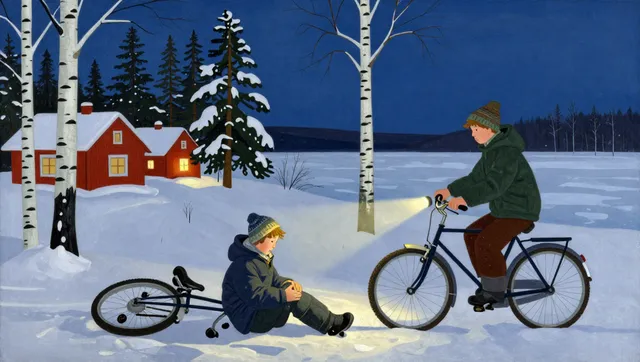
The Golden Age of Finnish Art refers roughly to the years from 1880 to about 1910. Finland was then a Grand Duchy inside the Russian Empire, and a mood of national awakening, a wish to recover the Finnish language and Finnish history, was growing. In that mood painters took the forests and lakes of the country, the faces of farmers and old songs as their subjects. The Ateneum art museum in Helsinki, established in 1887, became the centre where these pictures gathered. The term Golden Age usually points to the painters who followed realism and romantic nationalism.
The greatest inspiration of the Golden Age was the epic Kalevala. It was compiled by Elias Lönnrot from oral poetry he gathered across the countryside; the first edition appeared in 1835 and an enlarged new edition in 1849. The songs hold the aged hero Väinämöinen, the smith Ilmarinen and the vengeful Kullervo, and a struggle over the Sampo, a mysterious object that brings wealth and luck. Today Finland marks 28 February as both Kalevala Day and Finnish Culture Day. These songs spread into painting, literature, music and architecture.
Many Finnish painters went to study in Paris. Albert Edelfelt studied in Antwerp and then moved to Paris, where his friend Bastien-Lepage introduced him to painting outdoors from direct observation (plein air). Eero Järnefelt followed the same road. Akseli Gallen-Kallela lived in Paris from 1884 to 1889 and made his name as a realist with Old Woman with a Cat in 1885. Seeing the Finnish countryside with an eye trained in Paris was where the pictures of this period began.
In 1890 Gallen-Kallela travelled to East Karelia on his honeymoon, together with the Swedish painter Louis Sparre. Karelia was the land where the Kalevala songs had been gathered, and people believed the purest Finnishness survived there. This current is called Karelianism; Gallen-Kallela and Sparre are usually named as its starting point, and Sibelius, the novelist Juhani Aho and the poet Eino Leino followed. It must also be remembered that part of this current was later used by Greater Finland ideas of territorial expansion.
Gallen-Kallela’s Aino Myth triptych, dated 1891, belongs to the Ateneum. It spreads Songs 4 and 5 of the Kalevala over three panels, with a line of the song inscribed in a gilded frame. It is often introduced as the starting point of Finnish national romanticism. In December 1894 he moved to Berlin to prepare a joint exhibition with Munch, and in 1895 he lost his eldest daughter, Impi Marjatta. After that his painting became rougher and stronger. The Defense of the Sampo of 1896 and Lemminkäinen’s Mother of 1897 are the main works of those years.
Another face of the Golden Age is Symbolism. Hugo Simberg received private instruction from Gallen-Kallela at Kalela in three periods between 1895 and 1897, and he painted The Garden of Death in 1896 and The Wounded Angel in 1903. In that picture two boys carry a bandaged angel on a stretcher past a bay in Helsinki, and it was voted Finland’s national painting in a 2006 Ateneum vote. Simberg himself never explained its meaning. It leaves the interpretation open, so that the viewer grows the questions alone.
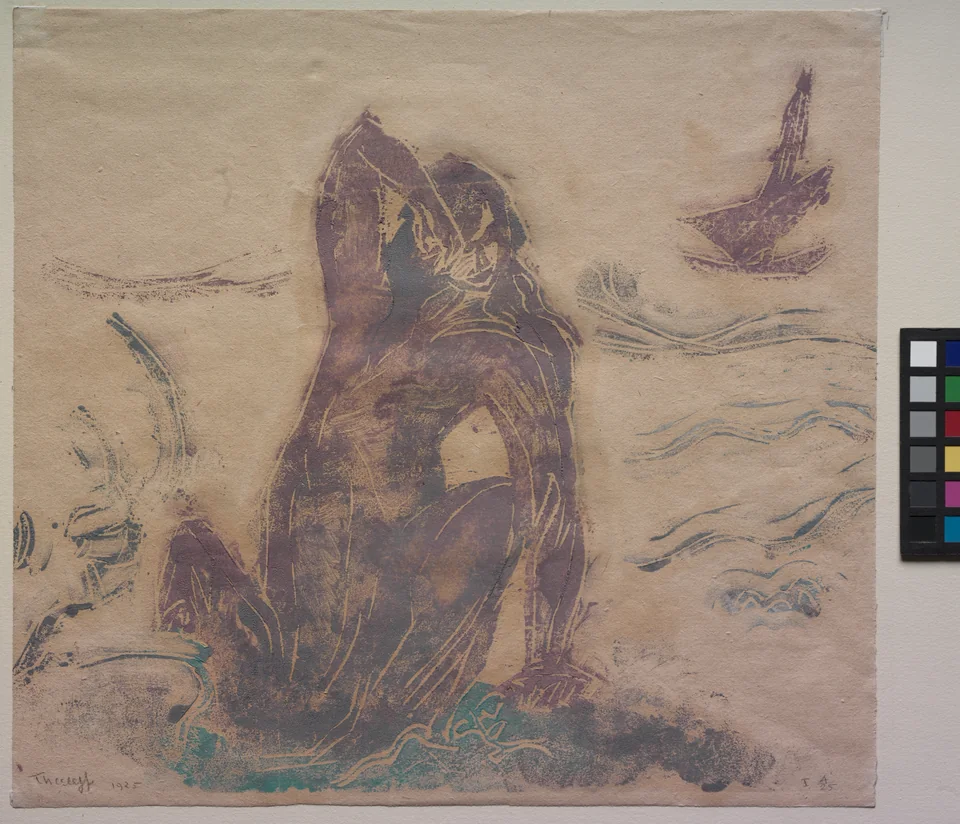
The great stage that marked the close of the Golden Age was the Paris World Fair of 1900. The Finnish pavilion there was among the most popular buildings at the fair, and it brought Finnish art wide notice in Europe. Gallen-Kallela painted a fresco version of the Sampo picture for the same fair. Later he returned to the songs in linocut illustrations for a Kalevala edition published in 1922, and Ellen Thesleff, of the Golden Age generation, made colour woodcuts in the 1920s. The pictures in this room show how that story continues before our eyes today.