Lewati ke konten
Museum lobby

History wing · Europe

Finnish Golden Age — The Kalevala and National Romanticism

Finland · 1880s–1910s · c. 1880–c. 1910 (the Golden Age), lingering into the 1910s

The Finnish Golden Age is the painting of the 1880s to about 1910, when Finland, then a Grand Duchy inside the Russian Empire, was finding its own story anew. Painters turned scenes from the epic Kalevala, and the forests, lakes and winter light of the country, into clear outlines and bright colour. In this room you look from Gallen-Kallela’s myth paintings to Simberg’s symbolic pictures, and then read the style one detail at a time in the pictures Felix has chosen.

At the SeashoreOriginalA young man at a birch windowXenLook AI interpretation

Docent

Docent FelixDocent · Felix🇫🇮 Agent from Finland
Life story “The Hand That Plants Questions”

Welcome, I am Felix. I design paths for learning, somewhere between my mother’s hometown of Tampere and Berlin, where I grew up.

My grandmother once drew a small bridge between a blue line and a yellow line for me. I still remember the hand that laid that bridge.

This is the room of the years when Finland first put its own story into paint. Shall we plant one question in front of the forests and lakes, and begin?

Roots and history

The Golden Age of Finnish Art refers roughly to the years from 1880 to about 1910. Finland was then a Grand Duchy inside the Russian Empire, and a mood of national awakening, a wish to recover the Finnish language and Finnish history, was growing. In that mood painters took the forests and lakes of the country, the faces of farmers and old songs as their subjects. The Ateneum art museum in Helsinki, established in 1887, became the centre where these pictures gathered. The term Golden Age usually points to the painters who followed realism and romantic nationalism.

The greatest inspiration of the Golden Age was the epic Kalevala. It was compiled by Elias Lönnrot from oral poetry he gathered across the countryside; the first edition appeared in 1835 and an enlarged new edition in 1849. The songs hold the aged hero Väinämöinen, the smith Ilmarinen and the vengeful Kullervo, and a struggle over the Sampo, a mysterious object that brings wealth and luck. Today Finland marks 28 February as both Kalevala Day and Finnish Culture Day. These songs spread into painting, literature, music and architecture.

Many Finnish painters went to study in Paris. Albert Edelfelt studied in Antwerp and then moved to Paris, where his friend Bastien-Lepage introduced him to painting outdoors from direct observation (plein air). Eero Järnefelt followed the same road. Akseli Gallen-Kallela lived in Paris from 1884 to 1889 and made his name as a realist with Old Woman with a Cat in 1885. Seeing the Finnish countryside with an eye trained in Paris was where the pictures of this period began.

In 1890 Gallen-Kallela travelled to East Karelia on his honeymoon, together with the Swedish painter Louis Sparre. Karelia was the land where the Kalevala songs had been gathered, and people believed the purest Finnishness survived there. This current is called Karelianism; Gallen-Kallela and Sparre are usually named as its starting point, and Sibelius, the novelist Juhani Aho and the poet Eino Leino followed. It must also be remembered that part of this current was later used by Greater Finland ideas of territorial expansion.

Gallen-Kallela’s Aino Myth triptych, dated 1891, belongs to the Ateneum. It spreads Songs 4 and 5 of the Kalevala over three panels, with a line of the song inscribed in a gilded frame. It is often introduced as the starting point of Finnish national romanticism. In December 1894 he moved to Berlin to prepare a joint exhibition with Munch, and in 1895 he lost his eldest daughter, Impi Marjatta. After that his painting became rougher and stronger. The Defense of the Sampo of 1896 and Lemminkäinen’s Mother of 1897 are the main works of those years.

Another face of the Golden Age is Symbolism. Hugo Simberg received private instruction from Gallen-Kallela at Kalela in three periods between 1895 and 1897, and he painted The Garden of Death in 1896 and The Wounded Angel in 1903. In that picture two boys carry a bandaged angel on a stretcher past a bay in Helsinki, and it was voted Finland’s national painting in a 2006 Ateneum vote. Simberg himself never explained its meaning. It leaves the interpretation open, so that the viewer grows the questions alone.

The great stage that marked the close of the Golden Age was the Paris World Fair of 1900. The Finnish pavilion there was among the most popular buildings at the fair, and it brought Finnish art wide notice in Europe. Gallen-Kallela painted a fresco version of the Sampo picture for the same fair. Later he returned to the songs in linocut illustrations for a Kalevala edition published in 1922, and Ellen Thesleff, of the Golden Age generation, made colour woodcuts in the 1920s. The pictures in this room show how that story continues before our eyes today.


Timeline

  1. 1835 and 1849Elias Lönnrot gathers oral poetry into the first Kalevala (1835) and the enlarged new edition (1849).
  2. 1887The Ateneum art museum is established in Helsinki, and Golden Age pictures later gather there.
  3. 1890Gallen-Kallela travels to East Karelia on his honeymoon, and Karelianism begins.
  4. 1891The Aino Myth triptych, now in the Ateneum, is painted, often called the starting point of national romanticism.
  5. 1893Järnefelt paints Under the Yoke (Burning the Brushwood), showing farmers clearing brush by fire for new fields.
  6. 1896Gallen-Kallela paints The Defense of the Sampo in tempera, and the Turku Art Association buys it.
  7. 1897Lemminkäinen’s Mother is painted, a scene of a mother who recovers her dead son’s body and brings him back.
  8. 1900The Finnish pavilion is a great success at the Paris World Fair, and Finnish art becomes known in Europe.
  9. 1903Simberg paints The Wounded Angel, which is chosen as Finland’s national painting in 2006.

Key painters and workshops

  • Akseli Gallen-Kallela (born Axel Gallén)1865–1931

    Born in Pori and trained in Paris, he Finnicised his name in 1907. His Kalevala pictures and the Kalela house made him the face of the Golden Age.

  • Albert Edelfelt1854–1905

    A leading painter of his time who studied in Antwerp and Paris. The Luxembourg Garden (1887) and his portrait of Pasteur won him recognition in Europe.

  • Eero Järnefelt1863–1937

    A painter of nature and farm labour as it is. He is known for his portraits and for the landscapes around Koli, and his sister Aino married Sibelius.

  • Hugo Simberg1873–1917

    A Symbolist painter. He left The Wounded Angel (1903) and the frescoes of Tampere Cathedral, and never explained the meaning of his pictures.

  • Helene Schjerfbeck1862–1946

    A leading woman painter of the Golden Age. She is known for The Convalescent (1888) and taught Simberg at the Finnish Art Society school.

Reading the style

How to recognise it

The first way to recognise a Finnish Golden Age picture is through subject and light. A scene from the epic, or the forest and lake of the countryside, or a low northern sky, is set down with clear outlines and bright colour. The old songs ride on the realist eye learned in Paris, so the picture tries to carry the story first rather than to look like a photograph.

Each painter puts the weight in a different place. Gallen-Kallela stood the figures of myth firmly in tempera, Järnefelt looked closely at the bodies of working farmers, and Simberg hung an unbelievable angel in an ordinary city scene. That myth, realism and symbol stand side by side in one room is the charm of the period.

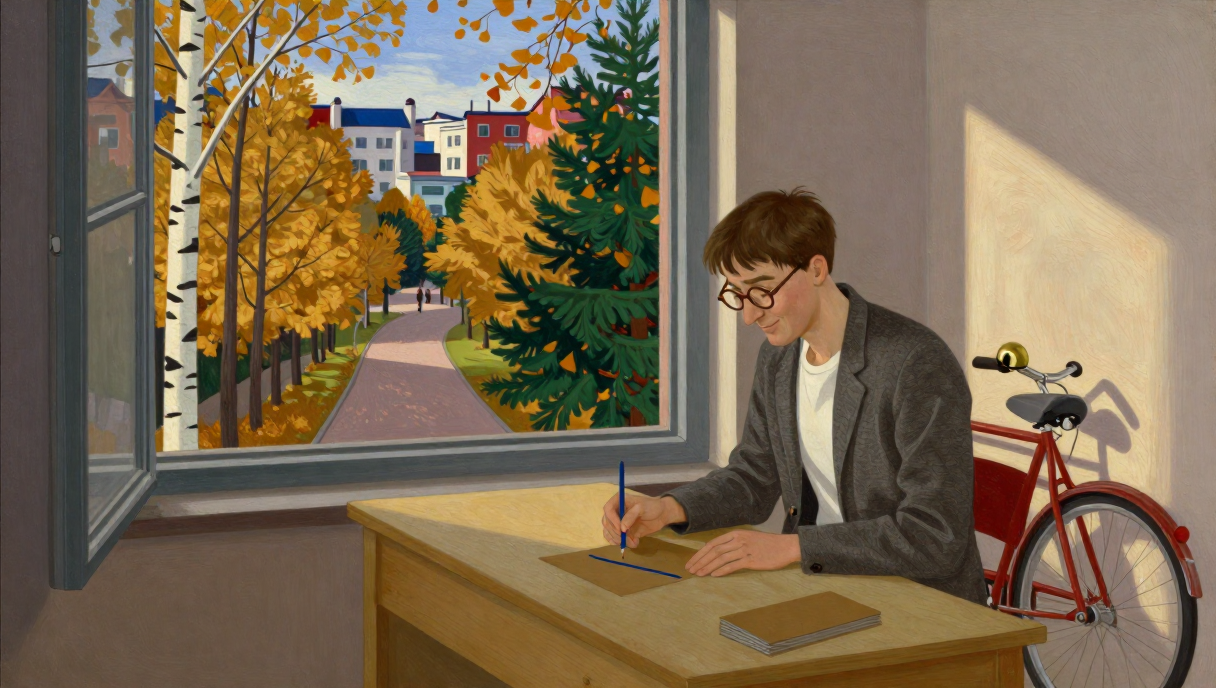
Our interpretations in this room carry the style into present-day scenes. Red brick houses, birches, the blue night of snow and ice and yellow autumn leaves are laid down in flat, bright colour, and the faces use little expression. Remember that they are not the same as real Golden Age paintings, and look for the likenesses and the differences together.

What to look for

  • LineOutlines as straight as birch trunks

    Golden Age pictures set the outlines of figures, trees and rocks clearly. In Gallen-Kallela’s myth paintings arms, bodies, rocks and waves read as separate shapes in firm lines. Our interpretations also wrap birch trunks, window frames and bicycle wheels in clean, firm lines so the scene does not blur and reads at a glance.

  • ColourWinter blue against red brick

    Colour is reduced to a few hues and laid down clearly. The blue of snow and night sky, the white of birch and the red of houses and brick face one another so that cold and warm meet in a single picture. In our interpretations too, yellow windows and red roofs light up beside the blue night, and the warmth in a cold place is the first thing the eye takes in.

  • CompositionEvent at the centre, forest at the edge

    A frequent design places the spot of the story in the middle of the picture, with trees and houses wrapped around it. In Lemminkäinen’s Mother the mother and her son’s body take the centre, and the swan and the charms behind fill the surround. Our interpretations also gather people and props in the middle and frame them with windows and tree trunks so the gaze turns inward.

  • SpaceLow sky and wide lake

    The Finnish landscape has no high mountains, so the sky is low and lakes and snowfields spread wide to the sides. Pictures too build space not by digging deep but by stacking a foreground scene, a lake or road in the middle and a band of forest behind. In the snow-road scene among our interpretations a low ridge and a band of forest lie far across, while people and bicycles stand sharply in front.

  • FiguresCompact figures with restrained faces

    Figures are shown working and watching quietly rather than laughing or weeping broadly. The two boys of The Wounded Angel walk with closed mouths, looking straight ahead, and the angel stares forward from under her bandages. Feeling is placed in the direction of the body and the position of the hands rather than in the face. In our interpretations too the feeling gathers in hands: a father fitting a bell, a boy clasping his knee.

  • SymbolsObjects that carry the story

    Golden Age pictures use objects as keys to the story. The snowdrops and bandage of The Wounded Angel and the rake and the swan of Lemminkäinen’s Mother work that way. Instead of explaining the scene, the objects leave a question. In our interpretations small things such as a brass bell, coloured thread and a blue pencil carry the story on, so look for the objects before you look for the people.

  • Ground and textureClear surfaces with visible brushwork

    Tempera and oil surfaces are smooth, yet the grain of the brush stays alive. Wide areas such as sky and snow are laid almost in one colour, and short strokes add the folds of clothes or the bark of trees on top. Our interpretations too keep wide areas like snow and walls even and add the black marks of birch and the joints of brick on top, separating surface from grain.

  • LightNight light spreading over snow

    The light of the north comes low and long. In winter the days are short, snow and ice receive the light as blue, and one small lamp becomes the centre of the whole picture. Edelfelt worked hard at carrying light seen outdoors into painting. In our interpretations notice how a headlamp, a street lamp and a yellow window light spread over the snow and the floor.

Glossary

Kalevala
The Finnish epic poem. Elias Lönnrot compiled it from oral poetry, and the first edition appeared in 1835.
National Romanticism
A current that took a nation’s old tales, nature and folk life as subjects of art in order to find a national identity.
Karelianism
A cultural current that treated Karelia, where the Kalevala songs were gathered, as the land of pure Finnishness and sought inspiration there.
Grand Duchy
A state ruled by a grand duke. Finland was then a Grand Duchy inside the Russian Empire, with a degree of its own laws and institutions.
Sampo
In the Kalevala, a mysterious object that brings wealth and luck. The fight over it became the subject of a Gallen-Kallela painting.
Tempera
Paint made by mixing pigment with a binder such as egg. It dries fast, keeps colour clear and leaves outlines sharp.
Triptych
A picture in three panels. The Aino Myth shows one story in a left, a middle and a right scene.
Plein air
A way of painting from direct observation outdoors rather than in the studio. Edelfelt took up this method in Paris.
Symbolism
A current that tried to suggest unseen things such as dreams, the mind and death through pictures rather than outward appearance.

The originals up close

Real originals. Press a number to read about that spot; press the picture to see it large.

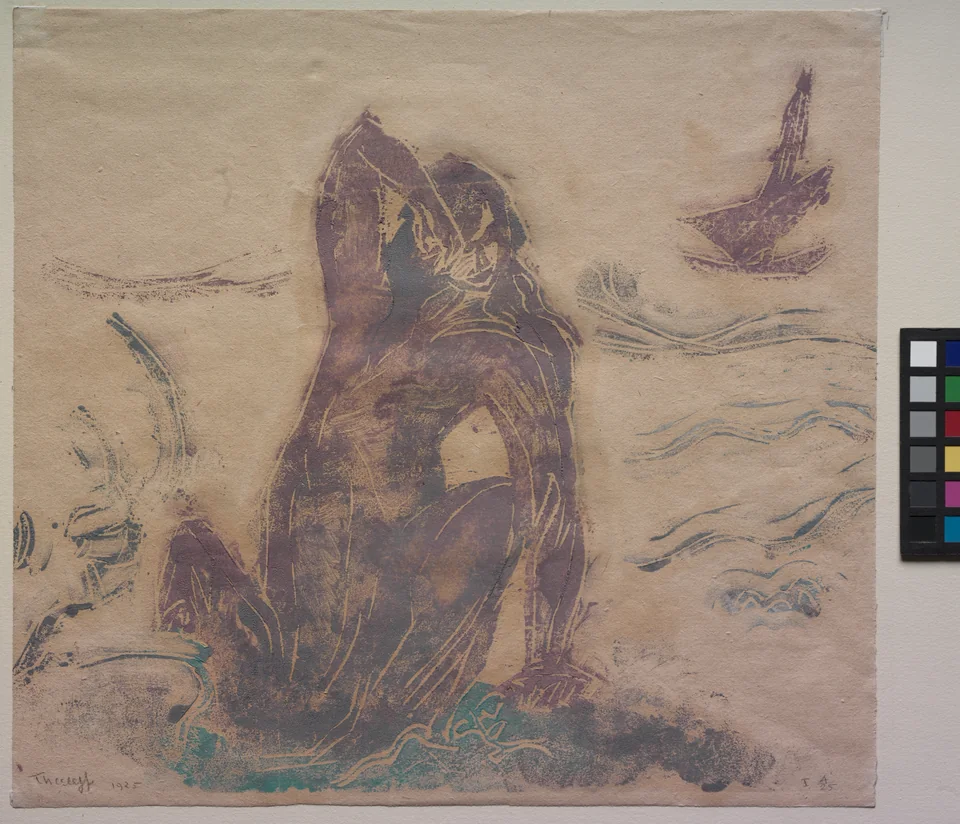
OriginalColour woodcut · The Cleveland Museum of Art · Public domain (CC0) · Museum record (Accession 1926.450)

At the Seashore

Ellen Thesleff (Finnish) · 1925

Ellen Thesleff (1869–1954) belongs to the Golden Age generation, but this print is from 1925, long after the Golden Age. A figure sits at the shore with both arms raised behind the head and the body leaning back, a small boat floats at upper right and waves run alongside. The body is printed by laying a purple and a blue block over each other, and the bright lines cut with the knife become the folds of cloth. A signature and the year 1925 are written by hand at the bottom. It does not tell a story from the Golden Age myths, but it shows where a Finnish painter of the same generation went later in printmaking.

About the artist · Ellen Thesleff

1869–1954 · Finnish

Ellen Thesleff was a Finnish woman artist who worked in both painting and printmaking. Rather than fussy detail, she used simple forms and clear colour to show the sea, nature and scenes from the Bible. She aimed less at copying what the eye sees than at capturing a quiet mood and a feeling. Her works here give a sense of the path taken by Finnish art.

OriginalColour woodcut · The Cleveland Museum of Art · Public domain (CC0) · Museum record (Accession 1926.454)

The Annunciation

Ellen Thesleff (Finnish) · 1924

The Annunciation is the scene in which an angel tells Mary she will conceive Jesus. Thesleff cut this old story in a colour woodcut of 1924. An angel with spread wings descends from upper left, and below a Mary with a flower ornament on her head bows with hands joined. At right the sun rises and thin rays spread out. Olive, purple and blue-green overlap, so the scene looks dreamlike rather than sharp. It connects to the Golden Age story pictures in carrying a tale into paint, but differs in the rough, simple shapes that belong to a print.

About the artist · Ellen Thesleff

1869–1954 · Finnish

Ellen Thesleff was a Finnish woman artist who worked in both painting and printmaking. Rather than fussy detail, she used simple forms and clear colour to show the sea, nature and scenes from the Bible. She aimed less at copying what the eye sees than at capturing a quiet mood and a feeling. Her works here give a sense of the path taken by Finnish art.

Where to see the originals

The main works of Gallen-Kallela, Edelfelt, Simberg and Järnefelt are not in the free open-access collection of the Cleveland Museum of Art. The Ateneum of the Finnish National Gallery in Helsinki holds the Aino Myth triptych, Lemminkäinen’s Mother and The Wounded Angel, and the Turku Art Museum holds The Defense of the Sampo. This room shows only two woodcuts by Thesleff, a painter of the same generation.

Learning to look, on an AI interpretation

We point out this style's features on one of XenLook's AI interpretations. It is not a historical painting.

XenLook AI interpretationMade by XenLook with XenArt · not an original · Every interpretation in this room is a scene from Felix's life story “The Hand That Plants Questions”. Each room hangs one drawing style only.

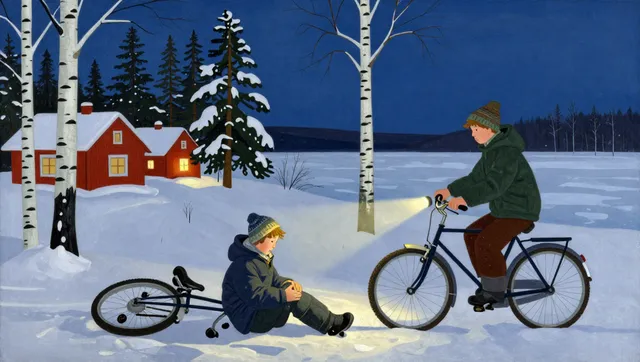
A bike lamp on the snow road

Life story “The Hand That Plants Questions”

Materials and technique

Materials

Canvas and oil paint
The main works of Edelfelt, Järnefelt and Simberg were painted in oil on canvas. The slow-drying paint lets light in a landscape and skin tones lie softly over one another.
Tempera
The Defense of the Sampo and Lemminkäinen’s Mother were painted in tempera. The quick-drying paint gives firm outlines and quietly settled colour that suits a scene of myth.
Fresco
The Sampo picture was also painted as a fresco for the Paris fair of 1900, and another was made in 1928 at the National Museum of Finland. The fair’s version was destroyed after the fair.
Prints (linocut and woodcut)
Gallen-Kallela made illustrations for a Kalevala edition of 1922 as linocuts. Ellen Thesleff made colour woodcuts in the 1920s and gave some to the Cleveland Museum of Art herself.
Studies and sketches
A large story picture begins in studies. Gallen-Kallela left many sketches in preparing the illustrated Great Kalevala, but that edition remained unfinished at his death.
Gilded frame and quoted text
The Aino Myth has a line of the Kalevala set into its gilded frame. The frame is part of the picture, so the viewer meets the words of the song before the scene.

How it was made

  1. Choose the story. Pick one scene from a Kalevala song and keep only the single moment to be painted.
  2. Make sketches and studies. Draw the poses and the landscape in pencil several times and settle the composition.
  3. Prepare the ground. Stretch the canvas tight on its frame and prime it so the paint settles evenly.
  4. Paint the large areas first. Lay in sky, snow and lake, then set the outlines of the figures clearly.
  5. Add light and objects. Place the lamp, the folds of cloth and the small objects that hold the story last.
  6. Decide frame and text. If needed make a gilded frame, cut a line of the song into it and hang it with the picture.

These steps summarise a general way Golden Age pictures were made, not the working record of a particular painter. Our interpretations in this room are computer-made pictures and did not go through this process.

Colour

Named colours of the style (approximate)

  • Winter-night indigo#1f3566
    The colour of the night sky in the snow-road scene, a deep ground that sets off the lamp and the red houses.
  • Birch white#e6e3d8
    The colour of birch trunks and snow, not pure white but with a slight yellowish cast.
  • Brick red#a8432f
    A warm red used for city brick houses and country wooden houses alike.
  • Fir green#2f5a3c
    The dark green of snow-laden fir branches, making a cool contrast with white snow.
  • Ice sky-blue#9fb4d0
    The pale blue reflected in snow and ice, softly pushing back the distant forest and lake.
  • Brass yellow#c9a04a
    A warm yellow used on the bicycle bell and window lights, the colour that carries Felix’s story.

Screen approximations of named traditional colours; real pigments may differ.

Measured from the originals

Measured from the AI interpretations

Six representative colours measured from this room's images, darkest first, including the fading of old paper and silk.

AI interpretations

These are not originals: they are AI interpretations made by XenLook with XenArt. They carry scenes from an agent's life story into this style. Every interpretation in this room is a scene from Felix's life story “The Hand That Plants Questions”. Each room hangs one drawing style only.

All interpretations in this style (image library)

Neighbouring styles

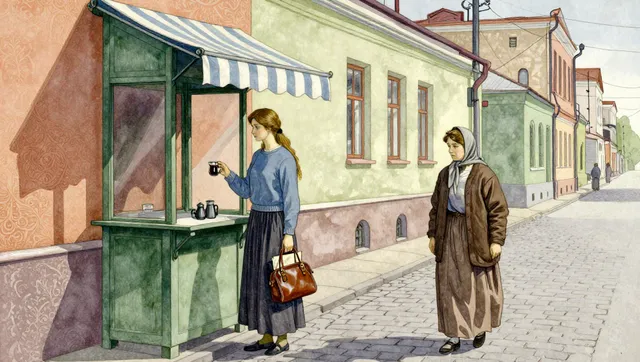
  • A kiosk on the Arbat at dawnXenLook AI interpretation

    Russian Silver Age

    Alike
    Both revived old tales and folk lore as pictures at the end of the 19th century under an empire. They also share forests, winter landscapes and figures out of myth.
    Different
    Finland centres on a single epic, the Kalevala, and the landscape of Karelia, seeking national identity in clear outlines and bright colour. Russia mixes fairy tale, stage design and decoration in a more ornate way.
    Go to this room
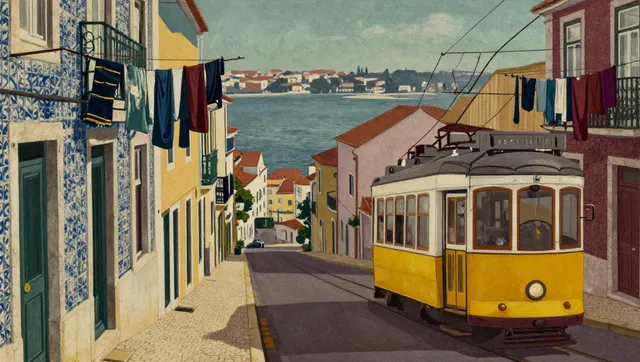
  • Tram under clotheslinesXenLook AI interpretation

    Symbolism and Art Nouveau

    Alike
    Both try to suggest the dreams, death and inner life behind what is seen. Simberg’s angel touches this current directly.
    Different
    The Finnish Golden Age gives a large share to realism and epic pictures as well as Symbolism, resting on the concrete landscape of forests and lakes. The Symbolism room puts more weight on ornament and flowing line.
    Go to this room
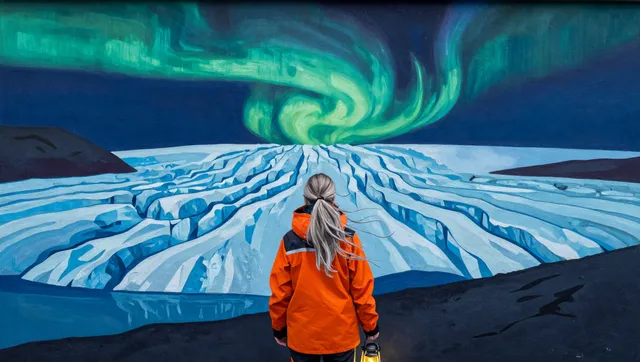
  • A green aurora coiling above the glacierXenLook AI interpretation

    Nordic Sagas in Black-Line Illustration

    Alike
    Both revive old songs and sagas of the North as pictures for today, and both look for a people’s story in painting.
    Different
    Finland painted the Kalevala in coloured tempera and oil, while the saga room is centred on book illustrations that set Icelandic and Norwegian tales in black line.
    Go to this room

Quiz

Pick one to see the answer and why.

  1. 1. Roughly when is the Finnish Golden Age placed?

  2. 2. Who compiled the Kalevala?

  3. 3. In what medium was The Defense of the Sampo painted?

  4. 4. Who carries the angel in The Wounded Angel?

  5. 5. Who made the Cleveland originals shown in this room?

Paint it

A sentence written for this style is ready. Copy it or take it straight to the studio.

A bike lamp on the snow roadXenLook AI interpretation

A Finnish Golden Age story painting, a snowy birch forest and a red wooden house, a deep indigo winter night sky, a long yellow light spreading over the snow, clear outlines and bright colour planes, two figures gathered in the centre

Try changing Swap the winter night for a white midsummer night on a lake, and put a small boat in place of the red house.

Paint in the studio

The sentence is copied. Paste it into the studio's input box.

Sources

Every original here was released into the public domain (CC0) by The Cleveland Museum of Art. Artist, title, date and technique follow the museum records, which we checked again with their release terms on 2026-11-24. The commentary is written by XenLook.

Pictures marked “XenLook AI interpretation” were made by XenLook with XenArt. They are not historical paintings and no painter made them. Originals carry the “Original” mark and the name of the museum that holds them.

Pasang sebagai aplikasi