Paul Gauguin was born in Paris in 1848. At about two he went with his family to Peru and grew up there until around six, and the strong colours and distant landscapes he saw are said to have stayed with him for life. Back in France he went to school in Orléans, as a teenager he signed on as a pilot's assistant in the merchant marine and sailed widely, and he then served two years in the navy. In the early 1870s he worked at a Paris brokerage and earned a steady income, and in 1873 he married the Danish woman Mette Gad, with whom he had five children. Painting began as a hobby for days off. He trained his eye in galleries and exhibitions, and by painting outdoors after the Impressionist Camille Pissarro he drifted toward the artist's life. He learned less from formal schooling than from meeting other painters.
When the financial crisis of 1882 shook the brokerage trade, Gauguin resolved to paint full time. In 1884 he moved his family to Copenhagen and tried selling tarpaulins, without success. Painting earned him nothing and the family grew poorer, until his wife Mette and the children stayed in Denmark while he returned to France alone. Leaving his family to give himself to painting is among the points for which his life has long been criticised. In saying where his art came from, it is only fair to note who paid beside him. In the summer of 1886 he went to Pont-Aven in Brittany. He chose it because living was cheap, and he found himself unexpectedly popular among the young art students who flocked there each summer.
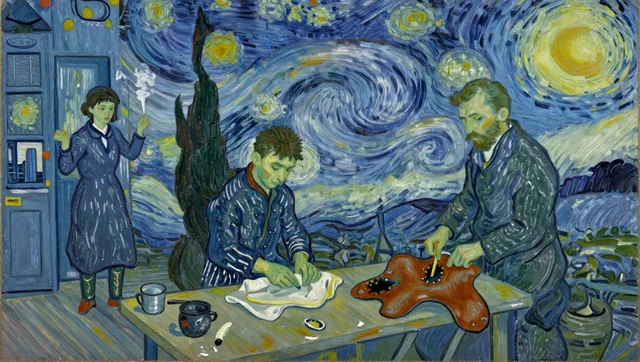
From Brittany Gauguin travelled to Panama and Martinique in 1887, then returned to Pont-Aven and mixed with younger painters such as Émile Bernard. Disappointed that Impressionism chased the light of a passing moment, he felt European painting had grown too imitative and lost depth of symbol. So he chose heavy outlines and flat colour, a manner called Cloisonnism and, in its wider sense, Synthetism. In autumn 1888 he accepted Van Gogh's invitation and painted with him in Arles for nearly nine weeks before the friendship broke down. That Van Gogh cut off his own ear on the night of 23 December is well known, but the razor scene rests on Gauguin's own much later account and should be read with care.
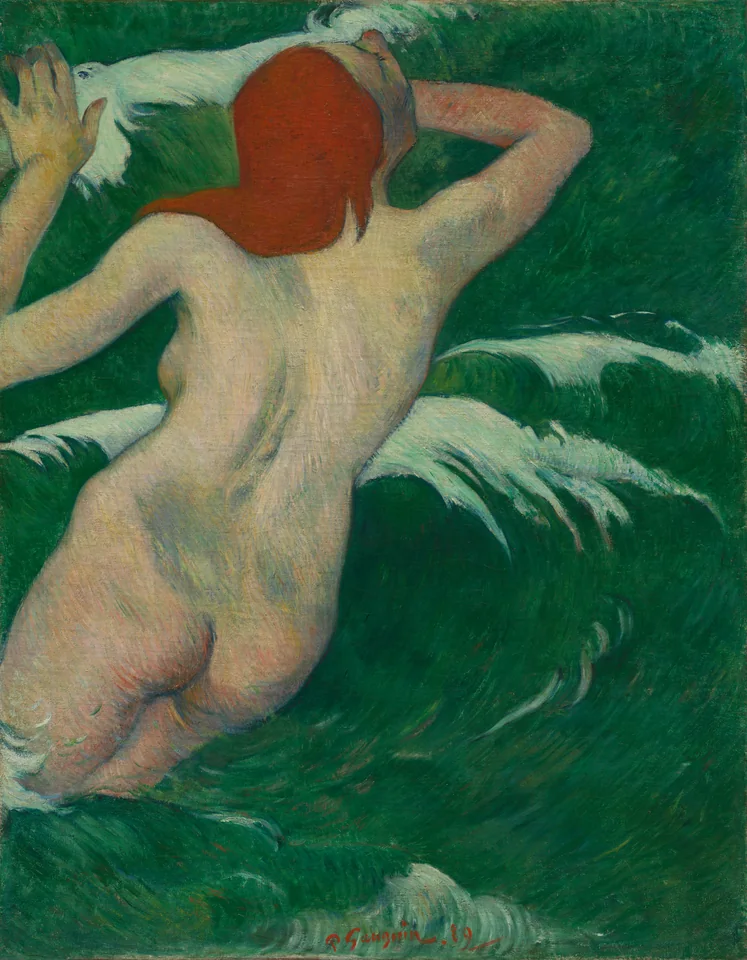
In 1889 Gauguin and his friends held an “Impressionist and Synthetist Group” show at the Café Volpini beside the Paris World's Fair. The café owner's decorative mirrors had arrived late and left his walls bare, so he gave them to the painters. The press largely ignored it and the show failed, yet works hung there such as In the Waves made Gauguin known as one of the Symbolist painters. By then he had begun to think of leaving Paris to look for a new life and new pictures far away. France had annexed Tahiti as a colony in 1880, and to him the island looked like a paradise beyond civilisation. It must be remembered that “paradise” was itself a European wish.
In February 1891 Gauguin sailed for Tahiti on the proceeds of a Paris auction. He spent his first three months in Papeete, the colonial capital, already dressed in French ways, and was disappointed to find no primitive paradise; he soon moved to a bamboo hut at Mataiea, about 45 kilometres away, and painted there. In these years he took as his “native wife” the thirteen-year-old Teha'amana, nearly thirty years his junior, in a “marriage” said to have been contracted in a single afternoon. Seen today it is the exploitation of a young girl in a colony by an adult man, and many scholars and descendants criticise it as such. This room admires his pictures without turning that relationship into romance. He returned to France in August 1893.
Back in Paris Gauguin prepared Noa Noa, a book weaving his Tahitian experience into text and image, and made several woodcuts for it. Many critics today see parts of the book as invented or borrowed from other writing. His November 1894 show at Durand-Ruel was a moderate success. A February 1895 auction failed, yet he left again for Tahiti that year. This time he settled at Punaauia near Papeete and lived with a neighbour's daughter, the fourteen-and-a-half-year-old Pau'ura. His circumstances worsened and his illness deepened, and the record of his battles with colonial officials and the church mixes fights on behalf of local people with fights for himself.
In 1901 Gauguin moved to Atuona on Hiva Oa in the more distant Marquesas. There too he took a fourteen-year-old girl, Vaeoho, and amid illness and poverty he used his last strength to paint, carve and write. Late pictures such as The Call ask deep questions about life and death, but the circumstances beneath them should be known as well. He died in Atuona on 8 May 1903, aged fifty-four. He won no great success in life, yet his way of freeing colour from the visible object passed to the Fauves, the Cubists and many painters after. In this room there are two ways of looking at him: one eye on the newness of the pictures, the other on the colonial ground they stood on.