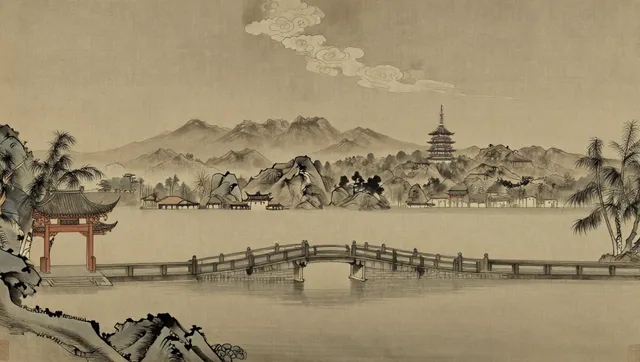
A handscroll (手卷) means a scroll rolled up in the hand. It can run to several metres, but it is usually only about 25 to 40 centimetres high. This picture is not hung on a wall. You lay it flat on a table and unroll it section by section, starting from the right end. The part you have seen is rolled up toward the left. So what you see at one time is about the width of two arms. This format made it possible to paint a story that runs on without a break. The viewer cannot hurry either. The speed of the unrolling hand becomes the speed of seeing. So a handscroll was a picture read quietly, alone or by a few people sitting around it.
The root of the scroll lies not in painting but in writing. Long ago in China, people wrote on strips of bamboo and wood, bound them together and rolled them. Later, in the Eastern Han (後漢), silk and paper are said to have come into use. Until the Tang dynasty the scroll was the main format for carrying text. Painting is said to have taken up the format widely from the Three Kingdoms period. The way of storing it rolled and reading it unrolled crossed over from writing to painting. That is also why adding writing beside a picture feels natural on a scroll. It is easy to understand if you think that the eyes and hands that read text came to read pictures in the same way.
The pictures in this room are gongbi (工筆). The word means carefully worked brushwork: outlines drawn meticulously with a fine brush and filled with colour. It began around the Han period, about two thousand years ago, and is said to have peaked between the Tang and Song dynasties. Gongbi often takes people or stories as its subject. That suited the long unrolling handscroll. Palace ladies, a groom leading horses, a procession passing through a night street could all be strung along a single line. The three works in this room are exactly such pictures. The power of gongbi to draw expression and gesture in detail became a story on the scroll.
A handscroll is one body made of joined parts. The outermost is a silk wrapper, the baoshou (包首), with a title label, the tiqian (題簽), attached. When you unroll it, the opening space at the right is the yinshou (引首), the frontispiece. Next comes the picture itself, the huaxin (畫心). After the picture ends, a trailing section called the tuowei (拖尾) follows at the left, where viewers write their comments. At the start there is a stave and a cord with a fastener, and at the end a wooden rod to roll it on. So even if the picture itself is about 1.4 metres, adding the silk and the writing makes the whole much longer. It looks complicated at first, but reading in order from right to left is not hard.
On a scroll, writing and seals matter as much as the picture. The comments that a viewer writes afterwards are called tiba (題跋), colophons. Seals are usually made of stone and stamped with red ink or cinnabar paste (朱砂). A painter signed his name and stamped a seal to claim the picture. Collectors and connoisseurs customarily stamped their own seals as marks of owning and enjoying it. So when an old handscroll is unrolled to the end, writing and red seals stand in a line. They are a record of whose hands the picture passed through. The red of the seals stays easy to see on silk even after centuries.
The first work in this room follows Zhou Wenju (周文矩) of the 10th century. Zhou Wenju is known to have worked as a court painter of the Southern Tang (南唐). But most pictures that now carry his name are said to be later copies. The Cleveland Museum of Art's 「In the Palace」 is also a copy from the Southern Song, made before 1140. Ren Renfa's (任仁發) 「Three Horses and Four Grooms」 and Yan Hui's (顏輝) 「The Lantern Night Excursion of Zhong Kui」 are Yuan-dynasty works. All three carry many seals added later. They are evidence of handscrolls that crossed the centuries because people loved them. Even a copy was a precious way of handing an old picture down.