Gongbi (工筆) means 'carefully worked brushwork'. A fine brush first draws the outline of a subject clearly, and the inside is then filled with clear colour laid on in many layers. The word is the counterpart of xieyi (寫意), in which a loose brush carries the idea rather than the detail. Gongbi tries to show every feather of a bird and every thread of a patterned robe. The method is said to have begun about 2,000 years ago in the Han dynasty and to have reached its peak in the Tang and Song dynasties (7th to 13th century), when royal families loved and collected it. For a long time the painting ground was silk (絹), whose threads are fine and even and which takes light softly, so it held fine lines and clear colour well. This room follows the silk painting of the court and its academy, known as the academy style (院體).
The Song court (960–1279) had a painting office, the academy (畫院), and its painters were called attendants-in-waiting (待詔). Emperor Huizong (徽宗, 1082–1135, reigned 1100–1126) of the Northern Song is famous as an emperor who painted himself and trained painters. The Xuanhe Catalogue of Paintings (宣和畫譜), compiled in 1120 to record the court's holdings, has 20 chapters and lists 6,396 paintings by 231 artists. Flowers and birds take the largest share, with 2,786 paintings by 46 artists, which shows how much the court prized the subject. Huizong was also a calligrapher who created the 'slender gold' script (瘦金體), whose strokes are straight and sharp like twisted gold wire. In a court that nurtured painting and writing together, exact bird-and-flower painting could take firm root.
Even before the Song, in the 10th century, painters had already won fame for flowers and birds. Huang Quan (黃筌, 903–965) worked as an imperial painter for many years and painted the rare flowers and birds of the palace gardens by drawing the outline first and filling it with bright colour. Xu Xi (徐熙) was active in the Southern Tang (南唐) and came from a prominent family but never entered officialdom, and he died before 975. The two are usually named together as the leading bird-and-flower painters of that century. The academy style seen in this room is closer to the court current of Huang Quan, which prized outline and fine colour. A later style cannot be explained by one name, however, so please take this only as a broad flow.
In 1127 the Jin army took the Northern Song capital Bianjing (汴京, today's Kaifeng), an event called the Jingkang Incident (靖康). Huizong, his son Qinzong and many of the imperial family were carried off as captives, which ended the Northern Song, and Huizong's huge collection was lost. The Song house moved south and continued as the Southern Song (1127–1279), where court painters such as Li Song (李嵩, active about 1190–1230) of Hangzhou worked. Li Song is said to have started as a carpenter and to have been taken in and trained by the court painter Li Congxun (李從訓). He excelled at precise pictures of figures, children, and the peddler with all his wares. His Knickknack Peddler of 1212 packs a single moment of street life onto one small silk album leaf.
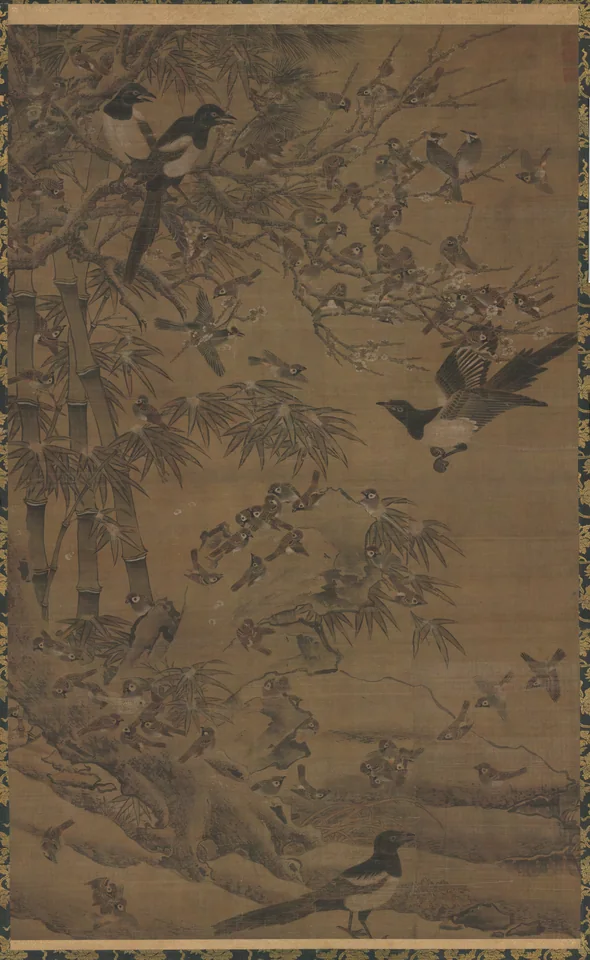
After the Mongol Yuan (1271–1368), the Han Chinese Ming (1368–1644) took the throne, and the court again gathered painters to serve it. In the early Ming (about 1368–1505) the Zhe School (浙派) and the court-supported Academy School (院體派) were dominant, and both drew on the Southern Song academy tradition and on the scholar-painters of the Yuan. Bian Wenjin (邊文進) worked at the court of the Yongle Emperor (reigned 1402–1424), and his Hundred Birds and the Three Friends is counted among his major works. The museum explains that its naturalistic birds recall the realistic bird painting of the Song academy. Yin Hong's (殷宏, about 1430–about 1500) Birds Gather under the Spring Willow is a large work that may once have hung in a great palace hall. The two works differ greatly in size and layout even though both are on silk.
Later, as scholars came to love the xieyi pictures that enjoy the taste of ink and brush, gongbi was no longer the only current. Even so, the mid-Ming produced painters such as Qiu Ying (仇英, 1494–1552) who were known for gongbi, and today gongbi is still taught and painted as one branch of Chinese painting. Paper also came into wide use as a ground, but the court's gongbi kept its love for the clear surface of silk. Silk is costly and sensitive to light and damp, so museums show such works only for short periods and keep them in the dark. A proper look at these pictures today is therefore a precious chance in itself. All three works in this room are images that the Cleveland Museum of Art has released for anyone to use.