Francisco de Goya was born on 30 March 1746 in Fuendetodos, a small village in Aragon, Spain. A child of a middle-class family, from about the age of fourteen he learned painting under the painter José Luzán in Zaragoza. He then went up to Madrid and tried to study with Anton Raphael Mengs, a painter the court favoured, but he is said to have clashed with his master and his examinations went poorly. In 1763 and 1766 he submitted work to the Royal Academy of San Fernando and was refused admission. After that Goya travelled to Italy, saw classical art in person and came home. He was not a man whose road ran smooth from the start, but one who got up again after being turned away at the threshold more than once.
On 25 July 1773 Goya married Josefa Bayeu, sister of the painter Francisco Bayeu. Bayeu became head of the royal tapestry works, and this connection opened the door of the court to Goya. From the mid-1770s Goya drew bright Rococo-style tapestry cartoons, scenes of hunting, play and markets for fabrics that were to decorate the palace walls. In 1786 he became a painter to the king, and when Charles IV took the throne in 1788 he was entrusted with portraits of the royal family and the nobility. In those years Goya was sociable and highly ambitious, and he climbed the steps of success by painting, even through the grief of losing several children.
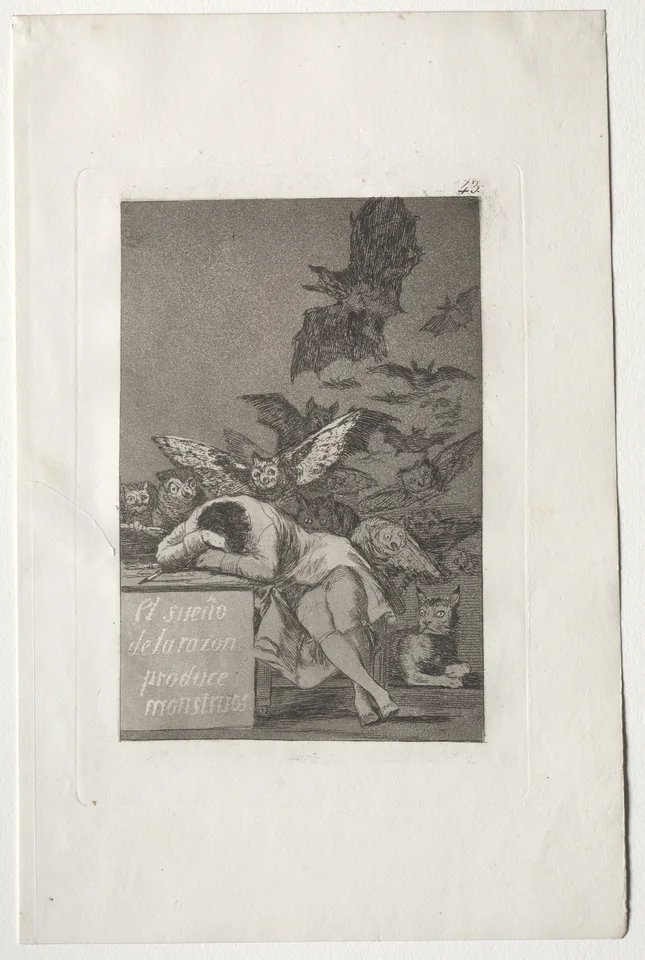
Between 1792 and 1793 Goya suffered a serious illness of unclear cause, after which he was left deaf. His work is judged to have grown steadily darker and more pessimistic from then on. In 1795 he became director of painting at the Royal Academy, and in 1799 he reached the highest post, first painter to the king. In the same period he made the eighty Caprichos. Engraved from 1797 to 1798 and issued in February 1799, this album of prints sharply mocked nobles and clergy, superstition and folly. But fourteen days after sales began, when the political winds shifted, Goya is said to have hurriedly withdrawn the copies still available for fear of the Inquisition.
In 1807 Napoleon's army entered Spain and the Peninsular War began, and Goya stayed in Madrid throughout. He did not reveal his thoughts in public, but from 1810 to 1820 he engraved the eighty-two plates of The Disasters of War. He began the work at sixty-two, almost deaf. This album shows not the triumph of heroes but the wounds that battlefield and hunger leave on individuals. The only words Goya left are the short captions beneath the pictures, and the series was published only in 1863, thirty-five years after his death. Among the later plates, number 79, Truth Has Died, and number 80, Will She Live Again?, hold together the despair and the hope that followed the return of the monarchy in 1814.
In 1816 came La Tauromaquia, which captured bullfighting in thirty-three prints. In this period Goya bought a house on the Manzanares river outside Madrid, the Quinta del Sordo, the House of the Deaf Man, and from about 1819 he painted on its walls the dark murals later called the Black Paintings. Between 1815 and 1823 he also made the enigmatic Disparates, which could not be published in his lifetime because of the Inquisition and the repressive political climate. The series was first shown to the public in 1864 by the Royal Academy, under the name Proverbios. In the same year, 1819, he painted the portrait of his friend Don Juan Antonio Cuervo, who worked with the academy. The work of digging into darkness and the work of honouring a friend came together from one hand.
In 1824 Goya left Spain and moved to Bordeaux in France. Even close to the age of seventy-eight he did not shy from new methods, and in 1825 he made the lithograph series The Bulls of Bordeaux, drawn on stone with crayon on the theme of bullfighting. The crowd in the pictures is rubbed in almost like scribble, while the bull charges powerfully out of the dark. Goya died in Bordeaux on 16 April 1828, at the age of eighty-two. The line and the darkness he left became a root to which many painters, from Romanticism through Realism to Expressionism, have traced back to learn. The six works in this room are testimonies that trace that long span one line at a time.