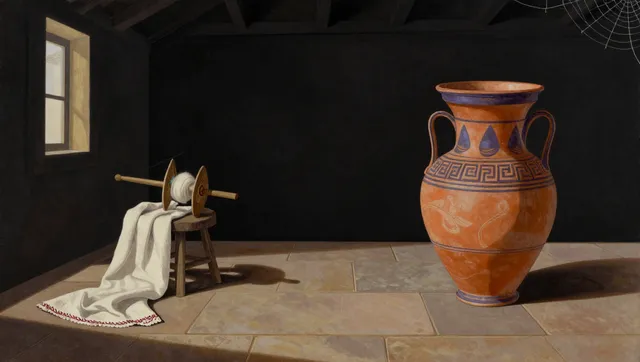
The ancient object that survives in greatest number from Greece is pottery. Fired clay does not rot, so even when a jar broke its pieces remained. Athens had a potters' quarter called the Kerameikos, which lay on both sides of the city wall near the Dipylon Gate, and from its name the English word ceramic comes. Vases were not ornaments but things to use. They held wine and olive oil, mixed water with wine, served drink, and were given to the dead. So the pictures too show every scene of life: myth and feasting, athletics, war and funerals.
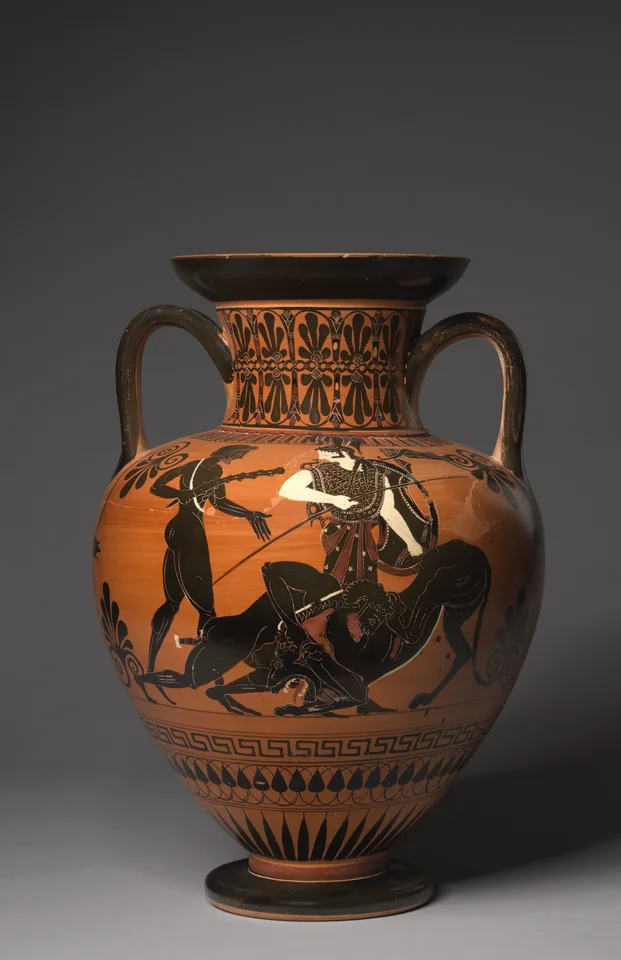
The first great style is black-figure. It began in the 7th century BC in the commercial city of Corinth, and the centre then moved to Athens. Figures are painted as dark, shadow-like bodies, and fine contours and inner lines are incised with a pointed tool so that the orange clay below shows through. Opaque white and red are added for details. The leading black-figure painter is Exekias, active about 545 to 530 BC. He was both potter and painter, and two amphorae carry the inscription 'Exekias made and painted me'. His vases are famous for the tension of heroes sitting quietly face to face.
Red-figure was invented in Athens about 530 to 520 BC. Its principle is the mirror image of black-figure. Figures are left in the colour of the clay, and the ground around them is filled with black slip. Inner lines can be painted with a brush instead of incised, so folds of cloth and expressions became much freer. Contours were drawn as a slightly raised line, the relief line. The Andokides Painter, active about 530 to 515 BC, is known to have led early red-figure. The so-called Pioneer Group, about 520 to 500 BC, greatly developed the method, and among them Euphronios, born about 535 BC, became one of the most famous painters.
The third is white-ground. It appeared in Attica about 500 BC; the whole vase is covered with a white slip of kaolin and painted on that. Fine lines on the white are soft and clear, and the technique is described as giving an idea of lost large-scale wall painting. But the painted surface is fragile, so it was used mostly for oil flasks for ritual and funerary use. One of the originals in this room is just such a white-ground oil flask. Among the fine brush hands of this time is Douris. He signed 39 vases, between 250 and 300 vases are ascribed to him, and most of them are cups.
Ancient painters left few names, but some vases carry signatures. For the rest, scholars of the 20th century sorted out painters by comparing habits of the brush. In 1911 the British art historian Sir John Beazley gave one painter the working name Berlin Painter, from a large vase in Berlin. Such names are not real names but are taken from where a key vase is or from a trait. In the 4th century BC mainstream red-figure production in Athens stopped about 360 BC, and the Kerch style, which lasted a few decades more, closed the story. This coincided with the loss of the Etruscan market.
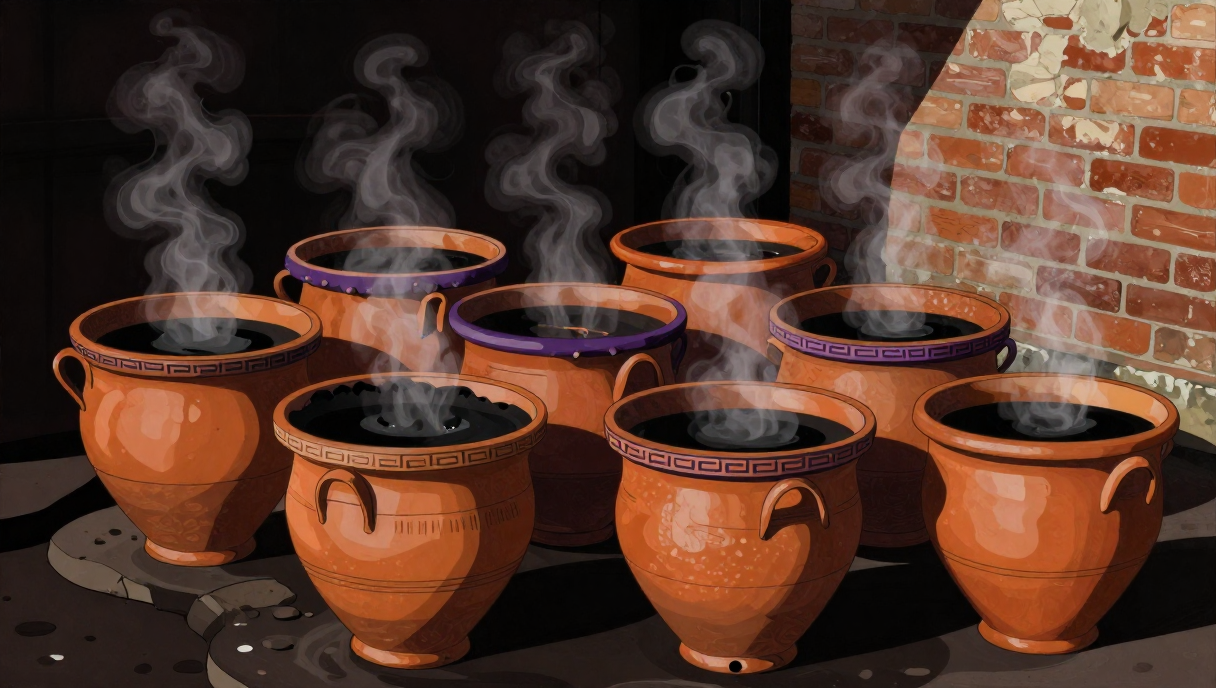
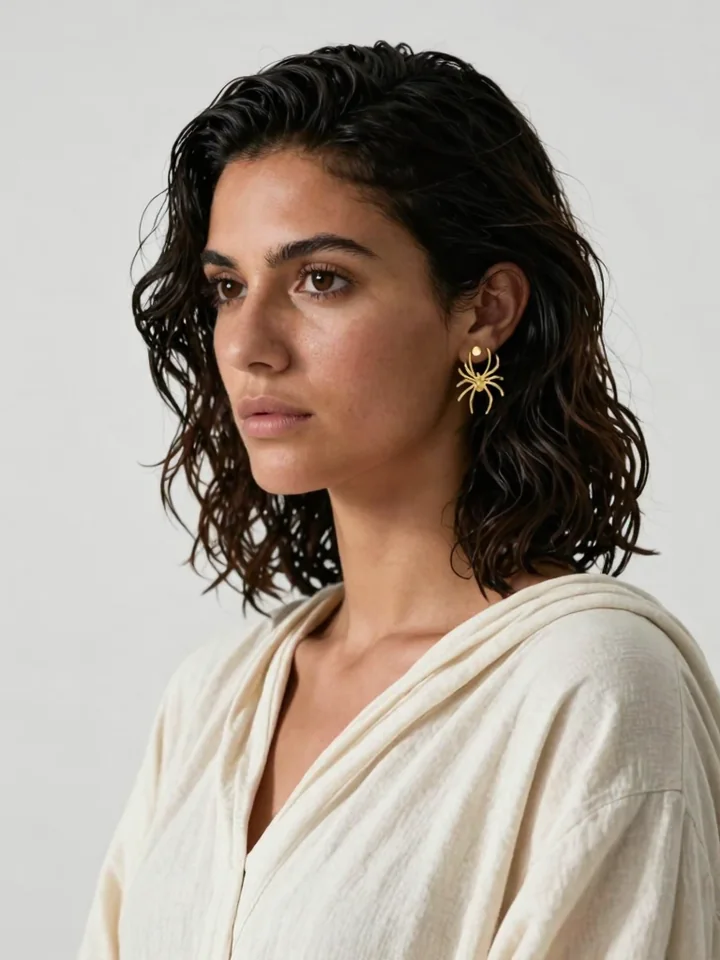
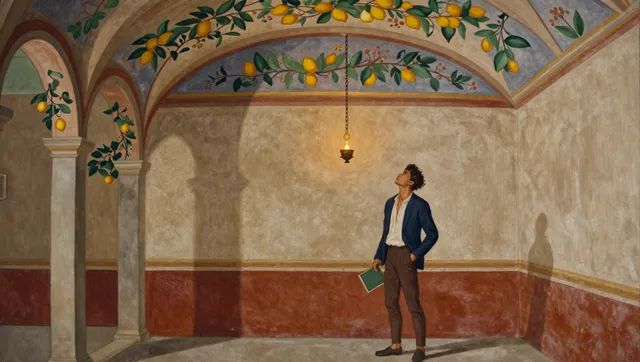
The three originals in this room are Athenian vases that the Cleveland Museum of Art (CMA) has released as public domain. There is one black-figure neck-amphora, one red-figure oil flask and one white-ground oil flask, so the three methods can be compared at a glance. The interpretations in this room are not genuine Greek vases. They are AI still lifes that set the objects of the textile engineer Gorak's story, The Hand That Spins the Thread, in vase colours. Unlike vase painting, which draws bodies flat, they are lifelike, with shadow, and that difference is on purpose. See the originals in the museum and the interpretations in this room.