Hiroshige is said to have been born in 1797 in Edo. His real name was Andō Tokutarō, and his family is known to have been a low-ranking samurai house charged with fire-warden duty at Edo Castle. Around 1809 he lost his parents in quick succession and is said to have inherited that post at a young age, learning to draw in spare moments. Some interpret that he noticed the bustling streets of Edo early on. Some find in this the reason why the small people coming and going on roads and bridges in his prints look so familiar.
In 1811 he entered the school of Utagawa Toyohiro and began using the name Hiroshige, taking the character hiro from his master. The Utagawa school was a place that drew many actors and beauties, but Hiroshige turned his eyes to landscape. In the 1820s he gradually made his name with bird-and-flower pictures and landscape prints. Kingfisher and Chinese Bellflowers in this room is one sheet that represents the bird-and-flower pictures of that time. The delicate observation seen in them carries over into the small people and leaves of his landscape series.
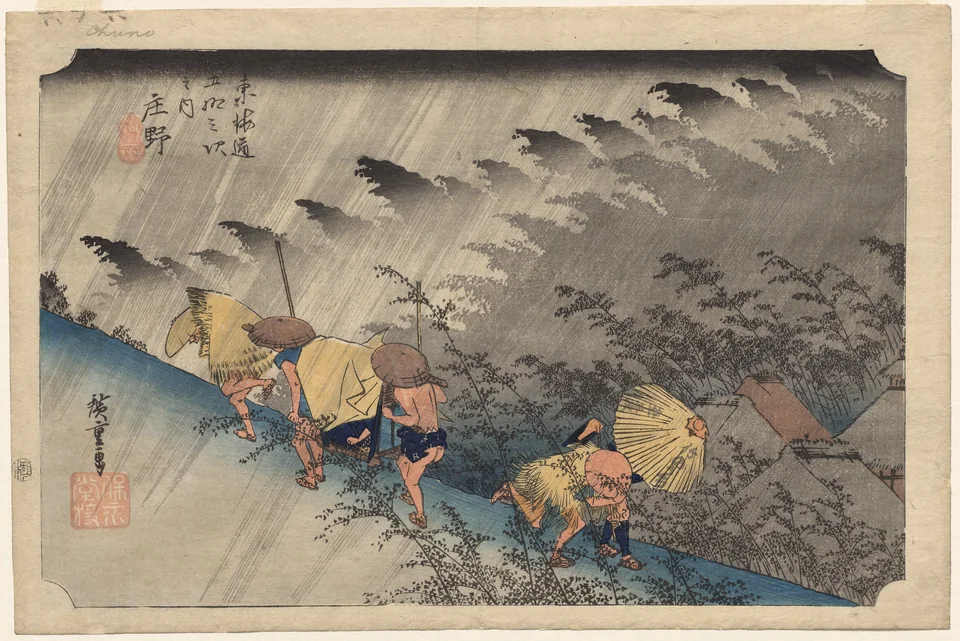
Between 1833 and 1834 the series Fifty-three Stations of the Tōkaidō appeared and Hiroshige's name became widely known. It depicts views of the post stations along the Tōkaidō road running from Nihonbashi in Edo to Kyoto. It is said he walked the Tōkaidō himself before issuing the series, but scholars differ on whether he actually visited every station. Driving Rain at Shōno in this room is a representative sheet of this series, and the figures hurrying along the rainy road are especially well known.
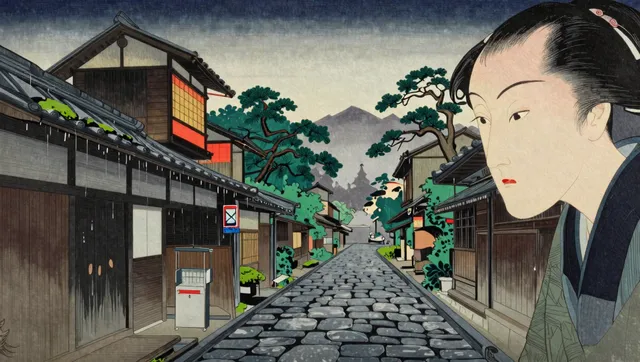
In the late 1830s he also took part in the series Sixty-nine Stations of the Kisokaidō. The series is said to have been made together with Keisai Eisen, and the number of sheets Hiroshige took and the dates are given slightly differently in different sources. Most opinions put it around 1835 to 1838. Shimosuwa in this room is one sheet of that series. It shows the lights and people of an inn along a mountain road, revealing the mountain air that differs from the Tōkaidō. You can see that even when the same road is drawn, the air differs by region.
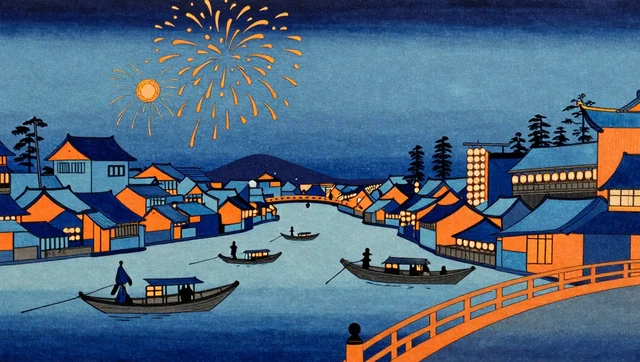
In his later years Hiroshige put his strength into One Hundred Famous Views of Edo. Issued between 1856 and 1858, this series drew the seasons and famous places of Edo in vertical format, and its bold composition that sets near things large stands out. Fireworks at Ryōgoku in this room, of 1858, belongs to this series. He is known to have died in 1858, so this series is work from nearly the very end. It is also said that some of the series was carried on and completed by a pupil after his death.
Hiroshige's influence was also great outside Japan. As a trend of collecting Japanese prints arose in late nineteenth-century Europe, the Impressionist and Post-Impressionist painters are said to have taken careful note of his composition and colour. Vincent van Gogh in particular is well known to have copied two of Hiroshige's prints in oils. All five works in this room belong to the Cleveland Museum of Art, showing that the same gentle gaze can be met in a far-off city's museum.